Do You Have to Tell Your Insurance About a Dash Cam — And Should You?
You are not legally required to tell your insurance company about a dash cam in the UK or US. A dash cam is not a vehicle modification under standard policy terms. But telling your insurer is still a smart move — many providers offer premium discounts of up to 15%, and your policy stays fully protected if you ever need to make a claim.
I fitted my first dash cam on a cold Tuesday morning. Took about ten minutes. Then I sat there thinking — do I need to call my insurance company now?
I’m Alex Rahman, and I’ve spent years researching car tech, road safety, and the insurance rules that drivers often miss. This question trips up a surprising number of people.
Most drivers assume a dash cam is a big deal to their insurer. It isn’t — but there’s a difference between what you’re required to do and what’s actually worth doing. That gap is where most people leave money on the table.
By the end of this guide, you’ll know exactly where you stand legally, how to turn your dash cam into a discount, and what to do if you ever need to use that footage in a claim.
- No legal requirement exists to tell your insurer about a dash cam in the UK or US.
- A dash cam is not classified as a vehicle modification under most standard insurance policies.
- Disclosing your dash cam can unlock discounts of 10–15% with many UK providers.
- Dash cam footage is admissible as evidence in insurance claims and UK courts.
- Not telling your insurer carries low risk — but telling them carries real financial upside.
What Does a Dash Cam Actually Do for Your Car Insurance?
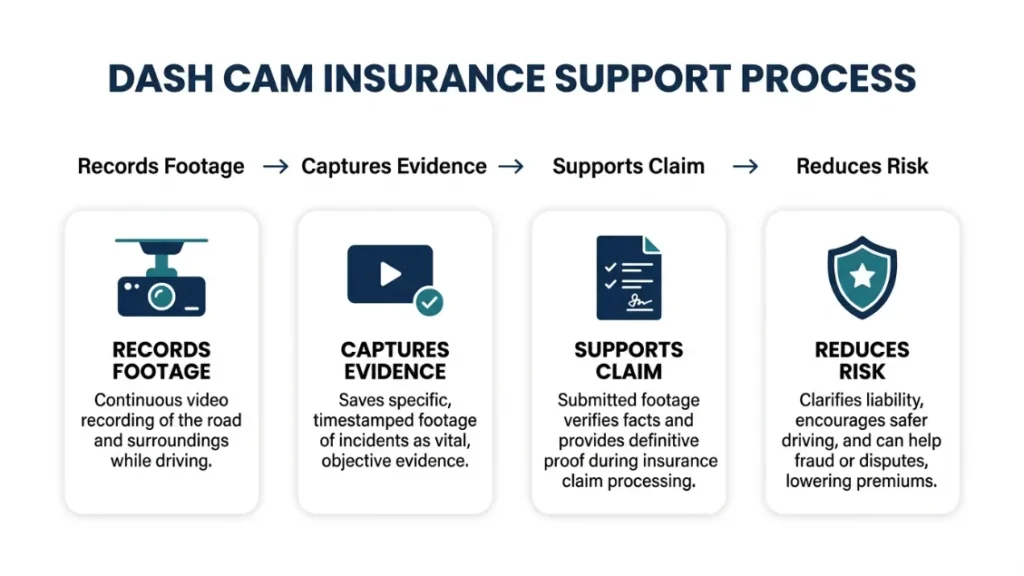
A dash cam records continuous video footage of the road ahead — and often behind — while you drive. It sits on your windscreen or dashboard and captures everything from minor scrapes to serious collisions in real time.
For insurance purposes, a dash cam does two things. First, it creates objective evidence if an accident happens. Second, it signals to your insurer that you’re a careful, safety-conscious driver.
Insurers price policies based on risk. A driver who installs a dash cam is statistically less likely to make a fraudulent claim and more likely to have clear evidence ready when a genuine one occurs. That shifts the risk calculation in your favour.
The result is simple: a dash cam makes you a more attractive customer. Not every insurer has acted on that yet — but many have.
How Insurers View a Dash Cam on Your Policy
Most insurers treat a dash cam as a neutral accessory — like a phone mount or a sat-nav. It doesn’t change how your car performs. It doesn’t affect its safety rating. And it doesn’t alter the value of the vehicle in any meaningful way.
That means it falls outside the standard definition of a material modification — the kind of change you’re obligated to report. A lowered suspension changes your car. A turbocharged engine changes your car. A small camera stuck to the windscreen does not.
Always check your specific policy wording. A small number of insurers do list any windscreen-mounted device as a declarable item. Two minutes of reading can save you hours of stress later.
Is It Legally Required to Tell Your Insurance About a Dash Cam?
No — there is no legal requirement to inform your insurance company about a dash cam in the UK or the United States. No road traffic law and no standard insurance regulation demands that you declare a dashboard camera as part of your vehicle disclosure.
Insurance contracts do require you to disclose material information — facts that would influence an underwriter’s decision to insure you or how they’d price your policy. A dash cam does not meet that threshold under current guidelines from the Association of British Insurers (ABI) or equivalent US state regulators.
That said, the rule of thumb is this: when in doubt, declare it. The cost of a quick phone call is zero. The cost of a disputed claim because of an undisclosed item can be enormous.
Does a Dash Cam Count as a Vehicle Modification?
A vehicle modification is any change that alters a car’s performance, appearance, or standard factory specification. Insurers need to know about these because they affect risk and vehicle value.
A suction-mounted or clip-on dash cam does not qualify. It’s a removable accessory — no different from a parking sensor you clip to the bumper. A hardwired dash cam is a slightly different case. It connects directly to the vehicle’s fuse box for constant power. Even then, most major insurers still don’t classify this as a modification because it doesn’t affect the car’s mechanical or structural integrity.
The only potential grey area is a professionally installed, permanently wired system with a large capacitor or battery pack — the kind found in commercial vehicle setups. Standard consumer dash cams from brands like Nextbase, Viofo, and BlackVue are universally treated as accessories, not modifications.
What UK and US Insurance Law Actually Says
In the UK, the Consumer Insurance (Disclosure and Representations) Act 2012 requires drivers to answer insurer questions honestly and not misrepresent facts. It does not require you to volunteer information about accessories unless specifically asked.
In the US, insurance requirements vary by state. But across all 50 states, no statute requires disclosure of a dash cam. If your insurer asks directly — say yes. If they don’t ask, you have no obligation to raise it.
Never lie if your insurer asks about accessories or modifications directly. Misrepresentation — even about a small item — can void your policy and leave you unprotected after an accident. Honesty always costs less than a voided claim.
Why Telling Your Insurer About a Dash Cam Is Usually Worth It
Even though you don’t have to tell your insurer, there are strong practical reasons to do it anyway. The biggest reason is money. A growing number of UK and US insurers reward dash cam owners with measurable premium discounts.
Beyond discounts, disclosure puts everything on the table. If you ever need to use dash cam footage in a claim, your insurer already knows the camera exists. There’s no awkward moment where they ask why you didn’t mention it before.
Transparency also builds your credibility as a policyholder. Insurers favour customers who communicate openly. That goodwill can make a difference when a claim gets complicated.
Can a Dash Cam Lower Your Insurance Premium?
Yes — a dash cam can lower your car insurance premium, but the discount depends on your insurer and your specific policy. Research from 2023 by Consumer Intelligence found that around 40% of UK insurers now factor dash cam ownership into their risk assessment, with discounts typically ranging from 5% to 15%.
The logic is straightforward. Drivers with dash cams are less likely to be victims of staged accidents — a practice known as “crash for cash” fraud that costs UK insurers an estimated £340 million per year. A camera eliminates the “your word against mine” problem that makes fraudulent claims so expensive.
Some insurers — including Aviva and certain Direct Line policies — will ask about dash cams during the quote process. Others won’t ask, but will apply a discount if you mention it. It costs nothing to bring it up.
Which Insurance Companies Offer Dash Cam Discounts?
Specific discount policies change regularly, so always confirm directly with your provider. As a general guide, here’s what the market looks like:
| Insurer | Country | Dash Cam Policy |
|---|---|---|
| Aviva | UK | Asks during quote; considers dash cam in pricing |
| Direct Line | UK | Accepts footage in claims; discount varies |
| Nextbase Insurance Partners | UK | Partnered schemes with verified cam discounts |
| Progressive | US | Snapshot program uses driving data; cam may support |
| State Farm | US | No standard dash cam discount; may accept footage |
When renewing or getting a new quote, simply say: “I have a dash cam fitted — does that affect my premium?” That one sentence can unlock a discount your insurer won’t always volunteer.
What Happens If You Don’t Tell Your Insurer About Your Dash Cam?
In most cases, nothing bad happens if you don’t tell your insurer about your dash cam. Because it isn’t a material modification, non-disclosure carries no legal penalty and doesn’t invalidate your policy under standard terms.
The risk isn’t legal — it’s financial. You miss out on any available discount. And in the unlikely event your insurer asks about accessories during a claim investigation, the conversation becomes less clean than it would have been.
Does Non-Disclosure Put Your Policy at Risk?
For a standard plug-in or suction-mounted dash cam — no. Your policy is not at risk. The camera is not a modification, and insurers know it.
The only scenario where non-disclosure could theoretically cause friction is this: a permanent hardwired installation, combined with an insurer whose policy wording specifically lists windscreen or electrical accessories as declarable items. This is rare, but it exists. A two-minute check of your policy documents eliminates that risk entirely.
The bottom line: Not telling your insurer costs you a potential discount and a small amount of transparency. Telling them costs you nothing and potentially saves you money every year.
How to Use Dash Cam Footage to Support an Insurance Claim
Dash cam footage can be one of the most powerful tools in an insurance claim — but only if you handle it correctly from the moment the accident happens. The footage provides objective, timestamped visual evidence of exactly what occurred, which cuts through disputed accounts and speeds up claim resolution.
Insurers across the UK and US now routinely accept dash cam footage as supporting evidence. In contested claims — especially those involving “crash for cash” staged accidents — this footage can be the difference between a fast settlement and a drawn-out dispute.
Is Dash Cam Footage Admissible as Evidence?
Yes. In the UK, dash cam footage is admissible in both civil insurance disputes and criminal court proceedings. The UK Judiciary and police forces actively encourage drivers to submit footage after accidents and road traffic offences.
In the US, admissibility depends on state law, but footage is accepted as evidence in the vast majority of civil insurance claims nationwide. The footage must be authentic, unedited, and clearly timestamped to carry full weight.
Nextbase — the UK’s best-selling dash cam brand trusted by over 3 million drivers — builds their cameras with Emergency SOS technology and GPS timestamping specifically to make footage legally useful from the moment of capture.
Step-by-Step: Submitting Dash Cam Evidence After an Accident
- Do not delete, overwrite, or edit any footage after the accident.
- Remove the SD card from your dash cam and store it safely as soon as possible.
- Copy the footage to a computer or cloud backup before handling the original card further.
- Note the date, time, and location shown in the footage timestamp.
- Contact your insurer to report the accident and state immediately that you have dash cam footage.
- Follow your insurer’s instructions for submitting digital evidence — most accept SD card files or a USB transfer.
- Keep a copy for your own records throughout the claims process.
Many dash cams use loop recording — they overwrite old footage automatically. After any accident, remove that SD card immediately. Waiting even a few hours risks losing the evidence permanently.
Dash Cam vs. Telematics — Which One Saves You More on Insurance?
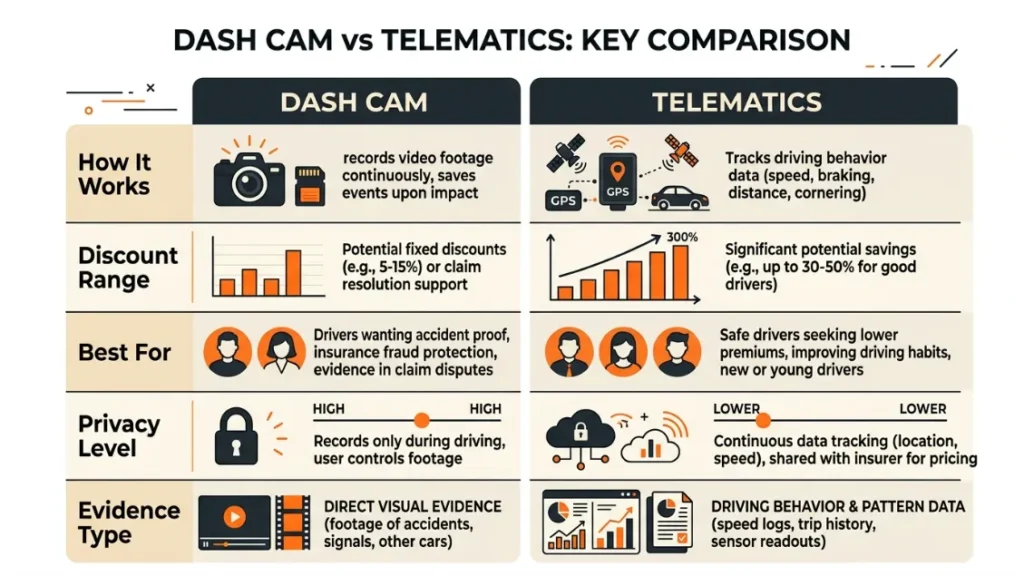
Telematics (black box) insurance and dash cams both aim to reward safe drivers — but they work in completely different ways and suit different types of driver. Understanding which option fits your situation can save you significantly more than using neither.
A telematics policy uses a GPS device or app to monitor your speed, braking, cornering, and driving hours. Your premium adjusts based on your actual driving behaviour. It’s most popular with young or new drivers, where standard premiums are highest.
A dash cam records what happens — not how you drive. It protects you reactively, after an event, rather than proactively rewarding good habits in real time.
| Factor | Dash Cam | Telematics |
|---|---|---|
| How it works | Records video footage | Tracks driving behaviour |
| Premium impact | 5–15% possible discount | Up to 40% for safe drivers |
| Best for | All drivers, claim protection | Young or high-risk drivers |
| Privacy concern | Low — records road only | Higher — tracks all movement |
| Evidence use | Yes — visual footage | Yes — but data-only, not visual |
For most experienced drivers, a dash cam is the better standalone choice. For younger drivers paying high premiums, combining a telematics policy with a dash cam can deliver both active discounts and reactive claim protection.
A dash cam protects you after an incident with hard video evidence. Telematics rewards you for good driving with lower premiums over time. Both tools are compatible — and using both gives you maximum protection and maximum savings potential.
How to Tell Your Insurance Company About Your Dash Cam the Right Way
Telling your insurer about a dash cam takes less than five minutes and follows a simple process. You can do it by phone, through your online account portal, or at renewal when your policy terms reset.
The best time to mention your dash cam is at renewal. Insurers recalculate your premium from scratch at this point, so any discount gets applied to a fresh quote. Mentioning it mid-policy is still worthwhile — some insurers will apply a partial-year adjustment.
What Information Does Your Insurer Actually Need?
Most insurers only need basic details to log your dash cam. You don’t need a serial number or installation certificate. Here’s what to have ready:
- Brand and model — e.g., Nextbase 622GW, Viofo A119 Mini 2, BlackVue DR970X
- Installation type — suction mount, adhesive mount, or hardwired
- Channels — front-only or front and rear dual-channel
- Whether it has GPS — some insurers value GPS-stamped footage more highly
When you call or message, simply say: “I’d like to note on my policy that I have a dash cam fitted. Can you confirm whether this affects my premium?”
That’s it. Most insurers will update your record, check for applicable discounts, and confirm in writing. The whole process takes under five minutes.
Ask your insurer for confirmation in writing — email or policy document update — that your dash cam has been noted. This protects you if any question arises during a future claim.
Conclusion
So — do you have to tell your insurance about a dash cam? No. You don’t. There’s no legal obligation, and a standard dash cam isn’t a vehicle modification under most policy terms.
But should you tell them? Almost always, yes. The potential discount is real, the process is simple, and the transparency pays off the moment you ever need to make a claim.
As I found when I finally made that call after fitting my first cam, the insurer updated my record in three minutes and applied a discount at my next renewal. Five minutes of effort, twelve months of savings.
Fit your cam. Secure your footage. Tell your insurer. Then drive knowing you’re covered from every angle.
Frequently Asked Questions
Do you legally have to tell your insurance about a dash cam?
No. In the UK and US, there is no legal requirement to inform your insurance company about a dash cam. A standard dash cam is not a vehicle modification and does not qualify as material information under insurance disclosure rules.
Can a dash cam reduce your car insurance premium?
Yes, it can. Many UK insurers now offer discounts of 5% to 15% for drivers with dash cams. The discount isn’t automatic — you need to inform your insurer and ask whether they factor dash cam ownership into their pricing.
Is a dash cam considered a vehicle modification for insurance purposes?
No — a standard suction-mounted or adhesive dash cam is not classified as a vehicle modification. Even hardwired models are generally treated as accessories by most major insurers, as they don’t affect the car’s mechanical or structural specification.
What happens if I don’t tell my insurer about my dash cam?
In most cases, nothing happens. Your policy remains valid because a dash cam is not a declarable modification. The main consequence is that you miss any available discount. Check your own policy documents to confirm your insurer’s specific position.
Can I use dash cam footage in an insurance claim?
Yes. Dash cam footage is accepted as evidence by most UK and US insurers and is admissible in court. For it to be useful, the footage must be unedited, clearly timestamped, and secured immediately after the accident before loop recording overwrites it.
Does a front-only dash cam or a dual-channel cam make a difference to my insurer?
Some insurers view a dual-channel (front and rear) dash cam more favourably because it captures a fuller picture of any incident. For claim purposes, rear footage is especially valuable in rear-end collision disputes. It’s worth mentioning the configuration when you speak to your insurer.

I’m Alex Rahman, a car enthusiast and automotive writer focused on practical solutions, car tools, and real-world driving advice. I share simple and honest content to help everyday drivers make better decisions.
