Where Can I Legally Put a Dash Cam? (US & UK Guide)
In most US states, you can legally mount a dash cam in a small zone near the rearview mirror or along the bottom strip of the windshield. It must not block your line of sight. Dashboard mounting is legal in all 50 states. UK drivers follow similar rules under the Highway Code.
I stuck my first dash cam dead center on the windshield. Two weeks later, a traffic officer knocked on my window and pointed right at it.
He didn’t write me up — but he told me I was one bad angle away from a fix-it ticket. That conversation sent me down a rabbit hole of windshield obstruction laws I wish I’d read before buying the camera.
I’m Alex Rahman, and I’ve spent years helping drivers understand the rules around dash cams — placement, recording laws, and everything in between. Here’s what I learned the hard way, so you don’t have to.
The short answer is: placement matters more than most people think. Get it wrong and you risk a fine, inadmissible footage, or both. Get it right and your camera works legally and records everything clearly.
- Mount your dash cam near the rearview mirror or the bottom windshield strip — these are the safest legal zones in most US states.
- Dashboard mounting is legal across all 50 US states and the UK, though footage angle is less ideal.
- California has the strictest windshield law — your cam must sit in a 5-inch square near the mirror or a 7-inch square at the bottom.
- Recording audio inside your car may violate wiretapping laws in two-party consent states like California and Florida.
- UK drivers must follow Highway Code rules and consider GDPR obligations when recording in public.
What Makes a Dash Cam Placement Illegal in the First Place?
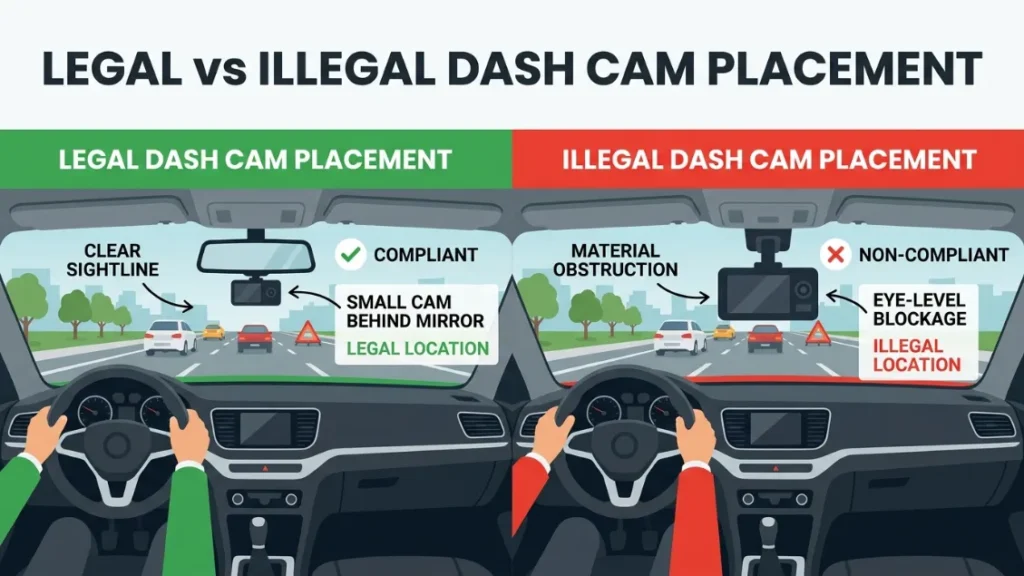
A dash cam becomes illegal when it blocks your view of the road — even slightly. Every US state and most countries treat an obstructed windshield as a safety violation, and that includes cameras, stickers, and GPS units. The law doesn’t care what the object is. It only cares whether it reduces your ability to see.
Most states base this on “material obstruction” — meaning anything that a reasonable driver would say reduces their visual field. A tiny camera tucked behind the mirror usually doesn’t qualify. A large screen-style cam mounted at eye level usually does.
The legal risk is real. In 2019, a California driver was cited under Vehicle Code 26708 for a dash cam that sat too low on the windshield. The footage was still used in his insurance claim — but he still paid the fine.
Why Windshield Obstruction Laws Exist and What They Protect
These laws exist because driver field of view directly affects reaction time. The National Highway Traffic Safety Administration (NHTSA) estimates that visual obstructions contribute to thousands of preventable accidents each year in the US.
A standard windshield gives you roughly 180 degrees of forward vision. Block even 10 degrees with a poorly placed device and your peripheral reaction time drops measurably. That’s the science behind why states draw strict lines around what you can and can’t put on your glass.
Mounting a dash cam on the passenger side or driver side A-pillar area is illegal in most states. These spots sit directly in your peripheral sightline and almost always qualify as material obstructions.
Where Can You Legally Mount a Dash Cam in the US?
You have three legal mounting options in the US: the rearview mirror zone on the windshield, the bottom windshield strip, or the dashboard itself. Each has tradeoffs for legality, footage quality, and ease of installation. The rearview mirror zone is the most universally accepted across all 50 states.
The Rearview Mirror Zone — Why It’s the Safest Legal Spot
The area directly behind the rearview mirror is the gold standard for legal dash cam placement. Your mirror already blocks that zone from your direct line of sight — so adding a small camera there creates zero additional obstruction. Most state laws specifically carve out this area as permitted.
Brands like Nextbase (a UK-based company trusted by over 3 million drivers worldwide) and Garmin design their mounts specifically for this spot. The Garmin Dash Cam 67W, for example, uses a low-profile magnetic mount that tucks flush against the mirror housing.
The key rule: the camera body must stay within the mirror’s shadow zone. If it extends below the mirror into your clear sightline, it’s no longer protected by this exception.
Use an adhesive mount rather than a suction cup in the mirror zone. Adhesive mounts sit flatter against the glass and are less likely to drift below the legal line over time.
Bottom Windshield Strip — The Second Legal Option Most Drivers Miss
Many states explicitly allow dash cam mounting along a small strip at the very bottom of the windshield, typically within 7 inches of the bottom edge. This zone sits below the driver’s natural sightline, so obstruction is minimal. It’s especially useful for drivers who want a cleaner look without anything near the mirror.
The downside is footage angle. A camera mounted at windshield base height captures more hood and less road ahead. You may need to angle it steeply upward, which can distort distance perception in the footage. For insurance and legal purposes, rearview mirror placement still produces more admissible footage because it more closely mirrors driver eye level.
Dashboard Mounting — Is It Legal and Does It Work?
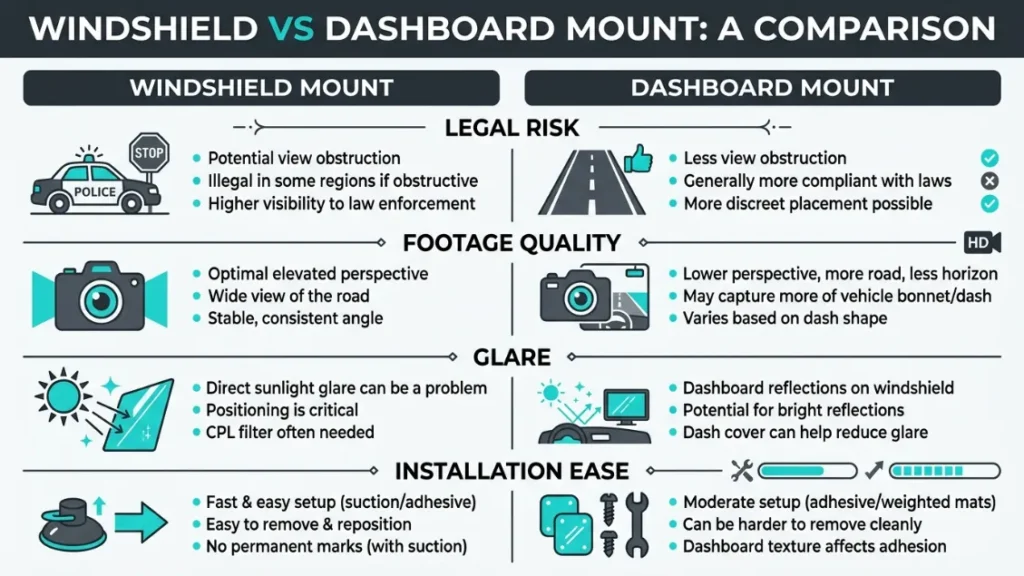
Dashboard mounting is legal in all 50 US states and in the UK. A camera sitting on the dash doesn’t touch the windshield at all, so windshield obstruction laws simply don’t apply. This makes it the safest choice from a pure legal standpoint.
Vantrue, a brand popular in North America, offers several models with low-profile dashboard mounts specifically designed for this placement. Their E1 Lite model sits at just 1.5 inches tall when mounted — barely visible from outside the car.
The tradeoff is glare and reflection. Dashboard cameras often pick up reflections from the windshield, especially at night. A lens hood or anti-reflective film strip can fix this in most cases.
Dash Cam Windshield Laws by State — What You Need to Know
US windshield laws vary significantly by state. Some states define exact measurement zones. Others use vague “obstruction” language. And a few have no dash cam-specific law at all — which still doesn’t mean anything goes. Here’s a clear breakdown of what matters most.
California Dash Cam Law — The Strictest Standard in the US
California’s Vehicle Code Section 26708 is the most detailed windshield law in the US. It allows dash cams only in two specific zones: a 5-inch square in the lower corner of the windshield on the driver’s side, or a 7-inch square in the lower corner on the passenger side. It also permits placement in a small area immediately behind the rearview mirror.
California specifically bans any device that creates a “material obstruction” — and courts have interpreted this broadly. If a police officer believes your camera blocks your view, you can be cited regardless of where exactly it’s mounted.
California also has strict two-party consent laws for audio recording. If you record conversations inside your car without all passengers knowing, you may violate the California Invasion of Privacy Act — even in your own vehicle.
Texas, Florida, and New York — What Each State Actually Allows
| State | Windshield Law | Legal Placement Zone | Audio Consent |
|---|---|---|---|
| California | Very strict — CVC 26708 | 5″ driver corner / 7″ passenger corner / behind mirror | Two-party consent |
| Texas | Moderate — no obstruction rule | Behind mirror or bottom strip | One-party consent |
| Florida | Moderate — obstruction broadly defined | Behind mirror or dashboard | Two-party consent |
| New York | Strict — VTL Section 375 | Behind mirror or lower corners only | One-party consent |
| Washington | Moderate — no specific dash cam law | Behind mirror recommended | One-party consent |
States With No Specific Dash Cam Law — Are You Still At Risk?
About 20 US states have no statute that specifically mentions dash cams. But that does not mean placement is unrestricted. Every state has a general windshield obstruction law. A dash cam mounted in a way that a reasonable officer considers obstructive can still result in a citation — even in states with no explicit cam law.
The safest strategy in any state: mount behind the rearview mirror or on the dashboard. These two positions carry zero legal risk in every jurisdiction we’ve reviewed.
No matter which state you’re in, the rearview mirror zone and the dashboard are your two safe bets. States with explicit laws (California, New York) add measurement limits. States without specific laws still enforce general obstruction rules. When in doubt, go lower or go behind the mirror.
Where Can You Legally Put a Dash Cam in the UK?
UK drivers can mount a dash cam on the windshield as long as it doesn’t obstruct the driver’s view — and specifically doesn’t interfere with the swept area of the windscreen wipers. The Highway Code Rule 235 requires a clear view of the road at all times. Most UK drivers mount their cameras behind the rearview mirror, which mirrors best practice in the US.
UK Highway Code Rules on Windshield Placement
The UK has no single law that specifies exact dash cam placement dimensions. Instead, Rule 235 of the Highway Code and the Road Traffic Act 1988 both prohibit anything that obstructs the driver’s forward vision. Practically, this means:
- Mount behind or near the rearview mirror — this is the standard accepted position
- Keep the camera out of the wiper sweep zone — devices there can block legally required vision areas
- Avoid suction mounts in the center of the windshield at eye level
- Never mount on the A-pillars or side windows where they block lateral vision
The Driver and Vehicle Licensing Agency (DVLA) does not issue specific guidance on camera size, but courts have upheld obstruction charges for cameras larger than roughly A5 paper size placed centrally on the screen.
Does GDPR Apply to Your Dash Cam Footage in the UK?
Yes — with important nuance. The UK Information Commissioner’s Office (ICO) confirmed in 2022 that personal use dash cam footage is generally exempt from UK GDPR when used solely for personal records. However, if you upload footage to social media, share it publicly, or use it commercially, you may trigger data protection obligations.
Fleet operators and taxi drivers using dash cams for business purposes must register with the ICO and follow full UK GDPR compliance — including displaying notices to passengers that recording is in progress. For a full breakdown, the ICO’s official data protection guide is the most reliable source.
UK drivers: if you’re a private hire or taxi driver, place a small visible notice in your vehicle stating that a dashcam is in operation. This satisfies GDPR transparency requirements and protects you legally if footage is ever disputed.
Where Should You Put a Rear Dash Cam Legally?
A rear dash cam mounts on the rear windshield, and in most US states and the UK, rear window placement carries far fewer restrictions than front windshield placement. Rear windows are not considered part of the forward vision zone, so obstruction laws apply more loosely — but they still apply.
Rear Window Placement Rules You Probably Haven’t Heard Of
The general rule for rear cam placement: mount it high on the rear window, near the top center or the top corner. This keeps the camera out of the driver’s rear sightline through the rearview mirror. Mounting a rear cam low in the center of the rear window can block the driver’s view of traffic behind them — which is still an obstruction violation in most states.
Some states, including California, treat rear window obstruction the same as front windshield obstruction. The California Vehicle Code requires an unobstructed rear view as explicitly as it requires a clear front view.
A dual-channel cam like the Vantrue N4 routes a cable from the front unit to the rear window, making installation cleaner and keeping the rear camera firmly in the upper corner — the safest legal position available.
The one placement no one talks about: If your vehicle has a rear wiper, keep the rear cam out of the wiper sweep area — just like the front. A camera hit by the rear wiper repeatedly will damage both the device and potentially the wiper blade, and courts in the UK have treated rear wiper zone obstruction the same as front.
Can You Record Audio With a Dash Cam Legally?
Recording audio with a dash cam is legal in most US states — but illegal in some without passenger consent. Whether you can record depends on which “consent law” your state follows. Getting this wrong doesn’t just create legal risk. It can make your footage completely inadmissible in court.
One-Party vs. Two-Party Consent States and Why It Matters
The US is split into two categories when it comes to audio recording:
- One-party consent states: You can record audio in your vehicle without notifying passengers. You are a party to the conversation, so your consent alone is enough. This applies in Texas, New York, and roughly 38 other states.
- Two-party (all-party) consent states: Everyone in the vehicle must consent to being recorded. Recording without consent can result in criminal charges. California, Florida, Illinois, Washington, and Michigan follow this rule.
The simplest solution: turn off audio recording entirely unless you specifically need it. Most dash cams allow you to disable the microphone in settings. This removes the legal risk completely and in most insurance or police situations, video-only footage is equally useful.
For a state-by-state breakdown of audio consent laws, the Reporters Committee for Freedom of the Press recording guide provides a reliable reference.
Windshield vs. Dashboard Mounting — Which Is Better for Legal Compliance and Footage Quality?
Windshield mounting gives you better footage angle — closer to driver eye level, more road ahead, less dashboard in frame. Dashboard mounting gives you zero legal risk — no windshield law applies. The right choice depends on your priority: footage quality or legal simplicity.
| Factor | Windshield Mount | Dashboard Mount |
|---|---|---|
| Legal risk | State-dependent — possible citation | Zero — no windshield law applies |
| Footage quality | Excellent — near driver eye level | Good — lower angle, more hood visible |
| Glare/reflection | Minimal — camera faces outward | Higher — windshield glass reflects at dash level |
| Installation ease | Easy — suction or adhesive | Easy — adhesive pad or non-slip mat |
| Best for | Drivers who want the best footage | Drivers who want zero legal friction |
My recommendation: if you’re in a state with clear windshield zones (California, New York), use the behind-mirror windshield spot — it’s legal and gives you the best footage. If you’re in a state with vague laws or you simply don’t want to think about it, the dashboard is your safest and simplest option.
How to Mount Your Dash Cam Correctly in 5 Simple Steps
- Check your state law first. Look up your state’s windshield obstruction statute before you open the box. California, New York, and Florida have the strictest rules — know the exact permitted zones.
- Choose your mount type. Adhesive mounts hold better long-term and sit flatter than suction cups. Use adhesive for behind-mirror placement. Use suction only if you need to move the camera between vehicles.
- Clean the mounting surface. Wipe the glass or dashboard with isopropyl alcohol and let it dry fully. Oils and dust prevent a secure bond — poor adhesion is the number one reason cameras fall mid-drive.
- Position the camera and test the angle. Before committing the mount, sit in the driver’s seat and check: does the camera block any part of your forward view? Does it sit fully within your state’s legal zone? Adjust before the adhesive sets.
- Route the power cable cleanly. Tuck the cable along the A-pillar trim and under the dashboard to the 12V socket or hardwire kit. A loose dangling cable creates its own obstruction risk and signals an amateur installation to any officer who looks.
Common Dash Cam Placement Mistakes That Could Get You a Ticket
Most drivers who get cited for dash cam placement didn’t know they were doing anything wrong. These are the five most common mistakes — and the exact fix for each.
- Mounting dead center on the windshield. This is the most common mistake. The center of the windshield is directly in your sightline. Move it behind the mirror or to a lower corner immediately.
- Using a suction cup that drops over time. Suction cups lose grip in heat — especially in cars parked in the sun. A camera that started behind the mirror can slide into your sightline by afternoon. Switch to an adhesive mount in the mirror zone.
- Mounting the screen too large. Dash cams with built-in screens above 2.5 inches are more likely to create material obstruction, especially when mounted on the windshield. A camera with a screen visible to the driver is treated more strictly than a camera-only device. Consider a screenless cam like the Nextbase iQ for cleaner compliance.
- Ignoring the rear cam obstruction rule. Placing a rear cam at eye level in the rear window blocks your rearview mirror line of sight. Always mount the rear cam in the top corner — not the center.
- Leaving audio recording on by default. Most dash cams record audio by default out of the box. In two-party consent states, this is a legal liability from your very first drive. Check your camera settings before you hit the road.
After mounting, take a photo of your camera’s position from the driver’s seat. If you’re ever questioned by an officer, you can show the photo as evidence of your placement and the clear sightline around it.
Conclusion
Dash cam placement isn’t complicated once you know the rules. Mount near the rearview mirror or on the dashboard — and you’ll be legal in every US state and the UK. Know your state’s audio consent rules and turn off the mic if there’s any doubt.
I’ve covered every angle here: US state laws, UK Highway Code, rear cam rules, and audio consent. The goal is simple — you want your camera to protect you, not create a new legal problem for you.
If one thing sticks from everything I’ve shared today: behind the mirror or on the dash. Those two positions keep you legal everywhere, preserve your footage quality, and ensure your evidence holds up when you need it most.
For more detail on state-specific windshield laws, the Insurance Institute for Highway Safety is an excellent resource for the broader legal context around in-vehicle devices.
Frequently Asked Questions
Can I get pulled over just for having a dash cam on my windshield?
Yes — if it visibly obstructs your view. Officers in California, New York, and several other states can cite you under windshield obstruction laws regardless of camera size. Mounting behind the rearview mirror or on the dashboard eliminates this risk entirely.
Does a dash cam have to go behind the rearview mirror?
No — but it’s the most universally accepted position. Most state laws permit this zone specifically because the mirror already blocks that area of the windshield. The dashboard is the other fully legal option available in every state.
Is it legal to put a dash cam on the dashboard in all states?
Yes. Dashboard mounting doesn’t touch the windshield, so windshield obstruction laws don’t apply. No US state prohibits a camera sitting on the dashboard, as long as it doesn’t block the driver’s forward view through the windshield.
Can my dash cam footage be used as evidence in court?
Yes — in most cases. Footage from a legally placed dash cam is admissible in traffic court and insurance disputes. However, footage recorded with audio in a two-party consent state without passenger knowledge may be ruled inadmissible or even create legal liability for you.
Where is the best place to put a dash cam for clear footage?
Behind the rearview mirror gives you the closest approximation to driver eye level, capturing the road ahead with minimal distortion. The dashboard is the second-best option, though the lower angle includes more of the car’s hood in frame.
Do dash cam laws apply to commercial vehicles and fleet trucks?
Yes — and commercial vehicles face additional requirements. Fleet operators in the UK must comply with UK GDPR and display recording notices. In the US, commercial driver obstruction standards are enforced by state DOT regulations, which are often stricter than standard passenger vehicle rules.

I’m Alex Rahman, a car enthusiast and automotive writer focused on practical solutions, car tools, and real-world driving advice. I share simple and honest content to help everyday drivers make better decisions.
