Do You Legally Have to Give Dashcam Footage to Police or Insurers?
You are not legally required to hand over dashcam footage at the roadside in most countries. But a court order, formal police production notice, or insurance policy clause can compel you. Destroying footage after a known incident risks obstruction of justice charges. Always back up footage before sharing any copy.
A police officer taps on your window after an accident. “Can I see your dashcam footage?” Your heart races. You don’t know your rights. Do you have to hand it over right now?
I’m Alex Rahman, and I’ve spent years researching road law and driver rights. This question comes up constantly — and most drivers get it wrong in one of two ways. They either hand over footage without thinking, or they refuse and risk a legal headache they didn’t need.
The answer depends on who is asking, how they’re asking, and where you live. Get it wrong either way, and it can cost you — in court, in your insurance claim, or in your driving record.
Here’s everything you need to know, in plain English.
- No law in the UK, US, or Australia forces you to hand footage to police on the spot — but a formal legal request changes everything.
- Your insurance policy may include a cooperation clause that effectively requires you to share footage with your insurer.
- A court subpoena or production order can legally compel you to produce dashcam recordings.
- Deleting footage after you know an incident may result in legal proceedings — this is called destruction of evidence.
- Under UK and EU GDPR rules, dashcam owners may be classified as data controllers — with real obligations attached.
What Does “Legally Required to Hand Over Dashcam Footage” Actually Mean?
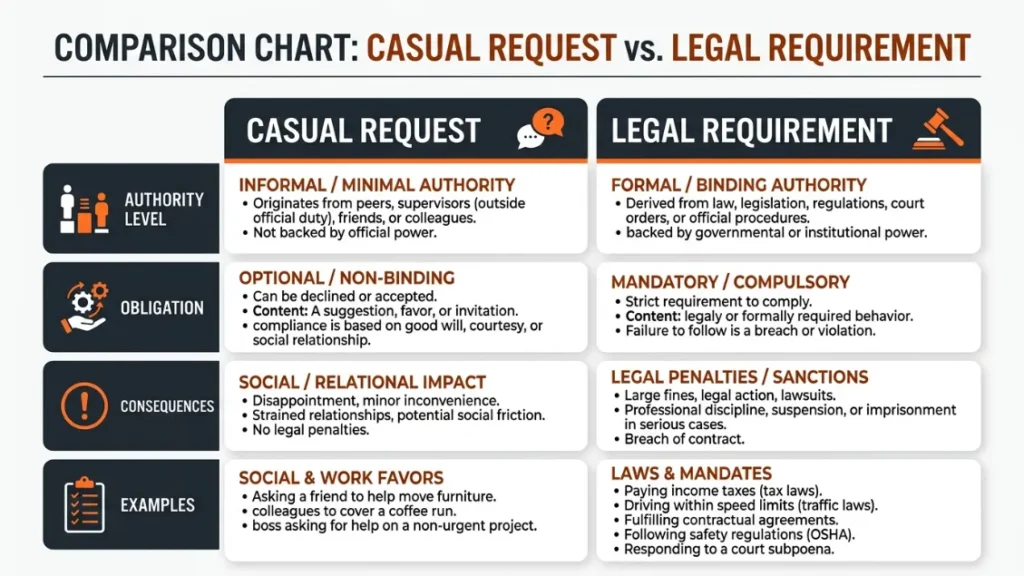
There is a big difference between someone asking for your footage and someone having the legal power to demand it. Most drivers don’t know where that line sits — and that confusion is costly.
A “legal requirement” means a formal mechanism exists that obligates you to comply. Ignore it, and you face real consequences: fines, criminal charges, or a failed insurance claim. A casual request — even from a police officer at the roadside — does not automatically carry that weight.
Think of it this way. A police officer asking to see your footage is like a neighbour asking to borrow your lawnmower. Polite. But you can say no. A court order demanding your footage is like a judge ordering you to testify. You cannot say no without legal consequences.
The key question every driver should ask: “Is this a request or a legal order?”
The Difference Between a Casual Request and a Legal Order
A casual request carries no enforcement power. A legal order — whether a court subpoena, a police production notice, or a section 172 notice in the UK — does. Refusing a legal order can lead to prosecution, contempt of court, or policy cancellation.
Most roadside interactions are casual requests. Police are trained to ask first. They know they need the right legal mechanism to compel disclosure. So when an officer asks to “take a look,” you are within your rights to say you’d prefer to speak with a solicitor before sharing anything.
Who Has the Authority to Formally Demand Your Footage?
Three parties can formally compel dashcam footage in most jurisdictions:
- Police and prosecutors — through a production order, search warrant, or equivalent legal notice
- Courts — through a subpoena or court order issued during civil or criminal proceedings
- Your insurance company — through cooperation clauses embedded in your policy contract
Third parties — other drivers, pedestrians, or their solicitors — cannot compel you directly. They must go through the courts to obtain a disclosure order.
Always make a backup copy of footage before handing over your SD card or device. Hand over a copy — not your original. This protects your evidence and your device.
Do You Have to Give Police Your Dashcam Footage at the Roadside?
At the roadside, you are not legally required to hand over dashcam footage on request in the UK, US, or Australia — but formally refusing a subsequent legal notice carries serious risk. The roadside moment is usually just a request, not a legal order.
Police officers can ask. They cannot — in most jurisdictions — legally seize your dashcam or SD card on the spot without a warrant or specific statutory power. In the UK, for example, officers need a production order under the Police and Criminal Evidence Act 1984 (PACE) to compel you to hand over recorded material.
That said, voluntarily sharing footage that helps your case is often the right move. If the footage clearly shows the other driver ran a red light, giving police a copy on the spot can help you. The problem arises when you’re unsure what the footage shows — or if it might show something that counts against you.
What Happens When Police Ask Nicely vs. Issue a Formal Request
A polite roadside request carries no legal enforcement. You can decline, and most officers will move on. A formal request — like a Section 172 notice in the UK or a grand jury subpoena in the US — carries legal weight. Ignoring it is a criminal offence.
In the UK, police can also use the Road Traffic Act 1988 to request information about a driver involved in an incident. If dashcam footage is later identified as relevant evidence, a formal production order under PACE can follow — sometimes weeks after the event.
Can Police Seize Your Dashcam on the Spot?
In most cases, no — not without a warrant. In the UK, a police officer needs reasonable grounds and a PACE warrant to seize property from a vehicle. In the US, the Fourth Amendment protects against unreasonable searches and seizures. Police generally cannot grab your dashcam without consent or a warrant.
There are edge cases. If police have a search warrant that covers your vehicle, the dashcam is fair game. If you’re arrested and the vehicle is searched as part of a lawful arrest procedure, footage may be seized. But a routine roadside stop? They need your cooperation or a warrant.
Never delete dashcam footage after an accident — even if you think it shows something unflattering. Destroying evidence once you know a legal matter may follow is a criminal offence in most jurisdictions. Courts take a dim view of this, and it can be treated as an admission of guilt.
Can Insurance Companies Force You to Hand Over Dashcam Footage?
Your insurer may not need a court order — because you already agreed to cooperate when you signed your policy. Most motor insurance contracts include a “duty to cooperate” clause that effectively requires you to share relevant evidence, including dashcam footage.
This is one of the most misunderstood areas. Drivers think their insurer is just asking nicely. In reality, your policy is a legal contract. Refusing to cooperate — including refusing to share footage your insurer considers relevant — can give them grounds to void your claim or even cancel your policy.
Check your specific policy wording. Phrases like “you must provide all information and assistance we reasonably require” are standard language that covers dashcam footage.
Your Policy Wording and What It Means for Footage Sharing
Most UK and US motor insurance policies include cooperation obligations. These typically require you to: report incidents promptly, provide all relevant documentation, and assist with any investigation. Dashcam footage falls under “relevant documentation” when it captures an insured incident.
The key word is “relevant.” If footage shows the incident in question, your insurer has a strong contractual basis to request it. If the footage is from a different date or shows nothing connected to the claim, that argument weakens considerably.
What Happens If You Refuse Your Own Insurer’s Request?
Refusing your own insurer’s reasonable request for footage can result in your claim being declined, delayed, or voided. In serious cases, your insurer may treat the refusal as evidence of fraud — particularly if the footage would have resolved a disputed liability question.
If you genuinely don’t have the footage — because the camera overwrote it before you knew an incident would be disputed — that’s a different matter. Most insurers accept this if you notify them promptly. The problem arises when you had the footage, knew it was relevant, and chose not to share it.
Your insurer can require dashcam footage through your policy’s cooperation clause — this is a contractual obligation, not just a polite request. Always read your policy wording and always back up footage immediately after any incident.
Can a Court Order You to Produce Dashcam Footage as Evidence?
Yes — a court absolutely can order you to produce dashcam footage, and refusal is contempt of court. This applies in civil cases (personal injury claims, insurance disputes) and criminal cases (dangerous driving prosecutions, hit-and-run investigations).
A court doesn’t care whether the footage helps or hurts your case. If it’s relevant to the proceedings, a judge can order its disclosure. At this stage, you have no legal right to withhold it.
How a Court Subpoena or Production Order Works
In the UK, a production order under PACE compels a person to produce specific material — including digital recordings — to police or prosecutors. In civil proceedings, a disclosure order serves the same function. In the US, a subpoena duces tecum (a subpoena for documents and records) compels production of dashcam footage in both civil and criminal cases.
The process typically works like this:
- An incident occurs and legal proceedings begin — either criminal or civil.
- One party identifies dashcam footage as potentially relevant evidence.
- Their legal team applies to the court for a production or disclosure order.
- The court reviews the application and — if the footage is deemed relevant — issues the order.
- You are formally served with the order and given a deadline to produce the footage.
- Failure to comply constitutes contempt of court — punishable by fines or imprisonment.
Is Dashcam Footage Admissible in Court — and When Does It Get Rejected?
Dashcam footage is generally admissible as evidence in UK, US, and Australian courts — but it must meet certain standards. Footage can be rejected if the chain of custody is broken, if metadata has been altered, or if the recording was obtained illegally.
For footage to hold up, you need to show it hasn’t been tampered with. Modern dashcams like those made by Nextbase and Garmin embed GPS timestamps and metadata that courts use to verify authenticity. If you edit the footage — even to trim irrelevant sections — you risk having the whole recording rejected as unreliable.
Never edit or trim dashcam footage before submitting it as evidence. Courts need the original, unaltered file with its metadata intact. Submit the raw file from the SD card — not a re-encoded copy.
Does GDPR Apply to Dashcam Recordings and What Does That Mean for You?
Under UK GDPR and EU GDPR, dashcam recordings that capture identifiable individuals — other drivers, pedestrians, passengers — may constitute personal data, making the driver a data controller with legal obligations to handle that data responsibly.
This surprises most people. You’re just driving. But the moment your dashcam records someone’s face, number plate, or other identifying information, you may be processing personal data under data protection law. The UK’s Information Commissioner’s Office (ICO) has confirmed this position.
Are Dashcam Owners “Data Controllers” Under GDPR?
The ICO’s guidance says that using a dashcam for personal use — like recording your daily commute with no intention to publish — likely falls under the “household exemption” in GDPR. This means the full weight of GDPR doesn’t apply.
But the moment you share footage publicly — posting it online, giving it to a news outlet, or using it for commercial purposes — the household exemption disappears. At that point, you may be acting as a data controller and face obligations around consent, data retention, and disclosure.
You can read the ICO’s guidance on domestic CCTV and dashcam use for the full breakdown of when GDPR applies to your recordings.
How to Use Your Dashcam Legally Under UK and EU Data Law
To stay within the law:
- Use dashcam footage only for your own personal or legal protection — not for social media content without blurring identities.
- Don’t retain footage longer than necessary — overwrite or delete old recordings regularly.
- If you post footage publicly, blur faces and number plates wherever possible.
- Only share footage in response to a genuine legal need — accident evidence, police request, insurance claim.
What Happens If You Refuse to Hand Over Dashcam Footage?
Refusing a formal legal request for dashcam footage can result in criminal charges, civil penalties, or a failed insurance claim — depending on who is asking and what legal mechanism they’ve used. The consequences scale with the seriousness of the refusal.
Refusing Police: The Real Legal Risk
Refusing a casual roadside request carries no immediate legal consequence. But refusing a formal production order, search warrant, or statutory notice is a different matter entirely. In the UK, refusing a PACE production order can result in prosecution. In the US, defying a subpoena is contempt of court — punishable by fines or imprisonment.
The riskiest move of all? Deleting the footage after receiving a formal request. That crosses from refusal into destruction of evidence — a separate and more serious offence in virtually every jurisdiction.
Refusing Insurers and Courts: Consequences You Need to Know
- Refusing your insurer: Claim denial, policy cancellation, possible fraud investigation.
- Refusing a court order: Contempt of court — fines, civil penalties, potentially imprisonment.
- Refusing a police production order: Criminal prosecution for failure to comply with a statutory notice.
- Destroying footage knowingly: Obstruction of justice, perverting the course of justice (UK), or tampering with evidence (US).
Destroying dashcam footage after an accident — even footage that might hurt your case — is legally far more dangerous than the footage itself. Courts treat evidence destruction as highly suspicious and it can result in criminal charges independent of the original incident.
Can Dashcam Footage Be Used Against You in Court?
Yes — dashcam footage can absolutely be used against you in court, even footage from your own camera. If your recording shows you speeding, using your phone, or failing to stop at a junction, that footage becomes evidence of your own offence.
This is the angle most dashcam articles skip. Everyone talks about using footage to protect yourself. Fewer people ask: what if my footage shows I was at fault? This is especially relevant in rear-end collisions, junction disputes, and speeding allegations.
When Your Own Footage Becomes Evidence for the Other Side
Once footage enters legal proceedings — whether you submitted it voluntarily or a court ordered its production — all parties can access it. If the other driver’s solicitor sees your footage first and it shows you were speeding, they will use it. You cannot take it back.
In the UK, civil disclosure rules (Part 31 of the Civil Procedure Rules) require parties to disclose all relevant documents — including dashcam footage that damages their own case. Selective disclosure is not permitted once proceedings begin.
How to Protect Yourself Before You Share Anything
Before sharing any footage — with police, insurers, or anyone else — watch it yourself first. Know what it shows. If there’s anything that might work against you, speak with a solicitor before disclosing anything voluntarily. You cannot un-share footage once it’s out.
Practical steps before sharing:
- Watch the full footage privately before doing anything else.
- Make a backup copy immediately — before sharing the original.
- If the footage is ambiguous or unflattering, consult a solicitor first.
- Only share what is directly relevant to the specific request.
- Never share footage “just to be helpful” without understanding what it contains.
UK vs. US vs. Australia: How Dashcam Footage Laws Differ by Country
There is no single global law on dashcam footage. Your obligations depend heavily on where you live. Here is a clear comparison of the three most common jurisdictions drivers ask about.
| Aspect | United Kingdom | United States | Australia |
|---|---|---|---|
| Roadside police request | No obligation to comply | No obligation to comply | No obligation to comply |
| Formal police request | PACE production order compels compliance | Subpoena or warrant compels compliance | Production notice under state law compels compliance |
| Court order | Fully compellable — contempt if refused | Fully compellable — contempt if refused | Fully compellable — contempt if refused |
| Insurance obligation | Policy cooperation clause — contractual duty | Policy cooperation clause — contractual duty | Policy cooperation clause — contractual duty |
| Data protection law | UK GDPR — household exemption applies for personal use | State-level laws vary; no federal equivalent of GDPR | Privacy Act 1988 — personal use generally exempt |
| Destroying footage risk | Perverting the course of justice | Obstruction of justice / tampering with evidence | Perverting the course of justice |
For US drivers, it’s worth noting that state laws vary significantly. California, for example, has stricter privacy provisions around recording than Texas. Always check your specific state’s rules if you’re unsure. The National Conference of State Legislatures maintains a useful overview of dashcam laws by state.
What Should You Do Right After an Accident to Protect Your Dashcam Footage?
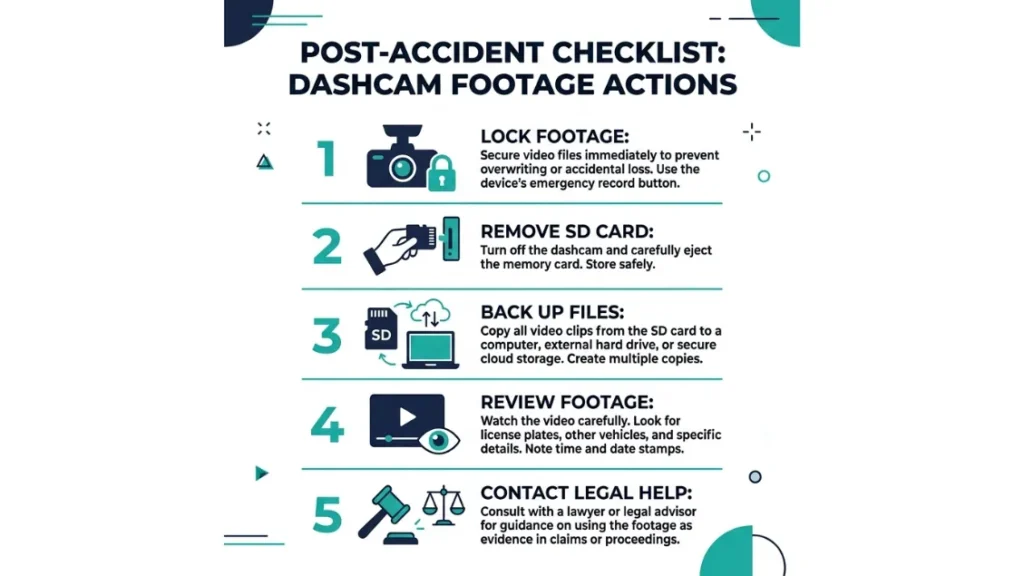
The 30 minutes after an accident are critical for dashcam footage. Act fast and correctly, and your footage becomes a powerful legal asset. Act slowly or carelessly, and you may lose it forever — or hand over more than you intended.
Most dashcams loop-record, overwriting old footage automatically. If you don’t lock or back up the relevant clip immediately, the camera may record over it before you even get home.
Step-by-Step: How to Preserve and Back Up Footage Legally
- Do not turn off your dashcam immediately — let it finish writing the current file.
- Use the dashcam’s “lock” or “protect” function to prevent the footage from being overwritten.
- Remove the SD card carefully and keep it somewhere safe — do not insert it into an unknown device.
- Make a backup copy on a second device (laptop, another SD card) before doing anything else.
- Watch the footage privately before sharing it with anyone.
- Note the date, time, and GPS location shown in the footage — these are key for evidence integrity.
- If the incident is serious, contact a solicitor or attorney before voluntarily sharing with anyone.
How Long Should You Keep Dashcam Footage After an Incident?
Keep dashcam footage for at least 3 years after a road accident in the UK — this matches the personal injury claims limitation period. In the US, keep it for the statute of limitations period in your state, which ranges from 2 to 6 years for personal injury claims. In Australia, the general rule is 3 years.
If criminal proceedings are involved, keep the footage until the case is fully resolved — including any appeals. Never destroy footage while any related legal matter is still open.
For general non-incident footage with no legal relevance, the ICO recommends not retaining dashcam recordings beyond 31 days under good data hygiene practice. Most loop-recording dashcams handle this automatically.
Use a dashcam with cloud backup — brands like Nextbase offer connected dashcams with automatic cloud storage. This protects footage from physical card damage and gives you an independent backup you control from your phone.
Dashcam footage is one of the most powerful tools a driver can have. But knowing your legal obligations — when you must share it, when you don’t, and what happens either way — makes it even more valuable. For more on how UK courts treat digital evidence, the UK Judiciary’s official guidance on electronic evidence is a useful reference point.
Frequently Asked Questions
Do you legally have to give police dashcam footage in the UK?
At the roadside, no — you are not legally required to hand over footage on a casual request. However, a formal police production order under PACE does legally compel you to produce it. Refusing a formal order can result in criminal prosecution.
Can insurance companies demand dashcam footage?
Your insurer can request dashcam footage under the cooperation clause in your policy — this is a contractual obligation, not a legal order. Refusing a reasonable request from your own insurer can result in your claim being denied or your policy being voided.
What happens if dashcam footage is accidentally overwritten before police ask for it?
If footage is genuinely overwritten before you knew it was needed, most courts and insurers accept this — provided you notify them promptly. The problem arises only if you overwrite or delete footage after knowing an incident may lead to legal proceedings.
Can dashcam footage be used against you in court?
Yes. Once footage enters legal proceedings, all parties have access to it. If your recording shows you driving carelessly or breaking traffic law, the other party’s legal team can and will use it. Always watch your footage privately before deciding whether to share it voluntarily.
Does GDPR apply to dashcam recordings in the UK?
GDPR’s household exemption generally covers dashcam use for personal protection. But if you publish footage publicly or use it commercially, you may be acting as a data controller with real GDPR obligations. The ICO has specific guidance on this distinction.
How long should you keep dashcam footage after an accident?
Keep footage for at least 3 years after a road accident in the UK to cover the personal injury claims window. If criminal proceedings are involved, keep it until the case — including all appeals — is fully resolved. Never delete footage while any related legal matter remains open.

I’m Alex Rahman, a car enthusiast and automotive writer focused on practical solutions, car tools, and real-world driving advice. I share simple and honest content to help everyday drivers make better decisions.
