Where to Put a Dashcam in Your Car for Best Results
Mount your dashcam on the windshield, directly behind the rearview mirror, near the top of the glass. This position keeps the camera out of your sightline, stays within legal placement zones in most countries, and gives the lens a wide, unobstructed view of the road ahead.
I installed my first dashcam in the wrong spot. It was stuck low on the passenger side of the windshield, angled toward the road like a periscope. The footage was shaky, half the frame was car hood, and a traffic officer once asked me if I knew that was illegal in my state.
Sound familiar? A lot of people buy a dashcam and just stick it somewhere. But placement is everything. The wrong position means blurry footage, legal trouble, or a camera that misses the exact moment you need it most.
I’m Alex Rahman, and I’ve tested and installed more than a dozen dashcams across different vehicle types. In this guide, I’ll show you exactly where to put a dashcam in a car — front, rear, and interior — so your camera actually does its job when it counts.
- The best front dashcam position is behind the rearview mirror, at the top of the windshield.
- Most US states restrict dashcam placement to the top 5 inches of the windshield to avoid blocking driver view.
- Dashboard mounting causes glare problems and is legal in fewer places — windshield is almost always better.
- Rear dashcams go on the inside of the rear window, centered and near the top, away from defroster lines.
- Hiding your cable along the A-pillar and headliner gives a clean, professional look without drilling.
What Is the Best Spot on the Windshield to Mount a Dashcam?
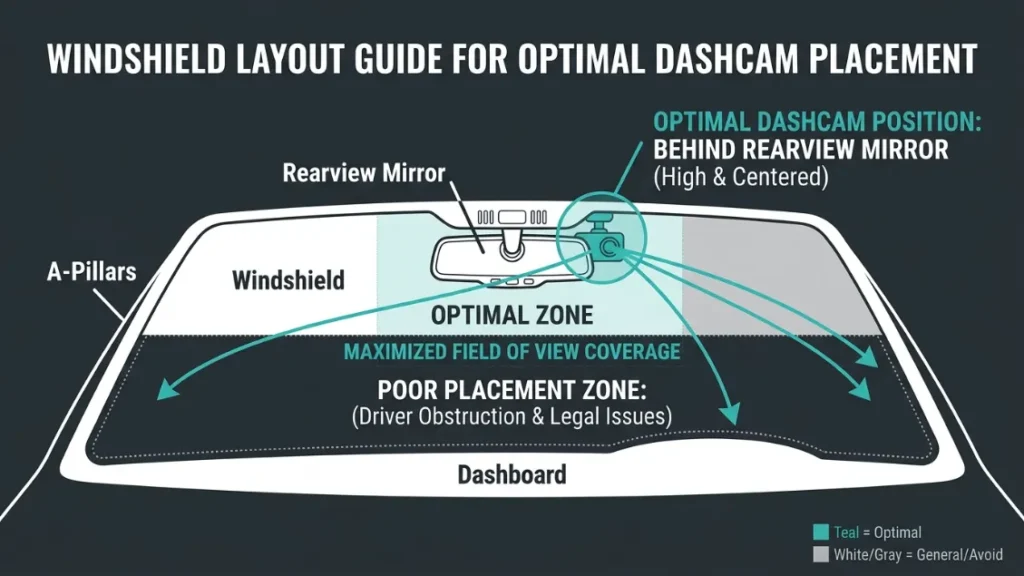
The best windshield position for a dashcam is centered behind the rearview mirror, as high up on the glass as possible. This single spot solves most placement problems at once — it keeps the camera out of your line of sight, uses the mirror’s natural shade to reduce glare, and puts the lens right where it needs to be to capture the full road ahead.
Think of the rearview mirror as a shield. It blocks direct sunlight hitting the dashcam lens from above. That means less lens flare and more readable license plates in your footage.
The higher the camera sits on the windshield, the better the horizon line in your video. A low camera picks up too much road surface. A high camera captures the full scene — cars, traffic lights, road signs, and the sky — all in one clean frame.
Why Behind the Rearview Mirror Is the Gold Standard Position
Placing your dashcam directly behind the rearview mirror is the most widely recommended position for four reasons. First, it keeps the camera invisible from outside the car. Second, it aligns the lens with your natural forward sightline. Third, it keeps the device within most countries’ legal windshield zones. Fourth, it reduces vibration because the mirror mount area is one of the most stable points on the glass.
Brands like BlackVue (known for ultra-discreet designs like the DR900X-2CH) and Garmin (whose Dash Cam 67W has a 180-degree field of view) specifically design their cameras to tuck cleanly behind the mirror for this reason.
Before you peel any adhesive, hold the dashcam up to the windshield behind the mirror and look through your camera app live. Check the angle from the driver’s seat. Move it 2–3 centimeters left or right until the road appears perfectly centered in frame.
Should Your Dashcam Sit Left, Center, or Right of the Mirror?
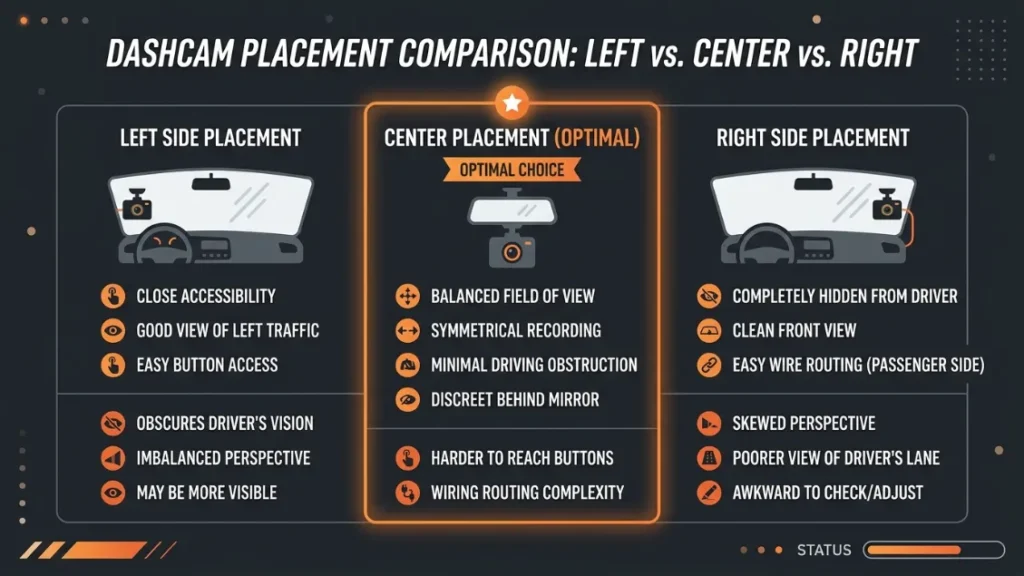
Center is almost always the right answer. A centered dashcam captures equal road coverage on both sides of your car. Shifting it left or right by even 5 centimeters tilts the frame and can miss important action on the opposite side.
The only exception: if your windshield has a tinted band at the very top, you may need to drop the camera down a centimeter or two to avoid purple or dark footage. In that case, keep it centered but just below the tint strip.
Is It Legal to Put a Dashcam on Your Windshield?
Yes, a dashcam on the windshield is legal in most countries — but only in specific zones. The key rule everywhere is that the camera must not obstruct the driver’s view. Get the position wrong and a traffic officer can issue a fine, even if the dashcam itself is perfectly legal to own.
Laws vary by country, state, and even vehicle type. Knowing your local rule before you mount anything saves you a lot of trouble.
Windshield Obstruction Laws in the US — What Each State Says
In the United States, windshield obstruction laws are set at the state level, not federally. Most states follow one of two patterns: either the dashcam must sit in the top 5 inches of the windshield, or it must sit in the bottom 5 inches. A small number of states ban windshield mounting entirely for anything other than GPS and toll transponders.
Here is a quick breakdown of key state rules as of 2024:
| State | Legal Zone | Notes |
|---|---|---|
| California | Top 5 inches or bottom 5 inches | Must not obstruct driver view |
| Florida | Top 5 inches | Stickers and devices restricted below this |
| Texas | Top 5 inches | No materials blocking driver’s clear view |
| New York | Not specified — no obstruction rule | Officer discretion applies |
| Minnesota | Restricted — windshield ban applies | Consider dash or rearview mirror mount |
Always check your state’s Department of Motor Vehicles (DMV) page or consult the Insurance Institute for Highway Safety for current vehicle safety device guidance in your region.
In Minnesota, New Jersey, and a handful of other states, attaching anything to the windshield that could obstruct the driver’s view is a finable offense. If you drive in these states, use a dashboard mount, a rearview mirror clip mount, or check with your local DMV before installing.
Dashcam Placement Rules in the UK and Australia
In the UK, the Highway Code says any device mounted on the windshield must not obstruct the driver’s view of the road. The practical guidance from most UK police forces is to mount the dashcam directly behind the rearview mirror — which is the same advice for most countries. Nextbase, the UK’s best-selling dashcam brand with over 2 million units sold, designs all their mounts with this legal zone in mind.
In Australia, the Australian Road Rules state that a driver must have a clear and unobstructed view. The general guideline is to avoid placing anything in the driver’s direct line of sight. Positioning the dashcam in the top center of the windshield behind the mirror satisfies this rule in all Australian states and territories.
Why the Dashboard Is Usually a Worse Spot Than the Windshield
Mounting a dashcam on the dashboard is legal in more places, but it produces lower-quality footage in most conditions. The dashboard sits below the driver’s eye level, which forces the lens to angle upward to see the road — and that upward angle catches glare, sky, and reflections instead of clean road scenes.
In direct sunlight, a dashboard camera can become completely washed out. In rain or at night, the reflection of dashboard instruments bounces off the windshield glass and appears directly in your footage. The windshield mount avoids both of these problems because the camera sits closer to the glass.
How Dashboard Glare Ruins Your Footage
When a dashcam sits on the dashboard, there are 5 to 10 centimeters of air between the lens and the windshield. That gap is enough for interior cabin light, dashboard glow, and sunlight reflections to enter the lens from multiple angles. The result is footage with washed-out whites, lens flare streaks, and unreadable license plates — exactly the footage that fails in an insurance claim.
A windshield-mounted dashcam presses the lens close to the glass. Glare has nowhere to enter from the sides. The result is cleaner, higher-contrast footage in almost every lighting condition.
When a Dashboard Mount Actually Makes Sense
Dashboard mounting works well in three specific situations. First, if your state or country legally restricts windshield mounting (like Minnesota), a non-slip dashboard pad mount is your best alternative. Second, if you drive a vehicle with a steep windshield rake that creates severe distortion, a dashboard mount can straighten the angle. Third, some commercial vehicle operators place secondary cameras on the dash for a wider cabin view alongside a windshield primary cam.
| Factor | Windshield Mount | Dashboard Mount |
|---|---|---|
| Glare resistance | Excellent | Poor in direct sun |
| Legal compliance | Most countries — yes | All countries — yes |
| Video clarity | High | Medium |
| Driver visibility impact | Minimal (behind mirror) | None |
| Stability | High | Lower (vibration) |
Suction Cup vs Adhesive Mount — Which One Should You Use?
Suction cup mounts are removable, repositionable, and easy to move between vehicles. Adhesive mounts are permanent, more stable, and virtually vibration-free. For most drivers, an adhesive 3M mount gives better long-term results — but a suction cup is better if you rent cars, share a vehicle, or simply want flexibility.
Suction cups are reliable in mild climates, but they fail in extreme heat. A dashcam left in a car on a 40°C (104°F) summer day can lose suction and fall — sometimes onto the dashboard, sometimes onto a moving steering wheel. If you live in a hot climate, an adhesive mount is the safer choice.
Vantrue and Thinkware both include 3M adhesive mounts with their flagship cameras for exactly this reason. The adhesive pad sticks to a small metal bracket, and the camera clips in — so the camera is removable even with a permanent mount on the glass.
Clean the windshield mounting spot with isopropyl alcohol before applying any adhesive mount. Oil and dust prevent full adhesion. Press the mount firmly and hold for 30 seconds. Wait 24 hours before attaching the camera to let the adhesive cure fully.
Where Should You Put a Rear Dashcam for Maximum Coverage?
Mount a rear dashcam on the inside of the rear windshield, centered horizontally, near the top of the glass. This position gives the lens a clear, full-width view of the road behind you. It avoids the defroster heating lines, reduces glare from following headlights, and keeps the camera out of your rear view sightline.
Rear cameras need the same logical thought as front cameras. Too low and the camera films your trunk or bumper. Too far to one side and you miss half the road. Center and high is the correct formula — just like the front.
Inside vs Outside Rear Window Mounting
Almost every rear dashcam mounts on the inside of the rear window. Exterior mounting exposes the camera to rain, dirt, heat, cold, and theft. Interior mounting through glass still captures clear footage in dry conditions, and modern rear cameras compensate for the glass distortion in their lens design. Some waterproof external cameras — like the Nextbase Rear Window Camera Module — are designed specifically for external mounting, but these are the exception, not the rule.
How to Avoid Blocking Your Rear View or Camera Angle
Position the rear camera above your existing rear view eyeline. If your car has a spoiler or high trunk lid, check that the camera angle clears it — tilt the lens down slightly if needed. Keep the camera body slim and close to the glass so it doesn’t create a blind spot in your rearview mirror. Cameras like the BlackVue DR590X-2CH use flat, low-profile designs precisely for this reason.
Where Does an Interior Cabin Camera Go in a Car?
An interior cabin camera mounts on the front windshield or rearview mirror, angled to face the interior of the car. The lens needs a wide enough field of view — typically 140° to 170° — to cover both front seats and ideally the rear seat area as well. Position the camera so the wide angle reaches from door to door without the A-pillars cutting off the frame edges.
Interior cameras are standard in taxi, rideshare, and commercial fleet vehicles. They are also increasingly popular with parents monitoring teen drivers and owners protecting against vehicle theft or vandalism.
Rideshare Driver Placement Guide (Uber and Lyft Best Practices)
Rideshare drivers using platforms like Uber and Lyft in the US need to follow local laws on passenger recording consent — which vary by state. For the camera itself, most experienced drivers mount a dual-channel dashcam (front exterior + interior) on the windshield behind the rearview mirror. The Vantrue N4 (a three-channel cam that records front, interior, and rear simultaneously) is a popular choice for this exact setup because a single mount handles all three angles.
Place the camera so passengers can see it clearly from the rear seat. In many US states, visible recording notice is part of the legal consent framework. A hidden camera can create legal exposure even if you own the vehicle.
Important: In two-party consent states like California, Florida, and Illinois, recording audio inside your vehicle without passenger knowledge may be illegal. Check your state’s wiretapping laws before using any dashcam with audio recording enabled in a rideshare or commercial context.
How to Angle an Interior Cam to Cover Both Front and Rear Seats
Mount the camera at the top center of the windshield and tilt the lens down and slightly back. Test the angle by checking the live view on the dashcam app or screen. The front seats should appear in the lower third of the frame, the rear seat in the upper two-thirds. This tilt captures a full cabin view and still shows a portion of the road ahead for context.
How Do You Route and Hide the Dashcam Cable Cleanly?
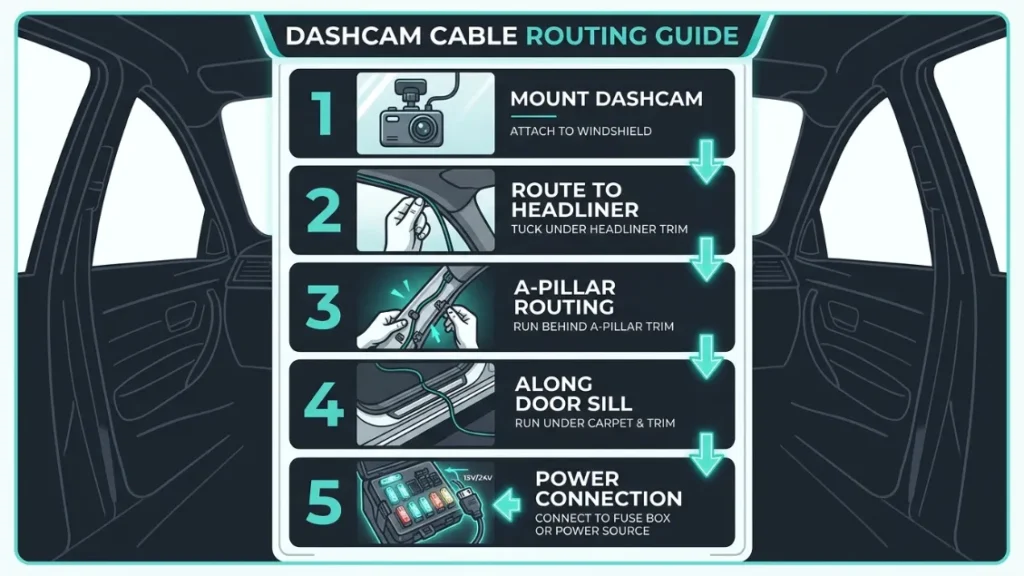
Route the dashcam power cable along the top of the windshield, tucked under the headliner, then down the A-pillar trim, and finally along the door sill to the power source. This path keeps the cable completely out of sight from the driver’s seat, removes any distraction or snag hazard, and gives the installation a factory-fitted appearance.
A messy cable dangling across your windshield is more than an eyesore. It can catch on the steering wheel, distract you in motion, and even trigger a traffic stop in some jurisdictions where dangling objects are a windshield obstruction violation.
Step-by-Step Cable Routing Along the A-Pillar and Headliner
- Connect the power cable to the dashcam and hang it loose to measure the full length you need.
- Push the cable up into the gap between the headliner and the windshield frame using a plastic pry tool or a flat card.
- Work the cable across the top of the windshield, tucking as you go — do not stretch or force it.
- At the driver’s side A-pillar, tuck the cable down behind the rubber seal or under the trim panel edge.
- Run the cable down the A-pillar to the base, then along the door sill trim toward the center console.
- Plug into the 12V cigarette lighter socket or, for a hardwired setup, connect to the fuse box via an add-a-fuse tap.
- Tuck any slack cable under the sill trim and test the dashcam powers on before closing everything up.
Hardwiring vs Cigarette Lighter Power — Does Placement Change?
The camera position does not change based on power source. But the cable routing path does. A cigarette lighter cable runs from the camera down the A-pillar and across the floor to the center console — a longer visible run. A hardwired cable connects to the fuse box, usually behind the dashboard trim on the driver’s side, which gives a much shorter and cleaner cable path. Thinkware and BlackVue both sell dedicated hardwire kits that include a low-voltage cutoff to protect your battery when the car is off.
For parking mode to work — where the camera records while parked — you must hardwire to a constant or switched power source. A cigarette lighter socket loses power when the ignition turns off in most modern vehicles.
For parking mode, hardwire your dashcam to the fuse box using a hardwire kit with a voltage cutoff. Run the cable behind the A-pillar trim and headliner for a clean, hidden install. The camera position stays the same — only the power source changes.
Common Dashcam Placement Mistakes That Ruin Your Footage
Even a great dashcam produces useless footage when it is mounted in the wrong spot. These are the most common placement errors — and exactly how to fix each one.
- Too low on the windshield: The lens films road surface instead of the full scene. Fix — move the camera to the top 5 inches of the windshield.
- Tilted left or right: One lane gets more coverage than the other. Fix — center the camera horizontally behind the mirror.
- Blocked by windshield tinting: Dark tint at the top of the glass creates dark, grainy footage. Fix — mount just below the tinted band.
- Too close to a defroster vent: Heat cycling loosens adhesive over time and fogs the lens. Fix — avoid placing directly over or below any vent.
- Rear camera on defroster lines: Heating elements interfere with the adhesive and can leave marks on the glass. Fix — mount above or between the defroster lines, never directly on them.
- Cable left dangling: A loose cable is a distraction, a snag risk, and a legal issue in some states. Fix — route the cable along the A-pillar and headliner immediately after mounting.
- Camera angled too far down: More hood than road appears in the frame. Fix — tilt the lens so the horizon sits in the upper third of the frame.
Never mount a dashcam on the inside of the front windshield in the driver’s direct forward sightline — for example, low on the driver’s side glass near the A-pillar. Even a small camera in your peripheral vision creates an ongoing distraction. Behind the mirror, at the top center, keeps it invisible and safe.
Getting placement right once means you never have to think about it again. The camera records clean footage automatically, every drive, without any effort from you.
For more guidance on dashcam installation and vehicle safety devices, the National Highway Traffic Safety Administration (NHTSA) and RAC Drive (UK) both publish helpful guidance on legal device placement in vehicles.
Conclusion
The right place to put a dashcam in your car is behind the rearview mirror, at the top center of the windshield. That single position checks every box — legal compliance, clear footage, glare reduction, and zero driver distraction.
Pair it with a clean cable route down the A-pillar and you have a setup that looks factory-fitted and works every single drive. Add a rear camera on the inside of the rear window and an interior cam if you carry passengers — and your car has complete 360-degree coverage.
I’ve seen drivers lose insurance claims because their dashcam footage was too dark, too tilted, or simply filmed the wrong part of the road. Five minutes of correct placement prevents all of that. Get it right once, and the camera does the rest.
If you found this guide helpful, share it with someone who just bought their first dashcam. The difference between a useless clip and courtroom-ready evidence often comes down to exactly where the camera was sitting.
— Alex Rahman
Frequently Asked Questions
Where is the best place to put a dashcam in a car?
The best place is behind the rearview mirror, at the top center of the windshield. This position keeps the camera out of your sightline, reduces glare, and places the lens within the legal mounting zones in most countries. It also gives the widest, cleanest view of the road ahead.
Can I put my dashcam on the dashboard instead of the windshield?
Yes, but the footage quality is usually lower. Dashboard cameras sit below eye level and angle upward, which catches glare and reflections from inside the cabin. The windshield mount — especially behind the rearview mirror — almost always produces clearer, more usable footage. Use a dashboard mount only if windshield mounting is legally restricted in your area.
How high should a dashcam be on the windshield?
As high as possible — right at the top of the windshield, just below the tinted band if one exists. In the US, most states require the camera to be within the top 5 inches of the windshield. High placement captures more of the road scene and less road surface, giving better context in any incident footage.
Where do I put a rear dashcam?
Mount the rear camera on the inside of the rear windshield, centered and near the top of the glass. Avoid the defroster lines — adhesive does not stick well to them and the heat can damage the mount over time. Position the lens so it captures the full lane behind you without obstructing your rearview mirror sightline.
How do I hide the dashcam cable in my car?
Tuck the cable under the headliner along the top of the windshield, then feed it down behind the A-pillar trim, and run it along the door sill to the power source. Use a plastic trim pry tool to push the cable into gaps — no drilling needed. This gives a completely clean look with no visible cable in the cabin.
Does dashcam placement affect insurance claims?
Yes, significantly. A correctly placed dashcam — high on the windshield, properly angled, with no glare obstruction — captures license plates, traffic signals, and road markings that make footage useful as evidence. Poorly placed cameras often produce blurry, overexposed, or incomplete footage that insurance companies and courts cannot use. Correct placement directly protects your claim.

I’m Alex Rahman, a car enthusiast and automotive writer focused on practical solutions, car tools, and real-world driving advice. I share simple and honest content to help everyday drivers make better decisions.
