Is Installing a Dashcam a Good Idea? Here Is the Honest Truth
Yes, installing a dashcam is a good idea for most drivers. It records accident footage, helps win insurance claims, deters parking lot damage, and can reduce premiums. A quality dashcam costs between $50 and $300 — a fraction of what one disputed claim could cost you out of pocket.
Last year, a driver rear-ended me at a red light. He got out, looked calm, and said I had reversed into him.
I had not. But without proof, it was my word against his.
That moment pushed me to finally install a dashcam. I am Alex Rahman, and I have spent years researching car safety gear, insurance practices, and driver technology. I want to give you the honest answer — benefits, drawbacks, and everything in between — so you can decide if a dashcam is right for you.
Spoiler: for most drivers, it absolutely is. But let me show you exactly why — and where the limits are.
- A dashcam records continuous footage and automatically locks clips during accidents using a G-sensor.
- Dashcam footage is admissible as legal evidence in most countries, including the US and UK.
- Some insurers offer premium discounts of 5–15% to drivers with dashcams installed.
- Dashcams can record while parked, catching hit-and-run incidents and vandalism.
- Your own footage can occasionally be used against you — so honest driving matters.
What Is a Dashcam and How Does It Actually Work While You Drive?
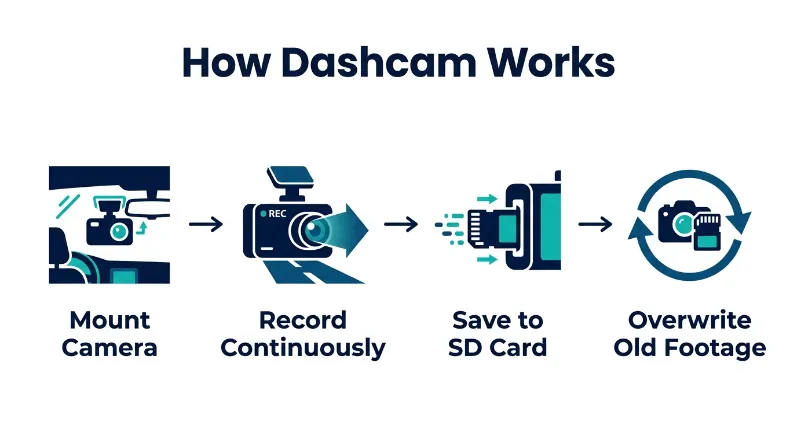
A dashcam is a compact camera mounted on your windshield or dashboard that records video continuously while your car is running. It captures everything in front of your vehicle — and with a rear camera, behind it too. The footage saves to a memory card and cycles automatically so you never need to manage storage manually.
Modern dashcams do much more than record video. Entry-level models from brands like Vantrue and Garmin record at 1080p Full HD. Mid-range and premium models from Nextbase and BlackVue offer 1440p or 4K resolution, built-in GPS to log your speed and location, Wi-Fi for smartphone pairing, and even emergency SOS features that call for help after a detected collision.
The camera runs silently in the background. Most drivers forget it is even there — until they need it.
What Does Loop Recording Mean and Why Does It Matter?
Loop recording means the dashcam continuously overwrites its oldest footage once the memory card fills up. Instead of stopping when the card is full, it keeps recording. You always have the most recent hours of driving saved without doing anything.
A 64GB card holds roughly 8 hours of 1080p footage. A 128GB card doubles that. You set it and forget it.
Use a dashcam-rated SD card — brands like SanDisk Endurance or Samsung Pro Endurance are built for constant read/write cycles. Regular SD cards fail much faster in dashcams.
How Does a G-Sensor Lock Footage During an Accident?
A G-sensor detects sudden changes in force — braking hard, a collision, or a sharp swerve. When it triggers, the dashcam immediately locks the current clip so loop recording cannot overwrite it. That file stays protected until you manually delete it.
This is what makes dashcams genuinely useful in accidents. The footage from the moments before, during, and after impact is preserved automatically. You do not need to remember to save it. The camera handles it the second the crash happens.
What Are the Real Benefits of Installing a Dashcam in Your Car?
The biggest benefit of a dashcam is indisputable video evidence — but the advantages go well beyond accident footage. Dashcams protect you financially, legally, and psychologically every time you drive.
How Does Dashcam Footage Help You Win an Insurance Claim?
Dashcam footage gives insurance adjusters objective proof of what happened. Instead of relying on conflicting driver statements, your insurer can watch exactly what occurred — from your car’s perspective — before deciding fault. This changes claim outcomes dramatically.
In the United Kingdom, where dashcam adoption crossed 40% of drivers by 2023, insurance companies now accept dashcam footage as primary evidence in the majority of disputed claims. Several UK insurers — including Admiral and Direct Line — have dedicated dashcam footage submission portals.
In the United States, dashcam footage is admissible as evidence in civil and criminal court. The Insurance Information Institute notes that objective evidence shortens claim resolution times and reduces fraud-related losses — both of which benefit honest drivers.
The real-world impact: Staged accident fraud — where a driver deliberately causes a collision to file a false claim — cost UK insurers over £340 million in 2022 alone. Dashcam footage is the single most effective counter to these schemes.
In South Korea, dashcam use is so widespread that not having one is considered unusual. Footage submission is now a routine part of the insurance claim process — and fraud rates there are among the lowest in Asia.
Can a Dashcam Catch a Hit-and-Run While Your Car Is Parked?
Yes — if your dashcam has parking mode enabled. Parking mode keeps the camera active while your engine is off. When a motion sensor or G-sensor detects activity near your car, it starts recording. Some models record continuously on low power; others use motion-triggered bursts to save battery.
Brands like Thinkware and BlackVue are especially well-regarded for parking mode quality. BlackVue’s cloud-connected models (such as the DR970X) even send a push notification to your phone the moment a parking event is detected.
Hit-and-run incidents in parking lots are far more common than most drivers realize. A 2021 study by the AAA Foundation for Traffic Safety found that a hit-and-run crash occurs in the United States every 43 seconds. A dashcam in parking mode is your best chance of capturing a plate number.
Does Installing a Dashcam Actually Lower Your Insurance Premium?
Some insurers offer direct discounts for dashcam-equipped vehicles, typically ranging from 5% to 15% off annual premiums. In the UK, companies like Nextbase have partnered with insurers such as Aviva and RAC to create dashcam-integrated insurance products where footage submission can actively reduce your excess after a claim.
In the United States, the discount landscape is less consistent — but it is growing. More insurers now factor dashcam ownership into their telematics and safe-driver programs. Even without a direct discount, dashcams reduce claim costs by proving fault faster, which keeps your no-claims bonus intact.
The math is simple: If a dashcam saves your no-claims bonus even once over five years, it pays for itself many times over.
Call your insurer before buying a dashcam and ask directly about discounts. Some require the dashcam to be from an approved list of brands. Nextbase models are the most commonly accepted in the UK market.
What Are the Disadvantages of a Dashcam You Should Know Before Buying?
Dashcams come with real downsides — and most review sites gloss over them. Before you install one, understand the risks and limitations so you go in with clear expectations.
Can Your Own Dashcam Footage Be Used Against You?
Yes, it can. If you were speeding, running a yellow light, or distracted at the moment of an accident, your dashcam records that too. Your insurer — or the other driver’s legal team — can request your footage as part of a claim or lawsuit.
This is not a reason to avoid dashcams. It is a reason to drive the way you always should. Dashcams protect honest drivers and expose dishonest ones — including yourself if you are at fault.
Never delete dashcam footage after an accident — even if it shows you made a mistake. Destroying evidence can be treated as obstruction in legal proceedings and will make your situation significantly worse.
Will a Dashcam Drain Your Car Battery Overnight?
A dashcam in parking mode does draw power from your car battery. Whether it drains it depends on three things: your battery’s capacity, how long your car sits idle, and the dashcam’s power consumption rate.
Most dashcams consume 200–400mA in parking mode. A healthy 60Ah battery can support that for 6–10 hours before dropping to a critically low level. Many dashcams have a built-in voltage cutoff — they shut down automatically when battery voltage falls below 11.8V to protect your car’s ability to start.
If you park for extended periods, a hardwire kit with a voltage cutoff module is essential. Alternatively, some dashcam models use a supercapacitor instead of a lithium battery, which handles heat better but provides shorter backup power.
Are There Privacy or Legal Issues With Running a Dashcam?
In most of the world, recording video in public spaces from inside your own vehicle is perfectly legal. Roads are public spaces, and you have no obligation to notify other drivers that you are recording.
The nuance comes with audio recording. In the United States, two-party consent laws in states like California mean recording conversations inside your vehicle without passenger consent may carry legal risk. Most drivers simply disable audio recording to avoid this entirely.
For detailed regional guidance, the Federal Trade Commission and local motoring authorities are the best resources. In Europe, GDPR rules apply to how long you store dashcam footage and how you share it.
What Features Should You Look for When Choosing the Right Dashcam?
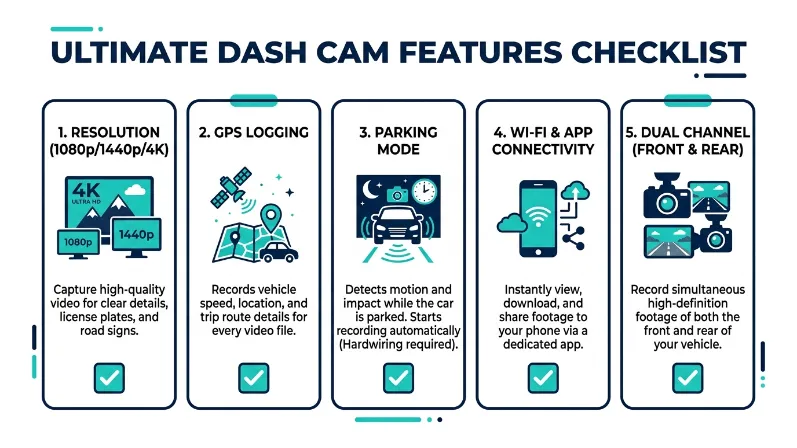
The right dashcam depends on your specific needs — commuter, long-distance driver, rideshare driver, or fleet operator. Focus on these core features before comparing prices.
Do You Need a Front-Only or Dual-Channel Dashcam?
A front-only dashcam covers the most common accident scenarios — rear-end collisions, running red lights, and road rage incidents in front of you. It suits most everyday drivers and costs less.
A dual-channel dashcam adds a rear-facing camera, which captures tailgating, rear-end impacts, and what happens behind you in parking situations. If you drive frequently in heavy traffic, tow a trailer, or run a rideshare vehicle, dual-channel is worth the extra cost.
| Feature | Front-Only | Dual-Channel |
|---|---|---|
| Cost | $50–$150 | $120–$350 |
| Rear coverage | No | Yes |
| Best for | Daily commuters | Rideshare, heavy traffic, towing |
| Installation complexity | Simple | Moderate |
| Parking mode capable | Most models | Most models |
What Resolution Do You Actually Need — 1080p, 1440p, or 4K?
For most drivers, 1440p (2.5K) hits the sweet spot between file size and image quality. At 1440p, license plates are readable at normal following distances even in daylight. 1080p is acceptable for tight budgets but struggles with plates at distance or in low light.
4K matters if you want maximum clarity for legal purposes or drive in genuinely low-light conditions regularly. The trade-off is larger file sizes — a 4K dashcam fills a 128GB card roughly twice as fast as a 1080p model.
Night vision quality matters more than resolution. A 1440p dashcam with Sony STARVIS sensor technology will outperform a 4K model with a cheap sensor in dark conditions. Look for STARVIS or similar low-light sensor specs when comparing models.
Hardwire Kit vs. Plug-In Power — Which Should You Choose?
Plug-in power (via the 12V/cigarette lighter socket) is easy to set up and works well if you only need recording while driving. The cable is visible and can look messy, but installation takes five minutes.
A hardwire kit connects directly to your car’s fuse box. It hides all cables cleanly inside the trim, enables parking mode without a separate battery pack, and includes a voltage cutoff to protect your car battery. Installation takes 30–60 minutes and may require a basic understanding of your car’s fuse panel.
- Mount the dashcam on the windshield behind the rearview mirror (minimizes driver distraction).
- Route the power cable along the headliner and down the A-pillar trim.
- Connect the hardwire kit to a switched fuse (powers on with ignition) and a constant fuse (for parking mode).
- Attach the ground wire to a bare metal bolt near the fuse box.
- Set the dashcam’s voltage cutoff to 11.8V to protect your battery.
- Test by starting the car and confirming the dashcam powers on automatically.
How Much Does a Good Dashcam Cost and Is It Worth the Investment?
A reliable dashcam costs between $50 and $300 — a one-time purchase that can prevent thousands in disputed claim costs. The price you pay determines the features you get, but even budget models deliver the core benefit: accident footage.
Budget vs. Mid-Range vs. Premium Dashcam — What Do You Get?
| Tier | Price Range | What You Get | Best For |
|---|---|---|---|
| Budget | $50–$100 | 1080p, loop recording, G-sensor, basic night vision | Occasional drivers, tight budget |
| Mid-Range | $100–$200 | 1440p, GPS, Wi-Fi app, parking mode, STARVIS sensor | Daily commuters, most drivers |
| Premium | $200–$350+ | 4K, dual channel, cloud connectivity, ADAS, emergency SOS | Rideshare drivers, fleets, safety-focused buyers |
For most drivers, the mid-range tier — models like the Nextbase 622GW or the Vantrue E1 Lite — delivers everything you need without overpaying. Nextbase’s 622GW includes a built-in emergency SOS feature that automatically contacts emergency services after a severe collision and transmits your GPS location — a feature that goes well beyond accident recording.
A dashcam is a one-time investment that protects you every time you drive. Budget models start at $50 and cover accident basics. Mid-range models around $150 add GPS, better night vision, and parking mode. Premium models above $200 add cloud connectivity, dual cameras, and driver assistance features. Buy the tier that matches how often and where you drive.
Is a Dashcam Worth It for Your Specific Situation?
A dashcam is worth it for almost every driver — but the value is highest in specific situations. If you commute daily in urban traffic, drive for a rideshare platform, park in public lots regularly, or live in an area with high accident or insurance fraud rates, a dashcam delivers clear and measurable value.
If you drive fewer than 3,000 miles per year on quiet rural roads and always park in a private garage, the benefit is lower — though still present. Even in low-risk situations, the peace of mind alone is worth the cost to most people.
The question is not really “should I get one?” It is “which one fits my situation?”
Best Dashcam Brands to Consider in 2025
- Nextbase — Best overall for UK drivers; excellent app, emergency SOS, insurance partnerships
- Vantrue — Best value for North American buyers; strong 4K and dual-channel lineup
- Garmin — Best for drivers who already use Garmin GPS; seamless integration, reliable hardware
- BlackVue — Best for cloud connectivity and fleet use; premium pricing, outstanding parking mode
- Thinkware — Best ADAS features and South Korean engineering; excellent for safety-focused drivers
For independent expert comparisons and user reviews, RTINGS.com’s dashcam section provides rigorous lab-tested data to help you compare models side by side.
Buy a dashcam-specific memory card at the same time as your dashcam. Standard SD cards are not designed for the continuous read/write cycle of dashcam use and fail within months. Budget an extra $15–$25 for a quality endurance card.
Conclusion: Should You Install a Dashcam?
Yes — for most drivers, installing a dashcam is one of the smartest, most affordable things you can do for your car safety and financial protection.
It gives you objective evidence in accidents. It catches hit-and-run incidents while you sleep. It can lower your insurance premium. And it deters the kind of dishonest behavior that costs honest drivers money every year.
The downsides are real but manageable. Choose the right power setup. Use a quality memory card. Drive the way you would drive with a camera watching — because one is.
I am Alex Rahman, and after my experience at that red light, I would not drive without a dashcam. Not because I expect the worst. Because when the worst happens, I want the truth on my side.
Start with a mid-range model, get a hardwire kit installed, and pick up a quality endurance SD card. That combination covers everything most drivers will ever need.
Frequently Asked Questions
Is dashcam footage legally admissible as evidence in court?
Yes, dashcam footage is admissible as evidence in civil and criminal court in most countries, including the United States and United Kingdom. Courts treat it as objective documentary evidence. The 2020 UK Highway Code update formally recognized dashcam footage in dispute resolution processes.
Can a dashcam record while my car is parked and turned off?
Yes, if the dashcam supports parking mode and has a power source. A hardwire kit connects the dashcam to your car’s battery and activates recording when motion or impact is detected. Most dashcams with parking mode include a voltage cutoff to prevent battery drain.
Will my insurance company give me a discount for having a dashcam?
Some insurers offer direct discounts of 5–15% for dashcam-equipped vehicles, particularly in the UK. In the US, discounts vary by insurer. Contact your insurance provider before purchasing to confirm eligibility and whether specific approved dashcam brands are required.
What happens if my dashcam footage shows I was at fault in an accident?
Your insurer or the opposing party’s legal team may request the footage as part of a claim. Never delete footage after an accident — destroying evidence can be treated as obstruction. Accepting fault when you caused an accident is both legally required and ethically correct.
How long does dashcam footage stay saved before it gets overwritten?
Storage duration depends on card size and resolution. A 64GB card holds roughly 6–8 hours of 1080p footage before loop recording overwrites the oldest files. Incident clips locked by the G-sensor are never overwritten and remain saved until you manually delete them.
Does a dashcam affect my car’s resale value?
A professionally installed hardwire dashcam generally has no negative effect on resale value and may be viewed positively by safety-conscious buyers. Poorly routed cables or adhesive residue on the windshield can reduce perceived value, so clean installation matters.

I’m Alex Rahman, a car enthusiast and automotive writer focused on practical solutions, car tools, and real-world driving advice. I share simple and honest content to help everyday drivers make better decisions.
