Do Dash Cams Work at Night? The Honest Truth
Yes, dash cams do work at night — but quality varies widely. Budget models often produce dark, grainy footage that misses license plates. Mid-range and premium cams with Sony Starvis sensors, wide apertures like f/1.6, and WDR technology deliver clear, detailed night video that actually holds up as evidence.
I bought my first dash cam after a parking lot incident on a dark Tuesday evening. Someone clipped my rear bumper and drove away. My camera caught the whole thing — or so I thought. When I pulled the footage, it was a blurry mess of orange light blobs. No plate. No make. Nothing useful.
I’m Alex Rahman, and after testing and researching dash cams for years, I can tell you that moment is incredibly common. Most people assume any dash cam will capture what they need at night. Many learn the hard way that it won’t.
The truth is complicated. Dash cams do work at night — but only some of them work well enough to matter. The difference comes down to a handful of technical features most buyers never check. By the end of this guide, you’ll know exactly what to look for and what to expect from your current camera.
- Dash cams work at night, but sensor quality and aperture determine whether footage is actually usable.
- Sony Starvis sensor technology is the single best shortcut for finding a capable night recording cam.
- WDR (Wide Dynamic Range) prevents headlights from wiping out license plates and road details.
- Parking mode works at night, but total darkness recording requires a cam with an IR illuminator or a hardwire kit with power.
- 4K resolution does not automatically mean better night footage — sensor size and aperture matter more.
What Does “Working at Night” Actually Mean for a Dash Cam?
A dash cam “works at night” when it produces footage clear enough to identify vehicles, read license plates, and show road conditions in usable detail. That sounds simple. But many cameras technically record at night while delivering footage that is practically worthless in any real incident.
There is a big gap between a camera that records something and a camera that records something useful. At night, that gap becomes enormous.
Why Nighttime Recording Is Much Harder Than Daytime
Light is everything in photography and video. During the day, your dash cam has abundant natural light bouncing off every surface. It has plenty of information to work with.
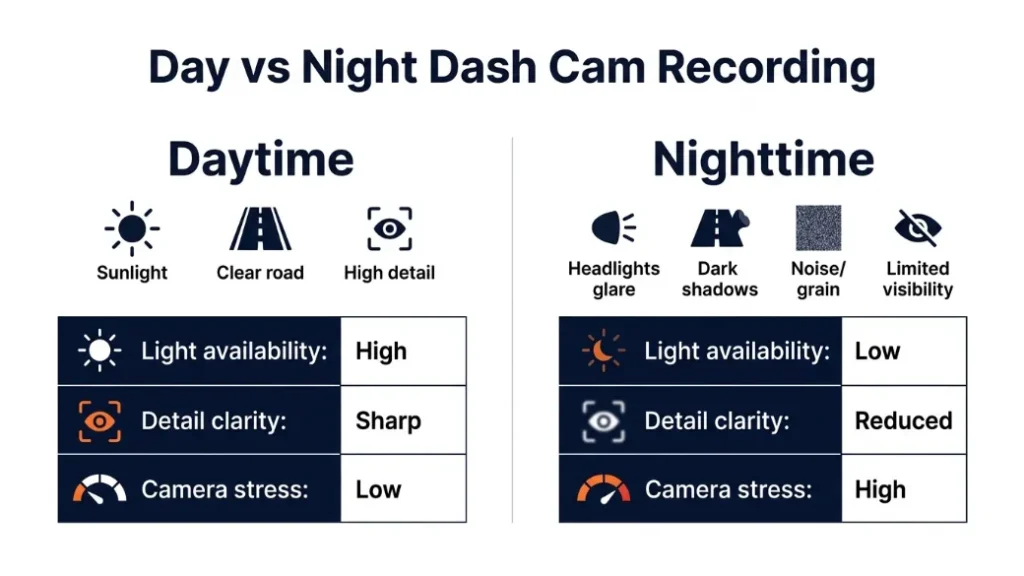
At night, that light disappears. Street lamps create harsh, isolated pools of orange or white light. Oncoming headlights blast the lens with intense brightness. Dark areas between lights become near-black voids. Your camera has to handle all of that simultaneously.
A cheap camera with a small sensor and a narrow aperture simply cannot gather enough light to produce clear footage. It compensates by brightening the image electronically — which adds grain, smears detail, and makes the footage nearly useless.
What Good Night Footage Actually Looks Like
Good dash cam night footage shows clear lane markings, readable street signs, and license plates at a reasonable distance. Colors are muted but visible. Moving vehicles leave minimal blur. Bright headlights don’t create a total whiteout around them.
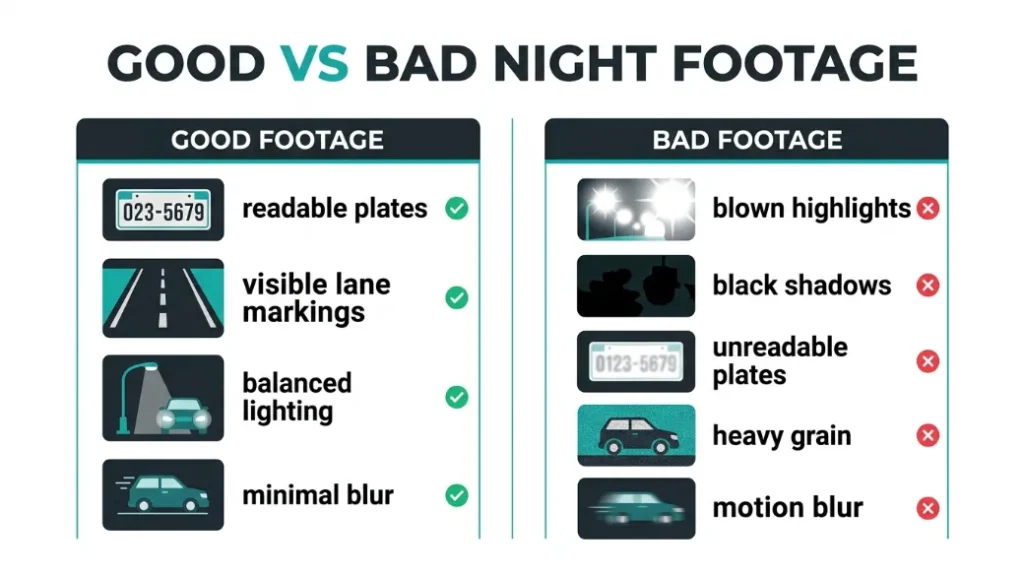
Bad night footage looks like this: everything is either overexposed orange or crushed into black. Plates are unreadable. Moving objects blur into streaks. The video looks like it was shot through a dirty window in a tunnel.
Knowing the difference helps you judge what your current camera can do — and whether you need an upgrade.
How Do Dash Cams Capture Video in Low Light?
Dash cams capture night footage through a combination of sensor sensitivity, lens aperture, and image processing technology. Each element plays a distinct role — and a weakness in any one of them limits overall performance after dark.
How Image Sensors Determine What Your Camera Sees in the Dark
The image sensor is the heart of any camera. It converts incoming light into electrical signals that become your video. In low light, sensor size and sensitivity are everything.
Larger sensors capture more photons per frame. More photons mean more signal and less digital noise. Budget dash cams use small, inexpensive CMOS sensors. Premium models use larger sensors — often Sony’s back-illuminated CMOS design — that gather light dramatically more efficiently.
Think of it like a bucket in the rain. A small bucket fills slowly and may overflow or stay mostly empty. A large bucket collects water steadily and consistently. Sensors work exactly the same way with light.
What Aperture Does and Why f/1.6 Beats f/2.0 Every Time
Aperture is the opening of your camera’s lens, measured in f-numbers. A lower f-number means a wider opening, which lets in more light. An f/1.6 aperture lets in roughly 56% more light than an f/2.0 aperture.
That difference is enormous at night. A cam with f/1.6 can produce clear, detailed footage in the same conditions where an f/2.0 model delivers a muddy, dark mess.
When you look at dash cam specs, the aperture number is one of the first things to check. Anything below f/2.0 is a positive signal. f/1.6 is excellent. f/2.4 or higher should raise a flag if night recording matters to you.
When comparing dash cams, treat a lower f-number like a higher performance score. f/1.6 beats f/1.8 beats f/2.0 — every time, in low light.
How WDR and HDR Stop Headlights From Washing Out Your Footage
Wide Dynamic Range (WDR) and High Dynamic Range (HDR) solve one of the biggest night recording problems: contrast overload. When a bright headlight sits next to a dark shadow, most cameras can only expose for one. The other becomes either pure white or pure black.
WDR captures multiple exposures simultaneously and merges them into one balanced frame. The headlights stay bright but don’t completely blow out. The shadows lift enough to reveal detail. Everything in between looks natural.
HDR does the same thing but with a wider range and often better color accuracy. Most quality mid-range and premium dash cams include one or both of these features. Budget models skip them to cut costs — and it shows dramatically at night.
If you ever see footage where a license plate disappears inside a halo of white headlight glare, you’re seeing a camera without effective WDR.
What Is Sony Starvis and Why Does It Make Such a Big Difference at Night?
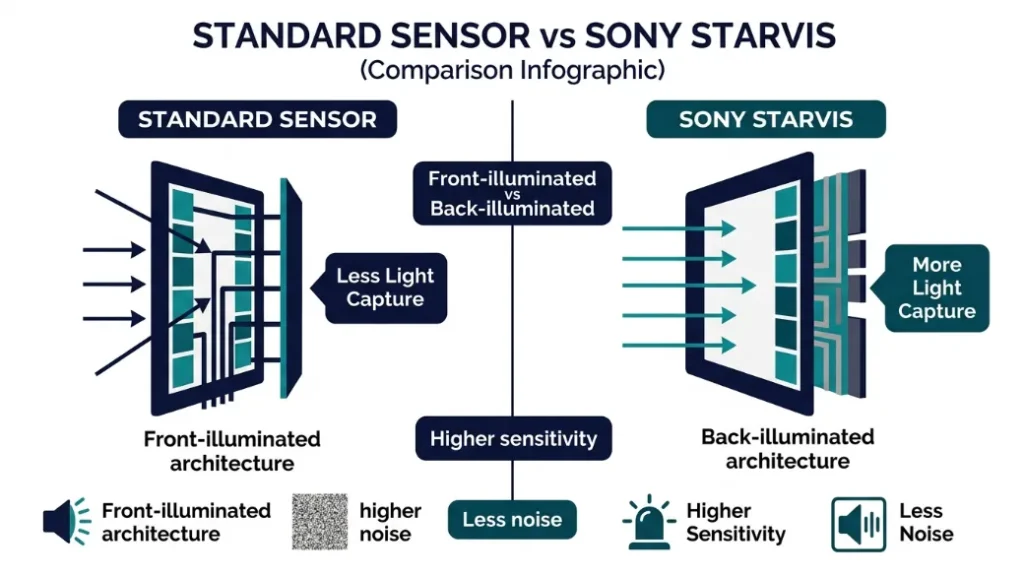
Sony Starvis is Sony’s back-illuminated CMOS sensor technology, designed specifically to perform in low-light environments. It first appeared in security cameras, but it transformed dash cam night recording after entering the consumer market around 2017.
Standard CMOS sensors place the wiring on top of the light-sensitive layer, which partially blocks incoming photons. Back-illuminated sensors flip the structure — the wiring moves behind the sensor so the full surface area collects light. The result is dramatically better sensitivity without increasing sensor size.
In practical terms, a Sony Starvis dash cam produces footage at night that a standard sensor cam can only match in daylight. Plates become readable. Colors stay visible. Grain drops sharply.
Brands like Vantrue, Nextbase, Blackvue, and Garmin all use Sony Starvis sensors in their mid-range and premium models. When you see “Sony Starvis” in a dash cam’s spec sheet, treat it as a strong signal of genuine low-light capability. When you don’t see it, ask why.
“Sony Starvis” is the single most reliable shortcut for identifying a dash cam that will genuinely perform at night. It’s not a marketing term — it’s a specific, verifiable sensor architecture.
Do Cheap Dash Cams Work at Night or Are They a Waste of Money?
Budget dash cams — typically under $40 — do record at night, but the footage often lacks the clarity needed in a real incident. They work best as a deterrent and for daytime use. For serious night recording, their limitations become apparent quickly.
What You Get With a Budget Dash Cam in Low Light
A budget model will capture broad shapes, obvious lighting conditions, and major events like collisions in most urban environments. Street lights and traffic signals provide enough ambient light to produce watchable footage in well-lit areas.
But in dimly lit suburbs, dark parking lots, or rural roads, budget cameras struggle badly. Grain overwhelms the image. License plates become white rectangles. Color disappears entirely. You get proof that something happened — but rarely the details needed to act on it.
Don’t rely on a sub-$40 dash cam to capture license plates or vehicle details at night. In a hit-and-run or parking incident after dark, the footage from a budget camera may not show enough detail to identify the other vehicle.
Where Mid-Range Cams Start to Pull Ahead After Dark
Mid-range dash cams in the $80–$150 range begin incorporating the features that genuinely matter at night. Sony Starvis sensors appear at this price point. Apertures drop to f/1.8 or f/1.6. WDR or HDR becomes standard rather than a premium add-on.
The Vantrue E1 Lite, Nextbase 522GW, and Garmin Dash Cam 57 all sit in this range and deliver night footage that is consistently clearer and more detailed than budget options. These are the cameras where night recording stops being a gamble and starts being reliable.
| Price Range | Sensor | Aperture | Night Performance |
|---|---|---|---|
| Under $40 | Generic CMOS | f/2.0–f/2.4 | Poor — grainy, plates unreadable |
| $80–$150 | Sony Starvis or equiv. | f/1.6–f/1.8 | Good — clear in most conditions |
| $150–$300+ | Sony Starvis 2 or IMX | f/1.4–f/1.6 | Excellent — detailed, color-accurate |
Can Dash Cams Read License Plates at Night?
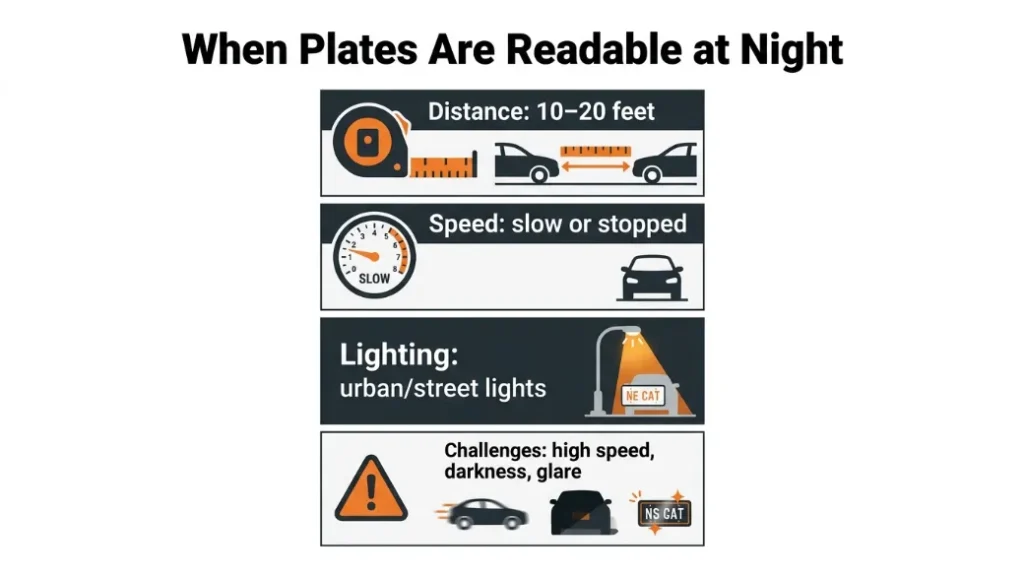
A quality dash cam with a Sony Starvis sensor, f/1.6 aperture, and WDR can read license plates at night in typical urban driving conditions — but distance, speed, and lighting all affect results. Budget cameras rarely produce plate-readable footage after dark.
Plate readability depends on several factors working together. The plate must be within roughly 10–20 feet for most cameras to resolve it clearly at night. The vehicle must not be moving too fast — a plate on a car doing 40 mph in darkness requires a fast shutter speed, which limits light intake and increases grain.
The most common scenario where plates become readable at night is when both vehicles are stopped or moving slowly — at traffic lights, in parking lots, or in slow urban traffic. In those situations, a good dash cam captures clear, detailed plates with high reliability.
For high-speed motorway incidents in darkness without street lighting, even premium cameras can struggle. This is the honest reality — no dash cam is perfect in all night conditions.
Does Parking Mode Work at Night When Your Car Is Off?
Parking mode does work at night — but it depends entirely on how your camera is powered and whether it has sufficient sensitivity to record in low or zero light. A dash cam running on its internal battery or capacitor in a dark parking garage may miss critical detail without the right setup.
How Parking Mode Captures Incidents Without Headlights
Parking mode activates motion or impact detection when your ignition is off. The camera wakes, records a short clip of the triggering event, then returns to standby. The challenge at night is that ambient light disappears — and so does your car’s headlights.
In well-lit car parks or streets with active street lighting, a good parking mode camera (like the Blackvue DR970X or Vantrue N4 Pro) captures useful footage without any problem. The available light is enough for a capable sensor to work with.
In true darkness — underground garages, rural driveways, unlit parking areas — ambient light drops to near zero. Only cameras with IR illuminators can record useful footage in these conditions.
For parking mode to work properly at night, hardwire your dash cam to a constant power source using a hardwire kit. Running on battery or capacitor alone drains power quickly and limits recording time.
Do You Need an IR Illuminator for True Darkness Recording?
Yes — if you regularly park in unlit areas, an IR illuminator is the only reliable solution. An infrared illuminator emits light invisible to the human eye but visible to camera sensors. It illuminates the scene without drawing attention or draining a visible light source.
Very few dash cams include built-in IR illuminators — most are found in dedicated security cameras. However, some interior-facing cameras (like the Vantrue E1 Lite interior cam) use IR LEDs to capture the cabin. For exterior night parking in total darkness, your best option is choosing a parking location with some ambient lighting, combined with a high-sensitivity sensor cam.
Is 4K Actually Better Than 1080p for Night Dash Cam Recording?
4K resolution is not automatically better than 1080p for night recording — and in some cases, it performs worse. Higher resolution requires more light per pixel to maintain image quality, which means a 4K camera with a small sensor can produce noisier night footage than a 1080p camera with a better sensor.
The resolution-versus-sensitivity tradeoff is real. More pixels packed onto the same size sensor means smaller individual pixels, each capturing less light. At night, this trades detail for grain.
That said, a 4K camera with a large Sony Starvis sensor and a wide aperture does outperform 1080p — because the sensor is large enough to compensate. The Blackvue DR970X 4K and the Vantrue N4 Pro handle this well. Cheaper 4K cameras do not.
For most drivers focused on night performance, a high-quality 1080p or 2K camera with Sony Starvis and f/1.6 aperture delivers better real-world results than a budget 4K model. Resolution is a headline number. Sensor quality is the substance behind it.
4K beats 1080p at night only when paired with a large, high-quality sensor. On a budget 4K cam with a small sensor, the extra resolution creates more grain, not more detail. Prioritize sensor quality and aperture over resolution when buying for night use.
Why Is My Dash Cam Footage Blurry or Dark at Night?
Blurry or overly dark dash cam footage at night comes from a specific set of causes — most of which are fixable or avoidable with the right knowledge. Understanding the reason is the first step to solving it.
Five Common Causes of Bad Night Footage and How to Fix Them
- Dirty lens: Road grime, fingerprints, and water spots cut light intake dramatically. Clean the lens with a microfiber cloth weekly.
- Wrong mounting position: Mounting behind a tinted windscreen section filters light before it even reaches the lens. Mount behind the rearview mirror in the clearest glass zone.
- Low bitrate setting: Some cameras default to low bitrate to save storage. Switch to the highest quality setting in the menu — this reduces compression artifacts that make night footage look muddy.
- Exposure compensation off: Many cameras allow manual exposure adjustment. If your footage looks consistently dark, increase exposure compensation by +0.3 or +0.7 in the settings.
- Sensor or aperture limitation: If none of the above fixes it, the camera itself lacks the hardware for good night recording. This is the honest answer for most budget cameras.
Most fixable problems come down to cleanliness and settings. Most unfixable problems come down to hardware. Knowing which category you’re in saves time and sets realistic expectations.
What Features Should You Look for in a Night Dash Cam?
The best dash cams for night recording share a specific set of features — and knowing them makes buying decisions straightforward. You don’t need to understand every technical detail. You just need to know which boxes to check.
The Must-Have Features for Clear Night Recording
- Sony Starvis sensor (or Starvis 2): The clearest signal of genuine low-light capability. Look for it by name in the product specs.
- Aperture of f/1.8 or lower: Wider aperture = more light = clearer footage. f/1.6 is ideal. Avoid f/2.4 or above for night use.
- WDR or HDR: Prevents headlight glare and shadow detail loss. Non-negotiable for driving footage at night.
- High bitrate (15+ Mbps): Reduces compression artifacts that create “blocky” or smeared night footage. Check the spec sheet, not just the resolution.
- Parking mode with motion detection: Essential for capturing overnight incidents when you’re not in the vehicle.
- Hardwire compatibility: Allows constant power for extended parking mode recording.
You can verify a dash cam’s sensor type by checking the manufacturer’s full spec sheet — usually found on their official website rather than retailer listings. If a retailer doesn’t list the sensor, that’s often a sign the camera uses a generic, unbranded one.
Budget vs. Mid-Range vs. Premium Night Performance Compared
Choosing the right tier depends on your primary use case. Here’s a clear breakdown to help you decide:
| Use Case | Recommended Tier | Why |
|---|---|---|
| Daytime-only driving in a well-lit city | Budget ($25–$50) | Night limitations won’t matter much |
| Regular night commuting on lit roads | Mid-Range ($80–$150) | Sony Starvis + WDR = solid results |
| Rural or motorway night driving | Premium ($150–$300+) | Maximum sensor size and aperture needed |
| Overnight parking in dark areas | Premium + hardwire kit | Needs constant power and best sensitivity |
For most drivers who do a mix of day and night driving in urban or suburban areas, a mid-range cam with Sony Starvis hits the sweet spot. You get genuine night capability without paying premium prices.
For a deep dive into which specific models lead the category right now, RTINGS.com’s dash cam testing lab provides objective, measured night performance scores for current models. And if you want to understand more about how image sensors work in automotive cameras, Sony’s official Starvis technology page explains the engineering behind the sensor in plain language.
Conclusion
Dash cams do work at night — but the word “work” needs a honest definition. Recording something and recording something useful are two very different things after dark.
The cameras that genuinely deliver at night share the same core strengths: a Sony Starvis sensor, a wide aperture below f/2.0, effective WDR or HDR processing, and sufficient bitrate to preserve detail. Budget cameras can handle well-lit urban nights in a pinch. For anything darker or more demanding, they fall short.
If overnight parking incidents, rural night driving, or license plate capture matter to you, invest in at least a mid-range camera. The difference between a $35 budget cam and a $120 Sony Starvis model is night and day — literally.
I’m Alex Rahman, and the single piece of advice I give every driver asking about dash cams at night is this: check the sensor before you check the resolution. A great sensor in a 1080p camera beats a bad sensor in a 4K camera every single time after dark. That one check will save you from my parking lot experience.
If you found this guide useful, check the manufacturer’s spec sheet for your current camera — you might be surprised what you find. And if you’re shopping for a new one, you now know exactly what to look for.
Frequently Asked Questions
Do dash cams work at night without street lights?
A quality dash cam with a Sony Starvis sensor and f/1.6 aperture can record useful footage in low ambient light, but true zero-light conditions remain challenging without IR illumination. In rural areas with no street lighting, even premium cameras produce limited detail. Cameras with IR illuminators handle total darkness, but these are rare in standard dash cams.
Can a dash cam read license plates at night?
Yes — a mid-range or premium dash cam with WDR and a wide aperture can read license plates at night when vehicles are close and moving slowly. In dark conditions at highway speeds, even good cameras struggle to resolve plates clearly. Urban traffic lights and car parks are the most reliable conditions for plate capture at night.
Why does my dash cam footage look dark and grainy at night?
Dark, grainy footage at night usually points to a small sensor, a narrow aperture, or both. Your camera may also have the brightness or exposure setting too low. Check your exposure compensation setting first — increase it by +0.3 to +0.7. If that doesn’t help, the camera hardware itself is the limiting factor.
Does parking mode record at night when the car is off?
Yes, parking mode activates and records at night when triggered by motion or impact — but it needs power to function. Most dash cams run on a capacitor or small battery in parking mode, which limits recording time. A hardwire kit connected to a constant 12V source keeps the camera powered all night without draining your car battery.
Is 4K better than 1080p for dash cam night recording?
Not automatically. A 4K camera with a small, budget sensor can produce worse night footage than a 1080p camera with a large, high-quality sensor. More pixels on a small sensor means each pixel captures less light, which increases grain. Prioritize sensor quality and aperture over resolution when buying for night use.
What is Sony Starvis and do I need it for night recording?
Sony Starvis is Sony’s back-illuminated CMOS sensor technology built for low-light environments. It dramatically improves night recording by capturing more light with the same sensor size. You don’t technically need it — but it’s the clearest shortcut to finding a dash cam that genuinely performs at night. Any dash cam listing Sony Starvis is worth a serious look for night use.

I’m Alex Rahman, a car enthusiast and automotive writer focused on practical solutions, car tools, and real-world driving advice. I share simple and honest content to help everyday drivers make better decisions.
