Which Is Better: 2K or 4K Dash Cam for Real Driving?
Quick Answer
A 4K dash cam captures more detail than 2K, especially at distance. But a 2K dash cam often gives better value, uses less storage, and performs reliably for daily driving. Most drivers do not need 4K unless they want maximum detail for evidence.
I remember checking dash cam footage after a close call on a busy road.
The video looked fine, but the license plate stayed blurry.
That moment changed how I think about dash cam resolution.
I’m Alex Rahman, and I test car tech with a focus on real-world use.
Many drivers feel confused choosing between 2K and 4K dash cams.
Both sound impressive, but the difference is not always obvious.
So which one actually works better when you need it most?
The answer depends on how and where you drive.
Let’s break it down in simple terms.
Key Takeaways
- 4K dash cams capture more detail but use more storage.
- 2K dash cams offer the best balance of quality and price.
- Sensor quality matters more than resolution at night.
- Most drivers do not need 4K for daily commuting.
What Is the Real Difference Between 2K and 4K Dash Cams?
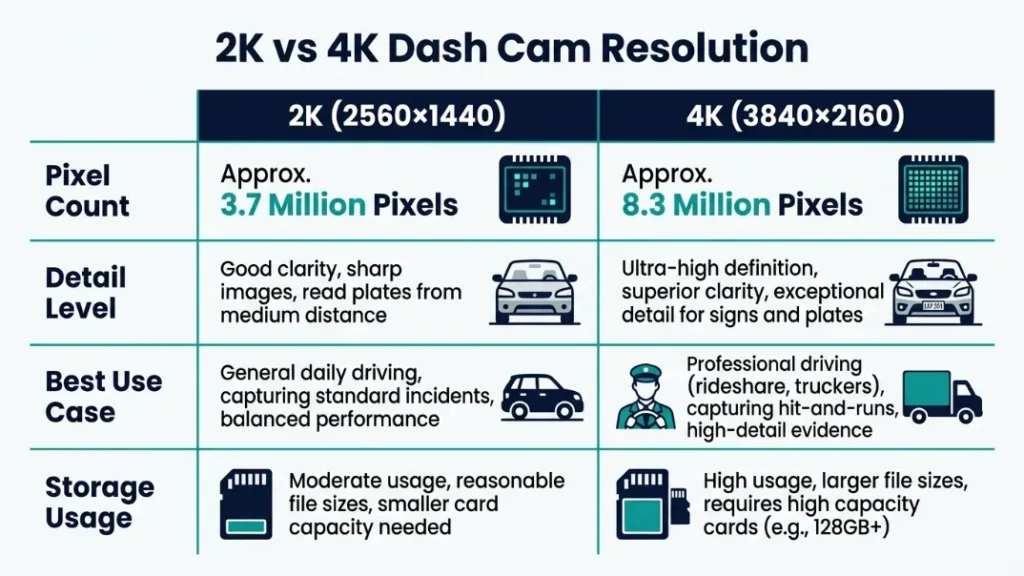
The main difference between 2K and 4K dash cams is resolution, where 2K records at 2560×1440 pixels and 4K records at 3840×2160 pixels, giving 4K about twice the detail, which helps capture distant objects more clearly in ideal lighting conditions.
Resolution means how many pixels a camera uses to build an image.
More pixels create sharper images with more visible details.
This helps when you zoom into footage later.
What do 1440p and 2160p actually mean?
1440p refers to 2K resolution, while 2160p refers to 4K resolution.
The numbers describe vertical pixels in the video frame.
Higher numbers mean more detail per frame.
A 4K video contains over 8 million pixels per frame.
A 2K video contains around 3.7 million pixels.
That difference matters when reading small details like license plates.
Why resolution alone does not tell the full story
Resolution alone does not guarantee better footage because bitrate, sensor quality, and lens design all affect clarity, meaning a well-built 2K dash cam can outperform a cheap 4K model in real-world conditions.
A high resolution with low bitrate creates blurry results.
A good sensor captures better light and color accuracy.
That improves footage more than raw pixel count.
Here is the rule: resolution matters, but only with good hardware.
Keep that in mind as we compare both options.
Is a 4K Dash Cam Really Better Than 2K?
A 4K dash cam is better than 2K when you need maximum detail at longer distances, but for everyday driving, the difference often becomes small because motion blur, lighting, and compression reduce the visible advantage.
On paper, 4K wins easily.
In real life, conditions change everything.
Traffic speed, light, and weather all affect clarity.
Where 4K clearly wins
- Reading license plates from far distance
- Capturing small road signs clearly
- Zooming into footage after an incident
If you drive on highways often, 4K helps more.
Higher speed means you need extra detail to freeze frames.
Where 2K performs just as well
- City driving with slow traffic
- Short-distance recording
- General accident evidence
Here is the key insight: most daily driving happens at short range.
That is where 2K performs nearly the same as 4K.
Tip:
Look for high bitrate and a good sensor before choosing resolution. These improve real footage quality more than pixel count alone.
Can 2K Dash Cams Read License Plates Clearly?
A 2K dash cam can read license plates clearly at close range in good lighting, but it struggles at higher speeds or longer distances because motion blur and lighting reduce sharpness, which affects detail regardless of resolution.
Many people expect perfect clarity in all situations.
That expectation often leads to disappointment.
Even 4K cameras can fail in bad conditions.
Real-world limitations of resolution
Motion blur reduces detail when cars move fast.
Glare from headlights hides plate numbers at night.
Rain and dust also affect image clarity.
How speed and lighting affect clarity
Bright daylight improves visibility significantly.
Night driving reduces detail for both 2K and 4K.
Slow traffic increases your chance of capturing plates clearly.
The rule is simple: distance and light matter more than resolution.
Use this rule when setting expectations.
Which Dash Cam Works Better at Night: 2K or 4K?
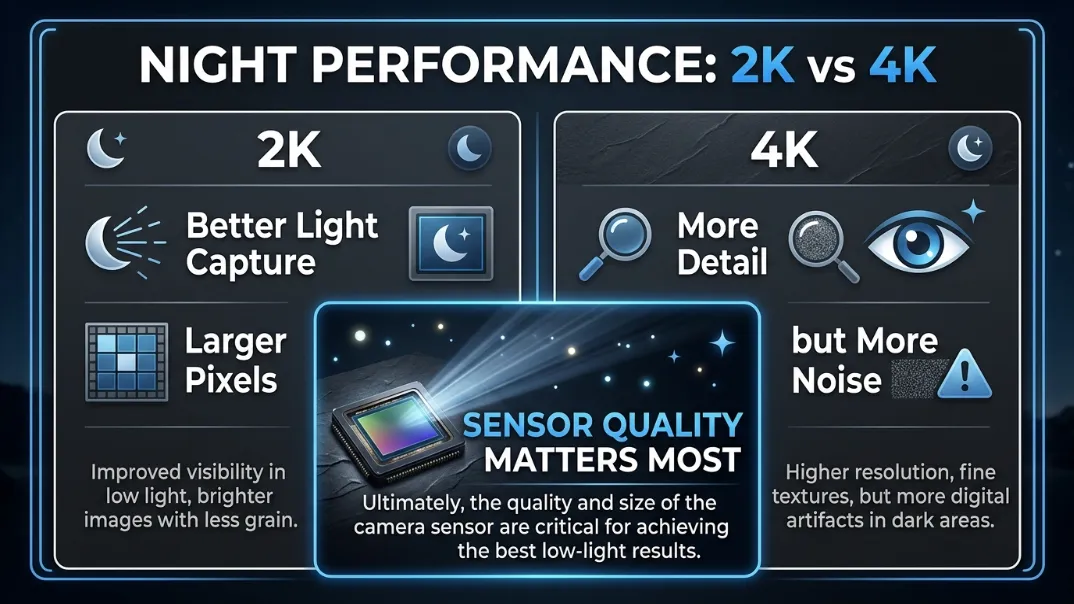
A 2K dash cam often performs better at night than a 4K model because larger pixels and better sensors capture more light, while 4K cameras may struggle with noise and lower brightness if they use smaller sensors.
Night driving creates a different challenge.
Low light forces cameras to work harder.
This is where sensor quality becomes critical.
Sensor quality vs resolution explained
Sensors like Sony STARVIS improve night performance.
They capture more light and reduce noise.
This leads to clearer night footage.
Why some 2K cameras beat 4K at night
Many 2K cameras use larger pixels per sensor.
Larger pixels absorb more light.
This improves clarity in dark conditions.
The key insight: better sensor beats higher resolution at night.
Choose wisely based on your driving time.
Warning:
Do not assume all 4K dash cams perform well at night. Many budget 4K models produce darker and noisier footage than quality 2K cameras.
How Much Storage Does 2K vs 4K Dash Cam Use?
A 4K dash cam uses significantly more storage than a 2K model, often recording about 20–30 GB per hour compared to 10–15 GB for 2K, which means 4K fills memory cards faster and requires higher-capacity storage for continuous recording.
Storage affects how long your camera records before overwriting.
This matters for long trips and parking mode use.
More data means more cost over time.
File size comparison per hour
| Resolution | Average Storage per Hour |
|---|---|
| 2K (1440p) | 10–15 GB |
| 4K (2160p) | 20–30 GB |
Best memory card setup for each
- 2K dash cam: 64GB to 128GB cards work well
- 4K dash cam: 128GB to 256GB recommended
Tip:
Choose high-endurance microSD cards designed for dash cams. They last longer under constant recording stress.
Quick Summary
4K uses more storage and costs more long term. 2K offers a balanced option with lower storage needs and stable performance.
Does 4K Dash Cam Overheat More in Hot Weather?
A 4K dash cam generates more heat than a 2K model because it processes higher resolution video, which can increase the risk of overheating in hot climates and lead to reduced lifespan or performance issues.
Heat affects electronics over time.
Dash cams stay on for long hours in sunlight.
This creates a real challenge in warm regions.
Why higher resolution creates more heat
4K recording requires more processing power.
More processing creates more heat.
Small devices struggle to dissipate that heat.
What drivers in hot regions should consider
- Choose dash cams with heat-resistant design
- Avoid parking in direct sunlight for long periods
- Consider 2K models for better long-term reliability
In hot climates, reliability matters more than resolution. A stable 2K dash cam often outlasts a stressed 4K unit.
Is 4K Dash Cam Worth the Extra Cost?
A 4K dash cam is worth the extra cost if you need maximum detail for legal evidence or long-distance clarity, but for most drivers, the higher price does not deliver enough real-world benefit compared to a well-built 2K dash cam.
4K models cost more upfront.
They also require larger storage cards.
That increases total cost over time.
Price vs performance breakdown
| Factor | 2K Dash Cam | 4K Dash Cam |
|---|---|---|
| Price | Affordable | Premium |
| Storage Cost | Lower | Higher |
| Detail | Good | Excellent |
Best value range for most users
The sweet spot for most drivers sits in the 2K range.
It balances cost, clarity, and reliability well.
You get strong performance without overspending.
When Should You Choose a 2K Dash Cam Instead?
You should choose a 2K dash cam if you want reliable daily recording, lower storage use, and strong value, especially for city driving where most events happen at close range and extreme detail from 4K is not necessary.
Best use cases for 2K
- Daily commuting
- Urban traffic driving
- Budget-conscious buyers
Budget and daily driving scenarios
2K fits most real-life situations well.
It captures enough detail for insurance claims.
It keeps costs manageable over time.
When Does a 4K Dash Cam Make Sense?
A 4K dash cam makes sense when you drive at high speeds, need maximum detail for legal evidence, or want the ability to zoom into footage clearly after recording, especially in highway or professional driving scenarios.
High-speed driving and detail needs
Highways require faster reaction and clearer frames.
4K helps capture small details at distance.
That can matter in serious incidents.
Professional or security-focused use
- Ride-sharing drivers
- Fleet vehicles
- Security-focused users
2K vs 4K Dash Cam: Side-by-Side Comparison Table
| Feature | 2K Dash Cam | 4K Dash Cam |
|---|---|---|
| Resolution | 2560×1440 | 3840×2160 |
| Detail Level | High | Very High |
| Storage Use | Moderate | High |
| Night Performance | Often Better | Varies |
| Cost | Lower | Higher |
How to Choose the Right Dash Cam Resolution for Your Needs?
Choosing the right dash cam resolution depends on your driving style, budget, and environment, where most users benefit from 2K for daily use, while 4K suits those needing maximum detail in high-speed or professional scenarios.
Step-by-Step
- Identify your driving type (city or highway)
- Set your budget range clearly
- Check storage capacity you can afford
- Compare sensor quality before resolution
- Choose 2K unless you truly need extra detail
Common mistakes to avoid
- Choosing resolution without checking sensor quality
- Ignoring storage costs
- Buying cheap 4K models with poor performance
Final Verdict: Should You Buy 2K or 4K Dash Cam?
The best choice between 2K and 4K dash cams depends on your needs, but for most drivers, a 2K dash cam offers the best balance of performance, cost, and reliability, while 4K works best for those who need maximum detail in specific situations.
If you want simple and reliable, choose 2K.
If you want maximum detail, choose 4K.
Make your choice based on real needs, not marketing.
I’m Alex Rahman, and I always recommend choosing what works in real life.
A smart choice today saves you frustration later.
Frequently Asked Questions
Is 4K dash cam always better than 2K?
No, 4K is not always better. It offers more detail but may not improve real-world footage in all conditions.
Can 2K dash cam capture license plates clearly?
Yes, 2K can capture plates at close range in good lighting. Distance and motion affect results more than resolution.
Does 4K dash cam improve night recording?
Not always. Sensor quality matters more at night. Some 2K cameras perform better in low light.
How long can a 128GB card record in 4K?
A 128GB card records around 4 to 6 hours in 4K. It depends on bitrate and compression used.
Is 2K dash cam enough for daily driving?
Yes, 2K is enough for most daily driving needs. It provides clear footage and balanced performance.
Should I upgrade from 1080p to 4K?
Upgrade to 2K first for better value. Move to 4K only if you need extra detail.

I’m Alex Rahman, a car enthusiast and automotive writer focused on practical solutions, car tools, and real-world driving advice. I share simple and honest content to help everyday drivers make better decisions.
