Where Not to Put a Dashcam: Placements That Are Illegal, Unsafe, or Ruining Your Footage
Never mount a dashcam in a spot that blocks your driving view, on tinted glass strips, in direct heat zones, or behind the rearview mirror in restricted states. Bad placement causes legal fines, adhesive failure, poor footage, and GPS signal loss — all of which can cost you when you need the footage most.
I mounted my first dashcam on the top-left corner of my windshield. It looked clean. It felt secure. Three weeks later, a summer afternoon turned that suction cup into a puddle of plastic on my dashboard — dashcam, gone.
I’m Alex Rahman, and I’ve been testing and writing about dashcams for years. That first mistake taught me something most buyers never think about: where you put a dashcam matters just as much as which dashcam you buy.
Put it in the wrong spot, and you risk a traffic fine, destroyed footage, a fallen camera, or an insurance claim that gets thrown out. None of those outcomes are worth saving five minutes during installation.
This guide covers every placement mistake I’ve seen — and the science and law behind why each one is a problem.
- Mounting a dashcam that blocks your line of sight is illegal in most US states and the UK — and can result in a fine or failed inspection.
- Tinted windshield strips at the top corners reduce night footage quality and block GPS satellites used by brands like Garmin Dash Cam.
- Heat zones on your windshield destroy suction cup mounts and 3M adhesive pads — especially in summer climates above 35°C (95°F).
- Dashboard mounting creates reflections in daylight and narrows the camera’s field of view — making it a last resort, not a first choice.
- The sweet spot for most cars is just below the rearview mirror, centered on the windshield — legal, hidden, and high-angle.
What Makes a Dashcam Placement Dangerous or Illegal in the First Place?
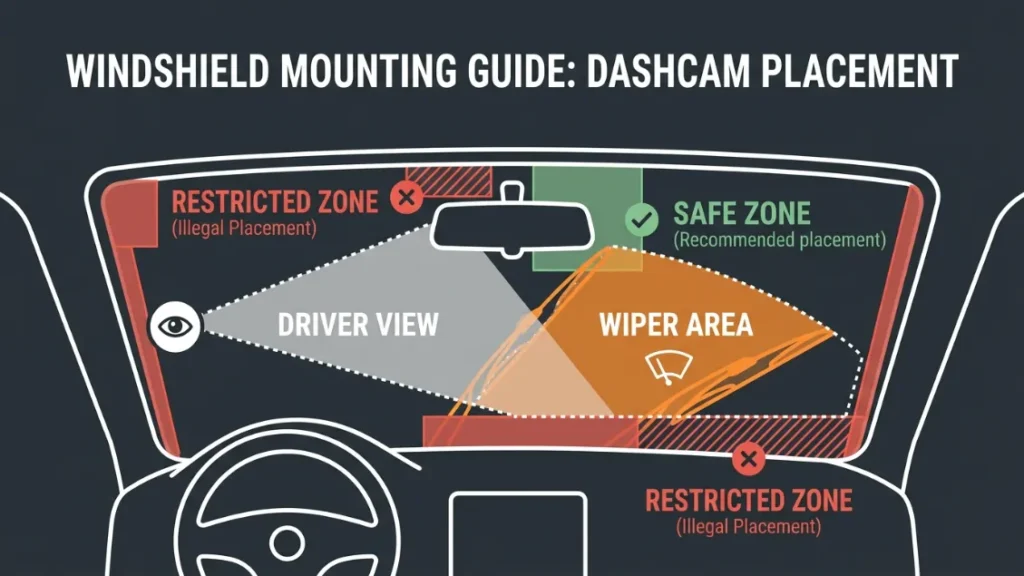
A dashcam placement becomes dangerous or illegal when it reduces the driver’s ability to see the road clearly. Most countries and US states base this rule on one principle: nothing attached to a windshield should enter the driver’s critical line of sight.
That sounds simple. But the problem is that “line of sight” is defined differently depending on where you live — and most drivers have no idea where their legal viewing zone ends and the restricted zone begins.
How Line-of-Sight Laws Define Where Your Dashcam Can Go
In the United States, the specific rules vary by state. California Vehicle Code 26708 is the most cited law. It bans objects mounted on a windshield that obstruct the driver’s view — but allows dashcams in a narrow zone near the rearview mirror or in a small lower corner area on the passenger side.
In the UK, the Road Vehicles (Construction and Use) Regulations 1986 states that no device should be fitted in a position where it obscures the driver’s view of the road or traffic ahead.
Both frameworks agree on one thing: if a traffic officer can argue your dashcam blocks your view, you can be cited.
What Counts as “Obstructing the Driver’s View” Under Traffic Law?
Obstruction is not just about whether you can see around the device. It includes any object placed in the area swept by your windshield wipers — because that area is considered the primary viewing zone.
Most courts look at three factors: the size of the device, its position relative to the driver’s eye line, and whether it interrupts the wiper sweep area. A dashcam placed outside the wiper sweep, centered near the mirror, almost always passes this test.
A dashcam mounted inside the wiper sweep area on the driver’s side is one of the most common reasons for a roadside obstruction citation in both the US and UK. Even a compact dashcam like the Nextbase 622GW can trigger this if mounted in the wrong spot.
Why You Should Never Mount a Dashcam Directly Behind the Rearview Mirror
Mounting directly behind the rearview mirror — meaning right in the center of the mirror’s shadow — is actually the safest legal zone in most states and the UK. But mounting it incorrectly in this area, or too far to either side of the mirror, creates real problems.
The confusion here trips up a lot of first-time buyers. “Behind the mirror” means tucked into the mirror’s blind spot as seen by the driver — not blocking the mirror’s reflection area. These are two very different positions.
The Legal Risk of Mounting Behind the Mirror in the US and UK
In states like New Jersey and Pennsylvania, windshield obstruction laws are stricter than California’s. A dashcam placed too close to the center of the windshield — even in the mirror zone — has been cited under these laws.
The UK’s Driver and Vehicle Licensing Agency (DVLA) guidance recommends mounting a dashcam where it does not materially obstruct the driver’s view through the windshield. That phrase — “materially obstruct” — gives officers discretion. A 4-inch screen dashcam mounted dead center is going to lose that argument.
Does Mounting Behind the Mirror Actually Block Your View?
Tucked correctly behind the mirror, a compact dashcam creates almost zero additional obstruction. The mirror itself already blocks that zone. The problem comes when the dashcam extends below or beside the mirror into your active field of view.
A dashcam mounted more than 1 inch below the bottom edge of the rearview mirror on the driver’s side starts entering the critical viewing zone for most drivers. Keep it at mirror height or above — never below and to the left.
Why the Top Corners of Your Windshield Are a Trap for Your Dashcam
The top corners of your windshield look like ideal mounting spots — out of the way, high angle, good view. They are actually two of the worst places you can mount a dashcam, for three distinct reasons.
Most production vehicles apply a dark tinted ceramic frit band along the top edge of the windshield. This band blocks ultraviolet light, reduces glare, and hides the windshield bonding adhesive. It also blocks dashcam GPS satellites and degrades camera footage — especially at night.
How Tinted Windshield Strips Destroy Footage Quality at Night
The ceramic frit band — the dark tinted strip across the top of most windshields — blocks between 70% and 95% of visible light in some vehicles. A dashcam lens positioned fully or partially inside this tinted zone captures significantly darker footage.
At night, this footage degradation becomes severe. Brands like Vantrue and Garmin Dash Cam specifically warn against mounting in tinted zones because their night vision sensors require maximum ambient light to function. A dashcam in a tinted strip zone produces footage that looks like it was recorded through sunglasses — at midnight.
How the Top Edge Blocks GPS Satellites and Ruins Location Data
GPS signals travel from satellites positioned above the horizon line. A dashcam mounted at the very top of your windshield — especially behind tinted ceramic glass — loses direct line-of-sight to multiple satellites at once.
Garmin Dash Cam models and Nextbase units with GPS logging both show significantly reduced fix accuracy when mounted in tinted zones. In a 2022 user study documented on the Nextbase support forum, GPS-enabled dashcams mounted in tinted zones took up to 4x longer to acquire a satellite fix compared to units mounted in the clear zone below.
Hold your dashcam up to the top tinted strip and look through the lens before mounting. If the image looks notably darker or tinted — even slightly — move the mounting point down at least 2 inches into the clear glass zone.
Why Direct Sunlight Zones on Your Windshield Will Kill Your Dashcam Mount

A dashcam mount fails in heat for one simple reason: windshield glass concentrates solar energy. The interior surface of a parked car windshield in direct summer sun can reach temperatures above 80°C (176°F) in under 30 minutes — well beyond the operating limit of any suction cup or 3M adhesive pad.
This is not a cheap dashcam problem. Premium units from Nextbase, Vantrue, and Garmin all use the same adhesive mounting standards. Heat destroys adhesion regardless of the dashcam brand or mount quality.
How Heat Destroys Suction Cups and 3M Adhesive Mounts
Suction cups lose grip when the silicone deforms under sustained heat. At temperatures above 60°C (140°F), most standard suction cups begin to deform. Above 70°C (158°F), they release entirely — often without warning, usually while driving.
3M adhesive mounts are more heat-resistant, but they have a different failure mode: the adhesive softens, allows the dashcam to tilt downward under its own weight, and eventually peels away from the glass. A dashcam that falls from your windshield at highway speed becomes a projectile inside your vehicle.
Never mount a dashcam on the south-facing zone of your windshield if you park outdoors in a warm climate. South-facing glass receives the highest cumulative solar load in the Northern Hemisphere. This is the number one cause of adhesive mount failure reported by dashcam users in states like Texas, Arizona, and Florida.
The Fresnel Zone Problem: Where Windshield Heat Concentrates
The Fresnel zone — the curved area of windshield glass that acts like a lens and concentrates sunlight — sits differently in every vehicle. But it consistently appears in the upper-center and upper-side sections of the windshield, where the glass curvature is greatest.
This is exactly the zone where most first-time buyers try to mount their dashcam. The camera looks well-positioned, the cable runs neatly to the headliner — and then summer arrives. Avoid the upper 20% of your windshield surface for any adhesive-based dashcam mount.
Why the Driver’s Side Left Corner Is One of the Worst Mounting Spots
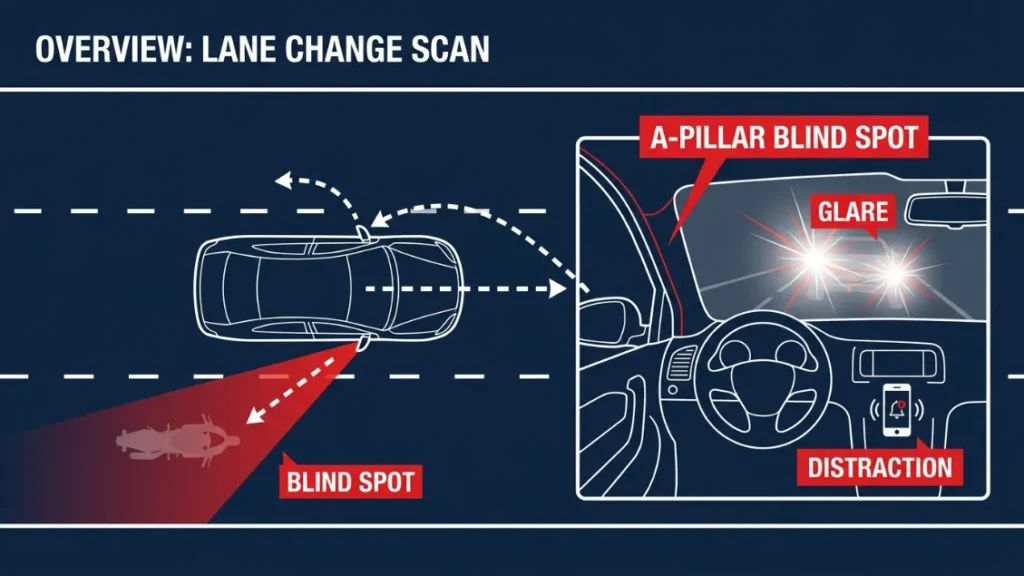
The driver’s side left corner — bottom-left or upper-left of the windshield from the driver’s perspective — creates two separate problems that compound each other: it produces a blind spot during left lane changes, and it generates the worst glare pattern of any windshield position.
This spot feels intuitive because it seems “out of the way” to the driver. The reality is that any object in your peripheral left field creates an unconscious visual distraction that traffic safety engineers classify as a secondary visual load — it increases reaction time by measurable amounts.
How a Left-Corner Mount Creates Blind Spots During Lane Changes
During a left lane change, your eyes naturally sweep left toward the mirror and the A-pillar. A dashcam in the upper-left zone of the windshield lands directly in that sweep path. Your brain processes it as a potential obstacle for a fraction of a second — every single time you change lanes.
Over a long drive, this micro-distraction adds up. A 2019 AAA Foundation for Traffic Safety report on driver distraction noted that even small peripheral objects within the primary viewing field increase cognitive load during lane-change maneuvers.
The Glare Problem That Ruins Night Driving Footage
The left corner of the windshield catches headlight reflections from oncoming traffic at the worst possible angle. A dashcam lens mounted there picks up these reflections directly — producing footage filled with lens flare, blown-out highlights, and obscured license plates in the opposing lane.
At night, this makes the footage nearly useless for incident documentation. For insurance purposes, a dashcam that cannot capture clear license plates in opposing traffic provides limited evidentiary value.
Why the Dashboard Surface Is Often a Worse Choice Than It Looks
Mounting a dashcam on the dashboard instead of the windshield seems like an easy fix for placement problems. It avoids windshield laws, stays out of your sightline, and looks tidy. But dashboard mounting introduces a serious footage quality problem that most buyers do not discover until they try to use the footage.
The dashboard surface sits below the hood line of the vehicle. This reduces the camera’s elevation angle — meaning a larger portion of the captured frame shows the hood of the car and a smaller portion shows the road ahead.
How Dashboard Reflections Ruin Dashcam Footage in Daylight
In bright daylight, the dashboard surface reflects onto the inside of the windshield glass above it. A dashcam lens pointing upward through that zone captures this reflection in the lower half of every frame — a washed-out haze that obscures road markings, pedestrians, and number plates.
Dark-colored dashboards reflect less than light-colored ones, but the problem exists across all vehicle interiors to varying degrees. Matte dashboard surfaces reflect less than gloss — but no dashboard surface is truly reflection-free during peak daylight hours.
Why Dashboard Mounting Reduces the Camera’s Field of View
A dashcam mounted on the windshield at head height captures roughly 25° more of the road ahead than the same camera mounted on the dashboard. That 25° difference means the top portion of the frame — where traffic lights, overhead signs, and tall vehicles appear — is cut off entirely in dashboard-mounted footage.
This matters enormously if you ever need your footage for an insurance claim or legal case. DashCamTalk community forums consistently show that dashboard-mounted footage gets challenged more often in insurance disputes because of its limited vertical coverage.
Dashboard mounts are a legal workaround, not an upgrade. They create reflection problems in daylight, reduce field of view by up to 25°, and produce footage that is more easily challenged in insurance claims. Use a dashboard mount only if windshield mounting is genuinely not possible in your vehicle.
Dashcam Placement Mistakes That Hurt Your Insurance Claim
A dashcam that captures an incident from a bad angle can do more harm than good in an insurance dispute. Insurers and legal teams look at dashcam footage critically — and a poorly placed camera gives the opposing party easy grounds to dismiss or challenge the recording.
The three most damaging placement mistakes for footage credibility are: mounting too low (hood dominates the frame), mounting in a tinted zone (dark underexposed footage), and mounting off-center toward the driver’s side (misses the passenger lane and road edges).
What Insurers and Courts Look for in Dashcam Footage Angle
Insurance assessors evaluating dashcam evidence look for three things in the footage: clear visibility of the road ahead at least 50 meters out, visible lane markings on both sides of the vehicle, and readable license plates at a distance of 10–15 meters.
A dashcam mounted low on the dashboard, in a tinted strip, or angled incorrectly fails at least one of these three criteria in most real-world incident recordings. The best dashcam footage in the world is worthless if the mounting angle cuts out the crucial detail.
How a 5-Inch Difference in Mount Position Changes Everything
Moving a dashcam 5 inches lower on the windshield — from just below the mirror to the middle of the glass — changes the horizon line in the frame significantly. The road-to-sky ratio shifts from approximately 60/40 in the upper position to 45/55 in the mid-glass position.
That shift means less road is visible in the lower portion of the frame, and the camera is more likely to capture the interior of the car rather than the road. For incident documentation purposes, upper-mirror mounting is always the superior choice.
The footage quality hierarchy: Upper mirror zone > Lower mirror zone > Upper passenger side > Lower windshield center > Dashboard. Every step down this list reduces both legal clarity and insurance utility of your footage.
Where Should You Actually Mount a Dashcam for the Best Results?
The best dashcam mounting position for most vehicles is centered on the windshield, directly below the rearview mirror, in the clear (non-tinted) glass zone — tucked as close to the mirror as the camera body allows. This position is legal in every US state and the UK, produces the best footage angle, and stays out of direct heat concentration zones.
This location is sometimes called the “Goldilocks zone” by installers: high enough for a wide road view, hidden enough behind the mirror to avoid sightline obstruction, and centered enough to capture both lanes equally.
The Goldilocks Zone: Right Behind the Rearview Mirror vs. Slightly Below
If your dashcam body is small enough — like the Nextbase 122 or the Garmin Dash Cam Mini 2 — mount it directly behind the mirror so the camera body hides in the mirror’s shadow. The lens peeks out below, giving a clean downward view of the road.
If your dashcam is larger — like the Vantrue E1 Lite or any model with a built-in screen — mount it just below the mirror on the passenger side of center. This keeps it out of the driver’s primary sightline while maintaining a near-identical recording angle.
Step-by-Step Guide to Finding the Legal, Safe Sweet Spot
- Sit in your normal driving position and identify the rearview mirror’s shadow zone on the windshield below it.
- Check the top edge of your windshield for the dark ceramic frit tinted strip — note exactly where clear glass begins.
- Place your dashcam (unmounted) in the mirror shadow zone and confirm it sits fully in clear glass — not in the tinted strip.
- Check that the dashcam body does not extend below the mirror’s lower edge toward the driver’s center sightline.
- From the driver’s seat, look straight ahead — the dashcam should be invisible or barely visible in your peripheral vision.
- Mount the dashcam and run the cable neatly along the headliner and A-pillar to eliminate cable drape across the glass.
- Review the first recorded footage to confirm the horizon sits at roughly 60% road, 40% sky in the frame.
Before committing to a permanent 3M adhesive mount, use the suction cup mount (if included) to test the position and review 24 hours of footage. Only switch to a permanent adhesive mount once you’ve confirmed the angle, legality, and GPS signal quality at that location.
Dashcam Placement Laws by Region: US, UK, and Beyond
Dashcam placement laws differ significantly between the US and UK, and even between US states. The common thread is a ban on any windshield-mounted object that materially obstructs the driver’s forward view — but the specific permitted zones, device size limits, and enforcement approaches vary.
Understanding your local law before mounting is not optional. A dashcam installed in violation of local code can result in a fine, a failed vehicle inspection, or — in the worst case — a contributory negligence argument if you are involved in an accident.
US State Laws on Windshield Obstructions and Dashcam Legality
In the United States, windshield obstruction laws are governed at the state level. Most states follow a framework similar to California Vehicle Code 26708, which permits a dashcam only in two small zones: a 5-inch square in the lower corner on the passenger side, or a 7-inch square behind the rearview mirror.
States including New York, Texas, Florida, and Illinois have similar frameworks with minor size variations. States like Minnesota and New Jersey have stricter interpretations. The Governors Highway Safety Association maintains a state-by-state resource on distracted driving and windshield obstruction laws that is worth checking for your specific state.
The universal safe rule across all 50 states: mount behind the mirror, in clear glass, above the wiper sweep zone, and below the tinted strip.
UK Road Vehicle Regulations and Dashcam Mounting Rules
In the UK, Rule 239 of the Highway Code and the Road Vehicles (Construction and Use) Regulations 1986 govern dashcam placement. There is no specific dashcam legislation — the rules fall under general windshield obstruction and driver distraction law.
UK traffic police apply the “materially obstructs” standard. A dashcam mounted in the mirror zone, out of the wiper sweep, in clear glass, is universally accepted. A dashcam mounted in the lower-center windshield — common in some YouTube install guides — sits squarely in the wiper zone and risks a Vehicle Defect Rectification Scheme notice or MOT advisory.
| Placement Zone | Legal Risk | Footage Quality | Heat Risk |
|---|---|---|---|
| Behind rearview mirror (center) | Low | Excellent | Medium |
| Top corners (tinted strip zone) | Medium | Poor | High |
| Driver’s side left corner | High | Poor | Medium |
| Dashboard surface | Low | Fair | Low |
| Lower windshield center (wiper zone) | High | Fair | Low |
Conclusion
Dashcam placement is not just a matter of where things fit. It determines whether your camera is legal, whether the mount survives summer, whether the footage is usable, and whether GPS tracking works reliably.
Avoid the top tinted strip. Avoid direct heat concentration zones. Avoid the driver’s side left corner. Avoid dashboard mounting unless it is your only option. And never place a dashcam anywhere that enters your active forward sightline.
The centered mirror zone — clear glass, above the wiper sweep, hidden behind the mirror body — solves every problem at once. It is where I now mount every dashcam I test, and it is where yours should go too.
As I always tell readers: the best dashcam footage is the footage that actually captures what you need, at the angle you need, without getting you pulled over on the way there. Get the placement right first. Everything else follows from that.
— Alex Rahman
Frequently Asked Questions
Is it illegal to mount a dashcam on your windshield?
Mounting a dashcam on your windshield is legal in most US states and the UK, provided it does not materially obstruct the driver’s view. The safest legal position is directly behind the rearview mirror in the clear (non-tinted) glass zone. Always check your specific state or country law, as rules vary.
Can a dashcam get you a fine for obstructing your view?
Yes — a dashcam mounted in the driver’s active sightline, inside the wiper sweep area, or in a state-restricted windshield zone can result in a traffic citation. California, New Jersey, and Minnesota are among the states with the strictest enforcement of windshield obstruction rules.
Why does my dashcam keep falling off the windshield?
Dashcam mounts fall off primarily due to heat. Windshield glass surfaces can exceed 80°C (176°F) in direct summer sun, which causes suction cups to deform and 3M adhesive pads to soften and release. Mounting in a direct-sun zone and not using a heat-rated mount are the two main causes.
Does dashcam placement affect GPS accuracy?
Yes. Mounting a GPS-enabled dashcam — like those from Garmin Dash Cam or Nextbase — in the tinted ceramic frit strip at the top of the windshield significantly blocks satellite signals. This causes slow GPS fix times and inaccurate location logging. Mount in clear glass for reliable GPS performance.
Where is the best place to put a dashcam for insurance purposes?
The best position for insurance footage is directly behind the rearview mirror, centered on the windshield, in the clear glass zone. This height produces optimal road-to-sky ratio in the frame, captures lane markings on both sides, and records license plates clearly at 10–15 meters distance.
Can I mount a dashcam on my dashboard instead of the windshield?
Dashboard mounting is legal in most regions but reduces footage quality significantly. It cuts up to 25% of the vertical road view, creates windshield reflection glare in daylight, and produces footage that is more easily challenged in insurance disputes. Use it only when windshield mounting is not possible.

I’m Alex Rahman, a car enthusiast and automotive writer focused on practical solutions, car tools, and real-world driving advice. I share simple and honest content to help everyday drivers make better decisions.
