Are Dashcams a Target for Thieves? How to Stop It
Yes, dashcams can attract thieves — especially when left visible on a windshield. A dashcam worth $100 to $400 is an easy smash-and-grab target. But removing it when you park, using a low-profile mount, or enabling parking mode dramatically cuts your risk.
I spotted it the moment I got back to my car. A fist-shaped hole in the passenger window. Glass everywhere. And a clean, empty mount where my dashcam used to sit.
It took about ten seconds. My dashcam was gone — and so was every piece of footage on it.
I’m Alex Rahman, and I’ve been writing about vehicle security and dashcam technology for years. After that break-in, I went deep on exactly how and why thieves target dashcams, and what actually works to stop it.
The answer isn’t “don’t buy a dashcam.” It’s smarter than that. Here’s everything you need to know.
- A visible dashcam signals to thieves that your car is worth breaking into — even for a $100 device.
- Removing your dashcam every time you park is the single most effective prevention method.
- Parking mode lets your dashcam record break-in attempts — but only if it stays powered on.
- Low-profile dashcams and mirror-integrated models attract far less attention than bulky windshield units.
- Cloud-connected dashcams like BlackVue can upload footage before a thief removes them.
Why Do Thieves Target Dashcams in the First Place?
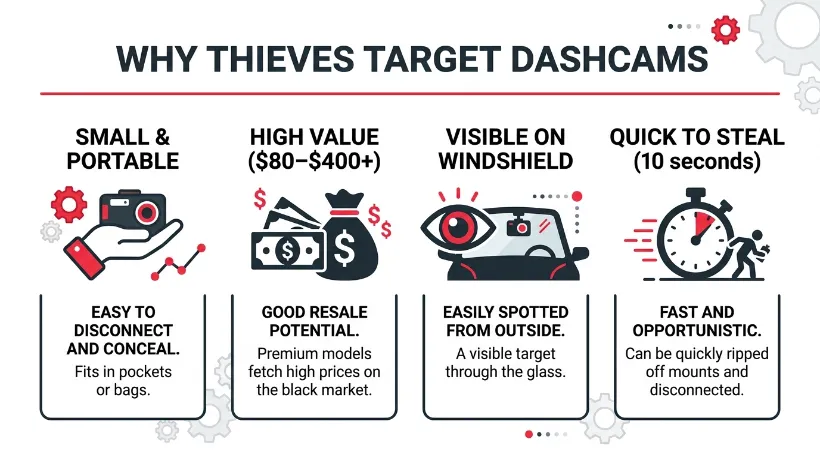
Dashcams attract thieves for one simple reason: they are small, valuable, and in plain sight. A thief walking a car park can spot a dashcam in two seconds and be gone in ten. No alarm triggers. No confrontation. Just a broken window and an empty mount.
The average dashcam sits at a retail price between $80 and $400. Premium models from brands like BlackVue or Garmin push past $500. That is a meaningful return for a smash-and-grab — and the resale market for used dashcams is active enough to make it worth the risk.
But it is not just the device itself thieves want. A dashcam in the window also signals that a driver pays attention to their vehicle. Some thieves interpret that as a sign that valuables may be inside. It is an unintended red flag.
What Makes a Dashcam Worth Stealing?
Three factors make a dashcam a theft target: visible brand branding, high perceived value, and easy removal. A suction-cup-mounted device with a visible logo — say, a Nextbase 622GW or a Viofo A139 Pro — takes under five seconds to pull free from a windshield.
Thieves also target dashcams for the memory card inside. A 128GB card holds hours of footage and retails for $15 to $25. For a thief, that is bonus value with zero effort.
Here is what increases risk most:
- Suction cup mounts — easy to release quickly
- Large or branded units visible from outside the car
- Models with visible LED indicators drawing attention at night
- Dashcams left in cars overnight in public spaces
Which Dashcam Brands Attract the Most Attention?
Larger, well-known dashcams carry higher theft appeal because thieves recognise their resale value. BlackVue DR970X, Garmin Dash Cam 67W, and Nextbase 622GW are all well-known enough that a thief can identify them at a glance and know exactly what they are worth.
Budget models from Viofo or lesser-known brands are less recognisable — which, ironically, makes them slightly safer on a windshield. Thieves tend to grab what they know they can sell.
Never leave a premium dashcam like a BlackVue or Garmin unit on your windshield overnight in a public car park. The resale value makes it a high-priority target for opportunistic thieves.
How Much Does Dashcam Visibility Actually Increase Your Break-In Risk?
A visible dashcam meaningfully increases your car’s appeal as a smash-and-grab target. A 2019 survey by the RAC in the UK found that one in five drivers had experienced a car break-in — and items left visible inside were the most common trigger. A dashcam sitting front and centre on a windshield is one of the most visible items in any parked vehicle.
This doesn’t mean you shouldn’t own a dashcam. It means visibility is the variable you can control. A dashcam you can’t see from outside the car is a dashcam a thief can’t target.
The Smash-and-Grab Problem Explained
Smash-and-grab theft is exactly what it sounds like. A thief breaks a window — usually a small quarter window or a side window — grabs the item, and leaves within seconds. The whole event takes less time than it takes you to buy a coffee.
Car alarms help, but many modern thieves move fast enough that an alarm doesn’t stop them. The window break triggers the alarm; the dashcam is already in their pocket.
The best defence is removing the target. No dashcam visible = no reason to break in.
Does a Suction Cup Mount Make It Worse?
Yes — a suction cup mount is the easiest mounting system for a thief to exploit. One push on the release button and the dashcam comes free in under two seconds. It requires no tools and leaves no evidence.
Adhesive mounts are slightly more secure, but thieves with a flathead tool can still pry them loose. The mount type matters less than whether the dashcam is visible in the first place.
When you remove your dashcam, also remove the mount and wipe away any suction ring mark on the windshield. Thief-spotters look for that circular mark as a sign a dashcam is usually present.
Can a Dashcam Actually Deter Thieves From Breaking In?
A dashcam can deter some thieves — but only if they notice it is recording. A visible dashcam with a flashing LED or a lit screen sends a clear message: this vehicle is being recorded. That deters opportunistic thieves who don’t want to be caught on footage.
The deterrence effect works best on cautious thieves. Experienced, fast-moving smash-and-grab operators often don’t care — they know they can take the camera before any footage is transmitted anywhere.
How Visible Recording Indicators Work as a Warning
Most dashcams display a visible indicator when recording — a flashing red or blue LED, a lit screen, or a status light. These signals tell a potential thief that the vehicle has active surveillance.
Some drivers deliberately choose dashcams with visible indicators for this exact reason. Nextbase (a UK-based dashcam brand trusted by over 2 million drivers) designs several of its models with front-facing status lights for this deterrence effect.
The logic is simple: a thief choosing between two cars picks the one without a recording device. A visible dashcam — even one a thief could steal — may redirect them to an easier target.
Does Parking Mode Catch Thieves in the Act?
Parking mode is a feature that keeps your dashcam recording even when the engine is off. It uses motion detection or G-shock sensors to start recording when it detects movement near the car or an impact. If a thief approaches or breaks a window, parking mode captures it.
The limitation: parking mode needs continuous power. Most dashcams with parking mode require either a hardwiring kit connected to your car’s fuse box, or a dedicated battery pack like the Viofo HK3 or BlackVue B-130X. Without that, parking mode drains your car battery in hours.
When properly set up, parking mode is genuinely powerful evidence. Multiple prosecutions in the UK and US have used parking mode footage to identify and convict car thieves.
If you park in the same spot regularly — at work or at home — invest in a hardwiring kit for parking mode. It costs $20 to $40 and provides 24-hour protection without draining your battery.
Where Should You Mount Your Dashcam to Reduce Theft Risk?
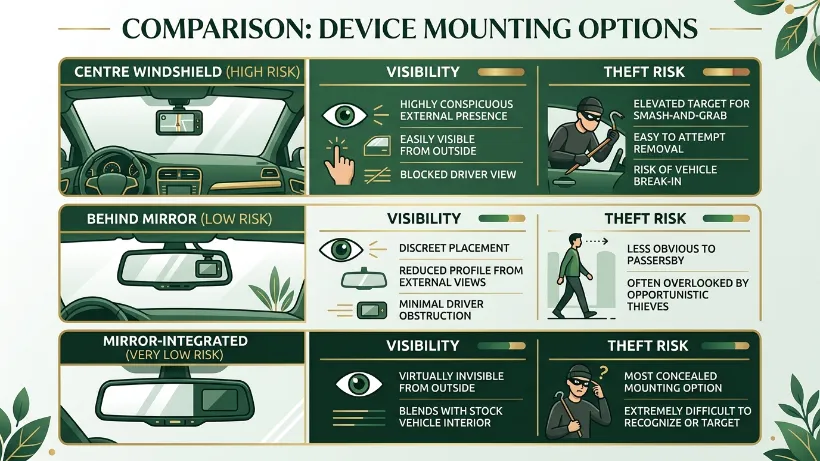
Mount your dashcam as low and as far behind your rearview mirror as possible. The goal is to keep it out of sightlines from outside the vehicle. A thief walking past your car should not be able to spot it easily from any angle.
Placement is the one factor you fully control. The right position makes your dashcam effectively invisible to anyone outside the car.
The Safest Windshield Positions for Low Profile
The safest position is directly behind the rearview mirror, mounted as close to the mirror housing as possible. This location:
- Blocks the dashcam from most external sightlines
- Keeps it legal in most regions (outside the driver’s primary view zone)
- Still provides an unobstructed camera angle of the road ahead
Avoid mounting in the centre of the windshield at eye level. That position is the most visible from outside — and the first place a thief looks.
Should You Use a Mirror Mount Instead?
Mirror-integrated dashcams are an excellent low-theft option. These devices replace or clip over your existing rearview mirror. From outside the car, they look identical to a standard mirror. There is nothing to signal that a dashcam is present.
Models like the Garmin Dash Cam Mirror or the Vantrue M2 take this approach. The trade-off is a slightly wider, less precise front camera angle compared to a dedicated windshield unit — but the theft protection is significantly better.
| Mounting Option | Theft Visibility | Ease of Removal | Best For |
|---|---|---|---|
| Windshield suction cup (centre) | High | Very easy | Drivers who always remove it when parked |
| Behind rearview mirror | Low | Easy | Most drivers wanting balance of stealth and access |
| Mirror-integrated dashcam | Very low | Difficult (permanently mounted) | Drivers in high-theft areas wanting permanent stealth |
| Hardwired low-profile unit | Very low | Difficult (requires tools) | Drivers who want parking mode without theft risk |
Should You Remove Your Dashcam Every Time You Park?
Yes — removing your dashcam every time you park is the single most effective way to prevent theft. No device on the windshield means no theft target. It takes about 20 seconds and eliminates the risk entirely.
The biggest complaint is inconvenience. Nobody wants to unclip, pocket, and reinstall a dashcam every trip. But modern dashcams on suction mounts make this genuinely fast — especially if you also use a small storage pouch in your door pocket or glovebox.
Remove It or Hide It — Which Works Better?
Removing the dashcam works better than hiding it. Hiding a dashcam under a seat or in a bag still leaves it in the car — and thieves who get in will find it. Removing it completely means even a determined thief finds nothing.
Hiding is a reasonable middle ground when you’re making a quick stop. For overnight parking or any unattended period longer than 30 minutes in a public space, removal is the right choice.
The bottom line: Hiding buys you minutes. Removing buys you certainty. In high-crime areas or unfamiliar locations, always remove the dashcam — and the mount — completely.
Step-by-Step: How to Quickly Remove and Pocket Your Dashcam
- Unplug the power cable from the dashcam first — this prevents cable snag damage.
- Press the mount release button or twist to disengage the camera body.
- Press the suction cup release tab and remove the mount from the windshield.
- Wipe the suction ring mark from the windshield with a cloth.
- Store the dashcam and mount in a pouch in your bag or jacket — never in the glovebox or under the seat.
- When you return, reverse the steps: mount first, then camera, then cable.
Which Dashcams Are the Least Obvious and Hardest to Steal?
The least obvious dashcams are small, cableless-looking, and mounted discreetly behind the rearview mirror. Models designed for low profile include the Viofo A119 Mini 2, the Garmin Dash Cam 67W (compact at 1.4 inches wide), and mirror-integrated units like the Vantrue M2.
The hardest dashcams to steal are hardwired units with no suction cup — they require tools and time to remove, which defeats the smash-and-grab model entirely.
Low-Profile Models That Blend In
Small form factor dashcams draw less attention from the outside. The Viofo A119 Mini 2 measures just 2 inches across. The Garmin Dash Cam 47 is similarly compact. Both sit behind a rearview mirror almost invisibly.
These models trade some lens size and screen convenience for a dramatically lower theft profile. For drivers in urban areas or those who park on the street regularly, that trade-off is well worth it.
You can read independent dashcam size and specification comparisons at The Dash Cam Store, which regularly reviews compact models in detail.
Hardwired vs. Plug-In — Which Setup Is Safer?
A hardwired dashcam is significantly harder to steal than a plug-in model. Hardwiring connects the dashcam directly to your vehicle’s fuse box via a dedicated cable. Removing the unit requires disconnecting a routed cable hidden inside the headliner — which takes tools, time, and knowledge.
Plug-in models that use the 12V socket or USB power are fast to steal. One pull on the cable and the whole unit comes free.
Hardwiring also unlocks parking mode — the dashcam stays powered after the ignition cuts out, running on a voltage cutoff circuit that protects your battery. It is the best long-term setup for both security and function.
Hardwired + low profile mount = lowest theft risk with parking mode active. Suction cup + visible placement = highest theft risk, best offset by always removing the unit when parked.
What Happens to Your Footage If Your Dashcam Gets Stolen?
If your dashcam is stolen mid-incident, you lose the footage — unless it has already been uploaded to the cloud or transmitted wirelessly. A standard dashcam stores footage only on the local memory card. When the card goes, the footage goes with it.
This is the cruel irony of dashcam theft. The device that records a break-in is the device the thief takes — along with the evidence of their own crime.
Cloud-Connected Dashcams and Remote Footage Access
Cloud-connected dashcams solve this problem. BlackVue (a South Korean dashcam brand renowned for cloud integration) built its DR970X and DR770X series to upload footage in real time via a Wi-Fi hotspot or LTE connection. That footage lives on BlackVue’s servers — not just on the memory card in the camera.
If a thief smashes your window and grabs the BlackVue unit, the footage of them doing so may already be uploaded. You can access it from your phone within minutes.
Nextbase also offers its MyNextbase Connect platform, which uploads clips wirelessly to your smartphone when the car is parked near a known Wi-Fi network.
For a detailed breakdown of cloud dashcam options and their upload capabilities, BlackboxMyCar’s cloud dashcam guide covers the main systems well.
Can You Recover Footage From a Stolen Memory Card?
Usually not. Once a thief has the memory card, footage recovery depends on whether they overwrite or destroy it. Most dashcams use loop recording, which means old footage gets overwritten automatically. If the incident happened recently and the thief hasn’t used the card, a forensic tool might recover something — but this is rare in practice.
The practical answer: assume footage on a stolen dashcam is gone. Cloud backup or Wi-Fi sync before the theft is your only reliable safety net.
If your dashcam is stolen after a collision or incident involving another vehicle, report it to police immediately. The stolen footage may constitute destruction of evidence, which is a separate offence. Your insurance company should also be notified.
You can also register your dashcam’s serial number with services like Immobilise, the UK’s national property register, to help police trace and return stolen electronics.
Conclusion
Dashcams are a theft target — but a manageable one. The risk is real, especially for visible, branded units on suction mounts in public car parks. But the solutions are practical and largely free.
Remove your dashcam when you park. Mount it behind the rearview mirror. Consider a hardwired, low-profile unit if you park on the street regularly. And if you want the strongest protection, choose a cloud-connected model that uploads footage the moment something happens.
After my own break-in, I switched to a hardwired Viofo unit mounted tight behind the mirror — and I remove it every time I’m parked somewhere unfamiliar. The inconvenience is real but small. The peace of mind is worth it.
I’m Alex Rahman, and if this guide helped you think through your dashcam setup, share it with someone who parks in a city. It might save them a broken window.
Frequently Asked Questions
Are dashcams a common target for car thieves?
Yes, dashcams are a frequent smash-and-grab target because they are valuable, portable, and clearly visible on a windshield. Their retail value of $80 to $400+ makes them worth the few seconds a break-in takes. Removing the dashcam when parked is the most effective prevention.
Does leaving a dashcam in a parked car attract thieves?
A visible dashcam increases the chance of a break-in because it signals value and is easy to grab. The risk is highest in public car parks, city streets, and overnight parking situations. Hiding or removing the dashcam eliminates this attraction entirely.
Can a dashcam record a break-in while the car is parked?
Yes — dashcams with parking mode can detect motion or impact and start recording automatically, even with the engine off. This requires either a hardwiring kit or a dedicated battery pack to stay powered. The resulting footage has been used successfully in theft prosecutions.
What is the best way to protect a dashcam from theft?
The most reliable method is to remove the dashcam and its mount every time you leave the car. For drivers who want to keep it installed, a hardwired low-profile model mounted behind the rearview mirror is the best permanent alternative. Wiping the suction mark from the windshield removes the last clue a dashcam is normally present.
Do cloud dashcams help if the camera is stolen?
Cloud-connected dashcams like BlackVue’s DR970X upload footage wirelessly in real time. If the camera is stolen after an incident, footage already uploaded to the cloud remains accessible from your phone. This makes cloud dashcams significantly more useful for theft evidence than standard local-storage models.
Is it worth keeping a dashcam if it might get stolen?
Yes — the benefits of dashcam ownership outweigh the theft risk when you manage that risk sensibly. Dashcam footage protects you in collisions, deters fraudulent claims, and can be invaluable in legal disputes. Simple habits like removing the unit when parked keep the theft risk minimal while preserving all the protection benefits.

I’m Alex Rahman, a car enthusiast and automotive writer focused on practical solutions, car tools, and real-world driving advice. I share simple and honest content to help everyday drivers make better decisions.
