Where Is the Best Place to Mount a Dash Cam for Clear, Legal Footage?
The best place to mount a dash cam is behind the rearview mirror, near the top center of the windshield. This spot gives you the widest unobstructed field of view, keeps the camera out of your sightline, and meets legal placement rules in most US states and UK law.
I bought my first dash cam in 2019 after a parking lot hit-and-run left me with a dented bumper and zero proof of who did it. When the device arrived, I stared at my windshield for a solid ten minutes wondering — where exactly does this thing go?
I’m Alex Rahman, and I’ve installed dash cams in four different vehicles since then. I’ve learned the hard way that placement is everything. A poorly mounted cam can block your view, capture the wrong angle, or even violate state law.
In this guide, I’ll walk you through every mounting option — windshield, dashboard, rear window, and interior — so you get the best footage possible without any legal headaches.
- Mount your dash cam behind the rearview mirror, near the top center of the windshield, for the best unobstructed view.
- Most US states restrict dash cam placement to specific windshield zones — usually the top or bottom few inches.
- Adhesive mounts hold better in heat; suction cups are easier to reposition.
- Rear cameras should sit inside the back window, angled slightly downward for road coverage.
- Rideshare drivers need an interior cabin cam mounted overhead, angled to cover both front and rear seats.
What Does Dash Cam Placement Actually Affect and Why Does It Matter?
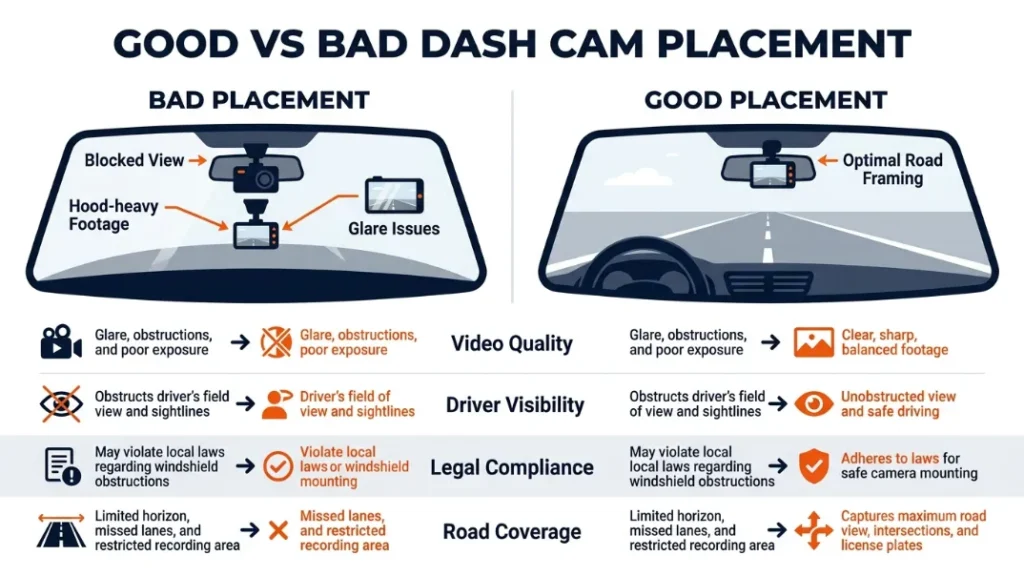
Where you mount your dash cam directly impacts video quality, legal compliance, and driver safety. A misplaced camera can capture sky instead of road, obstruct your line of sight, or violate your state’s windshield obstruction laws — none of which you want when you need that footage most.
Most drivers assume any spot on the windshield works fine. It does not. The angle of your camera changes what gets recorded. Even a few centimeters too low can mean your hood fills half the frame instead of the road ahead.
And it is not just about what you see on the recording. In the US, 43 states have laws that restrict where you can place anything on your windshield. Get it wrong, and you could face a traffic citation — even if your dash cam footage is perfectly clear.
How Mounting Position Changes Your Video Quality
A dash cam mounted too low captures too much of your car’s hood and not enough road. Too far to the side, and you lose center-lane detail. The right height — near the top of the windshield — gives your camera the same view your eyes have when driving normally.
Field of view (FOV) matters here. Most dash cams have a 140-degree to 170-degree wide-angle lens. At the wrong height, that wide angle picks up glare, reflections off the dashboard, or the roof of your car. At the right height, it captures full lanes, traffic ahead, and road markings.
Before permanently mounting, test your camera position by holding it in place and checking the live view on the app or screen. Make sure the horizon sits roughly in the upper third of the frame.
Why a Bad Placement Can Get You in Legal Trouble
In the United States, the National Highway Traffic Safety Administration (NHTSA) does not regulate dash cams directly, but individual states restrict windshield obstructions. California, for example, only allows dash cams in a 5-inch square in the lower driver’s corner or a 7-inch square in the lower passenger corner.
In the UK, the Highway Code requires that nothing impairs the driver’s view of the road. The UK Highway Code Rule 162 is clear — your windshield must be kept clean and free of obstruction. A dash cam blocking your line of sight can result in a careless driving charge.
The safest position in almost every jurisdiction? Behind the rearview mirror, near the top of the windshield. More on exactly why in the next section.
Where Is the Best Place to Mount a Dash Cam on the Windshield?
The best windshield position is directly behind the rearview mirror, centered horizontally, and placed as high as possible without entering the painted or tinted border zone. This gives you maximum road coverage, minimum driver distraction, and the cleanest legal compliance across most locations.
This is not just a popular opinion — it is the recommendation backed by most dash cam manufacturers including Nextbase, Garmin, and Blackvue. Their own mounting hardware is designed for exactly this position.
Why Behind the Rearview Mirror Is the Gold Standard Spot
Mounting behind the mirror keeps the camera hidden from the driver’s direct sightline. You do not see it when looking forward. You do not see it in your peripheral vision. It simply disappears behind the mirror housing — which is exactly where you want it.
It also keeps the camera protected from direct sunlight for most of the day. Excess heat from UV exposure is one of the leading causes of suction cup mount failure and internal battery swelling in dash cams. The mirror’s shadow helps more than you might think.
Nextbase (a UK dash cam brand trusted by over 3 million drivers) designs all of their mounts — including their Click & Go magnetic system — specifically for the behind-mirror position. Blackvue (a premium Korean brand known for their cloud-connected DR series) recommends the same spot for optimal GPS signal pickup.
How High on the Windshield Should Your Dash Cam Go?
Mount your dash cam as high as possible while staying inside the legally permitted zone — typically just below the painted or rubber seal border at the top of the windshield. In practice, this means the top edge of your camera should sit roughly 1 to 2 inches below the windshield trim.
Height matters because of angle. The higher the camera, the more road it sees ahead of you. A camera mounted at eye level or lower starts picking up your hood, dashboard, and the car interior — wasted frame space that reduces the useful footage you actually need.
Rule of thumb: Your dash cam lens should be at roughly the same height as the top of your steering wheel when you’re seated in the driver’s position. That angle mirrors your natural forward sightline and captures the most road ahead.
Should Your Dash Cam Be Centered or Off to the Side?
Center your dash cam as much as possible — directly behind the rearview mirror stem. This gives you equal left and right lane coverage, which matters most in side-swipe incidents, lane merges, and intersection accidents.
Some drivers mount slightly to the passenger side if their mirror blocks the center. That is fine — a 2 to 3 inch offset to the right still gives balanced coverage. Just avoid mounting far to either side, as you will lose coverage of the opposite lane entirely.
Vantrue (a popular US dash cam brand known for their dual and triple channel systems) builds their cameras with a slightly offset lens design for exactly this reason — it maximizes usable frame coverage even from a centered position.
Can You Mount a Dash Cam on the Dashboard Instead of the Windshield?
Yes, you can mount a dash cam on the dashboard, but it is generally not the best choice for most drivers. Dashboard mounting places the camera lower in the vehicle, which raises the angle toward the horizon and reduces the road visible in the frame. It works best for trucks, SUVs, and vans where windshield mounting is awkward.
Dashboard mounts also introduce more glare risk. Your dashboard reflects light back into the lens, especially on bright days or at night with oncoming headlights. This can wash out footage exactly when you need it most.
When Dashboard Mounting Makes Sense and When It Does Not
| Scenario | Best Mount Location | Reason |
|---|---|---|
| Standard sedan or hatchback | Windshield behind mirror | Best angle, most legal, hidden from sight |
| Pickup truck or large SUV | Dashboard or high windshield | Tall cabin means windshield angle may be too steep |
| Van or commercial vehicle | Dashboard center | Windshield too far from driver for easy wiring |
| Rental car (temporary) | Suction on windshield | Non-permanent, easy removal, no adhesive marks |
What Angle Should a Dashboard-Mounted Dash Cam Face?
Tilt a dashboard-mounted cam downward by 10 to 15 degrees from horizontal. This compensates for the lower starting height and angles the lens toward the road rather than the sky. Most cameras have a pivot adjustment on their mount — use it.
Check the live view before you lock the angle in. You want to see at least two car lengths of road ahead, not a sky-heavy shot with your hood dominating the bottom third of the frame.
Is It Legal to Mount a Dash Cam on Your Windshield in Your State or Country?
Dash cam windshield mounting is legal in all 50 US states and the UK, but each location has specific rules about where on the windshield the device can sit. Violating these zones — even accidentally — can result in a traffic citation for obstructing your view.
The key principle across nearly all regulations is the same: a dash cam cannot obstruct the driver’s critical viewing area. That area is roughly the space your windshield wipers clear, excluding the outer edges and corners.
US State Windshield Laws That Affect Dash Cam Placement
US state laws vary significantly. California (Vehicle Code 26708) is one of the strictest — it limits dash cam mounting to a 5-inch square in the lower-left corner or a 7-inch square in the lower-right corner as viewed from inside the vehicle. Many drivers misread this and mount in those spots, which actually places the camera far too low for good footage.
Most other states — including Texas, Florida, New York, and Illinois — follow a more general rule: nothing can be attached to the windshield that materially obstructs the driver’s view. In those states, the behind-mirror position at the top of the windshield satisfies the law easily.
Always check your specific state’s Vehicle Code before mounting. Laws change, and some states — like California and Pennsylvania — have unusually specific zone restrictions that can catch drivers off guard. A quick search for “[your state] windshield obstruction law” gives you the exact rules.
UK and European Dash Cam Placement Rules You Need to Know
In the UK, dash cams are fully legal and widely used. The RAC confirms that UK law requires dash cams to be mounted where they do not obstruct the driver’s view — which, in practice, means behind the rearview mirror at the top of the windshield. The same guidance applies in most EU countries including Germany, France, and the Netherlands.
In Germany, dash cam footage was officially declared admissible as court evidence in 2018 by the Federal Court of Justice (BGH), which drove a major uptick in dash cam adoption across Europe. Proper placement became a legal requirement alongside data privacy compliance under GDPR.
Suction Cup vs. Adhesive Mount — Which One Should You Use?
Suction cup mounts are removable, repositionable, and great for rental cars or drivers who switch vehicles. Adhesive mounts are more permanent, more stable in heat, and better for daily drivers who want a set-it-and-forget-it installation. Your choice depends on how permanently you want the cam in place.
| Feature | Suction Cup | Adhesive Mount |
|---|---|---|
| Installation | Seconds, no tools | 5–10 minutes, clean surface required |
| Heat resistance | Can fail above 40°C (104°F) | Rated for 80°C+ in quality mounts |
| Repositionable | Yes — easily moved | No — permanent bond |
| Stability | Can vibrate on rough roads | Rock solid even on dirt roads |
| Best for | Rental cars, seasonal use | Daily drivers, hot climates |
When a Suction Cup Mount Is the Better Choice
Choose a suction cup if you need flexibility. Rideshare drivers who rent their vehicle, people who share a car across family members, or anyone in a mild climate where summer temperatures stay below 38°C (100°F) will find suction cups perfectly reliable.
Garmin’s Dash Cam series ships with a magnetic suction mount that locks the camera in and out in one click. It stays firmly in place on normal roads but releases in seconds when you park and take your camera inside — which is smart in high-theft areas.
When an Adhesive Mount Wins Over Suction
Use adhesive if you live in a hot climate, drive on rough roads, or simply want zero cam movement. Hot climates like Texas, Arizona, Florida, and most of the Middle East regularly push car interior temperatures above 60°C (140°F) on summer days. Suction cups soften and release at those temperatures. A quality 3M adhesive pad holds firm.
Nextbase sells a dedicated adhesive mount plate for their Click & Go system. You peel and stick it once, then clip and unclip the camera daily without disturbing the base. Best of both worlds.
Before sticking any adhesive mount, clean the windshield thoroughly with isopropyl alcohol and let it dry for 2 minutes. Dust and oil are the number one reason adhesive mounts fail prematurely — especially on newer vehicles with coated windshields.
Where Should You Mount a Rear Dash Cam for the Best Back Coverage?
Mount your rear dash cam on the inside of the rear windshield, centered horizontally, as high as possible without being blocked by the rear wiper or brake light. This position gives you a clear view of vehicles directly behind you and captures tailgating, rear-end impacts, and lane changes from the back.
The rear camera is often treated as an afterthought — but in 2023, rear-end collisions accounted for nearly 28% of all US traffic accidents according to NHTSA data. A misplaced rear cam means you miss the footage that matters most in those incidents.
Inside the Rear Window vs. Outside: What Works Better?
Always mount inside the rear window — never outside. An external rear camera is exposed to weather, vibration, and physical damage from car washes. An internal rear cam, pointed through the glass, delivers stable, weather-protected footage with no lens exposed to rain or debris.
The one challenge with inside mounting is the rear defroster grid. Positioning the camera lens between the defroster lines — rather than directly over one — prevents grid lines from appearing across your footage. Most Blackvue dual-channel cameras (like the DR900X-2CH) come with a low-profile rear mount designed to sit flush between those lines.
How to Angle a Rear Cam So It Captures the Road Behind You
Tilt the rear camera downward by about 5 to 10 degrees. At horizontal, it captures the sky above following vehicles instead of the road where the actual contact points are. A slight downward angle captures front bumpers, license plates, and road markings — exactly what you need for a collision claim.
Rear cam: inside the rear window, centered, as high as possible, angled 5–10 degrees downward. Position the lens between defroster grid lines to keep footage clean. Never mount outside the vehicle.
Where Do You Mount an Interior or Cabin Dash Cam?
Mount an interior dash cam on the windshield or rearview mirror, angled to point into the cabin rather than forward at the road. The ideal position is above the center of the front seats, angled downward and rearward to capture both the front and back passenger areas in a single wide-angle frame.
Interior cameras — also called cabin cameras — are increasingly common for rideshare drivers using Uber and Lyft, taxi operators, fleet vehicles, and parents monitoring teen drivers. Vantrue’s E1 Lite, for example, is purpose-built for rideshare use with a 170-degree FOV that covers the front seats and full rear seat row from a single windshield-top mount.
Best Overhead Position for Rideshare and Taxi Drivers
Position the cabin camera directly above the center console, mounted on the windshield just below the mirror. This central overhead angle minimizes distortion at the edges of the frame and covers both the driver and all passengers in a single shot.
Avoid mounting a cabin cam off to one side. A passenger-side mount captures the driver poorly and misses the driver-side rear seat. A driver-side mount does the opposite. Center is always the right call for interior coverage.
What Angle Covers Both Front Seats and the Back Seat?
Tilt the interior camera backward and downward at roughly 20 to 30 degrees from horizontal. This angle, combined with a 140-degree or wider FOV, covers the entire interior from headrests to the rear seat floor — capturing faces, hands, and any incidents that occur between driver and passenger.
If you drive for Uber, Lyft, or any rideshare platform, check your local laws before installing a cabin camera. Some US states — including California — require you to notify passengers that recording is taking place. A visible sticker on the window is often sufficient, but check your specific state law first.
How to Hide Dash Cam Wires After Mounting for a Clean Install
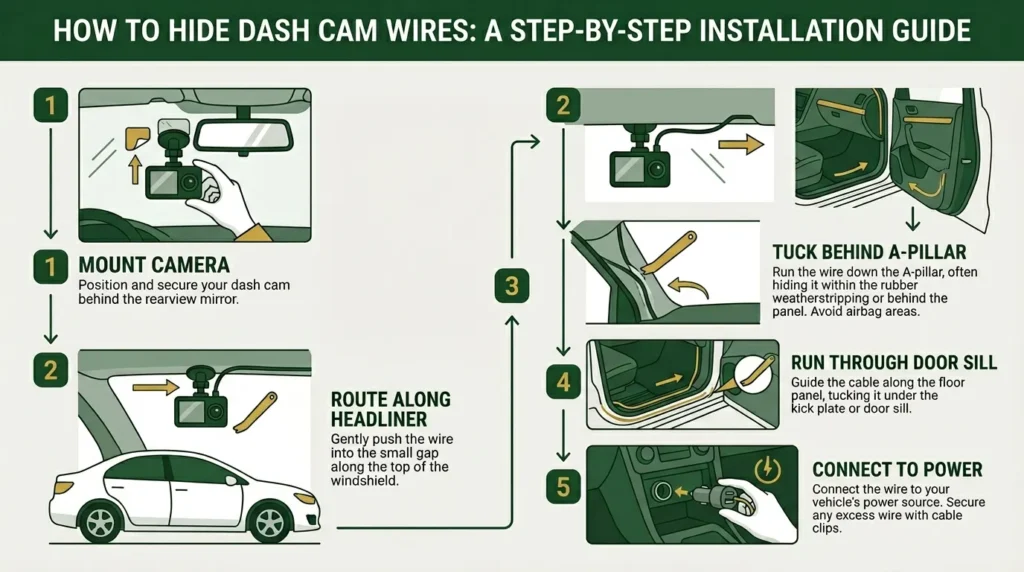
Route your dash cam power cable along the windshield trim, then tuck it into the headliner, down the A-pillar panel, and along the door sill to the 12V socket or hardwire kit connection near the fuse box. A wire fully hidden inside trim panels looks professional and eliminates the dangling cable that distracts drivers.
This is the step most guides skip — and it is the step that separates a $15 DIY install from one that looks factory-fitted. The good news? You do not need any special skills or tools. You just need patience and the right pry tool.
Step-by-Step: Running Wires Along the Headliner and A-Pillar
- Mount your dash cam in its final position and measure the full cable run length needed to reach the power source.
- Use a plastic pry tool or a flathead screwdriver wrapped in tape to gently lift the rubber windshield trim seal along the top of the windshield.
- Tuck the cable into the gap behind the trim seal, running it from the camera toward the driver-side A-pillar.
- Continue tucking the cable behind the A-pillar trim panel — most panels clip in and flex outward slightly without needing full removal.
- Run the cable down the A-pillar to the door sill, then along the sill trim to the 12V socket or fuse box.
- Plug into a low-profile 12V adapter or connect to the fuse box using a hardwire kit for parking mode support.
- Test the camera powers on, check the camera angle one final time, and press all trim back into place.
Tools That Make Wire Hiding Faster and Easier
A plastic trim removal tool set (available for under $10 on Amazon) does most of the work without scratching panels. A cable fishing rod helps thread wires through tight pillar spaces. And a low-profile right-angle USB adapter keeps the plug flush against the windshield for a cleaner finish at the camera end.
If you are hardwiring for parking mode, use a mini-fuse add-a-circuit tap from the fuse box rather than cutting into existing wires. It is cleaner, fully reversible, and does not void your vehicle warranty.
Common Dash Cam Mounting Mistakes That Ruin Your Footage
Even a perfectly good dash cam delivers useless footage if it is mounted incorrectly. These are the five most common placement mistakes — and exactly how to fix each one.
- Mounting too low: Captures more hood than road. Fix: move the camera as high as legally permitted on the windshield.
- Mounting off-center: Loses coverage of one full lane. Fix: center the camera directly behind the mirror stem.
- Ignoring dashboard glare: Dashboard reflections wash out daytime footage. Fix: use an anti-glare dash mat or angle the cam slightly upward to reduce reflected light pickup.
- Skipping the rear cam angle check: A flat-mounted rear cam captures sky, not cars. Fix: tilt the lens downward 5 to 10 degrees after mounting.
- Using suction cups in hot climates: Heat loosens the seal and the camera falls — sometimes while driving. Fix: switch to an adhesive mount base if your car regularly exceeds 38°C (100°F) interior temperature.
The most expensive dash cam in the world delivers zero value if it falls off the windshield at the moment of impact — or if it was pointed at the sky all along. Spend ten minutes getting placement right once, and it protects you for years.
Frequently Asked Questions

I’m Alex Rahman, a car enthusiast and automotive writer focused on practical solutions, car tools, and real-world driving advice. I share simple and honest content to help everyday drivers make better decisions.
