Where Are Dashcams Not Allowed? Country-by-Country Guide
Dashcams are completely banned in Austria, Portugal, and Luxembourg for private drivers. Several other countries — including Germany, Switzerland, and Belgium — allow them under strict privacy conditions. In the US, dashcams are legal nationwide but windshield placement rules and audio recording laws vary by state.
I packed my dashcam for a road trip through Europe. Plugged it in. Pointed it at the windshield. Ready to go.
Then a friend texted me: “You know dashcams are illegal in Austria, right?”
I didn’t know. And that one message sent me down a rabbit hole of confusing privacy laws, GDPR regulations, and country-specific rules I had no idea existed.
I’m Alex Rahman, and after researching dashcam legality across more than 30 countries, I can tell you this: the rules are wildly inconsistent, frequently misunderstood, and the stakes are real. Getting caught with an illegal dashcam can mean a fine, confiscation of footage, or worse.
This guide covers every country where dashcams face bans or restrictions — and exactly what you need to know before you drive.
- Austria, Portugal, and Luxembourg have outright dashcam bans for private drivers.
- Germany, Switzerland, France, and Belgium allow dashcams under strict privacy and data protection conditions.
- In the US, dashcams are legal in all 50 states — but windshield placement and audio recording laws differ by state.
- GDPR in the EU creates data handling obligations even when dashcams are technically permitted.
- Audio recording from a dashcam is separately regulated from video — and can be illegal even where video is allowed.
What Makes a Dashcam Illegal in Some Countries but Fine in Others?
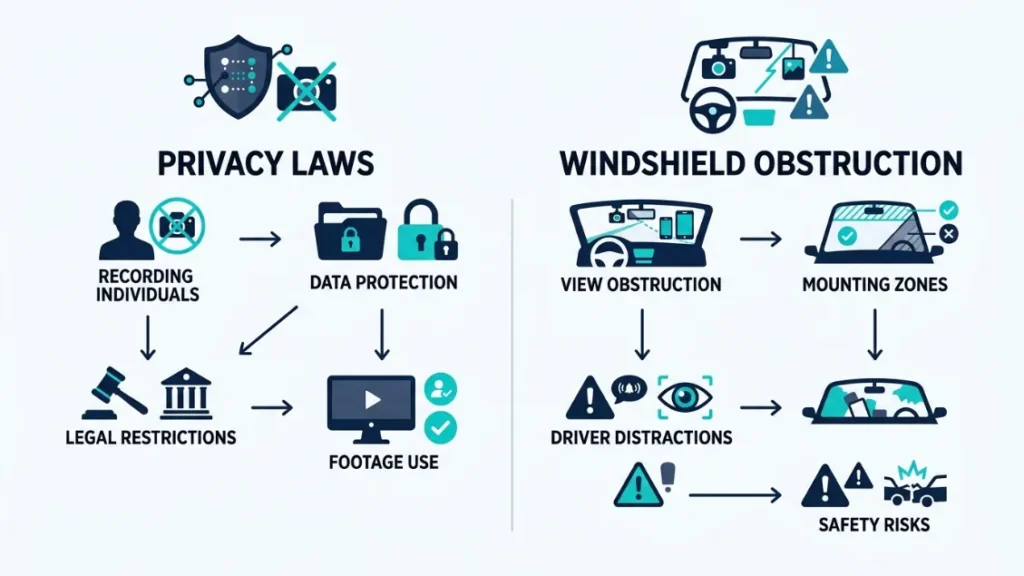
Dashcams become illegal for two main reasons: privacy law violations or windshield obstruction rules. Understanding which reason applies helps you know exactly what to do — or avoid — in each country.
Privacy-based bans stem from the idea that recording other people — pedestrians, passengers, other drivers — without their consent invades their legal rights. Countries with strong personal data protection frameworks, especially in the EU, treat dashcam footage as personal data. That triggers strict rules about recording, storing, and sharing it.
Windshield laws are different. These exist to keep your line of sight clear. A dashcam mounted in the wrong spot can legally count as an obstruction — even if the country has no problem with dashcams in principle.
Privacy Laws vs. Windshield Laws — Two Very Different Reasons for Bans
Privacy bans tend to be nationwide and apply to all drivers equally. Windshield laws tend to be local — state or province-level — and focus on placement rather than recording itself.
In practice, this means a driver in Germany faces privacy-based restrictions on sharing footage, while a driver in California faces a windshield-zone restriction on where the dashcam can physically sit. Two completely different problems with two different solutions.
Before driving in a new country, search “[country name] dashcam law” and check a source published after 2022. Laws in this space change faster than most people realise.
Which Countries Have Completely Banned Dashcams for Private Drivers?
Three European countries currently enforce outright bans on dashcam use by private drivers: Austria, Portugal, and Luxembourg. In each case, the ban comes from national privacy or data protection law — not a fringe regulation.
Austria — Europe’s Strictest Dashcam Ban and Why It Exists
Austria has one of the clearest and most enforced dashcam bans in the world. The Austrian Data Protection Act (Datenschutzgesetz) treats any continuous recording of public roads as an illegal collection of personal data. That applies to other vehicles, license plates, and pedestrians captured in footage.
Austrian courts have consistently upheld this. In 2016, a landmark ruling confirmed that private dashcam recordings violate personal rights under Austrian law. The fine for using a dashcam in Austria can reach up to €10,000 in serious cases.
Even storing dashcam footage on your device while parked counts as a violation. The law covers recording itself — not just sharing footage.
This surprises many tourists crossing into Austria from Germany, where dashcams are common. The moment you cross that border, your device becomes a legal liability.
Austrian police actively check for dashcams during routine traffic stops. If your device is visible and powered on, you may face an immediate fine. Turn it off and store it out of sight when entering Austria.
Portugal — Where Your Dashcam Could Get You a Fine on Day One
Portugal bans dashcam use by private individuals under its national data protection laws, aligned with GDPR principles. The Portuguese Data Protection Authority (CNPD) has ruled that recording public roads without justification violates the privacy of others captured on camera.
Commercial vehicles — taxis, buses, logistics fleets — may use dashcams under specific authorisation. But private car owners have no such exemption. Driving through Lisbon with a dashcam running is a fineable offence.
The fine range sits between €1,000 and €10,000 depending on the nature of the violation. Portugal is a popular driving destination, especially for UK and German tourists — and most arrive unaware of this rule.
Luxembourg — The Small Country With a Surprising Dashcam Rule
Luxembourg restricts dashcam use under its national privacy legislation. Recording individuals in public spaces without consent is prohibited, and dashcams pointed at shared roads fall under this restriction for private drivers.
Luxembourg’s rules are less frequently enforced than Austria’s, but the legal prohibition exists. Drivers passing through on longer European road trips often miss this entirely because the country is small and the crossing is quick.
Being in a country for 20 minutes does not make you exempt from its laws. Luxembourg’s proximity to Belgium, France, and Germany makes this a real risk for cross-border drivers.
Where Are Dashcams Allowed but With Strict Conditions You Must Follow?
Several countries permit dashcams but attach legal conditions that most drivers never read. Germany, Switzerland, Belgium, and France all fall into this category — legal in theory, complex in practice.
Germany — Legal to Own but Hard to Share Footage Legally
Germany allows dashcam ownership and recording, but the legal framework around it is genuinely complicated. A 2018 ruling by the Federal Court of Justice (Bundesgerichtshof) confirmed that dashcam footage can be used as evidence in court — but only if recorded under specific conditions.
The key condition: you cannot run continuous recording. German law favours short, looping recordings triggered by an incident (like a collision). Recording every minute of every drive creates privacy exposure for every person your dashcam captures.
Sharing or publishing footage of other drivers — even in an accident context — requires careful handling under GDPR. The footage must be deleted as soon as it serves no legal purpose. Posting clips online, even for entertainment, risks a data protection violation.
If you drive in Germany, use a dashcam with loop recording set to short intervals (1-3 minutes). Store only footage from actual incidents. Delete everything else promptly.
Switzerland — Dashcams Are Allowed Until You Hit Record on Audio
Switzerland permits video dashcams for private use, but audio recording is a separate and much stricter issue. Swiss law — specifically the Federal Act on Data Protection (FADP) — prohibits recording conversations without the consent of all parties.
A dashcam with audio enabled inside a vehicle records every conversation in the car. That makes it a potential wiretapping violation under Swiss law if passengers have not consented.
For video-only use on public roads, Switzerland is generally permissive. The footage still carries GDPR-adjacent obligations — store it securely, don’t share it publicly, delete it once irrelevant.
Belgium — Restricted Use and Limited Sharing Rights
Belgium allows dashcam use for road safety purposes but treats the footage as personal data under GDPR. Drivers must not record in ways that systematically profile individuals. Extended parking-mode recording — where the camera captures people walking past your parked car — is particularly problematic.
Belgian courts have allowed dashcam footage as evidence in accident cases. However, the recording must be proportionate to the purpose. A dashcam running 24 hours a day in a residential area crosses into surveillance territory under Belgian data protection law.
France — Legal With Conditions Around Privacy and Footage Sharing
France permits dashcam use and has even allowed dashcam footage as evidence in court proceedings. The Commission Nationale de l’Informatique et des Libertés (CNIL) — France’s data protection authority — has issued guidance clarifying that personal use dashcams are lawful as long as footage is not shared publicly.
Posting dashcam clips on social media, YouTube, or public forums without blurring identifiable information (faces, license plates) risks a GDPR violation in France. The footage is for personal safety use — not content creation.
Across all restricted European countries, the pattern is consistent: record for safety, store securely, share only with authorities, and delete footage you no longer need. That single principle keeps you legal in most of the EU.
Are Dashcams Legal Across the United States — or Do State Laws Vary?
Dashcams are legal in all 50 US states — no state has banned them outright. But two separate sets of rules create real restrictions for American drivers: windshield obstruction laws and audio recording consent laws.
Which US States Have Windshield Obstruction Laws That Affect Dashcam Mounting?
Many states prohibit mounting anything in specific zones of the windshield that could obstruct the driver’s view. The exact zones differ by state, but the principle is consistent: your dashcam cannot sit in a location that blocks your line of sight.
California, for example, restricts mounting to a small patch at the top of the windshield (within 5 inches of the top edge) or the lower-left corner near the AS-1 line. Minnesota, Texas, and New Jersey have similar zone-based rules.
The safest general practice across all US states: mount your dashcam behind the rearview mirror, as close to the top-center of the windshield as possible. This keeps it out of your sightline and complies with the strictest state standards.
Can Your Dashcam Record Audio Legally in Every US State?
No — and this catches many US drivers off guard. Audio recording laws in the US fall into two categories: one-party consent and all-party (two-party) consent states.
In one-party consent states, you can legally record audio in your own vehicle without telling passengers. In all-party consent states — including California, Florida, Illinois, and Washington — every person in the recording must give consent before audio capture begins.
Running a dashcam with audio enabled while carrying a passenger in California technically requires that passenger’s consent. Most dashcam owners never think about this. The simplest fix: disable audio recording entirely unless you specifically need it.
In the US, dashcams are legal everywhere. The two things to check: (1) your state’s windshield zone rules for mounting placement, and (2) whether your state requires all-party audio consent. Disabling audio and mounting behind the rearview mirror keeps you legal in every state.
How Does GDPR Affect Dashcam Use in Europe for Everyday Drivers?
GDPR — the General Data Protection Regulation — applies to dashcam footage in Europe because video of identifiable people counts as personal data. That means ordinary drivers face data protection obligations they may not even know exist.
What Data Protection Rules Mean for Your Dashcam Footage in the EU
Under GDPR, personal data must be collected for a specific and legitimate purpose, stored securely, and deleted when no longer needed. Dashcam footage of a road incident satisfies the “legitimate purpose” test — safety and insurance documentation. But continuous footage of unrelated people on public streets is harder to justify.
The UK’s Information Commissioner’s Office (ICO) has published guidance confirming that private dashcam use for road safety is lawful — but that footage must not be shared without a valid reason. The ICO specifically warns against posting dashcam clips online for entertainment purposes.
In practical terms, GDPR means four things for dashcam users in EU countries where recording is permitted:
- Record only what is necessary — don’t run your camera when parked with no reason
- Store footage on a secure, encrypted memory card
- Share footage only with police, insurers, or legal representatives — not publicly
- Delete footage that has no ongoing relevance within a reasonable time
Brands like Nextbase (a UK dashcam company with over 2 million customers) have built GDPR-conscious features into their devices, including automatic loop deletion and encrypted storage options. Vantrue, a US-based manufacturer popular for dual-channel interior/exterior cameras, includes firmware settings to disable audio recording for compliance in restricted states and countries.
For a deep dive into EU data protection rules, GDPR.eu provides plain-English guidance on personal data obligations for individuals.
Can You Use a Dashcam in Asia, the Middle East, and Africa?
Outside Europe and North America, dashcam rules vary enormously — from widely encouraged (Russia, South Korea) to actively restricted (some Gulf states). The rules in this region are less published and harder to verify, which makes research before travel even more important.
Countries in the Middle East Where Dashcams Face Restrictions
Several countries in the Middle East — including the UAE at certain times and under certain conditions — have historically restricted photography and recording in public spaces. The rules for in-vehicle cameras overlap with broader laws about photographing government buildings, military infrastructure, and public incidents.
In some Gulf states, using a dashcam that captures a government facility or security checkpoint — even accidentally — can attract legal scrutiny. Travellers driving in the region should check current travel advisories from their home government before using any recording device in a vehicle.
Saudi Arabia has become more permissive in recent years as the country modernises its road safety infrastructure, and dashcams are increasingly common among expat drivers. But the legal framework remains less clear than in Europe.
Russia, China, and Japan — Dashcam Culture vs. Legal Reality
Russia has the most famous dashcam culture in the world. After a wave of insurance fraud and traffic disputes in the early 2010s, dashcam adoption exploded. Today, a significant percentage of Russian drivers use them — and their footage has ended up in countless viral videos documenting everything from road rage to meteor strikes. Dashcams are legal and widely accepted in Russia.
China permits dashcam use but applies restrictions similar to its broader surveillance laws. Recording near sensitive government buildings or military zones creates legal risk. For everyday urban and highway driving, dashcams are common and commercially sold across the country.
Japan allows dashcams and their use has grown significantly since 2019, partly driven by a rise in road rage incidents. Japanese privacy law is strict about sharing footage that identifies individuals, but owning and using a dashcam for personal road safety is lawful.
What Happens If Police Find an Illegal Dashcam in Your Car?
The consequences of an illegal dashcam depend entirely on the country — and they range from a polite warning to a significant fine. In Austria, where the ban is most actively enforced, police can issue on-the-spot fines and may require you to delete footage. Fines up to €10,000 exist in the legal framework, though maximum penalties are typically reserved for repeat or commercial violations.
In Portugal and Luxembourg, enforcement is less aggressive but the financial risk is real. First-time foreign visitors caught with a dashcam may receive a warning or a smaller fine. But “I didn’t know” is not a legal defence in any of these countries.
Confiscation of your device or the memory card is possible in countries with active bans. In some cases, footage may be used as evidence against you — particularly if it shows a separate traffic violation.
Do not attempt to conceal a running dashcam in a banned country. Hiding it under a visor or pointing it downward while it still records does not make the recording legal. The act of recording is the violation — not just the visibility of the device.
How to Use a Dashcam Legally While Traveling Across Multiple Countries
Cross-border road trips in Europe are the most common scenario where dashcam legal status changes mid-journey. Driving from the UK through France, Belgium, Germany, Austria, and Switzerland means crossing through three different legal frameworks in a single trip.
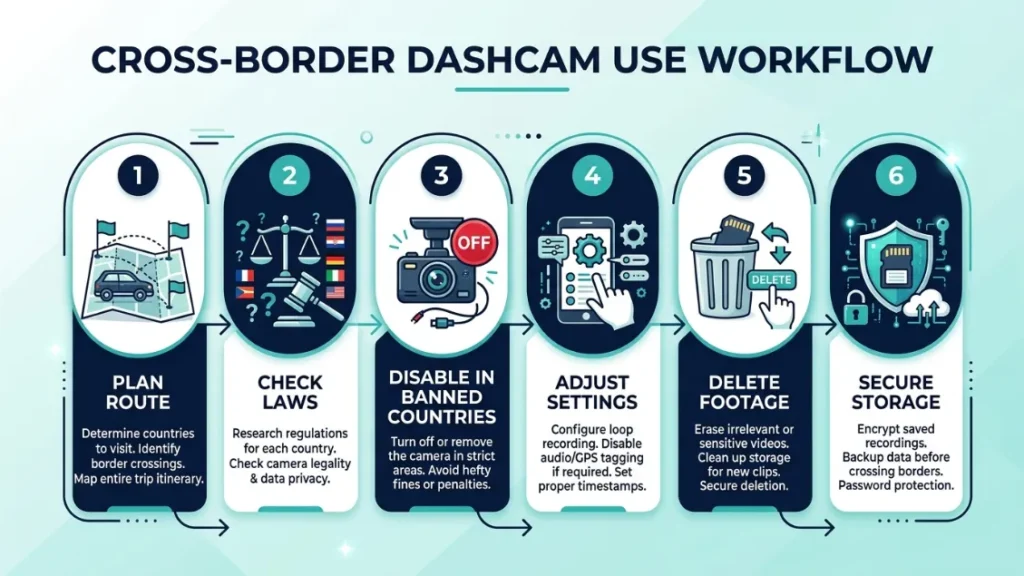
- Map your route and list every country you will drive through — including brief transits.
- Check dashcam legality for each country using a current source (published post-2022).
- For banned countries (Austria, Portugal, Luxembourg): turn off your dashcam and store it out of sight before crossing the border.
- For restricted countries (Germany, France, Switzerland): keep audio off, use short loop recording, and plan to share footage only with authorities if needed.
- Delete any footage you no longer need at the end of each day to reduce GDPR exposure.
- Store your memory card securely — not loose in the centre console where it is visible during a police stop.
For official travel guidance by destination, the UK Government’s Foreign Travel Advice pages and the US Department of State travel advisories both provide country-specific legal notes relevant to travellers.
Quick Country-by-Country Dashcam Legality Reference Table
| Country | Dashcam Status | Key Restriction |
|---|---|---|
| Austria | Banned | Data protection law — all recording illegal |
| Portugal | Banned (private) | CNPD ruling — privacy violation |
| Luxembourg | Restricted/Banned | Privacy law — recording individuals prohibited |
| Germany | Conditional | Short loop recording only; no public sharing |
| Switzerland | Conditional | Video OK; audio recording illegal without consent |
| Belgium | Conditional | GDPR applies; no extended surveillance use |
| France | Conditional | Legal for personal use; no public sharing of footage |
| United Kingdom | Legal | ICO data guidelines apply; footage admissible in court |
| United States | Legal (all states) | Windshield zone + audio consent laws vary by state |
| Russia | Legal | No significant restrictions; widely used |
| Japan | Legal | Privacy rules on sharing footage publicly |
| China | Conditional | Avoid sensitive government/military areas |
| Australia | Legal | State-level windshield and privacy rules apply |
Frequently Asked Questions
Are dashcams illegal in Austria?
Yes. Austria has a complete ban on dashcam use by private drivers under its national Data Protection Act. Recording other vehicles, pedestrians, or public roads is considered an illegal collection of personal data. Fines can reach up to €10,000.
Can I use my dashcam in Germany?
You can use a dashcam in Germany, but with strict conditions. Short loop recordings are permitted, but continuous recording raises privacy concerns under GDPR. A 2018 federal court ruling confirmed dashcam footage is admissible as accident evidence, but sharing footage publicly is not permitted.
Do US states have different dashcam laws?
Dashcams are legal in every US state, but two types of laws create variation. Windshield obstruction laws restrict where the camera can be mounted. Audio recording laws in states like California, Florida, and Illinois require all passengers to consent before audio is recorded.
Does GDPR apply to my personal dashcam footage?
Yes. In EU countries where dashcam recording is permitted, GDPR treats footage of identifiable individuals as personal data. You must record only what is necessary, store footage securely, and delete it once it no longer serves a safety or legal purpose. Sharing footage online without consent is a GDPR violation.
Which countries completely ban dashcams?
Austria, Portugal, and Luxembourg currently enforce the strictest restrictions — effectively banning private dashcam use under national privacy laws. Several other EU countries allow dashcams with significant conditions attached.
Is dashcam audio recording legal in Europe?
Not universally. Switzerland explicitly prohibits audio recording without consent from all parties in the vehicle. Most other EU countries treat audio recording as a heightened privacy risk under GDPR. Disabling audio is the safest approach for European driving regardless of the specific country.

I’m Alex Rahman, a car enthusiast and automotive writer focused on practical solutions, car tools, and real-world driving advice. I share simple and honest content to help everyday drivers make better decisions.
