Is a Dash Cam an MOT Failure — and Where Should You Mount It to Be Safe?
A dash cam is not an automatic MOT failure. But it can fail your MOT if it obstructs the driver’s view through the windscreen. The key rule: mount it outside the wiper zone, close to the rear-view mirror, and keep it small and unobtrusive. Remove it if you are unsure.
I pulled into the MOT bay last spring feeling confident. My car was clean, serviced, and ready. Then the tester walked around to the windscreen, pointed at my Nextbase 522GW, and said those words no driver wants to hear: “That’s going to be a problem.”
I’m Alex Rahman, and I’ve been writing about UK motoring rules for several years. That morning taught me something most drivers never think about. A dash cam — something millions of us fit for safety and peace of mind — can actually cause your car to fail its MOT if you get the placement wrong.
The good news? It is completely avoidable. You just need to know the rules. By the end of this guide, you’ll know exactly where to mount your dash cam, what MOT testers look for, and whether you should even leave it in for the test.
- A dash cam does not automatically fail an MOT — placement is everything.
- Mounting inside the windscreen wiper zone is the most common reason a dash cam causes failure.
- The safest position is top-centre behind the rear-view mirror, outside the wiper sweep area.
- MOT testers have discretion — two testers can reach different decisions on the same car.
- Removing your dash cam before the MOT is always the safest option if you are unsure.
What Does the MOT Test Actually Check on Your Windscreen?
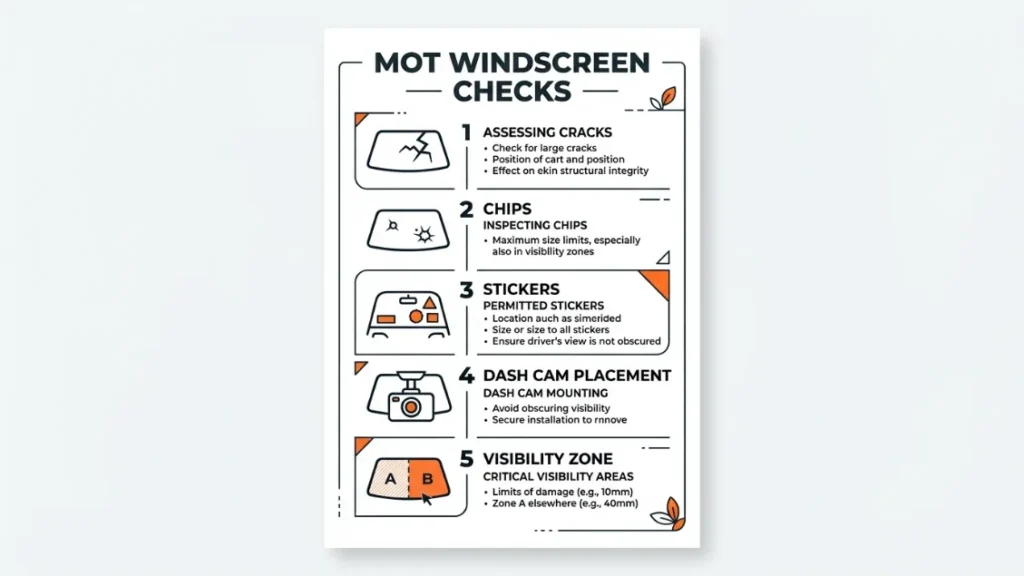
The MOT test checks whether your windscreen gives the driver a clear, unobstructed view of the road. This sits under the “Driver’s View of the Road” category in the DVSA’s MOT testing guide, and it covers anything that could limit how well you see what’s ahead.
Testers look at chips, cracks, stickers, and any object mounted on or near the glass. A dash cam falls directly into this category. It doesn’t matter whether it records in 4K or cost you £20 — if it blocks your view, it is a problem.
The MOT test has been updated several times over the years. Since 2018, the DVSA has applied stricter categories for defects, splitting them into minor, major, and dangerous. An obstruction to the driver’s view can land in the major category — which is an outright fail.
Why the Driver’s Field of Vision Is a Critical MOT Category
The driver’s field of vision is the entire sweep of what you can see through the windscreen while sitting in the normal driving position. Testers assess this from the driver’s seat. They check whether any object reduces what you can reasonably see.
A small, well-placed dash cam might not reduce your vision at all. A large unit mounted in the centre of the glass could block a meaningful section of your forward view. The tester makes that judgment based on what they see when they sit down.
This is why two identical cars with identical dash cams can get different results at different garages. There is a human element here, and understanding it helps you prepare.
What Counts as a Windscreen Obstruction According to DVSA Rules?
According to the DVSA’s official MOT testing guide, a windscreen obstruction is anything that significantly affects the driver’s view through the glass. This includes stickers, sat-nav units, air fresheners, and yes — dash cams.
The DVSA does not publish a specific size limit for dash cams. Instead, testers apply a judgment standard: does this device meaningfully reduce what the driver can see? A compact unit behind the mirror generally passes that test. A large device mounted low in the driver’s eyeline often does not.
The DVSA does not publish a maximum size for dash cams. But devices wider than 40mm placed outside the A-pillar zone draw regular scrutiny from testers. Err on the side of a compact model and a high mounting position.
Can a Dash Cam Fail an MOT — What the Rules Actually Say?
Yes, a dash cam can fail an MOT — but only if it obstructs the driver’s view or creates another testable defect. A properly mounted, small dash cam positioned behind the rear-view mirror will pass with no issues in the vast majority of cases.
The key phrase in the DVSA’s guidance is “significant obstruction.” A compact device, tucked neatly behind the mirror and outside the wiper zone, does not significantly obstruct anything. A large, suction-cupped unit sitting in the middle of the glass at eye level — that is a different matter.
The DVSA’s MOT Inspection Manual is publicly available. Section 8 covers driver’s view of the road and is worth reading before your next test.
The Wiper Zone Rule That Catches Most Drivers Off Guard
The wiper zone is the area of the windscreen swept by your wipers when they operate. Mounting a dash cam inside this zone is one of the most common reasons drivers get an MOT advisory or failure related to their camera.
Here is why it matters. When the wiper sweeps across the glass, a dash cam mounted in that path creates a problem. The wiper cannot clean that section of glass properly. That means reduced visibility in rain — which is, itself, a separate MOT concern about the wiper’s effectiveness.
On most UK cars, the wiper zone covers the lower two-thirds of the windscreen in a curved sweep from each A-pillar inward. The top strip of the windscreen — roughly the top 10% — is generally outside this zone. That strip, directly behind the rear-view mirror, is the sweet spot for dash cam mounting.
Turn your wipers on before you mount your dash cam. Watch where the blades sweep. Mount your camera above the highest point the wiper blade reaches — that keeps you safely outside the wiper zone.
Does Dash Cam Size Matter to an MOT Tester?
Size absolutely matters to an MOT tester. A compact dash cam — roughly the size of a matchbox — mounted high and centrally behind the mirror is almost never flagged. A larger unit, particularly one with a wide housing or extended screen, draws far more attention.
Popular compact models like the Viofo A119 Mini or the Nextbase 222 are small enough that most testers will not flag them if mounted correctly. Larger dual-channel units with front-facing screens — especially those mounted lower on the glass — carry more risk.
The principle is simple: the smaller the device and the higher the mounting position, the less likely it is to obstruct your view. Choose your dash cam model with MOT compliance in mind, not just video quality.
Where to Mount Your Dash Cam to Avoid an MOT Failure
Mount your dash cam at the top centre of the windscreen, directly behind the rear-view mirror, outside the wiper sweep zone. This position keeps the device out of your direct eyeline, minimises the area of glass it covers, and sits outside the wiper path.
This is not just advice — it reflects the standard that most UK MOT testers apply in practice. Hundreds of thousands of UK drivers run dash cams in this position with no MOT issues at all.
| Mounting Position | MOT Risk Level | Reason |
|---|---|---|
| Top centre, behind rear-view mirror | Low | Outside wiper zone, outside driver’s direct eyeline |
| Top corner, near A-pillar | Medium | May partially block side view depending on size |
| Centre of windscreen, mid-height | High | Sits in wiper zone and likely in driver’s eyeline |
| Dashboard mount (non-windscreen) | Low | No windscreen contact — but may affect forward view if large |
| Low centre, near dashboard line | Very High | Deep inside wiper zone, direct forward obstruction |
The Safest Mounting Position Behind the Rear-View Mirror
Behind the rear-view mirror is the gold standard mounting position for dash cam MOT compliance in the UK. The mirror already blocks a section of glass — tucking the dash cam behind it means the camera adds virtually no new obstruction to what the driver can see.
Most compact dash cams are specifically designed with this position in mind. Nextbase, one of the UK’s most trusted dash cam brands with over 2 million cameras sold, recommends this position in their installation guides for exactly this reason.
The only catch: make sure the camera lens has a clear view of the road ahead from that position. Some mirrors sit quite high, which means the camera angle needs slight adjustment. A ball-joint mount makes this easy to set up correctly.
Which Mounting Positions Put You at Risk of Failing?
Any mounting position in the lower two-thirds of the windscreen carries real MOT risk. This includes the popular habit of sticking the camera to the glass just above the dashboard — it looks tidy, but it sits squarely inside the wiper sweep zone.
Side-of-glass mounting, near the A-pillar and at eye level, is also a problem. It can partially obstruct your peripheral view and will draw attention from a careful tester. If your camera sits anywhere near your natural sightline while driving, move it up.
Does Dash Cam Wiring or Installation Affect Your MOT Result?
Dash cam wiring can affect your MOT, but only in specific situations. Loose cables trailing across the dashboard or dangling near the pedals are a safety concern that a thorough tester will note. A neat, properly routed installation will not cause any issues.
Most MOT testers focus on the camera position first. But a car with wires hanging loose near the steering column or obscuring the driver’s controls can receive an advisory or, in severe cases, a failure related to driver distraction or interference with controls.
Can a Hardwired Dash Cam Create MOT Problems?
A hardwired dash cam — one connected directly to the car’s fuse box — does not create MOT problems when installed correctly. The wiring sits behind trim panels and is invisible during the inspection. Testers have no way to assess what is behind your door cards or under your dashboard trim.
The MOT test does not check the electrical installation of aftermarket accessories unless there is visible evidence of unsafe wiring. A professional hardwire installation by a qualified auto electrician presents no MOT risk at all.
What About Loose Cables — Will an MOT Tester Fail Them?
Loose cables that interfere with driving controls are a legitimate MOT concern. A cable dangling near the steering wheel, looped around the gear lever, or trailing across the footwell creates a genuine safety risk — and an MOT tester can flag it.
The fix is simple. Route your dash cam cable along the A-pillar trim, across the headliner, and down behind the rear seats or trim. Tuck every inch of cable out of sight. It takes twenty minutes and removes any wiring-related MOT risk entirely.
Use a plastic trim removal tool to tuck your dash cam cable neatly behind the A-pillar. It takes under ten minutes and makes your installation look professional — no loose cables, no MOT worries.
Does a Rear Dash Cam Affect Your MOT Differently?
A rear dash cam — mounted on the rear windscreen — is assessed differently from a front camera because rear visibility rules are less strict in MOT testing. The rear window does not fall under the same driver’s forward field of vision rules, so there is more flexibility.
That said, a rear camera mounted on the rear windscreen should still avoid the wiper sweep zone on the rear glass. A device that prevents the rear wiper from functioning properly can trigger an advisory about wiper effectiveness. Mount it in the top centre of the rear glass, above the wiper arc.
Rear cameras also need their cables routed neatly. A cable trailing from the rear window across the parcel shelf and into the cabin should be tucked behind the headliner and C-pillar trim — the same principle as the front camera applies.
Dual-channel dash cam systems — with both a front and rear camera — are increasingly popular in the UK. Both cameras must comply with the placement rules for their respective windows. Getting both right means you carry full MOT protection front and back with zero compliance risk.
Should You Remove Your Dash Cam Before Your MOT?
Removing your dash cam before an MOT is the safest option if you have any doubt about its mounting position. It takes thirty seconds, removes all risk of a dash-cam-related failure, and costs you nothing. There is no rule that says it must stay in the car during the test.
If your camera is properly mounted — top centre, behind the mirror, outside the wiper zone — you can leave it in with confidence. But if it is mounted anywhere lower, or if you are using a larger model, taking it out is the smartest move.
Some drivers worry that removing the camera looks suspicious or raises questions. It does not. MOT testers are not concerned with why accessories have been removed. They test what is in front of them on the day.
What MOT Testers Actually Look For — and Their Discretion
MOT testers assess dash cams based on one core question: does this device significantly obstruct the driver’s view of the road? That word “significantly” gives them genuine discretion. Two experienced testers can look at the same camera and reach different conclusions.
In practice, most testers are pragmatic. A compact camera in the right position gets waved through. A large unit sat in the driver’s eyeline gets flagged. The grey area sits in between — mid-size cameras in borderline positions.
The Nextbase official guidance on dash cams and MOT acknowledges this directly. They recommend the top-centre position behind the mirror precisely because it removes any ambiguity from the tester’s assessment.
How to Check Your Dash Cam Position Before MOT Day — Step-by-Step
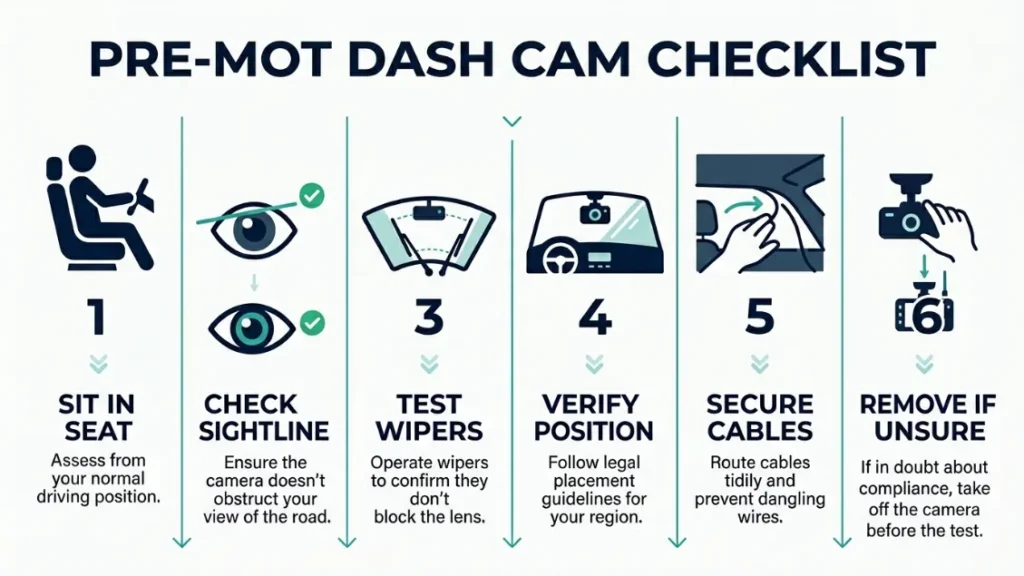
- Sit in the driver’s seat in your normal driving position.
- Look straight ahead through the windscreen at the road.
- Does the dash cam appear anywhere in your direct forward sightline? If yes, move it higher.
- Turn your wipers on at full speed. Watch exactly where the blades reach.
- Check that your dash cam sits above the highest point reached by the wiper blade.
- Check that no cables are visible hanging loose near the steering wheel, pedals, or gear lever.
- Confirm the camera is mounted behind the rear-view mirror, not beside or below it.
- If any step above raises a concern — remove the camera before your MOT.
Common Dash Cam Mistakes That Lead to MOT Failures
Most dash cam MOT failures come down to the same handful of mistakes. Knowing them in advance means you will never make them.
- Mounting too low: The most common error. Anything below the top quarter of the windscreen sits inside the wiper zone on most UK cars.
- Using a suction cup that migrates over time: A suction cup mount can slide downward in warm weather, moving a compliant camera into a non-compliant position. Check the position before every MOT.
- Choosing an oversized dual-screen model: Dash cams with large rear-facing screens on the front unit take up significantly more glass space. Size matters for compliance.
- Mounting near the A-pillar at eye level: Drivers sometimes choose this position to keep the camera out of the way — but it sits directly in the peripheral field of vision.
- Ignoring the rear camera: Fitting a front camera correctly but leaving the rear unit dangling inside the wiper zone on the back glass is a common oversight.
- Loose power cables: A cable from the camera to the 12V socket, draped across the dashboard, catches the eye of a thorough tester and can trigger an advisory.
A dash cam will not fail your MOT if it is small, mounted at the top centre of the windscreen behind the rear-view mirror, outside the wiper sweep zone, and wired neatly out of sight. The one risk factor you control most is mounting position. Get that right and your dash cam is no threat to your MOT result.
Conclusion
The answer to “is a dash cam an MOT failure?” is: not if you mount it correctly. The rules exist to protect driver visibility — and a well-placed dash cam does not threaten that at all.
Mount it high. Keep it behind the mirror. Stay above the wiper zone. Tuck the cables. Those four steps are all it takes to run a dash cam in your UK car with zero MOT risk, year after year.
I’m Alex Rahman, and I’ve spent years helping UK drivers navigate motoring rules that nobody explains clearly enough. The dash cam question is one of the most common — and the answer is simpler than most people think.
If you are booked in for an MOT soon, take two minutes to run through the pre-MOT checklist above. It could save you a retest fee and a frustrating afternoon. For more on UK vehicle inspection rules, the official UK government MOT guidance is always worth a read.
Frequently Asked Questions
Is a dash cam an MOT failure in the UK?
A dash cam is not an automatic MOT failure. It only causes a failure if it obstructs the driver’s view through the windscreen. A small camera mounted at the top centre of the glass, behind the rear-view mirror and outside the wiper zone, will pass without issue in the vast majority of cases.
Where is the best place to mount a dash cam to pass an MOT?
The best position is directly behind the rear-view mirror at the top centre of the windscreen. This keeps the camera out of the driver’s direct sightline and outside the wiper sweep zone. Most compact dash cam manufacturers, including Nextbase, recommend this position specifically for MOT compliance.
Can dash cam wiring cause an MOT failure?
Loose dash cam wiring that trails near steering controls, pedals, or gear levers can be flagged by an MOT tester as a safety concern. Wiring that is neatly routed behind trim panels and out of sight will not affect your MOT result at all.
Should I remove my dash cam before my MOT test?
Removing your dash cam before an MOT is the safest choice if you have any doubt about its mounting position. There is no rule requiring it to stay in the car during the test. If your camera is correctly positioned — high, behind the mirror, outside the wiper zone — you can safely leave it in.
Does a rear dash cam affect MOT differently from a front one?
Yes. Rear cameras are not assessed under the same forward field of vision rules as front cameras. They carry less MOT risk overall. However, they should still be mounted above the rear wiper arc and wired neatly to avoid any advisory related to wiper function or loose cables.
What size dash cam is safe for MOT purposes?
The DVSA does not publish a specific size limit. In practice, compact models — roughly matchbox-sized — rarely draw scrutiny when positioned correctly. Larger units with screens wider than approximately 40mm, especially when mounted outside the top mirror zone, attract greater attention from testers. Compact models are the safest choice for MOT compliance.

I’m Alex Rahman, a car enthusiast and automotive writer focused on practical solutions, car tools, and real-world driving advice. I share simple and honest content to help everyday drivers make better decisions.
