Are Dash Cams Legal and Where Can You Legally Install One?
Dash cams are legal in most countries, including the US, UK, Canada, and Australia. The key rule: your camera must not obstruct your view while driving. In the US, laws vary by state. In the UK, GDPR rules apply. Always check your local windshield obstruction law before mounting.
I pulled into a parking lot last year after a minor fender bender. No witnesses. The other driver told the police a completely different version of events. I had no footage. I had nothing.
That was the moment I started taking dash cam legality seriously. Not just “is it allowed” — but where to mount it, what it can record, and whether footage holds up in court.
I’m Alex Rahman, and I’ve spent years writing about vehicle safety and technology. In this guide, I’ll answer every question about dash cam legality — including the ones most guides skip entirely.
By the end, you’ll know exactly whether your setup is legal — and what to fix if it isn’t.
- Dash cams are legal in the US, UK, Canada, and Australia — with conditions.
- The most common legal rule: the camera must not obstruct the driver’s line of sight.
- Audio recording inside your car may require passenger consent depending on your state.
- In the UK, GDPR applies — even to personal dash cams used on public roads.
- Rideshare drivers must follow both platform rules and local recording laws.
What Is a Dash Cam and Why Does Its Legal Status Matter to You?
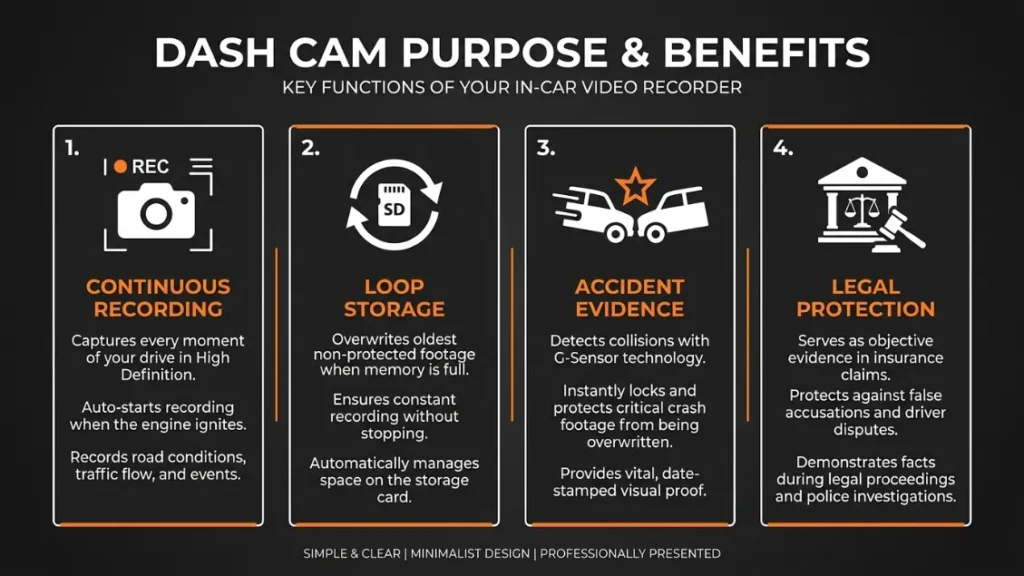
A dash cam is a small camera that mounts in your vehicle and records video continuously while you drive. Most loop-record — overwriting old footage when the memory card fills up. Some save clips automatically when a collision sensor triggers.
The legal status matters for one simple reason. Installing a camera incorrectly can get you ticketed, invalidate your footage in court, or expose you to privacy lawsuits.
Getting this right before you install saves you from a much bigger problem later.
How a Dash Cam Works in Your Vehicle
Most dash cams connect to your car’s power via the 12V socket or hardwire directly to the fuse box. They record to a microSD card in a continuous loop. When the card fills, the oldest footage gets overwritten.
Premium models like the Nextbase 622GW — trusted by over 2 million UK drivers — include built-in GPS, emergency SOS, and collision detection. The Garmin Dash Cam Mini 2 records in 1080p and fits in a space smaller than a golf ball.
The hardware is simple. The legal part takes a little more attention.
Are Dash Cams Legal in the United States?
Dash cams are legal in all 50 US states. No federal law bans them. However, each state has its own rules about where you can mount a camera on your windshield. The core concern across every state is the same: don’t block your line of sight while driving.
Most problems happen not from owning a dash cam — but from mounting it in the wrong spot.
Which US States Have Specific Dash Cam Windshield Laws?
State laws differ in how they define the legal mounting zone on your windshield. Here is a breakdown of key states:
| State | Windshield Mounting Rule |
|---|---|
| California | Must be in lower-left corner (7″ from bottom) or upper-right corner (5″ from top) |
| New York | No object may obstruct the driver’s view — camera must be small and positioned carefully |
| Texas | Anything attached to the windshield must not obstruct the driver’s clear view |
| Florida | No object can be placed between the driver and the windshield if it impairs visibility |
| Illinois | Dash cams are permitted but must not obstruct the driver’s view of the road |
California has the most specific rules of any US state. It defines exact zones on the windshield where mounting is permitted under Vehicle Code Section 26708. If you live in California, mount in either the lower-left or upper-right corner — nowhere else.
Mounting a dash cam behind your rearview mirror sounds logical — but in some states, anything in that center zone can count as an obstruction. Always check your state DMV guidelines before mounting.
Does It Matter Whether Your Dash Cam Is Visible?
Legally, no US state requires your dash cam to be visible to other road users. But practically, a visible camera can deter aggressive drivers and staged accident attempts — which is exactly why insurance fraud has dropped in areas with higher dash cam adoption.
Some drivers worry that a visible camera invites break-ins. If that concerns you, choose a compact model like the Garmin Dash Cam Mini 2 — it’s small enough to go almost unnoticed behind your mirror.
Are Dash Cams Legal in the UK, Australia, and Other Countries?
Dash cams are fully legal in the UK, Australia, and Canada. Each country has its own framework — but none ban them outright. The UK sits in a unique position because GDPR adds a data privacy layer that most other countries don’t have.
How Do UK GDPR Rules Affect Your Dash Cam Use?
In the UK, dash cam footage technically counts as personal data under UK GDPR guidelines from the ICO (Information Commissioner’s Office). For personal, household use — like recording your own commute — you fall under a domestic exemption and GDPR does not fully apply.
However, if you share footage online, submit it to police, or use it commercially, you may need to consider data protection obligations. The ICO published guidance specifically for personal dash cam users in 2023.
The practical rule: record for your own protection, and think before you post or share.
In the UK, submitting dash cam footage to police via the National Dash Cam Safety Portal is encouraged and legal. Your footage can directly contribute to road safety prosecutions.
What Are the Dash Cam Laws in Australia and Canada?
In Australia, dash cams are legal in every state and territory. The rules mirror the US approach: the camera must not obstruct the driver’s view. In New South Wales, the road rules specifically prohibit any object in a position that interferes with the driver’s vision.
Canada follows a similar pattern. No federal ban exists. Provincial rules vary slightly, but the consistent rule across all provinces is that windshield-mounted devices must not block the driver’s sightline.
| Country | Legal Status | Key Rule |
|---|---|---|
| United States | Legal — all 50 states | No windshield obstruction; state zones vary |
| United Kingdom | Legal | No obstruction; GDPR applies to shared footage |
| Australia | Legal — all states | Must not obstruct driver’s view |
| Canada | Legal — all provinces | Province rules vary; no sightline blockage |
| Germany | Legal with restrictions | Recording other people requires legitimate purpose under GDPR |
Where Can You Legally Install a Dash Cam in Your Car?
You can legally install a dash cam on your windshield, dashboard, or rearview mirror mount — as long as it doesn’t block your line of sight to the road. The exact legal zone on your windshield depends on your state or country. Most drivers mount behind the rearview mirror to minimize obstruction.
Is It Legal to Mount a Dash Cam on Your Windshield?
Yes — windshield mounting is the most common and generally accepted method. The key is placement. A camera mounted dead-center at eye level blocks your forward view. A camera tucked behind your rearview mirror stays out of your sightline entirely.
Most dash cam manufacturers — including Nextbase, Vantrue, and Garmin — design their products to mount directly behind the rearview mirror for exactly this reason.
Where on the Windshield Is It Legal to Mount a Dash Cam?
The legal mounting zone depends on your location. Here is a clear breakdown:
- Check your state or country’s vehicle code for windshield obstruction rules.
- In California: use the lower-left (7 inches from the bottom) or upper-right corner (5 inches from top).
- In the UK: mount behind the rearview mirror — keep the camera within the swept area of your wipers.
- In most other US states: mount behind the rearview mirror, centered at the top of the windshield.
- Test your view — sit in the driver’s seat and confirm the camera does not enter your natural sightline.
Can You Mount a Dash Cam on Your Dashboard Instead?
Yes, and in many ways a dashboard mount is the safest legal choice. It keeps the windshield clear and avoids obstruction laws entirely. The tradeoff is a lower camera angle — your footage may capture more of the hood and less of the road ahead.
Dashboard mounts work especially well for rear-cabin or interior cameras pointed at passengers. Commercial vans and taxis often use this setup for exactly that reason.
If you’re unsure about windshield laws in your state, mount on the dashboard. You get full legal cover and still capture a clear road view — especially with a wide-angle lens of 140 degrees or more.
Is It Legal to Use a Rear-Facing or Interior Dash Cam?
Rear-facing cameras mounted on the inside of your rear windshield are legal in the US, UK, Canada, and Australia. They must not block the driver’s rear visibility through the window.
Interior cabin cameras — pointed at passengers — are legal on a video-only basis in most places. Audio recording inside the vehicle is where the law gets complicated. More on that in the next section.
Are Dash Cams Legal for Recording Audio Inside Your Car?
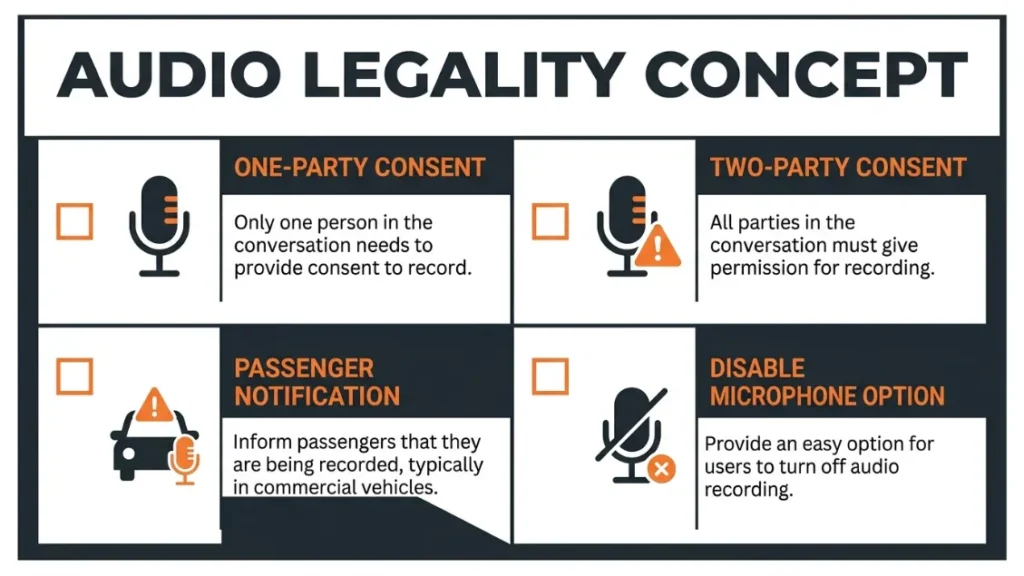
Video recording inside your car is legal in most places. Audio recording is not always legal — it depends entirely on where you are and who is in the vehicle. Many drivers don’t realize their dash cam records audio by default. This is one of the most overlooked legal risks in dash cam use.
What Is Two-Party Consent and Why Should You Care?
Two-party consent (also called all-party consent) means everyone in a conversation must agree to being recorded. In states with two-party consent laws, recording a passenger’s voice without their knowledge can be a criminal offense.
One-party consent states only require one person in the conversation to consent — which means you can legally record audio as the driver. But in a two-party consent state, you must tell passengers they may be recorded.
The simplest fix: turn off audio recording in your dash cam settings. Most models — including Vantrue and Nextbase cameras — let you disable the microphone with one button press. If audio isn’t essential, just switch it off.
Which States Require Passenger Consent Before Recording Audio?
As of 2024, the following US states use a two-party (all-party) consent standard for audio recordings:
- California
- Florida
- Illinois
- Maryland
- Massachusetts
- Michigan
- Montana
- Nevada
- New Hampshire
- Oregon
- Pennsylvania
- Washington
In these states, recording a passenger’s voice without their consent may violate the state wiretapping statutes tracked by the National Conference of State Legislatures. Always inform passengers in these states — or disable the microphone.
In California, violating the two-party consent law is a criminal offense — not just a civil matter. If you regularly carry passengers in California and your dash cam records audio, disable that feature immediately.
Are Dash Cams Legal for Rideshare and Commercial Drivers?
Rideshare and commercial drivers can use dash cams legally — but they face additional rules beyond standard traffic law. Platform policies, state audio laws, and commercial vehicle regulations all apply at the same time. Getting all three right is what protects you.
Can Uber and Lyft Drivers Use Dash Cams Legally?
Both Uber and Lyft permit drivers to use dash cams. Neither platform bans them. But both require drivers to comply with all local laws — including audio consent rules.
Many rideshare drivers use the Vantrue E1 Lite or similar dual-channel cameras that record both the road and the cabin simultaneously. This setup provides protection in disputes with passengers and on the road.
If you drive for Uber or Lyft in a two-party consent state, place a visible notice in your vehicle. Something simple like “Audio and video recording in progress” satisfies consent requirements in most states. Check your state’s specific language to be sure.
What Rules Apply to Fleet and Commercial Vehicle Cameras?
Fleet operators installing cameras in commercial vehicles must comply with employee monitoring laws. In the UK, the ICO requires employers to tell staff about any camera monitoring as part of their data protection obligations under UK GDPR.
In the US, federal regulations covering commercial drivers (FMCSA rules) don’t specifically address dash cams — but state employee privacy laws may apply. Fleet managers should always disclose camera use in driver employment contracts.
Rideshare drivers: check both platform policy and state audio laws. Fleet drivers: ensure all employees are informed of camera use in writing. Both groups: video recording of the road is fine everywhere — audio recording is the risk point.
Can You Use Dash Cam Footage as Legal Evidence in Court?
Yes — dash cam footage is admissible as evidence in US, UK, and Australian courts, provided it was recorded legally and the footage is authentic. Courts have accepted dash cam video in civil accident claims, criminal proceedings, and insurance disputes.
In the UK, police actively encourage drivers to submit footage via the National Dash Cam Safety Portal. Since its launch, the portal has received hundreds of thousands of footage submissions used to support prosecutions for dangerous driving.
For footage to hold up in court, three things matter:
- Chain of custody: Don’t edit or alter the footage in any way after the event.
- Metadata intact: GPS timestamps and date/time stamps on the footage add credibility.
- Legal recording: Footage recorded in violation of audio consent laws may be challenged or excluded.
A dash cam with built-in GPS — like the Garmin Dash Cam 57 — records speed and location data alongside video. That metadata makes your footage significantly harder to dispute in court.
What Common Dash Cam Installation Mistakes Could Get You in Trouble?
Most legal problems with dash cams come from installation errors — not from owning the camera. Here are the mistakes that create legal exposure:
- Mounting in the center of the windshield: This blocks sightlines and violates obstruction laws in most states.
- Leaving audio recording on in a two-party consent state: A default setting you haven’t changed can become a criminal issue.
- Installing a camera that blocks the rearview mirror: Even a small camera at the wrong angle can obstruct your rear visibility.
- Running cables across the driver’s footwell: Loose cables near pedals are a safety hazard and may fail a vehicle inspection.
- Using a sun visor mount: This positions the camera directly in your sightline — illegal in most jurisdictions.
Route your power cable along the rubber trim at the edge of your windshield. It tucks away cleanly, looks professional, and keeps your footwell clear. Most dash cam kits include a pry tool to help you do this.
Is Your Dash Cam Setup Fully Legal? A Quick Checklist
Run through this checklist before your first drive with a new dash cam. Each point covers a real legal risk — not just a best practice.
- Camera is mounted in a legally approved zone for your state or country.
- Camera does not block your forward or rearward sightline.
- Audio recording is either disabled or passengers have been informed.
- Power cables are routed safely — not across pedals or the driver’s footwell.
- If you’re a rideshare driver: a visible notice informs passengers of recording.
- If you’re a fleet manager: camera use is disclosed in employee documentation.
- You have checked your specific state or country’s windshield obstruction law.
If you tick every box, your setup is legally solid. If anything is missing, fix it before you drive.
Conclusion
Dash cams are legal — almost everywhere. The law doesn’t care that you have one. It cares where you put it and what it records.
The core rules are simple. Don’t block your view. Know your state’s audio laws. Tell passengers if you record them. And mount the camera behind your mirror, not in the center of your windshield.
I’m Alex Rahman, and I’ve seen too many drivers lose insurance claims — or face unnecessary legal headaches — because of a preventable installation mistake. A good dash cam gives you powerful protection. A legally sound setup makes that protection actually work.
Check your state’s dash cam guidelines via DMV.org, run through the checklist above, and you’re good to go.
Frequently Asked Questions
Are dash cams legal in all US states?
Yes, dash cams are legal in all 50 US states. No federal or state law bans them outright. The key restriction in every state is that your camera must not obstruct the driver’s line of sight through the windshield.
Where is the best legal place to mount a dash cam?
The safest legal position is directly behind your rearview mirror, at the top center of the windshield. In California, use the lower-left corner (7 inches from the bottom) or upper-right corner (5 inches from the top) as required by Vehicle Code 26708.
Do passengers have to know they are being recorded by a dash cam?
For video-only recording, no notice is typically required in the US. For audio recording, passengers must be informed in the 12 states with two-party consent laws, including California, Florida, and Illinois. The easiest solution is to disable audio recording entirely.
Can dash cam footage be used as evidence in a car accident claim?
Yes. Dash cam footage is admissible in US, UK, and Australian courts when it was recorded legally and has not been altered. Footage with GPS timestamps and date/time data is especially strong evidence. Do not edit the file after an incident.
Is it legal for Uber and Lyft drivers to use a dash cam?
Both Uber and Lyft allow drivers to use dash cams. Drivers must comply with local recording laws, especially audio consent rules. In two-party consent states, a visible notice informing passengers of recording is recommended before every trip.
Does UK GDPR affect personal dash cam users?
For everyday personal use — recording your own commute — UK GDPR’s domestic exemption applies and you are not subject to full data protection obligations. If you share footage publicly or submit it to third parties beyond police, GDPR may apply. The ICO published specific guidance for dash cam users in 2023.

I’m Alex Rahman, a car enthusiast and automotive writer focused on practical solutions, car tools, and real-world driving advice. I share simple and honest content to help everyday drivers make better decisions.
