How Much Should You Pay for a Decent Dash Cam? (A Complete Price Guide)
A decent dash cam costs between $50 and $150 for most drivers. Budget models ($30–$80) cover basic recording. Mid-range ($80–$150) adds GPS, better night vision, and rear cameras. Premium ($150–$400+) suits rideshare drivers, frequent travelers, or anyone wanting parking mode and 4K footage.
A few years ago, I almost missed capturing a hit-and-run because my cheap $25 dash cam corrupted the file. The plate was there. The footage was not. That was a frustrating and expensive lesson.
I’m Alex Rahman, and I’ve tested and researched dash cams for years — from $30 bargain buys to $400 cloud-connected systems. I know exactly where the value is and where you’re just paying for a logo.
Most people searching “how much does a dash cam cost” don’t actually need the cheapest option or the most expensive one. They need the right one for their situation. That is what this guide will help you find.
By the end, you’ll know exactly which price tier fits your needs, which features are worth paying for, and what hidden costs to plan for.
- A reliable dash cam starts at around $50 — below that, quality and reliability drop sharply.
- The $80–$150 mid-range tier delivers the best value for most everyday drivers.
- GPS, night vision quality, and parking mode are the features most worth paying extra for.
- A front-and-rear system typically costs $30–$60 more than a front-only model.
- Budget at least $10–$20 extra for a quality microSD card — cheap cards cause recording failures.
What Does a “Decent” Dash Cam Actually Mean for Most Drivers?
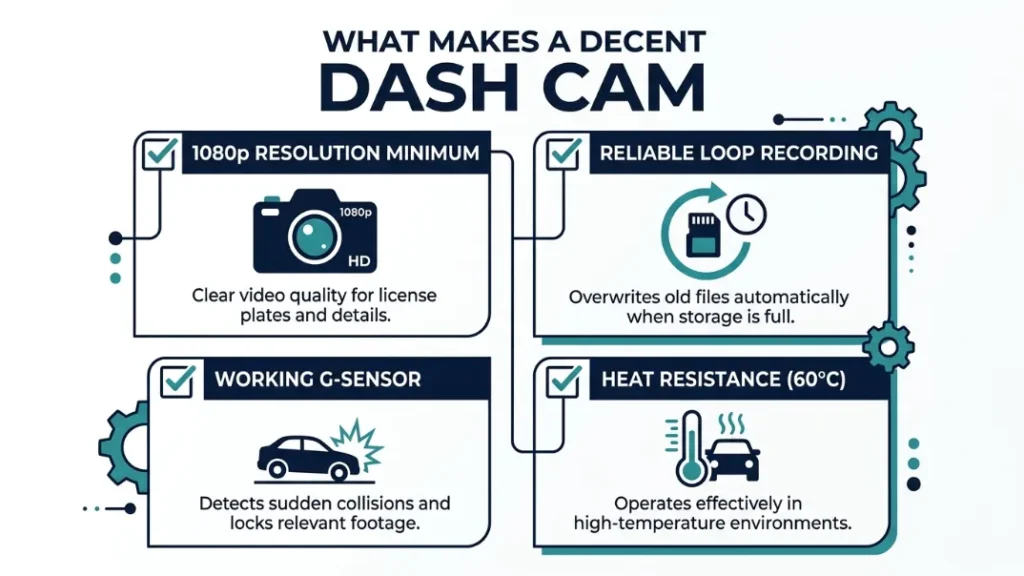
A decent dash cam records clear footage that is actually usable when you need it — in an accident, during an insurance dispute, or as evidence after a hit-and-run. It does not overheat in summer, corrupt files, or stop recording randomly.
Many people buy the cheapest dash cam they can find, assuming all cameras do the same thing. They don’t. A $20 no-name camera may technically record, but the footage often comes out blurry, overexposed, or corrupted at the exact moment it matters most.
A “decent” dash cam clears four bars:
- 1080p resolution minimum — sharp enough to read license plates in daylight
- Reliable loop recording without file corruption
- A working G-sensor that locks footage after an impact
- Stable performance in heat above 140°F (60°C) inside a parked car
Once a camera clears those bars, everything else is a bonus you pay more for.
What Is the Minimum You Should Spend to Get a Reliable Dash Cam?
The realistic minimum for a reliable dash cam is around $50. Below that price, you risk inconsistent recording, poor build quality, and customer support that does not exist.
Brands like Viofo and Garmin have proven that solid performance is achievable at $50–$70. Viofo’s A119 Mini 2, for example, retails around $55–$65 and delivers clean 1440p footage with a compact design and no major reliability complaints.
The $20–$40 range is filled with unbranded cameras from Amazon marketplace sellers. Some work fine for months. Many fail within a year or corrupt footage without warning. For something protecting you legally and financially, that is not a risk worth taking.
Avoid cameras with no brand name, no customer service contact, and no listed country of manufacture. If the listing disappears after your purchase, you have no warranty support and no one to call when it fails.
What Do You Get at Each Dash Cam Price Range?
Dash cam features scale clearly with price. Knowing what each tier includes helps you stop overpaying for features you don’t need — and stop underpaying for ones you actually do.
Here is a full breakdown of what each price tier delivers:
| Feature | Budget ($30–$80) | Mid-Range ($80–$150) | Premium ($150–$400+) |
|---|---|---|---|
| Resolution | 1080p | 1080p–1440p | 1440p–4K |
| Night Vision | Basic / inconsistent | Good (Sony Starvis sensor) | Excellent |
| GPS | Rarely included | Often included | Standard |
| Parking Mode | No | Some models | Yes (hardwire required) |
| Wi-Fi / App | Rare | Common | Standard |
| Rear Camera | Add-on (separate cost) | Bundled in many kits | Standard in most systems |
| Brand Examples | Viofo A119 Mini, Garmin 67W | Vantrue E1 Lite, Nextbase 422GW | BlackVue DR900X, Vantrue N4 |
Budget Tier ($30–$80): What Works and What Falls Short
Budget dash cams in the $30–$80 range handle basic accident recording well — but they cut corners on night vision, GPS, and build quality. For a casual commuter with a short daily drive in a city with good streetlighting, a $55–$70 model from Viofo or Garmin works fine.
The Viofo A119 Mini 2 sits at the top of this tier. It records 1440p footage, uses a capacitor instead of a battery (better for hot climates), and retails around $55–$65. That is genuinely impressive performance for the price.
Where budget cams fall short:
- Night video quality degrades quickly without a Sony Starvis or similar low-light sensor
- No GPS means no speed or location data stamped on footage
- Build quality varies — some units develop rattles, loose mounts, or screen glitches within 12 months
If your budget is firm at under $80, stick to named brands with verifiable reviews — not anonymous listings with 4.5 stars and 50 reviews.
Mid-Range Tier ($80–$150): Where Value Meets Real Performance
The $80–$150 range is where most drivers should land. You get 1080p–1440p resolution, reliable low-light performance, GPS tracking, Wi-Fi connectivity, and often a rear camera bundled in — features that matter when an incident actually happens.
Vantrue’s E1 Lite ($90–$110) is a standout here. It uses a Sony Starvis sensor for strong night vision and includes built-in Wi-Fi for easy footage transfer to your phone. Nextbase’s 422GW ($100–$130) adds Alexa integration and a clean companion app.
This tier suits the majority of drivers — daily commuters, parents tracking new drivers, and anyone who wants solid protection without spending on features they will rarely use.
If you are comparing two mid-range models, check whether GPS is built in or costs extra. Some brands advertise a $90 price then charge another $20–$30 for the GPS module separately.
Premium Tier ($150–$400+): Who Actually Needs to Spend This Much?
Premium dash cams deliver 4K resolution, advanced parking mode, cloud connectivity, and multi-channel recording — but most everyday drivers will never use all of those features. This tier makes real sense for rideshare drivers, fleet operators, and anyone parking in high-risk areas overnight.
BlackVue’s DR900X-2CH records 4K front and 1080p rear footage and connects directly to BlackVue’s cloud platform. You can check live footage remotely from your phone. That is powerful — but it comes with a $350+ price tag and a monthly cloud subscription.
Vantrue’s N4 ($200–$230) covers front, rear, and interior simultaneously — essential for Uber and Lyft drivers who need documentation of in-cabin incidents.
If you park in a garage at home and drive a normal commute, a premium cam adds very little practical value over a good mid-range model.
Which Dash Cam Features Are Worth Paying Extra For?
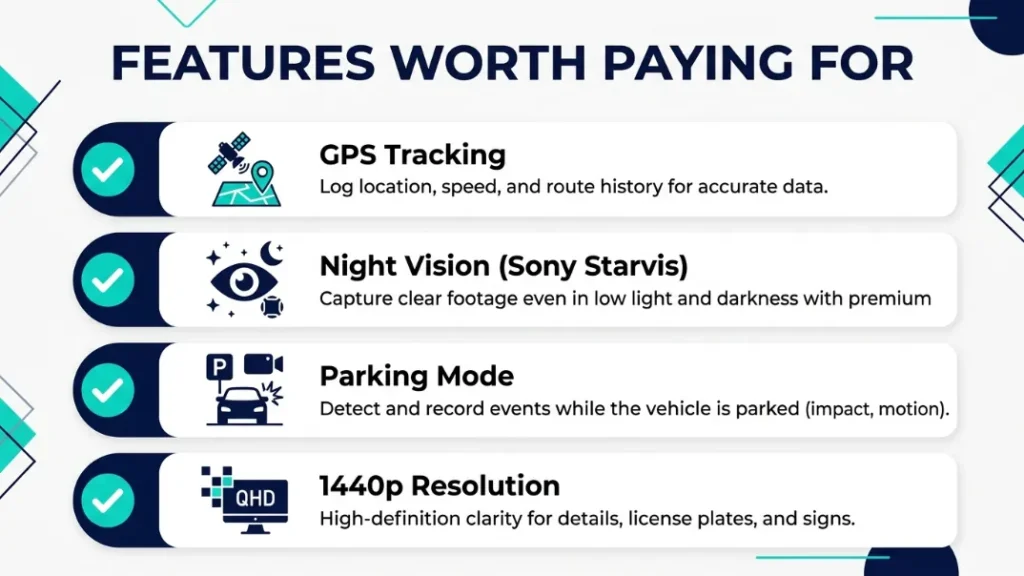
Not every premium feature justifies a higher price. Some genuinely improve your protection. Others are marketing additions that rarely matter in real use.
Is GPS Worth the Extra Cost on a Dash Cam?
GPS is worth paying for. It stamps your exact speed and location onto footage — data that strengthens your position significantly in insurance disputes and legal cases.
Without GPS, you have video showing what happened. With GPS, you have video plus documented proof of where you were and how fast you were traveling at the exact moment of impact. Insurance adjusters and attorneys treat those two things very differently.
GPS typically adds $10–$30 to a camera’s price. At that cost, it is one of the highest-value upgrades available.
Does Paying More Get You Better Night Vision?
Yes — and this is one of the most important performance differences between price tiers. Cameras with a Sony Starvis image sensor (common in $80+ models) capture significantly more detail in low-light conditions than cheaper sensors.
A 2022 consumer test by Which? found that low-light performance varied dramatically even among 1080p cameras — with sensor quality mattering far more than resolution alone.
The practical impact: cheaper cameras often produce blurry, washed-out night footage where license plates are unreadable. In a hit-and-run that happens at night, that footage is useless.
Is 4K Resolution Worth the Higher Price Tag?
4K is worth it only in specific situations — mainly when license plate legibility at a distance is critical. For most everyday use, 1440p (2.5K) delivers excellent clarity and keeps file sizes manageable.
4K footage files are roughly four times the size of 1080p files. That fills a 128GB microSD card far faster, meaning shorter recording loops or more frequent card management.
The sweet spot for most drivers is 1440p (2.5K) — sharp enough for license plates, manageable file sizes, and available at mid-range prices. 4K matters most for rideshare drivers and fleet vehicles needing maximum detail.
Front-Only vs. Front-and-Rear: How Much More Does a Two-Channel System Cost?
A front-and-rear dash cam system typically costs $30–$80 more than a comparable front-only model. In most cases, that extra cost is worth it — rear-end collisions are among the most common accident types, and rear footage resolves fault disputes quickly.
You have two options for adding rear coverage:
- Bundled front-and-rear kit: The manufacturer pairs a front cam with a rear cam at a set price. Vantrue, Viofo, and Nextbase all offer these. Prices typically run $100–$180 for a quality two-channel system.
- Adding a rear cam to an existing front cam: Some front-only models support an add-on rear camera sold separately. This often costs $30–$60 extra and requires a cable run through the car’s headliner.
If you are buying new and want dual coverage, a bundled kit is almost always the better value.
If you regularly drive in heavy traffic or park on busy streets, a front-and-rear system is a smart investment. Rear footage resolves “he said / she said” disputes that front-only cameras cannot.
Is a Cheap Dash Cam Good Enough for an Insurance Claim?
A cheap dash cam can support an insurance claim — but only if the footage is clear, timestamped, and uncorrupted. Many sub-$50 cameras fail on at least one of those three requirements when it matters most.
Insurance companies do not require 4K footage. They need clear, readable video that shows what happened, when, and where. A solid 1080p clip with a visible timestamp from a reliable $60 camera often does that job perfectly.
The risks with very cheap cameras:
- File corruption after impact due to poor G-sensor quality
- Overexposed or blurry footage making license plates unreadable
- Missing timestamp data due to clock resets after power loss
- No GPS to confirm location or speed during the incident
A $50–$80 camera from a reputable brand eliminates most of those risks. Spending $20 less on a no-name alternative introduces them all back.
Always verify your dash cam records correctly every 2–3 weeks. Play back a recent clip to confirm the timestamp is accurate and the footage is clear. Many drivers only discover a problem after an accident — when it is already too late.
Which Dash Cam Price Tier Actually Fits Your Driving Situation?
The right dash cam price depends entirely on how and where you drive — not on picking the most expensive model available. Match your tier to your real needs and you will get full value from every dollar you spend.
Use this decision guide:
| Driver Type | Recommended Tier | Budget Range |
|---|---|---|
| Casual commuter, garage parking | Budget to low mid-range | $50–$90 |
| Regular commuter, street parking | Mid-range | $90–$150 |
| Rideshare / taxi driver | Mid to premium (3-channel) | $150–$250 |
| High-crime parking area | Premium with parking mode | $180–$350 |
| Fleet / business vehicles | Premium with cloud connectivity | $250–$400+ |
Most drivers reading this article fall into the first two rows. A $90–$130 mid-range cam with GPS and a Sony Starvis sensor covers nearly every scenario a regular driver faces.
What Hidden Costs Should You Budget for Beyond the Dash Cam Price?
The sticker price is not the total cost. Three additional items add $30–$150 to your real spend — and many buyers are surprised by all three.
- MicroSD Card ($10–$25): Most dash cams do not include one. Always buy a dash-cam-rated card — Samsung Endurance or SanDisk High Endurance. Standard cards wear out quickly under constant loop recording.
- Hardwire Kit ($15–$30): Required for parking mode. It connects the camera to your car’s fuse box for continuous low-power recording while the engine is off. Not needed if you skip parking mode.
- Professional Installation ($50–$100): Optional, but recommended for hidden cable routing. A clean install keeps cables out of sight and away from airbag deployment paths.
A $120 mid-range cam with a $20 SD card and $20 hardwire kit becomes a $160 total investment. That is still excellent value — just budget for it upfront.
Which Dash Cam Brands Give You the Best Value at Each Price Point?
Brand matters more with dash cams than many buyers expect. Reliable firmware updates, accessible customer support, and warranty honoring separate the serious brands from the marketplace fillers.
Here is where the top brands sit by tier:
- Viofo — Best value in the budget and low mid-range tier. The Viofo A119 Mini 2 and A229 Plus are community favorites on forums like r/Dashcam for their price-to-performance ratio. Strong firmware support.
- Garmin — Compact and reliable across all tiers. Their Dash Cam 67W ($130–$150) is a standout for clean design, wide 180-degree lens, and trusted brand support.
- Vantrue — Excellent mid-range to premium lineup. The E1 Lite and N4 consistently rank among the top performers in their price categories.
- Nextbase — Strong UK-heritage brand trusted by over 2 million drivers globally. Their 422GW and 522GW models are well-regarded for ease of use and build quality.
- BlackVue — The premium cloud-connected choice. Ideal for users who want remote access, fleet management, or the best available parking mode system. Reviewed in depth on DashCamTalk.
For most drivers, Viofo and Vantrue deliver the best value under $150. Garmin is the safest all-around pick for buyers who want a trusted global brand. Nextbase leads for ease of use. BlackVue is the top choice for parking protection and fleet use.
Conclusion: How Much Should You Actually Pay?
The answer for most drivers is $80–$150. That range covers everything you genuinely need — reliable 1080p or 1440p footage, GPS data, solid night vision, and Wi-Fi connectivity — without paying for features designed for fleet operators or rideshare professionals.
If your budget is tighter, $50–$80 from a reputable brand like Viofo still gives you meaningful protection. If you park in high-risk areas or drive commercially, investing $180–$250 in a system with parking mode makes clear financial sense.
The worst move is spending $20 on a no-name camera and assuming you are covered. You probably are not — and you will only find that out at the worst possible moment.
I’m Alex Rahman, and the one piece of advice I give every driver is this: buy the best dash cam you can comfortably afford from a brand with real customer support. That $30 difference between a budget cam and a solid mid-range model could save you thousands in a disputed claim.
Frequently Asked Questions

I’m Alex Rahman, a car enthusiast and automotive writer focused on practical solutions, car tools, and real-world driving advice. I share simple and honest content to help everyday drivers make better decisions.
