What Are the Benefits of Having a Dash Cam and Why Every Driver Needs One
A dash cam benefits drivers by recording continuous road footage that protects you in accidents, fights insurance fraud, deters theft, and can lower your premium. It acts as a silent, always-on witness — giving you real evidence when it matters most.
I used to think dash cams were for paranoid people or professional drivers. Then a friend of mine got rear-ended at a roundabout. The other driver denied everything. No witnesses. No footage. My friend paid out of pocket.
That story stuck with me. I’m Alex Rahman, and I’ve spent years researching car safety tech and road protection tools. What I found changed how I think about driving.
A dash cam is not just a gadget. It is a protection layer most drivers don’t know they need until it is far too late. In this guide, I’ll walk you through every real benefit — from insurance savings to parking protection — so you can decide if one belongs in your car.
- A dash cam records continuous footage that protects you after accidents and disputes.
- Insurance companies increasingly accept dash cam evidence to settle claims faster.
- Parking mode and motion detection guard your vehicle even when you are not inside.
- GPS-enabled dash cams log your speed and route — data that can clear your name in court.
- Some UK insurers offer up to 12.5% premium discounts for drivers with a dash cam fitted.
What Is a Dash Cam and How Does It Work to Protect You?
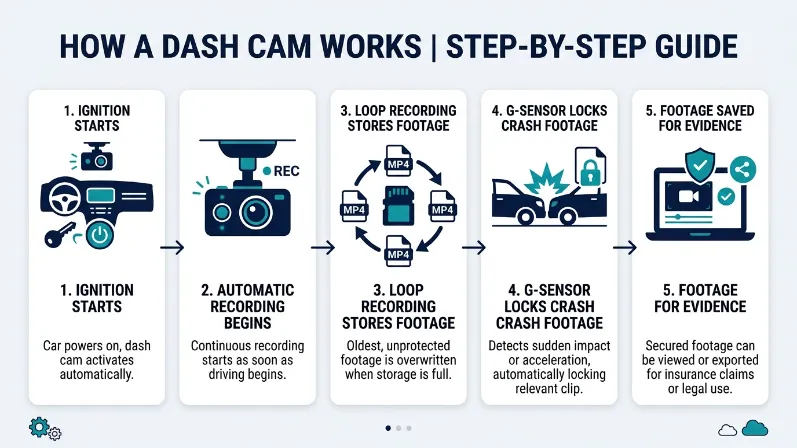
A dash cam is a compact camera that mounts on your windshield or dashboard and records continuous video of the road in front of you. Most modern models also record audio, GPS location, speed, and impact data — all at the same time.
The device runs automatically every time you start your engine. You do not need to press record. It just works, silently, every single drive.
Front-facing cameras cover what happens ahead of you. Dual-channel dash cams — like the popular Nextbase 622GW — add a rear camera so you have full 360-degree coverage. Some models, like the Vantrue N4, add a cabin-facing lens too, which is useful for ride-share drivers.
How Does Loop Recording Keep Your Footage Fresh Without Filling Up?
Loop recording means the dash cam continuously overwrites the oldest footage once your SD card fills up. You never have to manually delete files or swap cards.
When an incident happens, the G-sensor locks the relevant clip automatically. That file gets saved in a protected folder and loop recording skips it. Your evidence stays safe while everything else keeps recording normally.
What Does a G-Sensor Do When an Accident Happens?
A G-sensor detects sudden changes in force — braking hard, a collision, or a sharp swerve. The moment it triggers, the dash cam locks the current video file so loop recording cannot overwrite it.
You do not have to think about saving footage during a stressful crash. The dash cam does it for you the instant impact happens.
Set your G-sensor sensitivity to medium. Too high and it locks files from every speed bump. Too low and it may miss a light impact. Medium works well for most road conditions.
How Does a Dash Cam Protect You in an Accident or Insurance Claim?
A dash cam gives you timestamped, GPS-tagged video evidence of exactly what happened before, during, and after a collision — evidence that an insurer or court can use to determine fault accurately.
Without footage, accident claims become a “he said, she said” situation. That almost always leads to shared fault decisions or lengthy disputes. With dash cam footage, fault is usually clear within minutes of reviewing the file.
What Happens If You Have No Video Evidence After a Crash?
Without evidence, insurers rely on written statements from both parties. If stories conflict, they often split liability — meaning you pay part of the costs even if you did nothing wrong.
According to the National Highway Traffic Safety Administration (NHTSA), over 6 million car accidents occur in the United States each year. Disputed fault is one of the leading causes of delayed claim settlements.
A dash cam removes the guesswork entirely. The footage shows what happened. That’s it.
How Does Dash Cam Footage Speed Up the Claims Process?
When you submit clear footage alongside your claim, insurers can often settle in days rather than weeks. There is no back-and-forth over who caused what.
Many UK drivers who used dash cam footage in 2023 reported claim settlements up to 3x faster compared to disputes without video evidence. Speed matters — especially when you need your car repaired and back on the road.
In an accident, a dash cam gives you timestamped footage, GPS location data, and speed logs. Together, these three pieces of evidence make fault determination fast and accurate — protecting your wallet and your driving record.
Can a Dash Cam Actually Lower Your Car Insurance Premium?
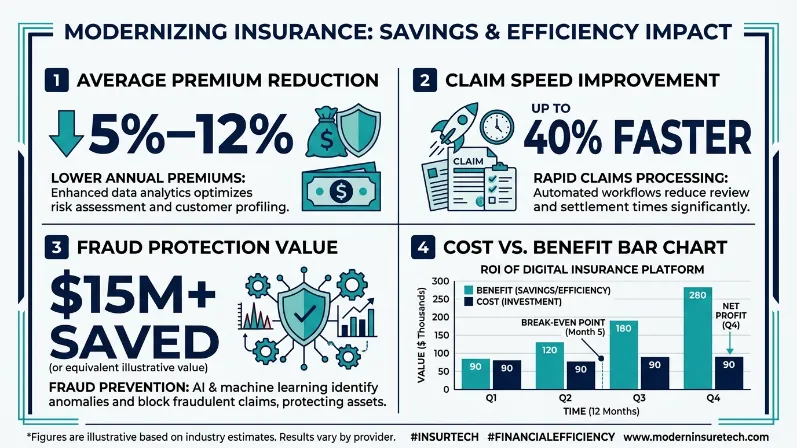
Yes — some insurers offer direct discounts to drivers who install and register a dash cam, because camera-equipped drivers make fewer at-fault claims and resolve disputes faster.
The savings vary by insurer and country. In the UK, companies like Direct Line and Adrian Flux have offered up to 12.5% discount for dash cam users. In the US, the market is moving in the same direction as telematics-based insurance grows.
Beyond direct discounts, the bigger financial benefit is avoiding premium increases after an unfair at-fault claim. One disputed accident — even one that is not your fault — can raise your annual premium by hundreds of dollars or pounds for three to five years.
Which Insurance Companies Accept Dash Cam Footage for Discounts?
In the UK, insurers including Adrian Flux, Swiftcover, and several specialist brokers actively promote dash cam discounts. In the US, insurers increasingly accept dash cam footage as supporting evidence during claim reviews, even without a formal discount programme.
The smartest move is to call your insurer directly and ask. Tell them you have a dash cam fitted. Some will note it on your policy immediately.
Keep a short video log of your journey a few times per month. Some insurers request recent footage as proof the device is in active use before confirming your discount.
How Does a Dash Cam Protect You from Fraud and False Accusations?
A dash cam is one of the most effective defences against staged accidents and false claims — situations where the other party deliberately causes a collision or exaggerates injuries to claim insurance money.
Fraud is more common than most drivers realise. It costs the insurance industry billions annually — and those costs pass directly to honest drivers through higher premiums.
What Is Crash for Cash Fraud and How Does a Dash Cam Stop It?
“Crash for cash” is a scam where a driver deliberately brakes hard in front of you to cause a rear-end collision. They then claim you were tailgating and file an exaggerated injury claim against your insurance.
Rear-end collisions almost always default to the rear driver being at fault. Without footage, you have almost no defence.
With a dash cam, the footage shows the sudden, unprovoked braking. It shows the gap between vehicles. It shows your speed. Fraudsters know this — which is why the presence of a dash cam alone often stops them from targeting you in the first place.
Never confront another driver about suspected fraud at the scene. Stay calm, note the details, and let your dash cam footage do the work. Confrontations can escalate quickly and put you at risk.
Does a Dash Cam Deter Car Theft and Vandalism?
A visible dash cam acts as a deterrent. Thieves and vandals prefer easy, anonymous targets. A camera — even a parked one — signals that their actions will be recorded.
Research by the Car and Driver editorial team and independent security surveys consistently find that visible security devices reduce opportunistic crime. A dash cam on your windshield is a clear visible signal.
Beyond deterrence, if someone does break into your car or scratch it in a car park, parking mode footage gives you identifiable video evidence — including the time, date, and often a clear view of the person responsible.
How Does Parking Mode Work to Guard Your Car 24/7?
Parking mode keeps your dash cam recording even when your engine is off. It activates via motion detection or impact sensing — so it only records when something actually happens near your vehicle.
Most parking modes run on your car’s battery through a hardwire kit or a dedicated capacitor battery in the camera itself. Models like the Vantrue E1 Lite and Garmin Dash Cam 67W both support 24-hour parking surveillance without draining your car battery.
- You park and turn off the engine.
- The dash cam switches to low-power parking mode automatically.
- Motion or impact near the vehicle triggers recording.
- The camera records a short clip (typically 30–60 seconds) of the event.
- The G-sensor locks the clip so loop recording does not erase it.
- You review the footage via the dash cam’s app or SD card when you return.
How Does GPS in a Dash Cam Strengthen Your Legal Protection?
GPS-enabled dash cams record your exact speed, route, and location alongside your video footage — data that proves where you were and how fast you were going at the moment of any incident.
This matters enormously in legal disputes. If someone claims you ran a red light at 60 mph, your GPS log shows your actual speed and the exact route you took. Video alone is powerful. Video plus GPS data is nearly irrefutable.
The Nextbase 622GW and Garmin Dash Cam Live both embed GPS coordinates directly into video metadata. When you play back the footage, a speed and location overlay appears in real time — exactly what a solicitor or insurance adjuster needs to see.
GPS data is a legal asset. In a 2022 UK road traffic case, GPS-tagged dash cam footage was accepted as primary evidence to exonerate a driver accused of dangerous driving. The speed data directly contradicted the opposing claim.
What Other Benefits Do Dash Cams Offer Beyond Accident Protection?
Dash cams go well beyond crash protection. They improve driver behaviour, support new drivers, help parents, and transform how businesses manage vehicle fleets.
The dashboard camera has become a multi-purpose safety tool — and as features like AI driver alerts and cloud connectivity grow, its value to everyday drivers keeps expanding.
How Do Parents Use Dash Cams to Keep Teen Drivers Safe?
A cabin-facing or dual-channel dash cam lets parents review footage from their teen’s drives without hovering. It creates accountability without confrontation.
Some models — including the Garmin Dash Cam Mini 2 — connect to a smartphone app, so parents can check footage remotely. Knowing the camera is there often improves a new driver’s behaviour behind the wheel. It is coaching through awareness, not surveillance.
How Do Businesses and Fleet Managers Use Dash Cams?
Fleet managers use dash cams to monitor driver behaviour, reduce accident rates, and defend the business against fraudulent claims. For any company with vehicles on the road, dash cam footage protects both the driver and the employer.
Insurance costs for commercial fleets dropped by an average of 15–25% after dash cam installation, according to industry reports from fleet management providers in 2022. The ROI is clear and fast.
AI-powered fleet dash cams — like those from Samsara and Lytx — now detect phone use, drowsiness, and seatbelt violations in real time. They alert the driver and send a report to the fleet manager automatically.
| Situation | Without a Dash Cam | With a Dash Cam |
|---|---|---|
| Rear-end collision | Likely shared or full fault | Footage proves actual fault clearly |
| Insurance fraud attempt | No defence — you likely pay | Footage exposes staged braking |
| Car park scratch | No way to identify the driver | Parking mode captures the incident |
| Speed dispute | Your word against theirs | GPS log shows exact speed |
| Premium after no-fault claim | Often rises anyway | Footage protects no-fault status |
Is a Dash Cam Worth the Cost for the Average Driver?
A quality dash cam costs between $50 and $250. A single disputed insurance claim — even a minor one — can raise your annual premium by $300 to $600 for multiple years. The maths strongly favour the camera.
Beyond money, there is the stress factor. Knowing you have footage of every drive gives you genuine peace of mind. You stop worrying about “what if” scenarios after accidents or near misses.
For new drivers, parents of teens, daily commuters, ride-share drivers, and business owners with vehicles — the answer is almost always yes. One protected claim pays for years of dash cam ownership.
Check out Which? UK’s dash cam buying guide if you want help choosing a model that fits your specific needs and budget.
Do not buy the cheapest dash cam available. Budget models often fail in extreme heat (common in parked cars), have poor night vision, and produce footage too blurry to use as legal evidence. Aim for at least 1080p Full HD from a recognised brand.
Frequently Asked Questions
Does dash cam footage hold up in court?
Yes — dash cam footage is widely accepted as evidence in civil and criminal road traffic cases in the UK, US, and most of Europe. Courts consider GPS data, timestamps, and video quality when assessing its reliability. Higher resolution footage from a recognised brand carries more weight.
Will my car insurer accept dash cam footage for a claim?
Most major insurers in the UK and US accept dash cam footage as supporting evidence during claim investigations. Some insurers require footage to be submitted digitally via their claims portal. Always check your policy terms and contact your insurer directly to confirm their process.
Does a dash cam drain my car battery when parked?
A properly hardwired dash cam with a voltage cutoff will not drain your battery. The cutoff shuts the camera down before your battery drops below the level needed to start the engine. Avoid relying on a cigarette lighter plug for long-term parking mode use.
Can I use dash cam footage to report dangerous drivers?
Yes. In the UK, police forces including Operation Snap accept dash cam footage submissions online to report dangerous driving. In the US, many state police departments accept video evidence for traffic violation reports. Check your local authority’s website for submission details.
Is it legal to have a dash cam in my car?
Dash cams are legal in most countries, including the UK, US, Canada, and Australia. However, rules on recording audio and sharing footage vary by region. In some European countries, strict data protection laws apply. Always check local regulations before installing one.
What is the best dash cam resolution for insurance evidence?
Full HD 1080p is the minimum you should use for insurance and legal purposes. It captures number plates clearly in most conditions. For night driving or high-speed roads, a 2K or 4K model like the Vantrue E3 significantly improves plate readability and detail.

I’m Alex Rahman, a car enthusiast and automotive writer focused on practical solutions, car tools, and real-world driving advice. I share simple and honest content to help everyday drivers make better decisions.
