
OBD2 Scanner vs Bidirectional Scanner: Key Differences
Quick Answer
An OBD2 scanner reads fault codes and live data from your car, while a bidirectional scanner also sends commands back to the car to test parts on demand. The difference is control, not just reading. A standard tool fits simple code checks, and a bidirectional tool fits repairs that need a part to move, cycle, or reset.
- A standard OBD2 scanner reads codes and live engine data.
- A bidirectional scanner adds active tests that command a part.
- Active tests help prove a fan, pump, valve, or motor responds.
- Coverage varies by car, module, and tool, so check your exact car first.
An obd2 scanner vs bidirectional scanner choice starts with the job in front of you, not the box label. You may need a code and a clear plan, or you may need a part to move on command. This guide explains both tools in plain terms, compares them side by side, and helps you pick the one that fits your repairs.
In this article
- What is an OBD2 scanner?
- What is a bidirectional scanner?
- OBD2 scanner vs bidirectional scanner side by side
- How does bidirectional control work in an active test?
- What can a bidirectional scanner do that a standard scanner cannot?
- Which jobs need which tool?
- What limits bidirectional coverage?
- How to choose without paying for unused control?
- Common mistakes when comparing scanners
What is an OBD2 scanner?
An OBD2 scanner is a tool that plugs into the OBD-II port and reads fault codes, freeze frame data, and live sensor data from the car. It listens to the car and shows what the car reports. The port sits under the dash on the driver side in most cars.
OBD-II was built to watch engine and emissions systems. The EPA OBD rules describe a system that monitors emission control parts, engine misfire, fuel delivery, and other powertrain parts. A code points to a system that failed a test. Live data helps you see sensor values while the engine runs.
A basic scanner covers generic powertrain codes. Those codes start with P0 and mean the same thing on most makes. A fuller scanner can also read codes from other modules, such as transmission, ABS, and airbag systems, when the tool lists that access. OBD2 scanner functions vary by tool, so the system list matters more than the label on the box.
What is a bidirectional scanner?
A bidirectional scanner is a scan tool that reads data from the car and sends supported commands back to the car. It can ask a control module to run a part, move an output, or start a service step. The name points to two-way talk, not to a larger screen.
Bidirectional control is also called active testing or actuation testing. A command may turn on a cooling fan, run a fuel pump, cycle a purge valve, or move a door lock. The tool then watches the response in live data or by sight and sound. A response shows that the module and the part can work under the test conditions.
A bidirectional scanner is still an OBD2 scanner in most cases. It plugs into the same 16-pin port and reads the same basic codes. The added skill is command, and that skill depends on software, vehicle coverage, and the control module in the car.
OBD2 scanner vs bidirectional scanner side by side
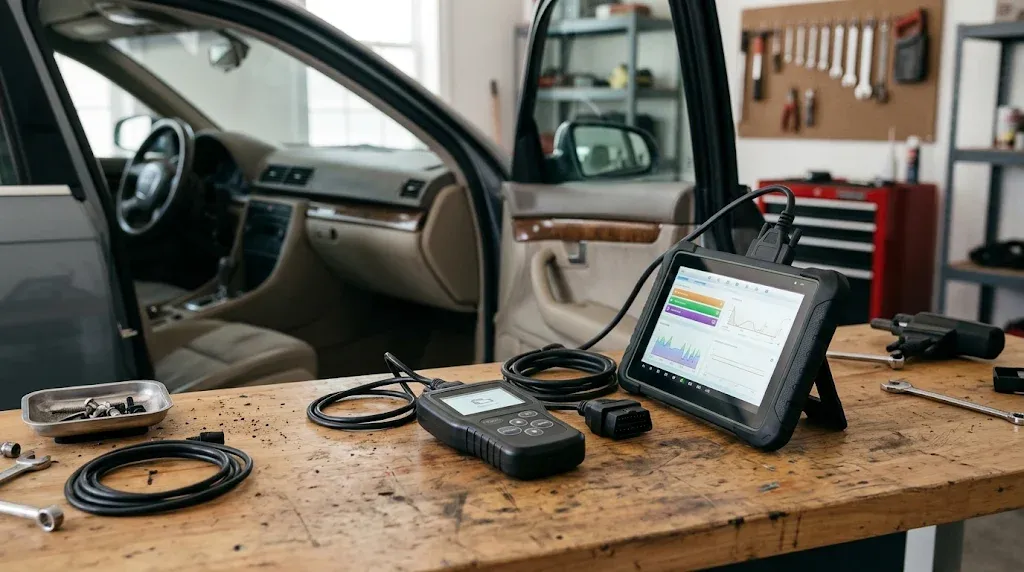
The table below compares a standard OBD2 scanner with a bidirectional scanner on the same points. Use it to see where the tools match and where control changes the job.
| Capability | Standard OBD2 scanner | Bidirectional scanner |
|---|---|---|
| Direction of talk | Car to tool only | Car to tool, and tool to car |
| Engine fault codes | Yes, generic codes | Yes, generic codes |
| Live data | Often, engine data | Often, wider data |
| Other systems | Limited, by tool | Wider, by tool |
| Active tests | No | Yes, on supported cars |
| Service resets | Few or none | Common on many tools |
| Coding and programming | No | Only on some advanced tools |
| Who it suits | Code checks and simple checks | Repairs that need a test or reset |
The table shows one clear split. Both tools read codes, but only the bidirectional tool can command a part. That split decides which repairs you can finish at home.
Do not judge a tool by the word scanner alone. A basic reader, a full-system scanner, and a bidirectional scanner can share the same shape and port. The menu, the system list, and the active test list show the real gap.
How does bidirectional control work in an active test?
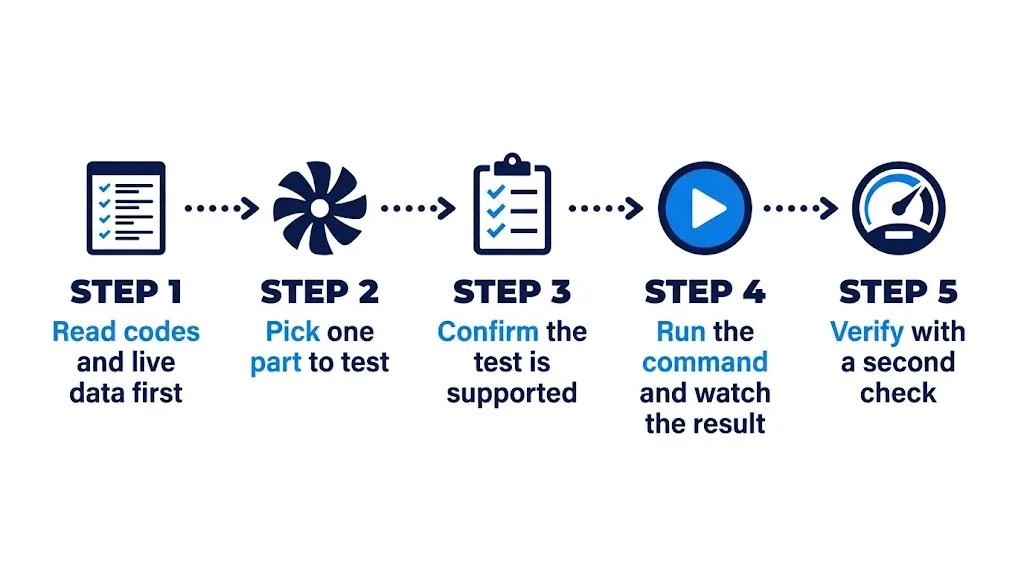
Bidirectional control works when the scanner sends a supported request to a control module and the module runs the part for a short test. The scanner asks, the module acts, and you watch the result. The test ends, and the car returns to normal control.
How scanners work starts with the same link. The scanner talks through the OBD-II port to the car network. In a read-only scan, data flows one way. In an active test, the scanner sends a command through the module that owns the part.
An active test answers one question: can the module command the part, and does the part respond? A fan that runs on command has a working motor, power path, and control path under test conditions. A fan that stays still needs checks for power, ground, relay, wiring, and module output.
Step 1
Read codes and live data first
Start with stored codes, freeze frame data, and live data. The test should answer a clear question, not run at random.
Step 2
Pick one part to test
Name the part and the fault you want to rule out. A fan test checks a fan, and a pump test checks a pump.
Step 3
Confirm the test is supported
Check the menu for your exact car and module. A missing test means the car, module, or tool does not offer it.
Step 4
Run the command and watch the result
Watch the part and the live data at the same time. Note the speed, sound, movement, and sensor change.
Step 5
Verify with a second check
Use a meter, gauge, or pressure test when the job needs proof. A part can move and still fail under load.
A test that works does not prove every part of a system is sound. It proves the command path and the actuator can respond in that moment. Use the result as one clue, then test power, pressure, or flow when the repair needs it.
What can a bidirectional scanner do that a standard scanner cannot?
A bidirectional scanner can command a supported part, run a service step, and in some cases change a learned value after a repair. A standard scanner can read and clear codes, but it cannot ask a part to act. That gap shows up in real jobs.
Common active tests include a cooling fan test, a fuel pump test, an EVAP purge valve test, an injector test, and a test for lights, locks, windows, or a horn. The bidirectional tests explained guide lists fans, valves, pumps, relays, solenoids, and ABS parts as common examples. The exact list still depends on the car.
Service work often needs more than a test. An electric parking brake needs a service mode before you press a rear caliper piston back. An ABS bleed may need the pump and valves to cycle to push out trapped air. A battery swap, throttle body swap, or steering repair may need a reset, relearn, or calibration on some cars.
Warning
Active tests can start fans, pumps, and moving parts without driver input. Keep hands, tools, and loose clothes clear, and use the vehicle state the test asks for.
Bidirectional control does not turn a scanner into a full workshop tool by itself. Coding, adaptation, and programming are separate skills. An active test sends a short command for diagnosis. Coding changes a stored setting, and programming writes new software to a module.
A scanner can have many service functions and few active tests. It can also have many active tests and few service functions. Read the two lists apart, and match each list to the jobs you plan to do.
Which jobs need which tool?
Jobs sort by what must happen after the code is read. A code check needs a reader. A part test or a reset needs command. Use the job list below to place your work in the right group.
- Check engine light and emissions readiness: a standard scanner is enough.
- ABS, airbag, or transmission light: a full-system scanner is the floor, and command may help.
- Fan, pump, valve, or injector fault: a bidirectional scanner helps prove the part.
- Electric parking brake service: a bidirectional scanner is needed on most cars with that brake.
- ABS bleed after brake work: a bidirectional scanner is needed when the car asks for a cycle.
- Battery, throttle, or steering work: a scanner with the named reset is needed.
- Intermittent fault with no clear code: live data helps, and active tests speed the check.
A used car check shows the same split in a small way. A standard scan can show engine codes and readiness. A fuller scan can show ABS and airbag faults that an engine-only scan would miss. A test that commands a part can add one more clue, but it does not replace a road test or a visual check.
If you
Read a check engine code and check readiness before a test
Choose a standard OBD2 scanner, because code reading covers that job.
If you
Service brakes with an electric parking brake or bleed ABS
Choose a bidirectional scanner, because the job needs a command.
If you
Work on many cars and chase faults across systems
Choose a bidirectional scanner, because tests and resets save repeat trips.
Home use does not always mean light use. A home owner with one car and simple fluid changes may never open an active test menu. A home owner who does brakes, cooling work, and electrical checks may use it on the first job.
What limits bidirectional coverage?
Bidirectional coverage is limited by the car, the module, the tool software, and the test conditions. A tool can claim bidirectional control and still offer few tests on your car. The claim alone does not show the test list.
Each car maker builds its own test menu. One car may offer a fan test, a pump test, and an ABS cycle. Another car may offer none of those tests on the same tool. The control module decides if a request is supported, and the car state decides if the test can run. Ignition state, gear position, temperature, voltage, and security access can block a test.
Software and protocols add a second limit. Some cars use a secure gateway or a newer protocol that an older tool cannot use. A tool that reads codes on a car may still miss the command path for that car. Check the coverage chart for your exact car, and check the active test list apart from the code list.
Engine code limits explain a related gap. A basic tool may read engine codes and miss ABS, airbag, transmission, and body codes. A bidirectional tool can have the same gap on a car it does not cover in full. The system list and the test list both need a check.
How to choose without paying for unused control?
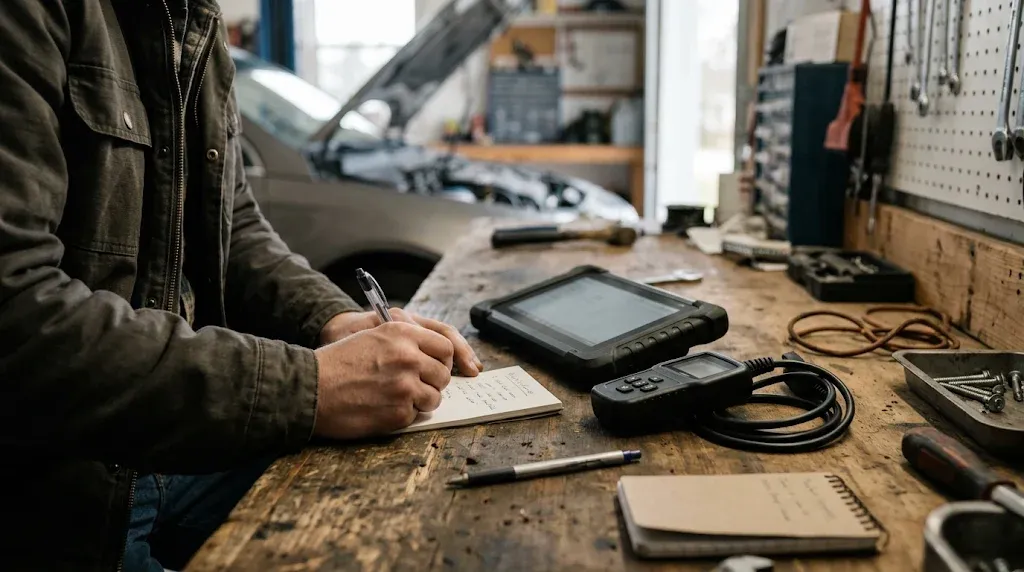
Choose by writing your job list first, then matching the tool to that list. A clear list stops you from buying control you will not use. It also stops you from buying a reader for a job that needs a command.
Write down three to five jobs you expect to do, with the cars named. Add the systems each job touches. Then look for a tool that names those systems and tests in its coverage chart. A tool page should list the active tests by name, not just the phrase bidirectional control.
Check four points on the product page before you decide. First, find your car in the coverage list for both reading and command. Second, count the named service resets you will use, such as oil, EPB, SAS, battery, and TPMS. Third, check the update terms and what happens when updates end. Fourth, check the protocol support for your car, such as CAN FD or DoIP where the maker lists it.
Cheap OBD2 scanners can fit a simple code check, and a low cost tool is not a fault by itself. The fault is a mismatch between the tool and the job. A low cost reader is a fair pick for code reading, while a command job needs a tool that lists that command.
Ask the seller or the maker one direct question when the page is vague: which active tests does this tool offer on my exact car and module? A clear answer names tests. A vague answer is a sign to keep looking.
Common mistakes when comparing scanners
Most bad buys come from a label, not a lack of skill. A shopper reads one phrase and assumes the tool does every job. The points below catch the most common errors.
- Trusting the word bidirectional without a test list.
- Mixing up a service reset, an active test, and coding.
- Assuming code reading covers ABS, airbag, and transmission.
- Clearing a code and calling the repair done.
- Buying for one car and then using the tool on a car it does not cover.
- Skipping updates and then finding a new car is not in the database.
Clearing a code erases the fault record and the freeze frame snapshot. It does not fix the part that set the code. Write down the code, the freeze frame data, and the live data before you clear it.
A test result also needs care. A part that moves on command can still fail under load, heat, or pressure. A part that does not move may have a power or wiring fault, not a bad part. Use the test as a fork in the road, then follow the branch with a meter or gauge.
Bidirectional OBD2 Scanner
A bidirectional OBD2 scanner helps you run active tests and service steps that a read-only tool cannot start.
Frequently Asked Questions
Is a bidirectional scanner worth it for home use?
A bidirectional scanner is worth the extra cost for home use only when your repair list needs active tests or service resets on a regular basis. If you change brake pads on a car with an electric parking brake, bleed ABS, or test a fan and pump, control saves time and guesswork. If you read a check engine code once in a while, a standard scanner covers that job.
Can a standard OBD2 scanner read ABS codes?
A standard OBD2 scanner often cannot read ABS codes because generic OBD-II covers engine and emissions codes, not the ABS module. Some mid-range tools add ABS, transmission, and airbag coverage, so check the system list for your exact car. A tool that lists ABS support may still miss a test on some trims.
Does bidirectional mean the scanner can code a new part?
Bidirectional control does not mean a scanner can code a new part, because an active test sends a short command while coding changes stored settings. Some advanced tools add coding, but that is a separate function with its own limits. Check the product page for coding, adaptation, and programming as distinct items.
Can a bidirectional scanner clear an airbag light?
A bidirectional scanner can read some airbag codes, but it should not clear an airbag light until the fault is found and fixed. Airbag faults sit in the SRS module, and clearing a code does not repair a sensor, wiring fault, or seat fault. Get professional help if the light stays on after a repair.
Do all cars support the same active tests?
All cars do not support the same active tests, because each make, model, and control module offers a different test list. A tool may command a fan on one car and show no test on another car. Check coverage for your exact make, model, trim, and system before you buy.
Can I use a bidirectional scanner on more than one car?
A bidirectional scanner can work on more than one car when the tool lists each make and system you plan to scan. Coverage still varies by car, so a test that works on one car may be absent on the next car. Keep the coverage list with the tool and check it for each car you own.
Conclusion
An obd2 scanner vs bidirectional scanner choice comes down to control. A standard scanner reads codes and live data, while a bidirectional scanner also commands parts and runs service steps. If your jobs need a part to move, cycle, or reset, choose a bidirectional scanner with that test listed for your exact car.

I’m Alex Rahman, a car enthusiast and automotive writer focused on practical solutions, car tools, and real-world driving advice. I share simple and honest content to help everyday drivers make better decisions.
