Which Dash Cam Brand Is Best and How Do You Pick the Right One?
Nextbase, BlackVue, Vantrue, Thinkware, and Garmin are the best dash cam brands in 2025. Nextbase suits most everyday drivers. BlackVue leads for cloud and fleet use. Vantrue wins for budget dual-channel setups. The best brand depends on your budget, driving style, and what you need the footage for.
I bought my first dash cam based on a YouTube thumbnail. It had good reviews, a flashy design, and cost $40. Six months later, the footage from a minor parking lot scrape was too blurry to use. The insurance company could not tell if the other car had reversed into mine or the other way around.
That $40 mistake cost me $600 in repairs I had to pay myself.
I’m Alex Rahman, and I’ve been researching, testing, and writing about car tech for over eight years. Dash cams are one of those products where brand matters more than most people think. Two cameras with identical specs on paper can produce completely different footage in real conditions.
This guide breaks down every major dash cam brand honestly — what each one does well, who it suits, and where each one falls short. By the end, you will know exactly which brand fits your situation.
- Nextbase is the best all-around brand for everyday drivers — easy to set up and reliable out of the box.
- BlackVue is the top choice for cloud connectivity, remote viewing, and fleet management.
- Vantrue offers the best dual-channel recording quality at a mid-range price point.
- Thinkware leads on ADAS safety alerts and long-term build quality for professional use.
- Choosing by brand reputation beats choosing by spec sheet — reliability is not visible in a spec list.
What Makes a Dash Cam Brand Actually Good — Not Just Popular?
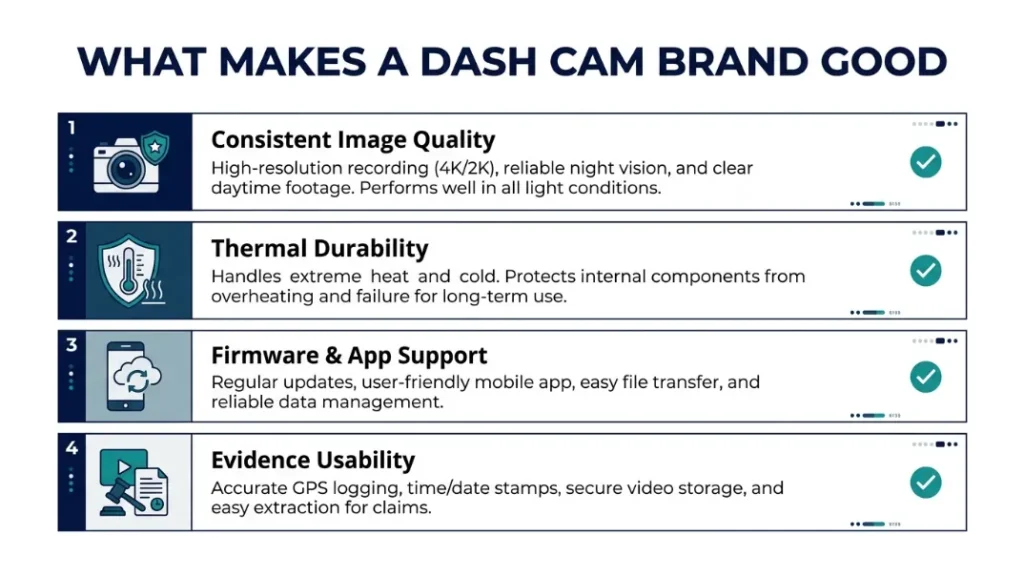
A good dash cam brand delivers clear, usable footage when it matters most — not just in demo videos on a sunny day. Popularity on Amazon does not equal reliability. Several highly-rated brands produce footage that falls apart in low light or extreme heat.
Four things separate a genuinely good brand from a well-marketed one.
First is consistent image quality across conditions — daylight, night, rain, and glare. Second is thermal durability — does the camera survive a hot car in summer without shutting down? Third is firmware and app support — does the brand push updates and fix bugs after purchase? Fourth is real-world evidence usability — would footage from this camera hold up in an insurance claim or police report?
Brands that score high on all four are the ones worth your money.
Video Quality: Why Resolution Alone Does Not Tell the Full Story
Resolution is the number people focus on, but it is only part of the picture. A 4K camera with a poor lens and weak image processor will produce worse night footage than a well-tuned 1440p camera.
What actually matters is the image sensor size, the lens aperture (look for f/1.6 or lower for better low light), and whether the camera uses Wide Dynamic Range (WDR) or High Dynamic Range (HDR) processing. These features balance bright and dark areas in a single frame — critical for reading license plates against a bright sky.
Nextbase, BlackVue, and Thinkware consistently invest in sensor and processing quality. Budget brands often put all their budget into resolution and skimp on the sensor.
When comparing brands, search YouTube for real-world night footage tests — not just the brand’s own demo videos. Real user footage at night tells you more than any spec sheet.
Build Reliability: Which Brands Survive Heat, Cold, and Years of Use
A dash cam sits behind your windshield where temperatures can reach 70°C (158°F) on a hot day. Cheap batteries swell and fail in that heat. That is why the best brands use capacitors instead of lithium batteries for internal power storage.
Thinkware and BlackVue use capacitors in most of their models. Capacitors handle heat far better than batteries and last significantly longer. Nextbase uses batteries in many models but has improved thermal management in recent generations.
Build quality also affects longevity of the mount, lens housing, and button durability. Brands like Vantrue and Thinkware use metal chassis on higher-end models. Many budget brands use all-plastic construction that warps over time.
The 6 Best Dash Cam Brands in 2025 and What Each One Does Best
These six brands represent the most reliable, most-tested, and most widely recommended options available right now. Each one has a clear strength and a clear audience. Knowing which one matches your needs saves you from buying the wrong camera twice.
Nextbase — Why It Dominates the UK Market and Suits Most Everyday Drivers
Nextbase is the UK’s best-selling dash cam brand and one of the most recognizable names globally. Their cameras are designed for simplicity — clean interfaces, fast setup, and an ecosystem that works together seamlessly.
The Nextbase 622GW is their flagship model, offering 4K recording, built-in Amazon Alexa voice control, and a stabilized image for smoother footage on rough roads. Their Emergency SOS feature — which alerts emergency services if the G-sensor detects a serious crash — is unique to Nextbase and genuinely useful.
The Nextbase app connects via Wi-Fi for easy footage transfer to your phone. Setup takes under ten minutes for most drivers.
Best for: Everyday commuters, first-time dash cam buyers, UK drivers who want a reliable single-brand ecosystem.
Watch out for: Higher price per feature compared to Asian brands. Battery-based power storage on some models can be an issue in very hot climates.
BlackVue — The Premium Cloud Dash Cam Brand Built for Serious Users
BlackVue, made by the South Korean company Pittasoft, is the gold standard for cloud-connected dash cameras. Their cameras upload footage directly to the BlackVue Cloud, letting you view live footage, receive parking alerts, and download clips remotely from anywhere in the world.
The BlackVue DR970X records in 4K front and 2K rear, uses a Sony STARVIS sensor for outstanding night performance, and integrates with a dedicated LTE module for always-on cloud access without relying on your phone’s hotspot.
BlackVue uses capacitors across most of their lineup — a major durability advantage in hot climates. Their companion app is one of the most polished in the industry.
Best for: Fleet managers, rideshare drivers, tech-forward users who want remote access, and anyone parking in high-risk areas.
Watch out for: Premium pricing — entry-level BlackVue models start around $200, and cloud subscriptions add ongoing cost.
Vantrue — The Best Budget Dual-Channel Brand Most People Overlook
Vantrue is a Chinese brand that has quietly built one of the strongest reputations in the budget-to-mid-range dash cam space. Their dual-channel systems — front and rear recording — deliver exceptional value for the price.
The Vantrue E2 Lite records 1440p front and 1080p rear, uses Sony STARVIS night vision sensors, supports parking mode with a hardwire kit, and costs around $130 for the full dual setup. That combination is extremely difficult to match at that price point.
Vantrue cameras are not the prettiest or the easiest to set up. Their app is functional but not as polished as Nextbase or BlackVue. What they deliver is honest, reliable footage quality at fair prices.
Best for: Budget-conscious buyers who want front and rear coverage without compromising image quality.
Watch out for: App experience is average. Customer support response times can be slow.
Thinkware — The Professional-Grade Brand With the Best ADAS Features
Thinkware is a South Korean brand used by fleet operators, rental companies, and professional drivers worldwide. Their cameras include some of the most advanced ADAS (Advanced Driver Assistance System) features in the consumer market — including lane departure warnings, forward collision alerts, and speed camera notifications.
The Thinkware U3000 records in 4K with a Sony STARVIS 2 sensor and includes built-in GPS, a radar parking sensor, and a dedicated cloud platform called Thinkware Connected. Build quality is exceptional — metal housing, capacitor-based power, and tight firmware quality control.
Thinkware cameras tend to be harder to find in physical stores. Most buyers order online. The interface has a steeper learning curve than Nextbase.
Best for: Professional drivers, fleet use, drivers who want the most complete safety feature set available.
Watch out for: Higher price point. Interface and setup take more effort than consumer-focused brands.
Garmin — A Trusted GPS Brand That Makes Surprisingly Good Dash Cams
Garmin is best known for GPS navigation, but their dash cam range — particularly the Garmin Dash Cam Mini 2 and Dash Cam 67W — has earned strong reviews for reliability and build quality.
Garmin cameras are compact, discreet, and extremely easy to use. The 67W offers a 180-degree field of view, voice control, automatic incident detection, and direct upload to the Garmin Vault cloud — 24 hours of free storage included.
What Garmin does well is integration with their broader ecosystem. If you already use a Garmin GPS unit or smartwatch, their dash cam connects natively.
Best for: Garmin ecosystem users, drivers who want a small discreet camera, buyers who value brand trust and after-sales support.
Watch out for: Rear camera options are more limited than BlackVue or Vantrue. Video processing is good but not class-leading at night.
Rexing — The Entry-Level Brand That Works Well for New Buyers
Rexing is a US-based brand aimed at first-time buyers who want a functional dash cam without spending much. Their cameras regularly appear in “best under $50” lists, and for good reason — they deliver decent 1080p footage and reliable loop recording at a low price.
The Rexing V1 is their best-known model — a simple front-only camera with a 170-degree wide-angle lens, loop recording, and G-sensor incident lock. It lacks Wi-Fi, GPS, and app connectivity, but it does what a basic dash cam needs to do.
Best for: First-time buyers, drivers who want basic protection on the smallest possible budget.
Watch out for: Rexing cameras are not suitable for insurance-grade evidence in all conditions. Night footage quality is average. Not recommended as a long-term solution for serious drivers.
Dash Cam Brand Comparison: Side-by-Side Breakdown of the Top 6
This table compares the six brands across the eight criteria that matter most to real buyers.
| Brand | Best For | Max Resolution | Night Vision | Cloud | Parking Mode | Power Type | Price Range |
|---|---|---|---|---|---|---|---|
| Nextbase | Everyday drivers | 4K | Very Good | Yes | Yes | Battery | $80–$250 |
| BlackVue | Fleet / Cloud users | 4K | Excellent | Yes (LTE) | Yes | Capacitor | $200–$600 |
| Vantrue | Budget dual-channel | 4K | Very Good | Limited | Yes | Battery/Cap | $80–$200 |
| Thinkware | Professional / ADAS | 4K | Excellent | Yes | Yes | Capacitor | $150–$500 |
| Garmin | Discreet / GPS users | 1440p | Good | Yes | Yes | Battery | $60–$200 |
| Rexing | Entry-level buyers | 1080p | Average | No | Limited | Battery | $30–$100 |
Which Dash Cam Brand Has the Best Night Vision in Real Conditions?
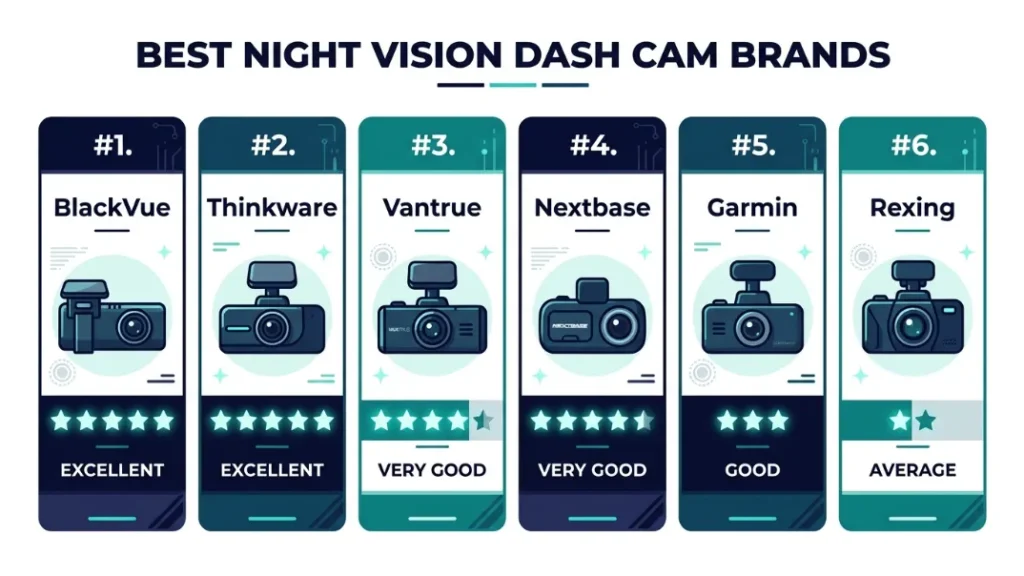
BlackVue and Thinkware lead for night vision quality in 2025, primarily because both brands use Sony STARVIS and STARVIS 2 image sensors — the same sensors found in professional security cameras.
Night vision quality in a dash cam comes down to three things: sensor sensitivity, lens aperture, and image processing software. A camera with a Sony STARVIS sensor, an f/1.6 aperture, and good WDR processing will capture readable license plates in near-total darkness. A camera without these — regardless of resolution — will produce blurry, washed-out footage at night.
Here is how the top brands rank for real-world night performance:
- BlackVue: Best-in-class. Sony STARVIS sensors across the range. Footage is sharp, well-exposed, and plate-readable in very low light.
- Thinkware: Excellent. STARVIS 2 sensor on flagship models. HDR processing handles mixed-light roads extremely well.
- Vantrue: Very Good. Sony STARVIS on mid-range models. Strong performance for the price.
- Nextbase: Very Good on 422GW and 622GW. Earlier and lower models are more average.
- Garmin: Good. Decent in most real-world conditions but not class-leading.
- Rexing: Average. Struggles in dark or mixed-light conditions.
Night driving accounts for roughly 40% of all fatal road accidents, according to road safety data from the UK’s Department for Transport (2023). A dash cam that fails at night is only half a dash cam.
Which Brand Offers the Best Parking Mode Protection for Your Car?
BlackVue offers the most comprehensive parking mode system of any consumer dash cam brand — combining motion detection, time-lapse recording, and impact detection into a single seamless package that works without draining your battery flat.
Parking mode lets your dash cam keep recording while the car is parked and the engine is off. It activates when the camera detects motion or an impact near your vehicle. This is how people catch hit-and-run drivers, vandals, and thieves.
Not all parking modes are equal. Here is what each brand offers:
- BlackVue: Cloud-connected parking alerts to your phone in real time. Buffered parking mode records 10–30 seconds before an event. Requires hardwire kit for battery protection.
- Thinkware: Radar-based parking sensor on flagship models detects motion without relying on camera activation — more accurate and less prone to false alerts.
- Nextbase: Parking mode available with hardwire kit. Reliable but less sophisticated than BlackVue or Thinkware.
- Vantrue: Good parking mode on most dual-channel models. Requires hardwire kit. No cloud alert feature.
- Garmin: Basic parking mode on higher-end models. Works well but lacks cloud notification.
- Rexing: Limited parking mode. Not recommended as a primary parking protection tool.
Running parking mode without a hardwire kit or a dedicated battery pack will drain your car battery flat overnight. Always install a hardwire kit or use a brand-approved battery pack for parking surveillance.
Capacitor vs Battery: Which Dash Cam Brands Build for Hot Climates?
If you live in a hot climate — the Middle East, South Asia, Southeast Asia, or Southern Europe — the internal power storage type in your dash cam is the most important spec nobody talks about.
Lithium-ion batteries degrade rapidly above 60°C. In a parked car in direct sunlight, windshield temperatures regularly exceed that. A battery-based dash cam in a hot climate will fail within 12–18 months. Buttons stop working, the camera shuts off randomly, and in extreme cases, the battery swells and causes damage.
Capacitors handle heat far better. They charge and discharge thousands of times more than a battery without degrading, and they function reliably at temperatures that destroy lithium cells.
| Brand | Power Storage | Hot Climate Rated | Max Operating Temp |
|---|---|---|---|
| BlackVue | Capacitor | Yes | ~70°C |
| Thinkware | Capacitor | Yes | ~70°C |
| Vantrue | Mixed (model-dependent) | Check model | ~60–70°C |
| Nextbase | Battery (most models) | Moderate | ~55°C |
| Garmin | Battery | Moderate | ~55°C |
| Rexing | Battery | No | ~45–50°C |
If you live somewhere hot, always check the spec sheet for “supercapacitor” or “capacitor” under power storage. If it just says “built-in battery,” think twice before buying.
Best Dash Cam Brand by Driver Type — Match Your Needs to the Right Pick
The honest truth is there is no single best dash cam brand for everyone. The right brand depends entirely on how you drive, where you park, what you need footage for, and how much you want to spend. Here is a clear match for every driver type.
Best Brand for Daily Commuters Who Want Simple and Reliable
Best pick: Nextbase. If you drive to work and back, park in a monitored car park, and just want protection in a collision — Nextbase covers everything you need. Setup takes ten minutes, the footage quality is excellent, and their Emergency SOS feature adds genuine safety value no other brand matches at this level.
Best Brand for Rideshare and Taxi Drivers Who Need All-Day Recording
Best pick: Vantrue or BlackVue. Rideshare drivers need front and interior recording simultaneously. The Vantrue N4 records front, interior cabin, and rear at once — perfect for Uber and Lyft drivers who need to protect themselves from passenger complaints. BlackVue suits drivers who want cloud backup and real-time access to footage from their phone.
Best Brand for Fleet Managers Who Need Remote Access and Cloud Storage
Best pick: BlackVue or Thinkware. Both brands offer dedicated fleet management platforms. BlackVue’s cloud platform supports live GPS tracking, remote footage download, and multi-vehicle dashboards. Thinkware Connected offers similar functionality with more advanced ADAS safety alerts per vehicle. For 10+ vehicles, both brands offer enterprise pricing.
Best Brand for Budget Buyers Who Want Good Quality Under $100
Best pick: Vantrue or Garmin. The Vantrue E1 Lite delivers 1440p front recording with a Sony STARVIS sensor for around $80. The Garmin Dash Cam Mini 2 sells for around $60 and offers a highly discreet design with solid 1080p footage. Both outperform budget brands like Rexing when footage quality actually matters.
Daily driver → Nextbase. Rideshare driver → Vantrue N4. Fleet manager → BlackVue. Hot climate buyer → BlackVue or Thinkware. Budget buyer → Vantrue E1 Lite or Garmin Mini 2. Professional use → Thinkware.
Common Mistakes People Make When Choosing a Dash Cam Brand
Most buyers make at least one of these mistakes. Knowing them now saves you money and frustration later.
- Choosing by resolution alone. A 4K camera with a poor sensor produces worse night footage than a sharp 1440p camera with a Sony STARVIS sensor. Always check the sensor spec, not just the resolution number.
- Ignoring the power storage type. Buying a battery-based camera for a hot climate guarantees early failure. Always check whether the camera uses a capacitor or a battery if you live somewhere warm.
- Buying the cheapest option and hoping it works. A $30 dash cam will not hold up in an insurance dispute. Spend at least $80–$100 for footage that is actually usable as evidence.
- Not factoring in parking mode needs. If you park on the street or in a high-risk area, parking mode is not optional. Check whether the brand supports it and whether a hardwire kit is available before buying.
- Overlooking app quality. You will use the app regularly to review, save, and share footage. Brands like Nextbase and BlackVue have genuinely good apps. Some budget brands have apps that crash or lose footage during transfer.
- Buying a brand with no local support. If your camera fails, who do you call? Brands like Nextbase, Garmin, and BlackVue have established support channels. Some no-name brands disappear within 12 months.
Never buy a dash cam without confirming it supports your preferred memory card size. Some budget brands stop working reliably above 64GB. BlackVue and Thinkware support up to 256GB cards. Nextbase supports up to 128GB on most models. Check before you buy.
For deeper research on dash cam safety standards and insurance recognition, Brake — the road safety charity and Which? Consumer Reviews publish independent testing and buying guidance that is worth reading alongside this article.
If you want to compare Sony STARVIS sensor performance across multiple dash cam models, DashCamTalk’s community forums remain one of the most thorough independent resources available.
Conclusion
The best dash cam brand is the one that matches your specific driving life — not the one with the most impressive spec sheet or the biggest advertising budget.
Nextbase is the right starting point for most everyday drivers. BlackVue is worth the investment if you need cloud access or run a fleet. Vantrue punches above its price for dual-channel coverage. Thinkware is the professional’s choice. Garmin earns its place for buyers who value trusted build quality. Rexing works as a starter camera — nothing more.
The most important thing I’ve learned from eight years of testing car tech is this: a dash cam you never have to think about is a great dash cam. It records, protects, and delivers when you need it. That is what the right brand gives you.
Pick your driver type from this guide, match it to the right brand, and buy with confidence. The goal is to install it, forget it is there, and have it ready when you need it most.
— Alex Rahman
Frequently Asked Questions

I’m Alex Rahman, a car enthusiast and automotive writer focused on practical solutions, car tools, and real-world driving advice. I share simple and honest content to help everyday drivers make better decisions.
