Are Dash Cams Worth It? Pros, Cons & Honest Verdict
Dash cams are worth it for most drivers. They record accident footage, protect against insurance fraud, and can lower your premiums. The main downsides are upfront cost, privacy concerns, and legal restrictions in a few regions. For most people, the protection they offer far outweighs the cost.
Are Dash Cams Worth It? Honest Pros, Cons, and Everything In Between
A few years ago, I watched a driver ahead of me brake-check a delivery truck on the motorway. The truck clipped the car. Both pulled over. Within seconds, the car driver was on the phone — calm, almost rehearsed. The truck driver looked panicked.
That moment stuck with me. The car driver knew exactly what he was doing. And without footage, the truck driver had no way to prove it.
I’m Alex Rahman, and I’ve spent years researching vehicle safety technology. Dash cams came up again and again as one of the most practical investments a driver can make. Not because they’re flashy — but because they work quietly in the background and show up when it matters most.
This guide covers every angle. The real pros. The honest cons. The legal stuff. And exactly who should — and shouldn’t — buy one.
- Dash cams record continuous footage that protects you in accidents and insurance disputes.
- Some insurers offer discounts of 10–15% for drivers with a dash cam installed.
- Parking mode can protect your car when parked — but needs a hardwire kit to avoid draining your battery.
- Your own footage can sometimes be used against you, so honest driving matters.
- Dash cams are legal in most countries, but mounting placement and privacy rules vary.
What Is a Dash Cam and How Does It Actually Work While You Drive?
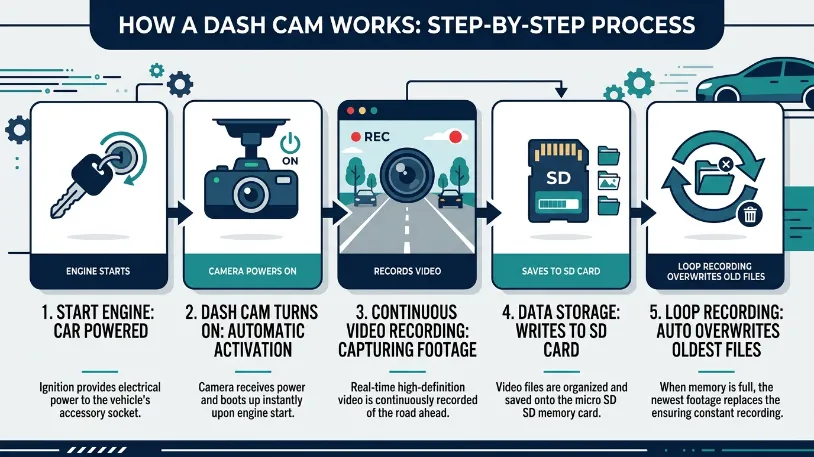
A dash cam is a small camera that mounts on your windshield or dashboard and records everything in front of your vehicle while you drive. It runs automatically when you start the engine, saves footage to a memory card, and overwrites old files when storage fills up. Most modern dash cams also include a G-sensor, GPS, and night vision — all working silently in the background.
The concept became widely known after Russian dash cam videos went viral around 2013–2014. The 2013 Chelyabinsk meteor strike — captured on dozens of Russian dash cams — showed the world just how constantly these devices record. Russians used them primarily to fight corrupt traffic police and staged accident fraud. The rest of the world quickly caught on.
Today, the UK has one of the highest dash cam adoption rates globally. Over 30% of UK drivers owned a dash cam by 2023, according to research by Nextbase, the UK’s leading dash cam brand.
What Types of Dash Cams Are Available and Which One Fits Your Needs?
There are four main types of dash cams, and the right one depends on how and where you drive.
| Type | Records | Best For | Price Range |
|---|---|---|---|
| Front-only | Road ahead | Budget-conscious drivers | $30–$100 |
| Dual-channel | Front + rear | Most everyday drivers | $80–$250 |
| Mirror cam | Front + rear via mirror | Discreet install preference | $100–$300 |
| 360° / Interior | All angles + cabin | Rideshare and fleet drivers | $150–$400+ |
Dual-channel dash cams hit the sweet spot for most drivers. Brands like Vantrue (known for their 4K front and 1080p rear setup) and Nextbase offer strong dual-channel options in the $100–$200 range.
How Does Loop Recording Keep Your Footage Fresh Without Filling Up Storage?
Loop recording automatically deletes the oldest footage once the memory card fills up — so you never have to manually manage files. Most dash cams use a 32GB to 256GB microSD card. At 1080p, a 64GB card holds roughly 8 hours of footage before looping begins.
When the G-sensor detects a sudden impact, it locks that clip immediately. Locked files never get overwritten — even when the card is full. This is how your accident footage stays safe even if you drive for hours afterward.
Use a dash cam-rated microSD card, not a standard one. Regular cards wear out faster from constant read/write cycles. Samsung Endurance and SanDisk High Endurance cards are built for this.
What Are the Real Benefits of Having a Dash Cam in Your Car?
Dash cams offer five core benefits: accident protection, insurance support, fraud prevention, theft deterrence, and driver accountability. Each one addresses a real problem drivers face — and together they make a compelling case for installation.
How Does Dash Cam Footage Protect You After an Accident?
Dash cam footage gives you an objective, timestamped record of exactly what happened during an accident. In a dispute where one driver blames the other, video evidence removes guesswork. Insurers and courts can see the speed, position, and behavior of every vehicle involved.
In the UK, the Association of British Insurers (ABI) confirmed in 2022 that dash cam footage speeds up claims settlement significantly. Cases that once took weeks to resolve — through back-and-forth between drivers — now close in days when clear footage exists.
The footage is also admissible in court across the UK, US, and most of Europe. Judges and juries respond to video evidence in a way they simply cannot to verbal testimony alone.
A dash cam does not lie. It records speed, angle, and timing with no emotional bias. In a he-said-she-said accident dispute, that objectivity is worth more than any witness statement.
Can a Dash Cam Actually Lower Your Car Insurance Premium?
Yes — several major UK insurers offer discounts between 10% and 15% for drivers who install a dash cam and share footage access with their provider. In the US, this practice is growing but less standardized across states.
Insurers like Direct Line, Admiral, and Churchill in the UK have built dash cam discount programs into their policies. The logic is simple: footage reduces fraudulent claims, which saves the insurer money — and they pass some of that saving back to you.
Over three to five years, those discounts can easily cover the cost of a mid-range dash cam. A $150 device paying back $30–$50 per year in insurance savings becomes cost-neutral within three years — and protective for life after that.
How Do Dash Cams Protect Against “Crash for Cash” Insurance Fraud?
“Crash for cash” is a fraud scheme where a driver deliberately causes a collision to make a false insurance claim. The fraudster brakes sharply in front of an innocent driver, causes the rear-end collision, then claims whiplash and vehicle damage. Without footage, the innocent driver almost always gets blamed — because rear-end collisions default to the following driver’s fault.
The Insurance Fraud Bureau (IFB) in the UK estimated that crash for cash fraud costs the industry over £340 million annually as of 2023. That cost gets passed to every driver through higher premiums.
A dash cam recording the sudden brake-check destroys the fraud attempt. The video clearly shows the lead vehicle slowing without cause — and the claim collapses.
If you suspect a crash for cash attempt, stay calm, call police, and do not admit fault at the scene. Let your footage speak when you file the claim.
Does a Dash Cam Deter Car Theft When You Are Parked?
A dash cam with parking mode records movement and impact around your vehicle even when the engine is off. It acts as a visible deterrent — many thieves will choose an unmonitored vehicle over one with a camera visibly mounted. And if theft or vandalism does occur, the footage captures the perpetrator’s face, clothing, and in some cases their vehicle.
BlackVue, a South Korean brand known for cloud-connected dash cams, offers real-time parking alerts sent directly to your phone. Their DR970X series can live-stream footage to an app the moment someone touches your car.
What Are the Honest Downsides of Owning a Dash Cam?
Dash cams have three real drawbacks: cost, potential battery drain from parking mode, and the small risk that your own footage works against you. These are worth knowing before you buy — not to discourage you, but to help you choose and set up correctly.
How Much Does a Good Dash Cam Actually Cost When You Add Everything Up?
A reliable dash cam costs between $80 and $250 for most drivers. But the total cost includes more than the device.
- Dash cam unit: $80–$250
- MicroSD card (64GB–128GB): $15–$30
- Hardwire kit (for parking mode): $20–$40
- Professional installation (optional): $50–$100
- Replacement SD card (every 1–2 years): $15–$30
A fully set-up dual-channel system with parking mode can run $200–$400 in the first year. That is still less than one at-fault accident excess payment in most insurance policies — which often starts at $500 or more.
Is Parking Mode Worth It or Does It Drain Your Car Battery?
Parking mode is worth it — but only with a hardwire kit that includes a low-voltage cutoff. Without one, the dash cam draws power directly from your battery and will drain it flat if the car sits for more than a day or two.
A hardwire kit connects the dash cam to a fused circuit and cuts power automatically when battery voltage drops below a safe threshold — usually 11.6V. This protects your battery while keeping parking mode active for 12–24 hours of monitoring.
Never run parking mode by plugging into your 12V cigarette socket. That circuit stays live in most cars and will drain your battery overnight. Always use a hardwire kit with a low-voltage cutoff for safe overnight monitoring.
Can Your Own Dash Cam Footage Be Used Against You in Court?
Yes — and this is the most overlooked downside. If your footage shows you speeding, running a red light, or driving aggressively before an accident, that evidence is now on record. In the UK and US, dash cam footage subpoenaed by police or opposing lawyers becomes discoverable evidence in legal proceedings.
This is not a reason to avoid dash cams. It is a reason to drive the way you would if someone were always watching — because now, someone is. Drivers who follow road rules have nothing to fear from their own footage.
The real downsides of dash cams are manageable. Cost is a one-time investment that pays off. Battery drain is solved with a $25 hardwire kit. And footage working against you only matters if you drive badly. For most drivers, none of these are dealbreakers.
Is It Legal to Use a Dash Cam in Your Country or State?
Dash cams are legal in most countries, including the UK, US, Canada, and Australia. However, rules around windshield mounting, audio recording, and filming other people vary significantly by region. Knowing your local rules before you install is essential.
What Are the Dash Cam Laws in the UK, US, and EU?
Here is a clear breakdown of the key legal points by region:
| Region | Legal? | Key Rules |
|---|---|---|
| United Kingdom | Yes | Must not obstruct driver’s view. GDPR applies if sharing footage publicly. |
| United States | Yes (most states) | Audio recording laws vary by state. Two-party consent required in CA, FL, and others. |
| European Union | Yes (with conditions) | GDPR governs footage of others. Cannot share identifiable footage without consent in many countries. |
| Austria / Portugal | Restricted | Strong privacy laws. Recording other vehicles in public spaces may be prohibited. |
In the UK, the Highway Code does not ban dash cams, but footage shared on social media may trigger GDPR obligations. In the US, check your specific state’s two-party consent laws before enabling audio recording on your cam.
In California, Florida, Illinois, and several other US states, recording audio inside your car without all passengers’ consent may violate wiretapping laws. Turn off audio recording in the dash cam settings if you are unsure about your state’s rules.
What Features Should You Look For When Choosing a Dash Cam?
The five features that matter most are video resolution, field of view, G-sensor sensitivity, night vision quality, and parking mode capability. Everything else — Wi-Fi, GPS, voice control — is useful but secondary to these core functions.
Why Does Video Resolution Matter More Than You Think?
Resolution determines whether you can read a licence plate from the footage. At 1080p, plates are readable within about 20 feet in good light. At 1440p or 4K, you can read plates clearly at 40–60 feet — even at highway speeds.
For accident evidence and fraud protection, plate recognition is critical. A 4K front camera combined with a 1080p rear camera — like the Vantrue E2 Lite — gives you the best balance of coverage and file size.
What Is a G-Sensor and Why Does Every Good Dash Cam Need One?
A G-sensor (gravitational force sensor) detects sudden acceleration or impact and automatically locks the current footage file so it cannot be overwritten. Without a G-sensor, a serious accident clip could be erased by normal loop recording before you retrieve it.
Most quality dash cams let you adjust G-sensor sensitivity. Set it too high and bumpy roads constantly trigger locks, filling your card with false alarms. Set it too low and a minor impact might not trigger a save. A medium sensitivity setting works for most driving conditions.
Why Do Top Dash Cams Use Sony STARVIS Sensors for Night Driving?
The Sony STARVIS is a back-illuminated CMOS image sensor designed for low-light performance. It captures far more light per pixel than standard sensors — producing clear, detailed footage in darkness where cheaper cameras produce blurry, grain-filled video.
At night, most accidents happen and most theft occurs. If your dash cam cannot record usable footage in low light, it fails you exactly when you need it most. Nextbase’s 622GW and BlackVue’s DR970X both use STARVIS-based sensors and remain two of the best performers in night recording tests.
When comparing dash cams, search for night vision sample footage on YouTube before buying. Real-world night tests reveal far more than spec sheets. Look for clear plate readability and low noise in dark street footage.
Which Dash Cam Brands Are the Most Trusted in 2024?
Four brands consistently rank highest for reliability, image quality, and customer support in independent testing across the UK and US markets.
| Brand | Origin | Known For | Best Model |
|---|---|---|---|
| Nextbase | UK | Ease of use, UK insurance integration | 622GW |
| BlackVue | South Korea | Cloud connectivity, fleet use | DR970X |
| Vantrue | US / China | 4K resolution, value for money | E2 Lite |
| Garmin | US | GPS accuracy, driver alerts | Dash Cam Mini 3 |
Nextbase (trusted by over 2 million UK drivers) built their 622GW with built-in Amazon Alexa — making hands-free operation genuinely effortless. BlackVue’s cloud platform lets fleet managers monitor dozens of vehicles remotely in real time. For pure value, Vantrue consistently outperforms cameras at twice the price in resolution and night vision tests.
For independent reviews and detailed comparisons, Which? Magazine publishes annually updated dash cam rankings based on lab testing.
Who Should Buy a Dash Cam and Who Can Probably Skip It?
Dash cams deliver the most value for specific types of drivers — and for a small group, the cost may not be justified. Here is an honest breakdown.
Buy a dash cam if you:
- Drive in high-traffic urban areas where accidents are more likely
- Commute daily on motorways or busy roads
- Are a new or young driver building a safe record with insurers
- Drive for rideshare services like Uber or Lyft
- Park regularly in busy public areas or car parks
- Want protection against crash for cash fraud schemes
- Manage a small fleet of vehicles for business
You can probably skip it if you:
- Drive rarely — fewer than 2,000 miles per year
- Park in a private, secure garage with no public access
- Live in a rural area with very low traffic density
- Already have comprehensive insurance with strong protection
Even for low-mileage drivers, the peace of mind argument holds. One accident without footage — even a minor one — can cost more in excess payments and premium hikes than the dash cam would have cost over ten years.
How Do You Install a Dash Cam Correctly Without Common Mistakes?
Installing a dash cam takes 15–30 minutes for a basic setup. A hardwired parking mode installation takes 1–2 hours and is best done by a professional auto electrician if you are not comfortable with car wiring.
- Choose a mounting spot behind the rearview mirror — this keeps the camera discreet and avoids blocking your view.
- Clean the windshield surface with an alcohol wipe before attaching the mount — this ensures a strong bond.
- Plug the power cable into the 12V socket or cigarette lighter port to test the camera before routing cables.
- Tuck the cable neatly along the windshield trim, down the A-pillar, and along the door sill to the 12V socket.
- Format the microSD card using the dash cam’s menu — not your computer — before first use.
- Adjust the camera angle so the horizon sits in the upper third of the frame with road filling the bottom two-thirds.
- Test recording for 10 minutes, then review footage to confirm focus, angle, and night vision quality.
For parking mode, a hardwire kit connects the dash cam to your fuse box rather than the 12V socket. This provides constant power with automatic low-voltage cutoff to protect your battery. Most professional installers charge $50–$80 for this job and complete it in under an hour.
Route your power cable away from airbag deployment zones. In most vehicles, the A-pillar airbag runs behind the trim panel on the driver’s side. Check your vehicle manual before tucking cables into trim panels.
Conclusion: Are Dash Cams Worth It for Most Drivers?
The answer is yes — for most drivers, a dash cam is one of the most practical safety investments you can make. It costs less than a single insurance excess payment. It works silently every drive. And it shows up with clear, objective evidence exactly when you need it most.
The cons are real but manageable. Cost is a one-time spend that pays back through insurance savings. Battery drain is solved with a $25 hardwire kit. And privacy concerns are addressed by understanding your local laws before you mount.
I’m Alex Rahman, and my honest take is this: if you drive more than a few times a week, a dash cam belongs in your car. Start with a reliable dual-channel model from Nextbase or Vantrue, install it properly, and forget it’s there. It will do its job quietly — until the one day it matters enormously.
For more guidance on vehicle safety equipment, the National Highway Traffic Safety Administration (NHTSA) publishes research on driver safety technology worth reading.
Frequently Asked Questions
Do dash cams record all the time or only in accidents?
Dash cams record continuously while the engine runs, using loop recording to overwrite old footage. When a G-sensor detects an impact, it automatically locks that clip so it never gets overwritten. Parking mode extends recording to when the car is off.
How long does dash cam footage last before it gets deleted?
Standard loop recording overwrites the oldest footage once the memory card fills. With a 64GB card at 1080p, that is roughly 6–8 hours of footage. Impact-locked clips are never deleted automatically — only manually by the driver.
Can a dash cam lower my insurance premium?
Yes — several UK insurers including Direct Line and Admiral offer discounts of 10–15% for dash cam users. In the US, discounts are available through select providers but less standardized. Ask your insurer directly, as programs differ by provider.
Does parking mode drain the car battery?
Parking mode can drain your battery if connected to the 12V socket without a hardwire kit. A proper hardwire kit includes a low-voltage cutoff that stops the camera before the battery drops to a dangerous level — protecting your ability to start the car.
Is dash cam footage admissible in court?
Yes — in the UK, US, Canada, and Australia, dash cam footage is generally admissible as evidence in civil and criminal proceedings. Footage must be authentic, unedited, and timestamped. Judges treat it as objective evidence, often carrying more weight than witness testimony.
Can a dash cam footage be used against me?
Yes, it can. If your footage shows speeding, running lights, or aggressive driving prior to an accident, that footage can be subpoenaed and used against you in legal proceedings. This is why dash cams are best thought of as an incentive to drive well — not just a safety net.

I’m Alex Rahman, a car enthusiast and automotive writer focused on practical solutions, car tools, and real-world driving advice. I share simple and honest content to help everyday drivers make better decisions.
