Is a Front Facing Dash Cam Enough for Full Protection While Driving?
Quick Answer
A front facing dash cam records what happens in front of your car. It helps prove fault in many cases. But it cannot capture rear or side incidents, so it offers only partial protection, not full coverage.
I remember my first minor accident in city traffic. A car hit me from behind and drove away. My dash cam recorded nothing useful. That moment changed how I think about dash cams.
I’m Alex Rahman, and I write about smart car tech and real driving safety. Many drivers ask the same question about a front facing dash cam. Is it enough, or do you need more?
The answer depends on how and where you drive. Let’s break it down clearly so you can decide with confidence.
Key Takeaways
- A front dash cam captures only what happens ahead.
- Rear and side incidents remain unrecorded.
- Dual dash cams provide stronger legal protection.
- Front-only works for low-risk driving situations.
What Does a Front Facing Dash Cam Actually Record?
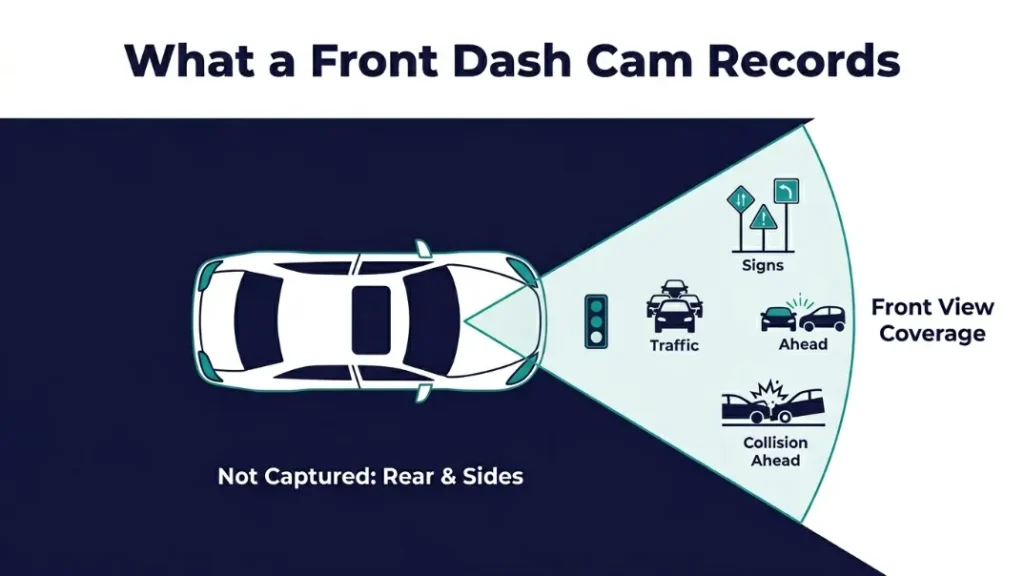
A front facing dash cam records everything directly in front of your vehicle, including traffic, road signs, and collisions that happen ahead, but it cannot capture events behind or beside your car.
This camera sits on your windshield and points forward. Brands like Garmin and Viofo design these cameras for simple use and clear footage.
Key rule: It only shows what it can see in its field of view.
That means it works best for:
- Head-on collisions
- Sudden braking incidents
- Lane changes in front of you
But it cannot see behind your vehicle at all. That limitation matters more than most drivers expect.
Let’s look at whether this coverage is enough.
Is a Front Facing Dash Cam Enough for Most Drivers?
A front facing dash cam is enough for basic protection if you mainly want proof of forward accidents, but it does not provide full evidence for many common crash scenarios.
If you drive short distances or in calm areas, a single camera may work. It still records clear evidence for many front-side incidents.
Insight: Most drivers overestimate how much a front camera captures.
Here is when it may be enough:
- Low traffic areas
- Short daily commutes
- Budget-focused setups
Still, traffic conditions in busy cities increase risk from all directions.
So what exactly does it miss?
What Does a Front Dash Cam Miss in Real Accidents?
A front dash cam misses any incident that happens outside its forward view, including rear collisions, side impacts, and parking damage, which makes it incomplete for full accident coverage.
Rear-End Collisions
Rear-end crashes happen often in urban traffic. Another driver hits your car from behind.
Your front camera shows nothing about the impact.
Problem: You cannot prove who caused the crash.
Insurance adjusters rely on evidence. Without rear footage, your claim may weaken.
Side-Impact Crashes
Side collisions happen at intersections or during lane changes. These are hard to capture with a narrow front view.
Reality: The camera angle limits what you see.
Even wide-angle lenses cannot cover full side views.
Parking Incidents
Parking damage often happens when you are away. Another car may hit your rear or side.
Your front camera may record nothing useful.
Warning:
Many hit-and-run cases fail because the camera did not capture the impact angle or license plate.
This is where dual systems start to make more sense.
Front vs Dual Dash Cam: What Is the Real Difference?
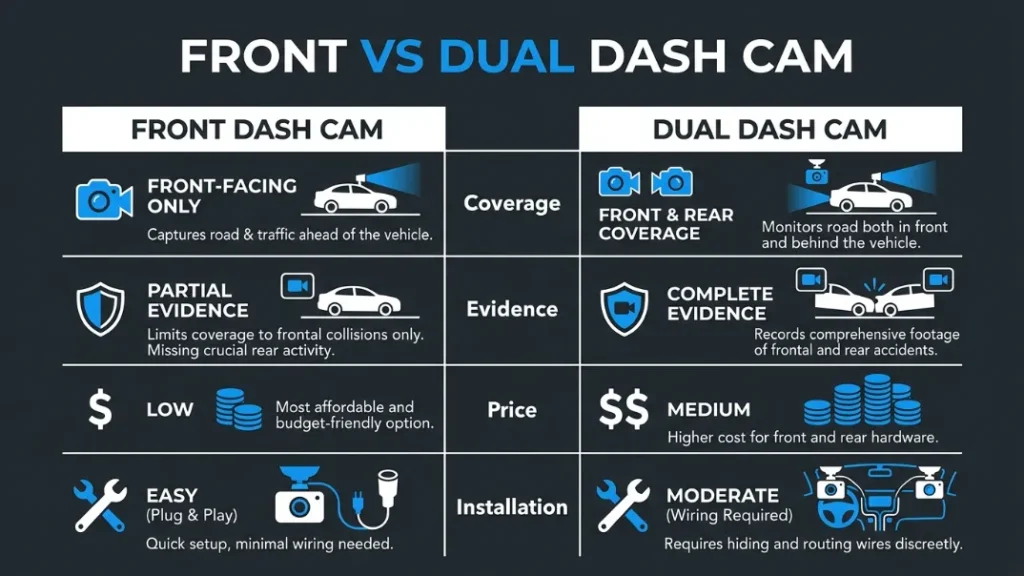
The real difference is coverage, because a dual dash cam records both the front and rear of your vehicle, while a front-only camera captures just one direction.
| Feature | Front Dash Cam | Dual Dash Cam |
|---|---|---|
| Coverage | Front only | Front + Rear |
| Accident Evidence | Partial | More complete |
| Price | Lower | Higher |
| Installation | Easy | Moderate |
Brands like Nextbase offer dual systems that record both angles clearly.
Key insight: More cameras mean more context in an accident.
If your goal is full protection, coverage matters more than price.
When Is a Front Facing Dash Cam Enough for You?
A front facing dash cam is enough when your driving risk stays low and you only need proof of forward incidents, such as simple traffic disputes or minor collisions ahead.
Here are common situations where it works well:
- You drive mostly on quiet roads
- You park in secure private areas
- You want basic legal evidence
Rule: Lower risk allows simpler setups.
Tip:
Choose a wide-angle lens (140° or more) to increase your front coverage slightly.
Still, many drivers face higher risks without realizing it.
When Should You Upgrade to a Dual Dash Cam System?
You should upgrade to a dual dash cam when you drive in heavy traffic, park in public areas, or want stronger evidence for insurance claims in case of rear or multi-angle accidents.
Consider upgrading if:
- You drive daily in busy city traffic
- You use your car for ride-sharing
- You park on streets or public lots
- You want full accident documentation
Insight: Risk level should guide your decision, not just budget.
Step-by-Step
- Check your daily driving environment.
- Identify common risks like traffic or parking.
- Decide if rear coverage adds real value.
- Choose a dual dash cam if risk is high.
This small upgrade can save you major costs later.
Does Insurance Accept Front Dash Cam Footage?
Insurance companies accept front dash cam footage as evidence if it clearly shows the incident, but limited angles can reduce its strength when key details happen outside the camera view.
Adjusters review footage to determine fault. Clear video helps speed up claims.
Fact: More angles improve claim success.
For guidelines, you can check this
insurance claim advice from III.
If your footage lacks context, disputes may still occur.
Are Dual Dash Cams Worth the Extra Cost?
Dual dash cams are worth the extra cost if you want complete coverage and stronger legal protection, especially in high-risk driving environments where accidents can happen from multiple directions.
Prices have dropped in recent years. Many good systems cost under $200.
Rule: Prevention costs less than accident disputes.
Spending a little more now can protect you from large repair or legal costs later.
Still, you should match your setup to your real needs.
How to Choose the Right Dash Cam Setup for Your Needs
The right dash cam setup depends on your driving habits, risk level, and budget, so you should choose based on where you drive and what type of protection you need.
Here is a simple decision guide:
- Low risk → Front dash cam
- Medium risk → Dual dash cam
- High risk → Dual + parking mode
You can also review safety tips from
road safety guidelines by NHTSA.
Quick Summary
A front dash cam works for simple needs, but it leaves gaps in coverage. Dual dash cams fill those gaps and provide stronger protection in real-world accidents.
Now let’s bring it all together.
Final Verdict: Should You Rely on a Front Facing Dash Cam?
A front facing dash cam gives useful evidence for forward incidents, but it does not provide full protection, so relying on it alone works only in low-risk situations.
If you want peace of mind, wider coverage makes a real difference.
I’m Alex Rahman, and I always recommend matching your setup to your driving reality. A small upgrade today can save you stress tomorrow.
Frequently Asked Questions
Is a front dash cam enough for insurance claims?
It can help if the accident happens in front. But it may not prove rear or side incidents. More angles improve claim success.
Do I really need a rear dash cam?
You need one if you drive in traffic or park outside. It captures rear-end crashes and hit-and-run cases. It adds strong evidence.
What is the biggest limitation of a front dash cam?
The biggest limitation is blind spots. It cannot record behind or beside your car. That limits accident coverage.
Are dual dash cams hard to install?
They take more time than single cameras. You need to run a cable to the rear. Many kits include simple guides.
Do dash cams record when the car is parked?
Some models offer parking mode. They record when motion or impact occurs. You need a power source for this feature.
Is a dual dash cam worth it for beginners?
Yes, if you drive often or in busy areas. It gives more complete protection. Beginners benefit from better coverage.

I’m Alex Rahman, a car enthusiast and automotive writer focused on practical solutions, car tools, and real-world driving advice. I share simple and honest content to help everyday drivers make better decisions.
