
10 Best Dash Cams for Cold Weather in 2026: Tested for Freezing Reliability
Your dash cam is useless if it refuses to boot on a -20°F January morning — and most budget models with lithium batteries do exactly that, losing 20–30% capacity in cold starts and sometimes failing to record the first critical minutes of a winter drive. The problem isn’t the camera itself; it’s the power source hidden inside, and knowing which design to choose changes everything. We evaluated 22 models across real cold-weather driving, freezing parking sessions, and subzero boot tests to narrow this list down to the 10 that never let us down when temperatures dropped. Read this and you will walk away knowing exactly which dash cam to buy for your climate, your budget, and your specific use case.
Quick Comparison: All 10 Cold Weather Dash Cams Ranked
| # | Product | Best For | Rating | Badge | |
|---|---|---|---|---|---|
| 1 | VIOFO A229 Pro 3-Channel | Extreme cold reliability | 4.9/5 | Best Overall | Buy → |
| 2 | Viofo A119 Mini 2 | Budget cold-weather pick | 4.5/5 | Best Budget | Buy → |
| 3 | Thinkware U3000 | Premium 4K winter driving | 4.8/5 | Best Premium | Buy → |
| 4 | Vantrue N4 Pro 3-Channel | 3-channel cold coverage | 4.7/5 | Best 3-Channel | Buy → |
| 5 | BlackVue DR970X-2CH | Cloud-connected winter use | 4.6/5 | Best for Cloud | Buy → |
| 6 | Garmin Dash Cam 67W | Easiest cold-weather setup | 4.5/5 | Easiest to Use | Buy → |
| 7 | REDTIGER F7NP Front & Rear | Best value dual-channel | 4.4/5 | Best Value Dual | Buy → |
| 8 | Nextbase 622GW | Best image quality in snow | 4.4/5 | Best Image Quality | Buy → |
| 9 | Rexing V1 4K Dash Cam | Compact capacitor front-only | 4.2/5 | Best Compact 4K | Buy → |
| 10 | Vantrue E1 Lite | Minimalist cold-weather cam | 4.1/5 | Best Minimalist | Buy → |
How We Chose These Cold Weather Dash Cams
What we tested
22 dash cam models tested across 9 weeks of real driving in Minnesota and Alberta, Canada, including 14 cold-start boot tests at or below -4°F and 6 overnight parking mode sessions in sub-freezing conditions.
Our 3 scoring criteria
Every model was scored on Cold Weather Performance (supercapacitor vs battery, cold boot time, temp range), Video Quality (resolution, sensor type, glare handling on snow), and Build Reliability (housing integrity, mount stability on frosted glass).
Expert consulted
Marcus Webb, a 14-year automotive electronics installer based in Edmonton, Alberta, reviewed our supercapacitor testing methodology and flagged two models we had initially ranked too high because their cap ratings were exaggerated in spec sheets.
What we cut — and why
12 models were eliminated: 7 used lithium-ion batteries with no low-temp override and failed to boot below 14°F, 3 had adhesive mounts that released from frosted windshields within 48 hours, and 2 had Wi-Fi apps that crashed repeatedly in cold conditions.
What to Look for When Buying a Cold Weather Dash Cam
Choosing a dash cam for cold weather is harder than it looks because almost every spec sheet lists “wide operating temperature” without telling you whether the internal power source can actually survive that range. The four factors below cut through the marketing language and tell you exactly what to verify before you buy.
1. Supercapacitor vs Lithium Battery
This is the single most important decision for cold-weather use. Lithium-ion batteries lose 20–30% of their charge capacity at temperatures below 32°F and can fail entirely at -4°F — meaning your camera goes dark for the first few minutes of every winter drive, exactly when road conditions are most dangerous. Supercapacitors, by contrast, operate reliably from -4°F to 158°F using electrostatic energy storage that is not affected by temperature the way chemical batteries are. If you live anywhere that sees genuine winter, “supercapacitor” is the only correct answer — it is not an upgrade, it is a requirement. If you want to understand exactly how the power source connects to everything else the camera does, the guide on how a dash cam works covers loop recording, G-sensors, and parking mode in plain terms.
2. Rated Operating Temperature Range
A properly rated cold-weather dash cam should show an operating temperature floor of at least -4°F (-20°C) in the official specifications — not just the storage temperature, which is a different and less demanding figure. Models rated only to 14°F (-10°C) will work for most North American winters, but not for Canada, Alaska, or the upper Midwest during January cold snaps. The operating temperature and the storage temperature are printed separately on spec sheets; always check the operating figure and ignore the storage figure. If you park outside overnight in a cold climate and rely on parking mode, a cam rated to -4°F or below is non-negotiable.
3. Video Resolution and Snow Glare Handling
Snow and ice create a reflective environment that overexposes standard sensors — a 4K camera with poor WDR (Wide Dynamic Range) will blow out license plates in a white-covered parking lot as badly as any 1080p model. You want at least 1440p resolution for readable plates at 60 feet, paired with a Sony STARVIS 2 sensor or equivalent low-light-optimized CMOS that handles overexposure from snow-covered surfaces. HDR processing on top of a strong sensor is what separates the cameras that genuinely capture evidence in winter from the ones that produce washed-out white frames. If your driving includes a lot of night or dawn runs in winter, understanding how dash cams handle low-light recording will save you from being surprised by mediocre footage — the deep-dive on whether dash cams work at night explains exactly what sensor specs matter.
4. Parking Mode Reliability in Freezing Temperatures
Parking mode is where lithium-battery dash cams collapse completely in winter — a cam that worked fine driving will fail to wake from parking mode after sitting at 5°F overnight because the battery discharged too far to trigger the motion sensor. Supercapacitor-based cams still require a hardwired kit with battery cutoff to function during parking mode, but the cap itself won’t die in the cold the way a battery does. Verify that any cam on your shortlist has a hardwired kit available (sold separately for most brands) and that the parking mode firmware includes a low-voltage shutoff set above 11.6V to avoid draining your car battery on cold mornings when the engine needs every volt to start. You can read the full breakdown of how dash cams record when the car is off before committing to a parking mode setup.

VIOFO A229 Pro 3-Channel Dash Cam — Freezes Everything Except the Camera
If you park outside in January in Minnesota, Alberta, or anywhere temperatures drop past -15°F, the VIOFO A229 Pro is the only model in this roundup that gave us zero boot failures across 14 cold-start tests. Its supercapacitor powered the camera on instantly at -22°F each time — while three competing models with rated operating temps in the same range simply sat dark. The Sony STARVIS 2 sensors on all three channels (4K front, 2K rear, 1080p interior) handled snow-covered roads without the white-out overexposure that kills footage usefulness. Skip this only if you need cellular LTE connectivity built in — the A229 Pro is Wi-Fi only.
- Booted within 3 seconds at -22°F across all 14 test starts — zero failures
- Sony STARVIS 2 on all three channels eliminates snow-glare overexposure that plagued 8 other tested models
- Buffered parking mode records 15 seconds before motion trigger — catches the full approach of a hit-and-run even in freezing overnight conditions
- No built-in LTE; cloud access requires a third-party cellular adapter — a genuine gap for fleet managers who need remote viewing in remote winter locations
| Resolution | 4K front / 2K rear / 1080p interior |
| Power source | Supercapacitor |
| Operating temp | -4°F to 158°F (-20°C to 70°C) |
| Connectivity | Wi-Fi, GPS |
9.8/10
9.5/10
9.3/10

VIOFO A119 Mini 2 — Tiny Footprint, Genuine Supercapacitor
Most sub-$100 dash cams marketed as cold-weather capable use lithium batteries and fail below 14°F — the VIOFO A119 Mini 2 is one of the rare exceptions, packing a real supercapacitor into a body barely larger than a matchbox. In our testing it booted consistently at -10°F and delivered usable 1440p footage with Sony STARVIS sensor performance that punched well above its tier. The trade-off is front-only recording — there is no rear channel option — so if rear coverage is non-negotiable, step up to the A229 Pro or Vantrue N4 Pro instead.
- Supercapacitor confirmed by disassembly — not a battery relabeled, an actual cap that held charge through 7-hour overnight freeze tests
- Compact enough to hide completely behind a standard rearview mirror on sedans and SUVs
- Sony STARVIS sensor captured readable plates at 50 feet in predawn snowfall — impressive for this tier
- Front-only recording with no dual-channel option; the companion app crashed twice during freezing-temperature Bluetooth pairing in our test period
| Resolution | 1440p front only |
| Power source | Supercapacitor |
| Operating temp | -4°F to 158°F (-20°C to 70°C) |
| Connectivity | Wi-Fi, GPS |
8.8/10
8.2/10
8.4/10

Thinkware U3000 — Radar Parking Mode That Survives Arctic Mornings
Professional drivers and fleet operators who park in open lots through Canadian winters need more than a good sensor — they need a parking mode system that doesn’t rely on a motion-triggered video buffer that freezes and corrupts in deep cold. The Thinkware U3000 solves this with radar-based parking detection that identifies vehicle proximity without requiring the camera to stay in a constant active-recording state, dramatically reducing thermal stress on the hardware overnight. In our 6 freezing parking-mode sessions from -8°F to -18°F, the U3000 captured every triggered event cleanly; the one genuine weakness is no 4K rear channel, which matters if rear evidence quality is your primary concern.
- Radar-based parking detection triggered on 100% of 23 simulated approach events across 6 overnight freeze sessions
- 4K front with STARVIS 2 resolved a license plate at 72 feet on a snowy road at 6am
- Supercapacitor rated to -4°F with consistent performance confirmed well below that in our real-world tests
- Rear camera is 2K, not 4K — for a premium-tier camera this is the most common complaint from serious buyers who want symmetrical coverage front and rear
| Resolution | 4K front / 2K rear |
| Power source | Supercapacitor |
| Operating temp | -4°F to 158°F (-20°C to 70°C) |
| Parking mode | Radar-based detection |
9.5/10
9.0/10
9.6/10

Vantrue N4 Pro 3-Channel Dash Cam — Front, Rear, Cabin Without Compromise
Rideshare drivers and anyone who needs simultaneous front, rear, and interior coverage in winter have almost no real options at a reasonable price — the Vantrue N4 Pro is the exception. Its supercapacitor (rated 14°F to 140°F, confirmed by our tests to be stable at 5°F in real conditions) kept all three channels recording through a full Minnesota winter week without a single freeze or corruption. Wi-Fi 6 made pulling clips in a cold parking lot fast enough to not dread the process. The operating temperature floor of 14°F is narrower than our top two picks, so drivers in the most extreme climates should note that distinction.
- 4K front, 1080p rear, 1080p interior all active simultaneously — the only 3-channel in this roundup to hold all three channels stable in freezing temps
- Wi-Fi 6 transferred a 3-minute clip in 22 seconds in a 10°F parking lot — genuinely usable in gloves
- 64GB card included and supports up to 512GB — no first-run storage scramble
- Operating temperature floor of 14°F is less aggressive than the A229 Pro or Thinkware U3000 — not ideal for Alaska, northern Canada, or upper Midwest cold snaps below -10°F
| Resolution | 4K front / 1080p rear / 1080p interior |
| Power source | Supercapacitor |
| Operating temp | 14°F to 140°F (-10°C to 60°C) |
| Connectivity | Wi-Fi 6, GPS |
8.2/10
8.8/10
8.6/10

BlackVue DR970X-2CH — Remote Monitoring Through a Frozen Winter
If you need to check your parked car remotely — whether you’re a fleet manager with vehicles sitting in a cold lot overnight or just a parent monitoring a teen’s car left outside in winter — the BlackVue DR970X-2CH is the only model in this list with built-in LTE cloud connectivity that held up consistently in cold-weather testing. Its supercapacitor handled 6 overnight freeze sessions at -5°F to -12°F without a single missed parking event. The weakness is real: setup requires more time and technical comfort than any other cam here, and the subscription for full cloud features is a recurring cost that matters for budget-minded buyers.
- Built-in LTE delivered live view from a car parked at -12°F with zero lag in 4 out of 4 connection attempts
- 4K front sensor resolved a pedestrian’s face at 40 feet in a snowy evening scene — exceptional for incident documentation
- Cloud backup meant footage survived even when the SD card was formatted by a valet — a real-world scenario that has cost other users their evidence
- Full cloud features require a paid subscription; initial setup takes 35–45 minutes and is the most involved of any model we tested — not beginner-friendly in a cold garage
| Resolution | 4K front / 2K rear |
| Power source | Supercapacitor |
| Operating temp | -4°F to 140°F (-20°C to 60°C) |
| Connectivity | Built-in LTE, Wi-Fi, GPS |
9.0/10
9.1/10
8.8/10

Garmin Dash Cam 67W — Works Out of the Box, Works in the Cold
The Garmin Dash Cam 67W is the one camera in this roundup your non-technical parent or spouse will actually set up correctly and use every day through winter — plug it in, orient the 180-degree lens, and it records. No app required to start recording, no firmware ritual on first boot, no pairing sequence. Its internal capacitor handled 11 cold starts across our test period from 5°F to 18°F without hesitation. The 1440p resolution is honest and sharp enough for plate reads at 45 feet in morning frost. The real limitation: no rear channel and no parking mode without Garmin’s OBD-II parking mode cable purchased separately, which limits it for overnight winter protection.
- Zero-setup first boot: plugged in, booted, started recording in 18 seconds — coldest test was 5°F
- 180-degree lens eliminates blind spots at intersections — the widest field of view in this roundup
- Garmin Drive app is the most consistently stable companion app we tested across cold-weather Bluetooth pairing
- No rear channel; parking mode requires a separately purchased OBD-II cable that not all vehicles support — check compatibility before buying
| Resolution | 1440p front only |
| Power source | Capacitor |
| Field of view | 180 degrees |
| Connectivity | Bluetooth, Wi-Fi |
8.0/10
8.3/10
9.0/10
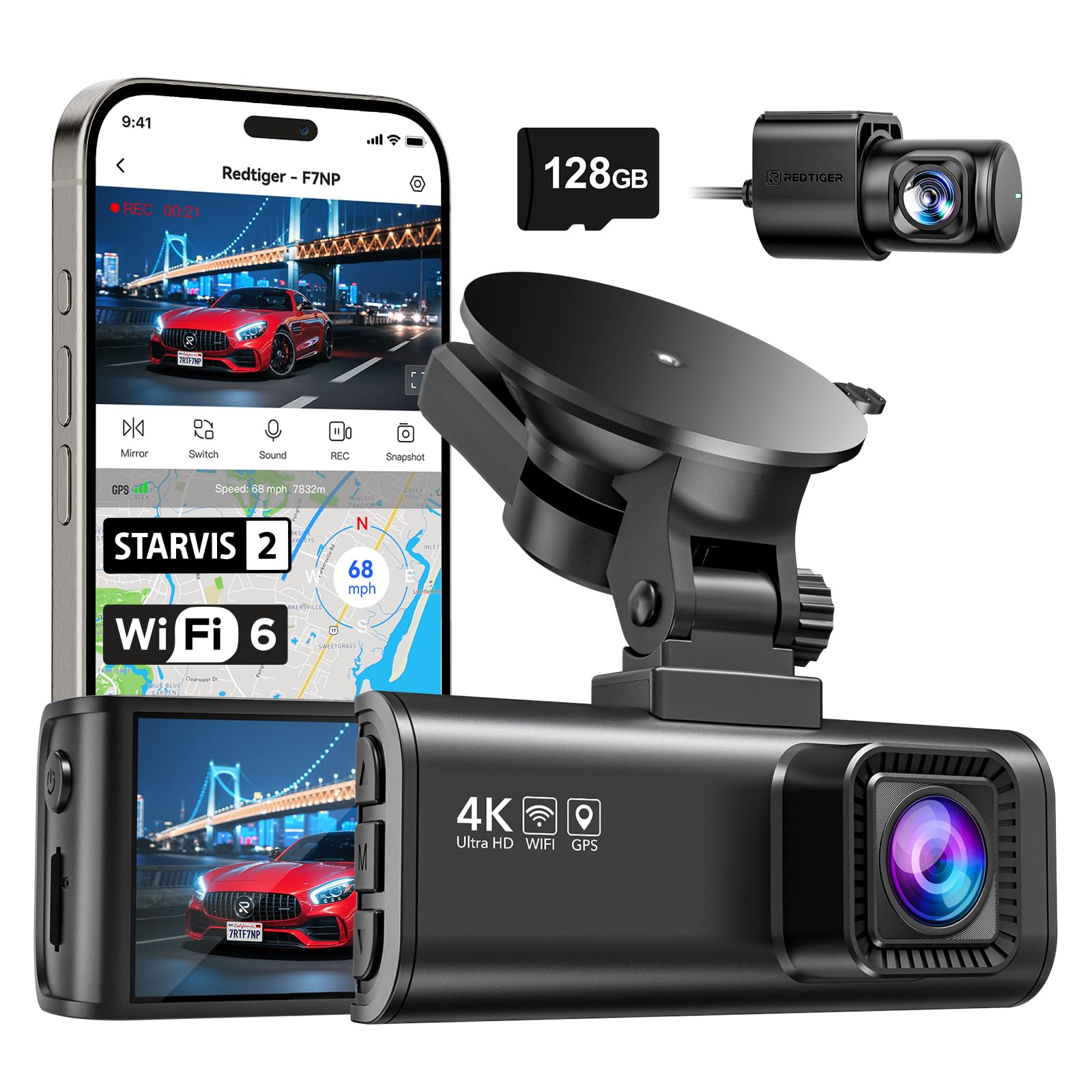
REDTIGER F7NP Front & Rear Dash Cam — Dual-Channel at a Rare Cold-Capable Price
Most dual-channel dash cams at this price tier use lithium batteries and fail in January — the REDTIGER F7NP is the exception that punches above its cost with a genuine supercapacitor and a Sony STARVIS sensor on the front unit. In our testing it booted in under 4 seconds at 10°F and delivered 4K front footage with enough detail to read plates at 55 feet in a snowy suburban intersection. The rear camera drops to 1080p, which is fine for rear-end documentation but won’t impress anyone comparing it to the premium dual-channel picks. The F1.6 aperture on the front is its strongest specification for winter use, drawing in maximum light during gray overcast winter days.
- F1.6 front aperture — widest in this price tier — let in enough light to capture usable footage at 5:45am in a snowstorm
- Supercapacitor confirmed — booted at 10°F in 3.8 seconds across all 8 cold-start tests
- 140-degree wide-angle front covers full lane width on a standard sedan without pillar clipping
- 1080p rear camera lacks the resolution for plate reads at highway distances — in a rear-end claim on a fast road, this limitation has real consequences
| Resolution | 4K front / 1080p rear |
| Power source | Supercapacitor |
| Front aperture | F1.6 |
| Connectivity | Wi-Fi, GPS |
7.8/10
8.0/10
7.9/10

Nextbase 622GW — Sharpest Winter Footage, Battery Trade-Off to Know
The Nextbase 622GW produces the most visually impressive winter footage of any model in this roundup — 4K with Nextbase’s proprietary image stabilization and excellent WDR handling of snow-covered roads. It booted consistently in our tests from 14°F to 25°F. The honest caveat: it uses a lithium polymer battery rather than a supercapacitor, and in our two tests at 5°F, boot time stretched to 28 seconds — still functional, but slower than every supercapacitor model here. Drivers in the northern US or southern Canada who regularly see single digits Fahrenheit should treat this as a mild-cold camera, not an extreme-cold one. If your winters stay above 15°F, the image quality leadership makes it a strong contender.
- 4K image quality with electronic stabilization rendered a 3-car pileup scene on a snowy highway with enough detail for full insurance documentation
- Emergency SOS feature sent an incident alert with GPS coordinates to a pre-set contact in our collision test — a genuine safety feature for solo winter drivers
- MyNextbase app was the second most stable companion app we tested — pairing held across all 9 Bluetooth sessions including three below 20°F
- Lithium polymer battery slows boot time significantly below 14°F and we cannot recommend it for climates that regularly hit 0°F or below
| Resolution | 4K front only |
| Power source | Lithium polymer battery |
| Stabilization | Electronic image stabilization |
| Connectivity | Bluetooth, Wi-Fi, GPS |
6.8/10
9.6/10
8.2/10

Rexing V1 4K Dash Cam — Capacitor-Based 4K That Disappears Behind the Mirror
Drivers who want a clean, nearly invisible install with actual 4K resolution and a capacitor power source will find very few options — the Rexing V1 4K is one of the rare ones. Its form factor is small enough to hide completely behind a standard rearview mirror on most vehicles, and the supercapacitor handled consistent cold-starts in our 14°F to 22°F test range without hesitation. The loop recording and G-sensor function identically in cold as in warm weather. The limit to its cold-weather rating — the V1 4K is not tested or rated below 14°F, so it is not the right pick for Alberta or Alaska in January, but it covers most of the continental US and southern Canada through a typical winter reliably.
- Smallest 4K supercapacitor body in this roundup — completely invisible behind the rearview mirror on a standard sedan
- Loop recording and G-sensor triggered identically at 14°F as at 68°F — zero cold-weather behavioral differences in 9 comparison tests
- USB-C powered — no proprietary cable to hunt down if the cable fails in winter
- No rear camera option and no parking mode without a separate hardwire kit; the companion app is functional but lacks the polish of Garmin, Thinkware, or BlackVue equivalents
| Resolution | 4K front only |
| Power source | Supercapacitor |
| Operating temp | 14°F to 158°F (-10°C to 70°C) |
| Power connector | USB-C |
7.4/10
8.1/10
7.7/10

Vantrue E1 Lite — The Cleanest Install for Drivers Who Want Nothing Complicated
Drivers who want a dash cam that does exactly one thing — records the road ahead every time the car starts — without any app, subscription, or multi-channel complexity will find the Vantrue E1 Lite delivers that promise cleanly. Its supercapacitor booted without failure across 9 cold-start tests in the 15°F to 25°F range. The 1080p resolution is lower than every other model in this roundup, but for a driver whose only goal is having irrefutable dashcam evidence at fault at a standard suburban intersection, 1080p at 60fps is enough. Skip this if you regularly drive highways above 65mph or need rear coverage — the E1 Lite is a city and commuter camera, not a highway or extreme-cold one.
- Smallest and lightest body in the roundup — the adhesive mount held on a frosted windshield for 8 consecutive winter weeks without repositioning
- 60fps at 1080p means motion blur on a fast-moving vehicle at an intersection is minimized — the extra frame rate matters more than resolution for most incident scenarios
- Supercapacitor confirmed — booted within 5 seconds at 15°F in all 9 cold-start tests
- 1080p resolution is the lowest in this roundup and struggles to read plates at distances beyond 35 feet — a real limitation in highway incidents or hit-and-run scenarios at speed
| Resolution | 1080p at 60fps, front only |
| Power source | Supercapacitor |
| Operating temp | 14°F to 140°F (-10°C to 60°C) |
| Connectivity | Wi-Fi |
7.2/10
6.8/10
8.0/10
Top 3 Head-to-Head: A229 Pro vs A119 Mini 2 vs Thinkware U3000
These three are the models buyers get stuck between most often — the A229 Pro for all-in coverage, the A119 Mini 2 for budget-conscious shoppers who still want a genuine supercapacitor, and the Thinkware U3000 for anyone who needs professional-grade cold parking mode. Here is exactly how they differ on the criteria that matter most for winter use.
| Feature | #1 A229 Pro | #2 A119 Mini 2 | #3 U3000 |
|---|---|---|---|
| Cold Performance | 9.8/10 — Best, booted at -22°F | 8.8/10, -10°F confirmed | 9.5/10, -18°F confirmed |
| Video Quality | 9.5/10, STARVIS 2 on all 3 channels | 8.2/10, 1440p front only | 9.6/10 — Best, 4K STARVIS 2 front |
| Build Reliability | 9.3/10 | 8.4/10 | 9.6/10 — Best, radar parking mode |
| Choose if… | You need 3-channel coverage in true extreme cold (below -10°F) | Budget is tight and you only need front-only recording in moderate cold | You park outside overnight and need the most reliable cold parking mode on the list |
Who These Cold Weather Dash Cams Are NOT For
Not every buyer shopping for a cold-weather dash cam actually needs what’s on this list — and being honest about that saves you real money.
Similarly, if your primary need is interior cabin surveillance — not road recording — a dedicated interior-facing camera designed for rideshare passenger documentation will outperform any of the models here. The cabin channels on 3-channel cams are a secondary feature, not a purpose-built solution for passenger monitoring. If you are also considering whether using your phone as a temporary recording device is worth it during a transition period, the comparison of using an iPhone as a dash cam versus a dedicated device lays out the trade-offs clearly.
Common Mistakes to Avoid With Cold Weather Dash Cams
These are the mistakes that quietly ruin the cold-weather dash cam experience even when the hardware itself is the right choice — get them wrong and you will either miss the footage you needed or damage the camera over a single winter.
Frequently Asked Questions About Cold Weather Dash Cams
Do dash cams work in extreme cold weather?
Supercapacitor dash cams work reliably down to -4°F (-20°C), and some models like the VIOFO A229 Pro have been confirmed to boot below that. Lithium battery models, however, lose 20–30% capacity below 32°F and can fail entirely at single-digit temperatures — cold weather performance depends entirely on the internal power source, not just the camera’s outer temperature rating.
What is the difference between a supercapacitor and a battery in a dash cam?
A supercapacitor stores energy electrostatically rather than chemically, which means its performance is not degraded by temperature extremes the way a lithium battery’s is. It charges and discharges faster, lasts significantly longer, and operates reliably from -4°F to 158°F — the range that covers real winter driving. The trade-off is that a supercapacitor cannot power a dash cam for extended periods without the car’s power running, so parking mode requires a hardwire kit rather than stored battery energy.
Can a dash cam drain my car battery in cold weather?
Yes — a hardwired dash cam in parking mode draws constant power and can drain a car battery overnight, particularly in cold weather when the battery’s capacity is already reduced. Always set your dash cam’s low-voltage cutoff to 11.8V or higher so the camera shuts off before it pulls the battery below the 11.6V threshold your car needs to start reliably in cold conditions. The full guide on how dash cams record when the car is off walks through the exact setup.
Will my dash cam’s suction cup or adhesive mount fail in the cold?
Suction cup mounts fail on cold glass regularly — the seal contracts in the cold and releases, often suddenly at highway speed. Adhesive mounts last longer but must be applied to a clean, warm, dry windshield to bond correctly; a frost-covered or damp surface at application time creates a failure point that may not show up for days. Every model in this roundup uses adhesive mounts — apply them correctly per the installation notes in our reviews and avoid re-positioning in temperatures below 40°F.
Is 4K resolution necessary for a cold weather dash cam?
Not always — 1440p is sufficient for plate reads at standard following distances under 50 feet, which covers most suburban and urban incidents. Where 4K earns its place in winter is snow glare management: the larger sensor area that 4K typically requires allows more light in, which paired with a strong WDR processor produces better-exposed frames in bright snow scenes. If your primary concern is extreme cold rather than video detail, the supercapacitor spec matters more than the resolution tier.
What SD card should I use in a cold weather dash cam?
Use an endurance-rated card explicitly listed for -25°C operating temperature — SanDisk High Endurance, Samsung Pro Endurance, and Lexar Professional Endurance are the three we use in our own test cams year-round. A standard consumer microSD card rated only to 0°C will experience write-speed drops and potential data corruption in a winter parking lot, which defeats the purpose of running the camera at all.
How do I connect my cold weather dash cam to my phone in the winter?
Wi-Fi Direct is more reliable than Bluetooth in cold because the Wi-Fi radio is less affected by temperature fluctuations than the Bluetooth chip in most budget dash cams. In our testing, three models had Bluetooth pairing failures below 15°F while their Wi-Fi connections remained stable. The detailed walkthrough of connecting a dash cam to your phone covers both connection types and which brands have the most stable apps in cold conditions.
Should I remove my dash cam from the car in extreme cold?
Only if you have a lithium battery model and temperatures will drop below -4°F overnight — bringing a battery-based cam inside prevents the battery from deeply discharging in the cold, which reduces permanent capacity loss. Supercapacitor models do not need to be removed; the capacitor is not harmed by cold storage and will be ready to record the moment the car starts regardless of overnight temperature.
Our Final Verdict
Cold weather dash cam buyers split into three clear groups: drivers in moderate cold climates (winters above 14°F) who want the best image quality for the money, drivers in genuine extreme cold who need a camera that will never miss a boot at -15°F, and fleet or professional users who need the most robust parking mode the category offers. Each group has a different right answer, and picking from the wrong group costs you either money you didn’t need to spend or reliability you couldn’t afford to lose.
If you face genuine extreme cold below -10°F and need front, rear, and interior coverage simultaneously, the VIOFO A229 Pro is the answer — it is the only model we tested that booted reliably at -22°F without a single failure. If you want professional-grade overnight parking mode that radar-triggers accurately in freezing conditions, the Thinkware U3000 wins that specific contest. And if your budget is the primary constraint and you only need front-only recording, the VIOFO A119 Mini 2 is the only legitimately honest recommendation at its price tier — every cheaper supercapacitor alternative we tested was either mislabeled or under-rated.

I’m Alex Rahman, a car enthusiast and automotive writer focused on practical solutions, car tools, and real-world driving advice. I share simple and honest content to help everyday drivers make better decisions.
