
Does OBD2 Work on All Cars? Check Year and Port First53 characters
Quick Answer
No, OBD2 does not work on all cars. It works on most modern passenger cars that meet the standard, but the model year, the market where the car was sold, and the communication protocol decide the result.
- United States gasoline cars from the 1996 model year onward must have OBD2.
- European gasoline cars follow from the 2001 model year, and diesel cars from the 2004 model year.
- Older cars, heavy trucks, and some imports use a different system or a different port.
- A 16-pin port does not prove that a basic scanner can read every system.
Does OBD2 work on all cars? That question matters before you buy or borrow a scanner. This article shows which cars meet the standard, how to check your own car in minutes, and what to do when a scanner will not connect.
In this article
- What Does OBD2 Work on All Cars Mean?
- Which Cars Does OBD2 Work On?
- How to Check If OBD2 Works on Your Car
- Why OBD2 Does Not Work on Some Cars
- Does an OBD2 Port Mean a Scanner Will Work?
- What Can a Basic Scanner Read?
- What to Do If Your Scanner Will Not Connect
- Frequently Asked Questions
What Does OBD2 Work on All Cars Mean?
OBD2 means On-Board Diagnostics II, a shared standard for engine and emissions checks. The standard sets one 16-pin port shape, one set of generic trouble codes, and a small set of communication protocols.
When people ask if OBD2 works on all cars, they often mean two things at once. First, does the car have the standard port and data? Second, will a given scanner read the codes they need?
Those two questions have different answers. A car can meet the standard for engine codes and still block a basic scanner from ABS, airbag, transmission, or body systems. That split explains most confusion about compatibility.
Which Cars Does OBD2 Work On?
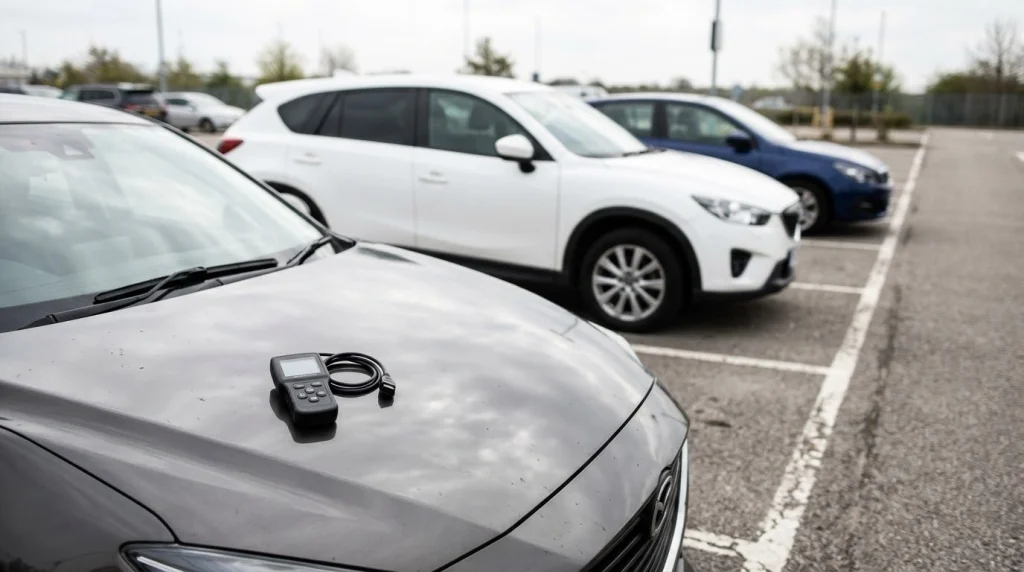
OBD2 works on most gasoline passenger cars and light trucks sold in the United States from the 1996 model year onward. The rule covers cars and light trucks below 8,500 pounds gross vehicle weight rating with gasoline engines, with full compliance required from that model year.
Diesel cars followed a later path in the United States. The EPA OBD regulations show full compliance for light-duty diesel engines from the 1997 model year, with aftertreatment monitoring added from the 2005 model year. Heavy-duty diesel vehicles use a different path and often need a different tool.
The table below gives a first check by region and fuel type. Use it as a guide, then confirm your own car with the port and label checks in the next section.
| Region | Fuel Type | Standard Start |
|---|---|---|
| United States | Gasoline | 1996 model year |
| United States | Diesel, light duty | 1997 model year |
| Canada | Gasoline | 1996 model year |
| European Union | Petrol | 2001 model year |
| European Union | Diesel | 2004 model year |
| Japan | Gasoline | 2002 model year, with earlier exceptions |
The table shows the start of the rule, not a promise for every car. An import can follow the rule of its home market, not the rule of the country where it now drives.
United States and Canada
Gasoline cars and light trucks sold in the United States from the 1996 model year must have the standard port and generic codes. Canada follows a similar path for gasoline cars from the same model year.
Some cars from the 1994 and 1995 model years already had full OBD2 function. Others from those years used a mixed system, so the model year alone does not settle the question for them.
All United States cars from the 2008 model year must use CAN, the protocol named ISO 15765-4. Older OBD2 cars may use CAN, ISO 9141-2, KWP2000, or J1850 PWM or VPW, so a scanner must support the protocol your car uses.
Europe and Other Markets
Europe uses EOBD, the European form of the same idea. Petrol cars follow from the 2001 model year, and diesel cars follow from the 2004 model year.
That gap matters for imports and for cars bought in one market and used in another. A car that meets the United States rule may not meet the European rule for the same model year, and the reverse can also hold. OBD2 rules in Europe differ in scope, so check the market of origin before you assume a fit.
Japan, Australia, and China adopted the standard on later dates. Japanese gasoline cars often follow from the 2002 model year, with some models earlier and some later.
How to Check If OBD2 Works on Your Car
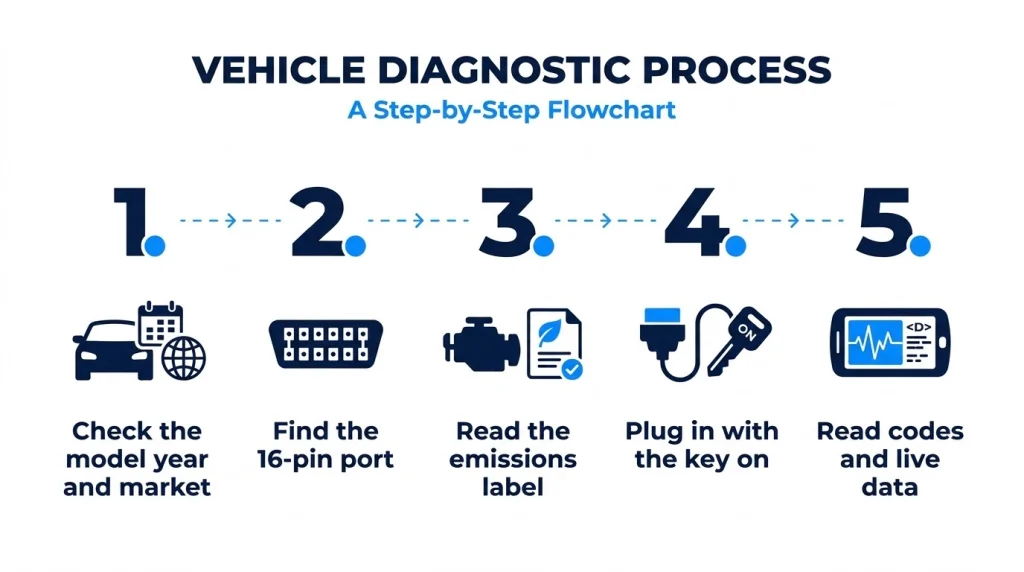
Five checks give a clear answer in most cases. Work through them in order, and stop at the first check that gives a firm no.
Step 1
Check the model year and market
Compare your model year and fuel type with the table above. Note the market where the car was first sold, not only where you bought it used.
Step 2
Find the 16-pin port
Look under the dashboard on the driver side, within reach of the driver seat. The port has a trapezoid shape with two rows of eight pins.
Step 3
Read the emissions label
Open the hood and find the Vehicle Emission Control Information label. It must state OBD II Compliant or OBD II Certified to confirm the standard.
Step 4
Plug in with the key on
Turn the key to on without starting the engine, then plug in the scanner. A scanner that links and shows the protocol has passed the first live test.
Step 5
Read codes and live data
Ask for stored codes and a short live data view. If the scanner shows codes or live values, the generic link works for engine checks.
The label check matters most for cars from the changeover years. Some cars from those years have the 16-pin shape but still use a maker-specific protocol, so the shape alone can mislead you. Guidance on how to check OBD2 compliance also points to the port location and the label text as the two firm signs.
Tip
Take a photo of the emissions label before you shop for a scanner, so you can match the exact text to the scanner coverage list.
Once the generic link works, learn how to use an OBD2 scanner for a clean first scan. A short first scan shows whether the tool reads codes, live data, and readiness monitors on your car.
Why OBD2 Does Not Work on Some Cars
OBD2 does not work on some cars because they were built before the rule, built for a different rule, or built for a different job. Each group fails for a different reason, so each needs a different fix.
Older Cars and OBD1
Cars built before the standard used OBD1, a name for maker-specific systems. Plugs, code formats, and steps varied by brand and model, so one generic reader could not serve them all.
Some cars from the 1994 and 1995 model years sit in a grey zone. A few had full OBD2 function, while others used a mixed system with partial function. Check the label and the port before you buy a tool for one of those cars. Guidance on cars that work on older cars explains the same split in more detail.
Heavy Trucks and Other Vehicles
Heavy trucks often use SAE J1939, a protocol built on CAN but made for a larger network of control units. Many of those trucks use a round 9-pin Deutsch connector, not the 16-pin car port.
A car scanner will not plug into that port, and it will not read the truck network. A heavy-duty scan tool with J1939 support is the right tool for that job. Cars that OBD2 on trucks covers show where the car standard ends and the truck standard starts.
Electric Cars and Hybrids
Electric cars often have the 16-pin port, but the data behind it is thin. The standard was built around engine and emissions checks, so a car with no engine has little of that data to share.
Hybrids sit in the middle. A generic scanner can often read engine codes and some live data, while hybrid battery and drive data may need a maker-level tool. Do not assume that a port on an electric car means full diagnostic access.
Imports add one more layer. A Japanese import may use JOBD, a system with the same port shape but different code details. A European import may follow EOBD dates, not United States dates. Check the home market first.
Does an OBD2 Port Mean a Scanner Will Work?
An OBD2 port does not prove that a scanner will work. The port proves that a plug fits, not that the car and the scanner share a protocol or that the scanner can reach the system you need.
Three gaps cause most failed links. First, the scanner may lack the protocol your car uses, such as ISO 9141-2 on an older Asian car or J1850 on an older American car. Second, the port may have no power because of a blown fuse on pin 16. Third, the car may use a maker-specific layer on top of the standard port.
Protocol support is the fix for the first gap. A multi-protocol scanner that lists CAN, ISO 9141-2, KWP2000, and J1850 PWM and VPW covers most OBD2 cars. A single-protocol adapter can link on one car and fail on the next.
Power is the fix for the second gap. Pin 16 must have battery voltage with the key on. If the scanner stays dark, check the fuse for the port or the cigarette lighter circuit before you blame the car or the tool.
What Can a Basic Scanner Read?
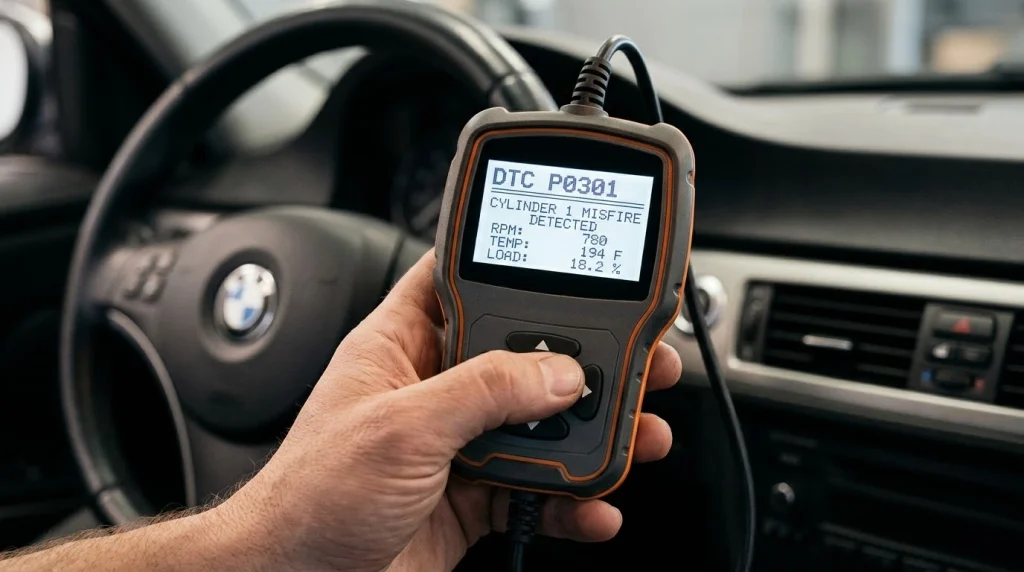
A basic scanner reads generic engine and emissions data. That data is the core of the standard, and it is the same across brands for the codes it covers.
Basic Scanner
Best for: engine codes and live data
- Generic codes: P0xxx powertrain codes
- Live data: engine speed, coolant, fuel trim
- Readiness: emissions monitor status
Full-System Scanner
Best for: ABS, airbag, and body systems
- Systems: ABS, airbag, transmission, body
- Codes: maker-specific codes beyond P0xxx
- Functions: service resets and relearns
The cards show the split in plain terms. A basic scanner answers the check engine light in most cases. A full-system scanner answers the ABS light, the airbag light, and many transmission faults.
Generic OBD2 access is engine and emissions focused by design. ABS, airbag, and other modules need a scanner with the right vehicle coverage and the right software for that brand.
That limit is not a fault in your car. The standard never promised access to every module, only a shared minimum for engine and emissions data. If you need one of those other systems, match the scanner to the system, not only to the port.
What to Do If Your Scanner Will Not Connect
A scanner that will not connect points to one of four causes in most cases. Work through them in order, and test after each step.
First, check power at the port. A dark scanner screen often means a blown fuse, not a failed car computer. Second, check the key position and try the scan with the key on and the engine off.
Third, check the protocol setting. Set the scanner to auto-detect if it has that mode, and try again. Fourth, test the same scanner on a second car that you know is OBD2 compliant, so you can tell a tool fault from a car fault.
Warning
Do not force the plug into the port, and do not clear codes before an emissions test. Forcing the plug can bend pins, and clearing codes can set monitors to not ready.
If the scanner links on a second car but not on yours, the fault sits in your car, the port wiring, or the protocol match. If it links on neither car, the fault sits in the scanner, the cable, or the app pairing. That test saves time and stops needless part buying.
OBD2 Scanner
An OBD2 scanner plugs into the 16-pin port and reads engine codes and live data on cars that meet the standard.
Frequently Asked Questions
Does OBD2 work on diesel cars?
OBD2 works on most light-duty diesel cars that meet the standard for their market. United States light-duty diesel cars follow from the 1997 model year, and European diesel cars follow from the 2004 model year. Heavy-duty diesel trucks often use J1939 instead, so they need a heavy-duty tool.
Does OBD2 work on electric cars?
OBD2 works in a limited way on electric cars. Many electric cars have the 16-pin port, but the standard was built for engine and emissions data, so the port shares little useful data. Battery, drive, and charging checks often need a maker-level tool or a tool made for electric cars.
Will OBD2 work on a motorcycle?
OBD2 does not work on most motorcycles in the same way as on cars. Many bikes use a maker-specific port, a different plug, or a different protocol, even when the bike has fuel injection. Check the bike manual for the port type and the tool list before you buy a car scanner for it.
Does OBD2 work on Japanese import cars?
OBD2 works on many Japanese import cars, but the result depends on the home market and the model year. Some imports use JOBD with the same port shape but different code details, while others follow the standard from a later date. Check the emissions label and test the link before you rely on a scan.
Can one scanner work on every car brand?
One scanner can work on many car brands for generic engine codes, but no basic scanner reaches every system on every brand. Maker-specific codes for ABS, airbag, transmission, and body systems need a full-system scanner with coverage for that brand and model year.
Will OBD2 work if the engine light is off?
OBD2 works when the engine light is off, and it can still show useful data. A scanner can read stored codes, pending codes, live data, and readiness monitors even with no light on. A stored code can point to a fault that has not yet turned the light on again.
Conclusion
Does OBD2 work on all cars? No, it works on most modern cars that meet the standard, while older cars, heavy trucks, and some imports need a different check. Check your model year, port, and label, then match the scanner to the job.

I’m Alex Rahman, a car enthusiast and automotive writer focused on practical solutions, car tools, and real-world driving advice. I share simple and honest content to help everyday drivers make better decisions.
