Can an ELM327 Read ABS Codes? | Leadfoot
Quick Answer
Usually no, not with a basic generic OBD2 app. An ELM327 can read ABS codes only when the app or software adds manufacturer-specific ABS support for your exact make, model, and year, and the adapter can reach that ABS module.
That distinction explains most of the confusion. “ELM327” describes the interface chip in the adapter, not the complete diagnostic system. The adapter can move messages between your phone or computer and the car, but the software decides which modules it asks, which commands it sends, and how it interprets the answers.
What “Reading ABS Codes” Really Means

A real ABS scan talks to the ABS control module and reads its own stored faults. That module watches wheel-speed sensors, hydraulic valves, pump operation, and related inputs. Its fault memory is separate from the engine controller’s emissions fault memory.
A generic OBD2 scan is different. It mainly asks the powertrain controller for emissions-related codes, live data, and readiness information. If that scan finds no codes, it has not proved that the ABS module is fault-free. It has only shown that the generic powertrain check did not return a code.
This is why an ABS warning light can stay on while a basic ELM327 app reports “no codes.” The two checks are looking in different places.
Why a Basic ELM327 Setup Usually Misses ABS
Generic OBD2 was standardised mainly for emissions-related powertrain diagnostics. Mode 03, the common request for confirmed trouble codes, returns emissions-related codes stored by the powertrain controller. ABS faults are normally chassis-system faults, often shown as C-codes, and they live in a different module with its own diagnostic routines.
To read them, software must know how to address that module, which diagnostic service to use, and how to decode that manufacturer’s responses. Some manufacturers use the Unified Diagnostic Services (UDS) protocol on CAN; others use older or brand-specific routines. Some ABS modules also sit on a secondary CAN bus that a basic adapter may not reach without the right hardware configuration.
The ELM327 itself does not supply that vehicle-specific knowledge. How an ELM327 communicates with a car is best understood as translation: it converts serial commands from an app into vehicle-protocol messages and back again. If the app never asks the ABS module the right question, no answer will appear, however good the adapter is.
| Check | Generic OBD2 scan | ABS-capable scan |
|---|---|---|
| Main module checked | Powertrain controller | ABS control module |
| Typical codes | Emissions-related P-codes | Chassis C-codes and ABS data |
| Wheel-speed data | Usually not shown | Often shown per wheel |
The table is a guide, not a guarantee. Coverage still depends on the vehicle and the software database behind the scan.
When an ELM327 Adapter Can Read ABS Codes
The exception is real, and it is becoming more common. Some apps and PC programs pair an ELM327-compatible adapter with a paid or brand-specific add-on that includes ABS, airbag, transmission, and other module coverage. In that setup, the adapter is only the messenger; the added software does the ABS work.
Three conditions usually have to line up. First, the software must list ABS support for your exact vehicle, not just “all OBD2 cars.” Second, the adapter must support the vehicle’s protocol and, where needed, the bus the ABS module uses. Third, the ABS module must respond; a module with no power, a broken bus connection, or a locked gateway will not answer any adapter.
That is also why two people with similar-looking ELM327 dongles can get different results. One may be using a generic engine-only app, while the other uses software with an ABS database for that car. The dongle alone does not tell you which result to expect.
Key Insight
Buy the ABS capability, not just the adapter. The question to check is whether the software supports ABS for your car, not whether the box says “ELM327.”
How to Check Whether Your Setup Can Do It
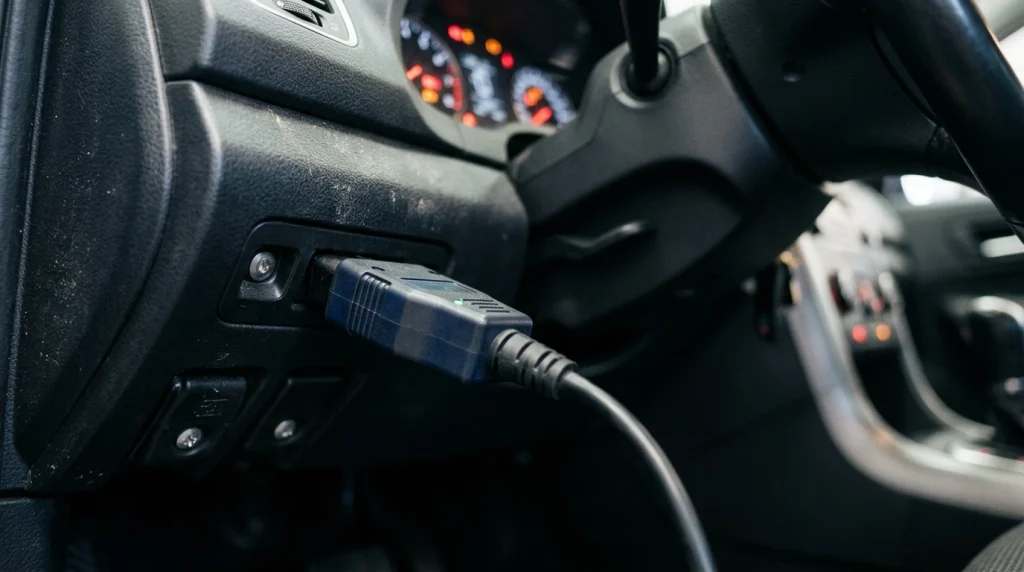
Use this order before assuming the car has no ABS fault.
- Look for an ABS menu, not just a code scan. If the app only offers “Read Codes” for the engine, it is probably a generic scan. An ABS-capable app usually has a separate system, module, or all-system scan.
- Check coverage by make, model, and year. Search the app’s vehicle list or help pages for ABS support for your exact car. “OBD2 compatible” alone is not ABS coverage.
- Confirm the adapter and bus. For some Ford and GM vehicles, for example, certain modules need medium-speed or single-wire CAN access. If your adapter cannot reach that bus, the app may connect to the engine and still miss ABS.
- Run the ABS scan with the ignition on and the car stationary. Follow the app’s prompts. If the ABS module does not respond, note the exact error instead of treating a blank result as a pass.
- Compare with a second method if the warning stays on. A dedicated ABS-capable scanner or a workshop scan can confirm whether the first result was a coverage gap.
If the app cannot show an ABS section at all, that is useful evidence. It usually means the software was not built to ask that module, rather than proof that the module is healthy.
If the ABS Light Is On but the ELM327 Shows No Codes
Do not clear anything yet, and do not assume the light is only a sensor glitch. Start with the simple, safe checks: brake fluid level, a loose or damaged wheel-speed sensor connector, and obvious wiring damage near a wheel. These checks do not replace a scan, but they can explain some faults.
Remember that normal braking often still works when ABS is disabled, while ABS and stability control may not intervene in a hard stop or skid. Drive cautiously, avoid harsh braking tests, and get a proper ABS scan sooner rather than later if the light stays on. If braking feels uneven, the pedal feels wrong, or another warning joins the ABS light, treat that as more urgent.
The same module-access problem affects other systems. Why a scanner cannot access the transmission module follows the same logic: generic access does not equal access to every controller. A similar gap explains why a generic tool may miss airbag faults, as explained in the guide to whether a generic OBD2 scanner can read airbag codes.
Common Mistakes and Misleading Claims
The most common mistake is reading “supports all OBD2 protocols” as “reads all systems.” Protocol support means the adapter can speak the car’s language. It does not mean the software knows every module’s diagnostic commands.
Another trap is a C-code shown by a generic scan. A chassis code in a generic result is worth noting, but it does not automatically mean you have performed a full ABS scan, seen wheel-speed data, or checked ABS live values. Check what module produced the code and what the app actually scanned.
Clone adapters add another variable. Many cheap “ELM327” dongles use copied or incomplete firmware, drop connections, or lack a needed protocol. If an app fails on one car but works on another, or if it connects to the engine but never lists other modules, the adapter is a suspect, but it is not the only suspect. Software coverage should be checked first.
Warning
Do not clear an ABS code just to turn the light off. If the fault is still present, the code and light will usually return, and you will have erased useful diagnostic history.
What to Look For in an ABS-Capable Tool
Look for explicit ABS coverage for your vehicle, live wheel-speed readings, and the ability to read and clear ABS codes from the ABS module itself. A tool that only lists “ABS” on the box but cannot show which module it scanned is not enough evidence.
Also check whether coverage is included or sold as an add-on, and whether it covers your model year. Some tools cover common makes well and others poorly. For a one-off ABS fault, a dedicated ABS-capable scanner or a workshop scan is often cheaper and faster than buying several apps to test coverage.
If you are still deciding which kind of scanner fits the job, what scanner can read ABS codes explains the broader tool choice. If your adapter will not connect at all, start with ELM327 not connecting to the ECU before blaming ABS coverage.
The EPA scan-tool report also makes the useful distinction between generic scan-tool functions and additional software for systems such as ABS. That distinction is still the right way to read adapter claims today.
Related Product
ABS-Capable OBD2 Scanner
Choose a scanner that explicitly lists ABS coverage for your make, model, and year, rather than a generic engine-only adapter.
As an Amazon Associate, we earn from qualifying purchases.
Frequently Asked Questions
Can a free ELM327 app read ABS codes?
Usually not. Most free generic apps read engine and emissions data only. ABS reading normally needs software with a manufacturer-specific ABS database for your car, which is often a paid feature or a different app.
Why does my ELM327 show no codes when the ABS light is on?
The app probably scanned only the powertrain controller. The ABS module stores its own faults separately, so a blank generic result does not clear the ABS system. Run an ABS-specific scan to check that module directly.
Does an ELM327 work for ABS on all cars?
No. Coverage varies by make, model, year, software database, and sometimes the CAN bus used. Always check ABS support for your exact vehicle before buying an app or adapter for that job.
Can an ELM327 clear an ABS light?
Only if the software can access the ABS module and clear its codes. A generic engine-code clear will not clear ABS faults. Even then, the light will return if the underlying fault is still present.
Will the same ELM327 adapter work with a better ABS app?
Sometimes. If the adapter supports the right protocol and bus, switching to ABS-capable software may unlock ABS access. If the adapter lacks that bus or uses incomplete clone firmware, a better app alone may still fail.
Can an ELM327 read wheel-speed sensor data?
Only through ABS-capable software that can read ABS live data. A generic OBD2 app normally shows vehicle speed from the powertrain controller, not individual wheel speeds from the ABS module.
Conclusion
An ELM327 is a useful bridge to the car, but it is not, by itself, an ABS scanner. A basic generic app will usually miss ABS faults because it checks the powertrain controller, not the ABS module. Check for explicit ABS support for your exact vehicle, confirm the adapter can reach the right bus, and use an ABS-specific scan when the warning light is on. That one check saves the most common misdiagnosis: a blank engine scan mistaken for a healthy braking system.

I’m Alex Rahman, a car enthusiast and automotive writer focused on practical solutions, car tools, and real-world driving advice. I share simple and honest content to help everyday drivers make better decisions.
