What Scanner Can Read ABS Codes? Full-System OBD2 Guide
Quick Answer
To read Anti-lock Braking System (ABS) codes, you need a full-system OBD2 diagnostic scanner or a dedicated ABS/SRS code reader. Standard budget code readers that only cost $20 to $30 are limited to generic powertrain (“P”) codes and cannot communicate with your vehicle’s braking or airbag modules.
Why Standard Code Readers Cannot Read ABS Codes
When the dashboard illuminates your Anti-lock Braking System (ABS) warning light, your first instinct might be to grab the basic code reader you keep in your glove box. However, plugging that budget device into your car’s under-dash OBD2 port usually results in finding no stored fault codes at all, even though the light remains brightly lit on your instrument cluster.
The reason comes down to how vehicle computer networks are structured. Under federal emissions regulations established decades ago, all light-duty vehicles sold after 1996 must support standard powertrain diagnostics. These are the classic “P” codes that tell you about engine misfires, oxygen sensors, and emissions control issues.
In contrast, safety systems like ABS, Traction Control, and Supplemental Restraint Systems (SRS airbags) operate on separate communication protocols and module networks. Basic plug-and-play code readers only possess the hardware and software licenses required to query the engine control unit (ECU). They completely ignore the electronic brake control module (EBCM) where ABS trouble codes—typically designated as “C” codes—are stored.
Types of Scanners That Can Read ABS Codes
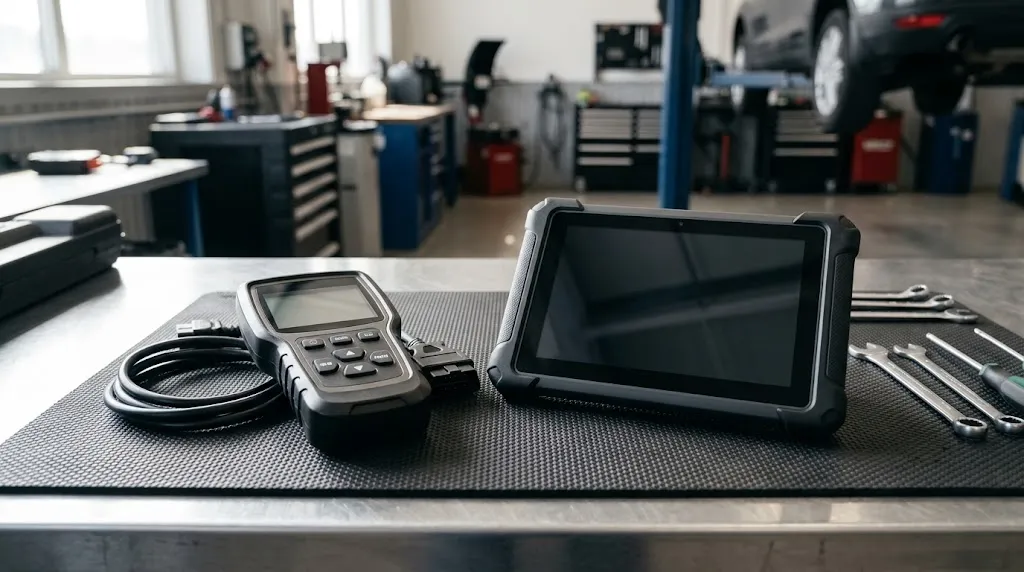
If you need to diagnose brake system faults, wheel speed sensor failures, or hydraulic pump issues, you must upgrade your diagnostic toolkit. Scanners capable of reading ABS codes generally fall into three distinct categories:
1. Dedicated ABS and SRS Code Readers
These mid-range handheld devices look similar to basic code readers but feature expanded software capabilities. Beyond reading engine codes, they include software packages specifically designed to communicate with ABS and airbag modules. They represent a cost-effective solution for DIYers who only need to check safety systems without investing in advanced professional tablets.
2. Full-System OBD2 Diagnostic Tablets
Full-system diagnostic tools—often built on Android tablet interfaces—provide comprehensive coverage across all electronic control units in modern vehicles. They read and clear codes not just for the engine and ABS, but also for the transmission, body control module (BCM), tire pressure monitoring system (TPMS), and infotainment electronics. These tools offer the best balance of capability and price for home mechanics and enthusiast DIYers.
3. Bi-Directional Professional Scan Tools
Advanced diagnostic scanners go far beyond simply reading fault codes. Bi-directional scan tools allow you to send commands directly to vehicle components. When troubleshooting an ABS issue, a bi-directional tool lets you command the ABS hydraulic pump to cycle, test individual wheel speed sensors in real time, and perform automated brake bleed routines. These professional-grade instruments are typically used by working technicians.
Key Features to Look For in an ABS Scanner
Shopping for a diagnostic tool that handles braking systems requires evaluating more than just price tags. Selecting the right hardware ensures you can effectively diagnose and resolve modern vehicle problems without running into software roadblocks.
Vehicle make coverage is a primary consideration. Some entry-level diagnostic tools require you to purchase separate software packages for different automotive manufacturers, while mid-tier and professional units include comprehensive multi-brand coverage out of the box. Verify that the scanner explicitly supports the make, model, and year of the vehicles in your household.
Another crucial capability is live data streaming. When diagnosing an erratic ABS light caused by a failing wheel speed sensor, looking at static fault codes is rarely enough. A capable scanner displays real-time wheel speed data from all four wheels simultaneously while the vehicle is in motion. If one wheel sensor reports zero speed or an erratic signal compared to the others, you instantly identify the root cause of the fault.
Key Insight
An illuminated ABS light does not always mean a broken hydraulic module. In most cases, the fault traces back to a damaged wheel speed sensor wire, a corroded electrical connector, or metallic debris buildup on the magnetic encoder ring.
How to Diagnose ABS Codes Step-by-Step
Using a multi-system diagnostic scanner to uncover brake system faults follows a straightforward procedure. Following a structured diagnostic routine prevents unnecessary part replacements and saves valuable time.
- Locate the OBD2 Port: Find the 16-pin diagnostic link connector under the driver-side dashboard, typically located near the steering column.
- Connect the Scan Tool: Plug the scanner cable or wireless Bluetooth dongle securely into the port while the vehicle ignition is switched to the “On” position without starting the engine.
- Perform Auto-VIN Identification: Allow the scanner to automatically read the Vehicle Identification Number to configure correct module communication protocols.
- Run a Full Health Report: Initiate an all-system scan rather than a quick engine-only scan. The tool will query the ABS module along with other onboard computers.
- Record Diagnostic Trouble Codes: Note any specific “C” codes (such as C0035 for a left front wheel speed sensor circuit) along with any accompanying freeze-frame data.
- Inspect Live Data: Access the live data menu for the ABS module, select individual wheel speed sensors, and verify consistent readings during a test drive or while manually spinning wheels safely on jack stands.
Common Causes of ABS Fault Codes
Understanding what triggers ABS codes helps you interpret the data your scanner retrieves. While electronic control module failures can occur, they are relatively rare compared to mechanical and electrical issues.
Wheel speed sensor failure is by far the most frequent culprit. These sensors endure extreme environmental exposure, enduring water, road salt, mud, and high temperatures near the brake rotors. Wiring harnesses connected to these sensors are also prone to chafing against suspension components during steering articulation.
Tone ring damage or contamination also generates persistent ABS codes. The tone ring—a notched magnetic or metallic ring attached to the axle shaft, wheel hub, or brake rotor—passes beneath the stationary speed sensor to generate a pulse signal. If rust flakes bridge the gaps in the ring or if the ring cracks due to corrosion, the sensor misreads wheel rotation speed and triggers a fault code.
Warning
Never ignore an active ABS warning light. While your standard hydraulic brakes will generally continue to function for normal stops, an inactive anti-lock system can cause your wheels to lock up during emergency braking on slippery or wet road surfaces.
Clearing ABS Codes and Resetting Systems
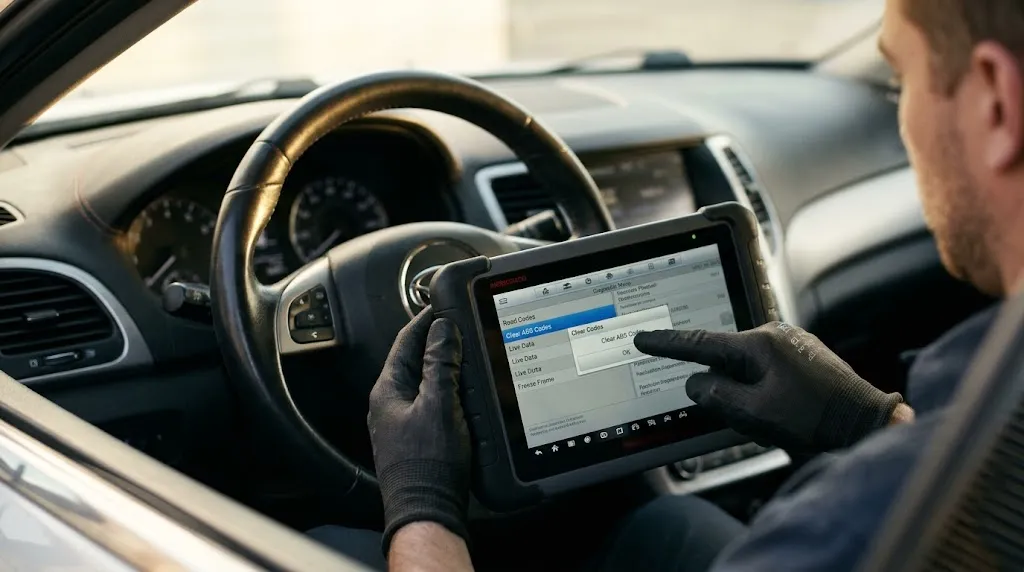
Once you replace a faulty wheel speed sensor, clean a corroded connector, or repair a broken wire harness, the physical problem is resolved, but the dashboard warning light will often remain illuminated.
Unlike basic engine codes that sometimes clear themselves after a set number of driving cycles, ABS warning lights usually require a manual reset using a diagnostic scan tool. Navigate to the ABS module menu on your scanner, select the “Clear Codes” function, and confirm the action.
In some instances, clearing the code is not enough to turn off the light immediately. You may need to take the vehicle for a brief test drive exceeding 15 mph so the computer can re-verify consistent signals from all four wheel speed sensors. Once the self-test completes successfully, the warning light will extinguish automatically.
Related Product
Full-System OBD2 Diagnostic Scanners
Explore multi-system diagnostic tablets capable of reading and clearing ABS, SRS, transmission, and engine fault codes across all major vehicle makes.
As an Amazon Associate, we earn from qualifying purchases.
Frequently Asked Questions
Can a generic code reader read ABS codes?
No, standard budget OBD2 code readers are programmed exclusively to read generic powertrain (“P”) codes from the engine control unit. They lack the software protocols required to access Anti-lock Braking System modules and retrieve chassis (“C”) codes.
Why do some scanners only show check engine lights?
Federal emissions regulations mandated standardized OBD2 ports and protocols for engine emissions, making engine data universally accessible. Safety systems like ABS and airbags use manufacturer-specific communication lines that require upgraded multi-system diagnostic software.
What does an ABS trouble code look like?
ABS trouble codes generally begin with the letter “C” followed by four numbers, such as C0035. The letter designates chassis systems, while the numerical sequence identifies the specific subsystem, circuit, or component experiencing the fault.
Can I drive my car with the ABS light on?
Yes, your standard friction brakes will typically continue to function normally for everyday driving. However, your anti-lock braking system will be disabled, increasing the risk of wheel lockup and loss of steering control during hard braking on slick roads.
How do I clear an ABS code after making a repair?
You can clear an ABS code by connecting a full-system diagnostic scanner, navigating to the ABS module menu, and selecting the “Clear Codes” function. Some codes may also clear automatically after several successful driving cycles once the underlying fault is fixed.
Are full-system diagnostic scanners difficult to use?
Modern diagnostic tablets feature intuitive touchscreen interfaces, automatic vehicle identification, and guided diagnostic menus that make them accessible even for novice DIYers who have never performed advanced automotive troubleshooting before.
Conclusion
Diagnosing modern vehicle braking issues requires looking beyond basic engine code readers. Because standard budget tools cannot access chassis modules, investing in a reliable full-system OBD2 scanner or dedicated ABS diagnostic tool is essential for any car owner who wants to accurately troubleshoot brake lights, wheel speed sensors, and safety system faults at home.

I’m Alex Rahman, a car enthusiast and automotive writer focused on practical solutions, car tools, and real-world driving advice. I share simple and honest content to help everyday drivers make better decisions.
