Does Every Check Engine Light Show an OBD2 Code?
Quick Answer
Yes, an illuminated check engine light on a 1996 or newer vehicle almost always stores a Diagnostic Trouble Code (DTC). However, a basic OBD2 code reader will often report “No Codes Found” if the fault is stored in a secondary module like the transmission computer, exists as a manufacturer-specific code your scanner cannot read, or is triggered by a bulb check or instrument cluster glitch rather than an active engine fault.
Connecting a code reader to an illuminated dashboard only to see “0 Codes” or “No DTCs Found” is one of the most confusing moments in DIY car repair. When the Malfunction Indicator Lamp (MIL) turns on, federal On-Board Diagnostics II (OBD2) standards require the vehicle’s computer to log a reason for the alert.
The disconnect rarely means the car turned the light on for no reason. Instead, the mismatch usually comes down to where the code is stored, what type of scanner you are using, or how the vehicle’s electrical system is powering the dashboard. Understanding how your vehicle categorizes fault data will tell you immediately whether you have a tool limitation or an actual vehicle hardware failure.
Why Your Check Engine Light Is On With No OBD2 Codes
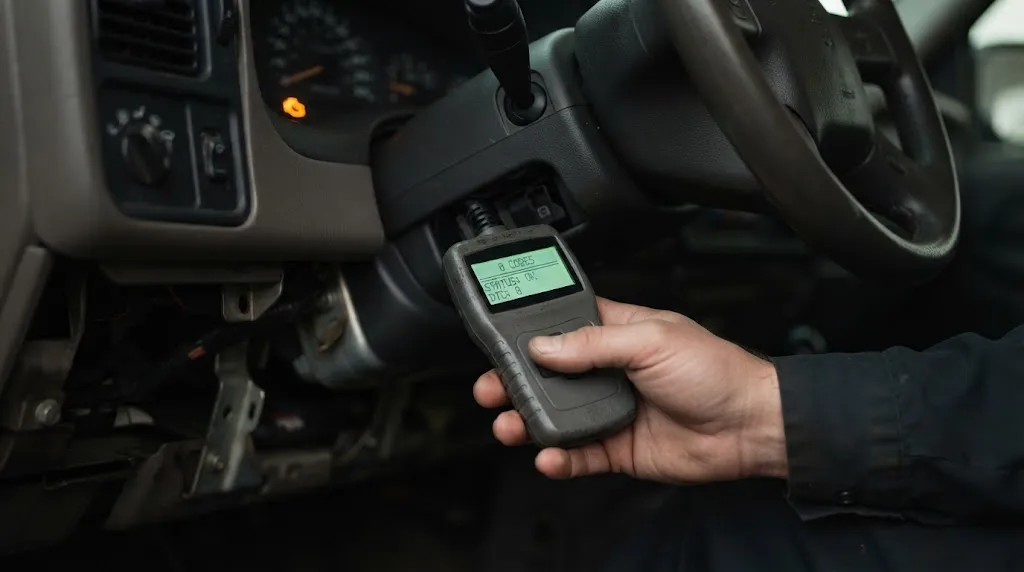
When the check engine light stays lit during normal driving but your scanner comes back empty, the problem almost always falls into one of five distinct scenarios. Identifying which condition applies prevents you from replacing parts blindly.
1. A Basic Code Reader Is Missing Manufacturer-Specific or Secondary Module Faults
Entry-level OBD2 dongle readers and budget handheld scanners are only programmed to interrogate the primary Engine Control Module (ECM) for generic emissions codes—commonly known as Mode $03 powertrain codes that start with P0 (such as P0420 or P0300).
Modern vehicles split powertrain management across multiple computers, most notably the Transmission Control Module (TCM). If your transmission slips, overheats, or experiences a solenoid circuit failure, the TCM sends a request over the Controller Area Network (CAN bus) telling the ECM to illuminate the check engine light.
When you plug in a basic engine-only reader, it asks the ECM for engine faults. Because the fault lives inside the TCM—or is logged as a manufacturer-specific code (starting with P1, P2, or P3)—an entry-level scanner cannot see the memory bank where the code resides and reports that no codes are present.
2. The Engine Is Off During the Scan (Key-On Bulb Test)
Every OBD2-compliant vehicle performs a self-test of the dashboard warning lights when you turn the ignition key to the “On” or “Run” position without starting the engine. During this state, the check engine light stays solidly illuminated to prove the LED or bulb works.
If you notice the light on while the engine is off and plug in your scanner, you are only seeing the normal bulb-check state. Start the engine and watch the cluster. If the light extinguishes within three to five seconds after the engine cranks, there is no active fault to read.
3. You Are Looking at a Maintenance Reminder Light, Not the MIL
Manufacturers frequently place service reminders right next to the check engine icon, and several use wording that mimics an engine warning. Depending on the make and model, you may see lights labeled:
- Maint Reqd (Toyota and Lexus oil change timer)
- Service Engine Soon (used on some vehicles as a maintenance interval, though on certain older Nissan and GM models it functions as the actual MIL)
- Wrench icon (Ford electronic throttle or scheduled maintenance alert, depending on model year)
Scheduled maintenance lights are triggered strictly by odometer mileage or elapsed time since the last oil reset. They do not communicate with the OBD2 emissions system and never generate a Diagnostic Trouble Code.
4. Low Battery Voltage or a Disconnected Battery Partially Cleared Memory
If your car recently struggled to start, needed a jump-start, or had a loose battery terminal, the sudden voltage drop can corrupt communication between control modules. In some vehicles, a severe voltage dip causes the instrument cluster or body module to latch a warning light while simultaneously resetting the volatile memory in the ECM where trouble codes are stored.
Similarly, disconnecting the negative battery cable for a few minutes might wipe the generic Mode $03 code register while leaving a latched fault state in a backup capacitor or secondary module.
5. An Instrument Cluster Short or Failing ECM
Although far less common than scanner incompatibility, hardware failures inside the dashboard or engine computer can illuminate the warning lamp without setting a software code. The check engine bulb is typically controlled by a ground-side switch inside the ECM or via a digital message sent to the instrument cluster.
If a wire in the harness chafes and shorts to ground, or if internal capacitors inside an aging ECM leak and fail, the circuit can close and power the dashboard LED continuously. In this scenario, the computer’s diagnostic software has no awareness that the physical lamp is turned on, resulting in zero stored codes on any scan tool.
How OBD2 Code Storage Determines What Your Scanner Sees
To figure out why a fault is hiding from your tool, it helps to look at how the OBD2 system categorizes problems before turning on the dashboard light. Your vehicle’s computer does not treat every sensor hiccup the same way. Instead, it separates faults into four distinct memory states based on severity and how many times the problem has occurred.
| Code Category | OBD2 Mode | Check Engine Light State | Scanner Requirement |
|---|---|---|---|
| Confirmed (Active) Codes | Mode $03 | On (Solid or Flashing) | Any basic OBD2 code reader |
| Pending Codes | Mode $07 | Off (awaiting second trip failure) | Scanner with Mode $07 / Pending support |
| Permanent Codes | Mode $0A | Off (if repaired, until monitor runs) | 2010+ vehicle & Mode $0A capable tool |
| Enhanced / OEM Codes | Manufacturer Specific | On or Off (depends on module) | Multi-system or OEM-level diagnostic scanner |
The distinction between these memory banks explains why two people can scan the same car and get completely different answers. If a fault only fails once on a two-trip monitor—such as an evaporative emissions (EVAP) small leak test—the computer logs a Pending Code in Mode $07 without turning on the check engine light. Conversely, if a transmission or hybrid battery controller triggers the light using an Enhanced OEM Code, a generic reader checking only Mode $03 will report a clean bill of health.
Key Insight
A cheap code reader only checks the public “front lobby” of your engine computer (Mode $03). If the check engine light was requested by the transmission computer, body control module, or manufacturer-specific diagnostic layer, a basic reader will say “No Codes” even though a multi-system scan tool will display the fault immediately.
Step-by-Step Troubleshooting When Your Scanner Shows No Codes

If your check engine light is on while the engine is running and your tool displays no codes, follow this diagnostic sequence to isolate the cause without wasting money on unnecessary parts.
- Verify the light with the engine running: Start the vehicle and let it idle for 30 seconds. Confirm that the symbol is the standardized engine block icon (or “Check Engine” / “MIL”) and not a tire pressure, oil pressure, wrench, or “Maint Reqd” reminder.
- Check Freeze Frame and Pending registers: Navigate past the main “Read Codes” menu on your tool and open Pending Codes (Mode $07), Permanent Codes (Mode $0A), and Freeze Frame (Mode $02). Even if the main code register appears blank due to a communication quirk, Freeze Frame will often display the exact code that triggered the last snapshot, along with engine RPM and coolant temperature at the moment of failure.
- Verify OBD2 protocol communication: Look at your scanner screen to confirm it actually established a link with the vehicle’s ECM. On older vehicles (1996–2007) that use ISO 9141-2, KWP2000, or SAE J1850 protocols before CAN bus became mandatory in 2008, certain aftermarket radios or faulty ABS modules can pull down the K-line data wire. However, if the scanner fails to link altogether, it will display “Link Error” rather than “No Codes.”
- Check I/M Readiness Monitor status: Open the Readiness Monitors menu on your scanner. If every monitor (Catalyst, EVAP, O2 Sensor, EGR) shows “Incomplete” or “Not Ready,” the vehicle’s computer memory was recently reset by a dead battery, a faulty alternator voltage spike, or someone clearing codes prior to your scan.
- Re-scan with a multi-system or OEM-capable scan tool: If the ECM links normally and shows zero generic codes while the check engine light remains lit, the fault is almost certainly stored in the Transmission Control Module (TCM) or a manufacturer-specific data bank. Scan the vehicle using a tool capable of reading all modules (ECM, TCM, BCM, ABS).
Tip
If you only own a basic code reader, ask a local independent repair shop or auto parts store if their handheld scanner reads TCM (transmission) and manufacturer-specific P1/P2/P3 codes before paying for a full diagnostic hour. Many commercial counter scanners have enhanced OEM software unlocked.
What If the Check Engine Light Turned Off Before You Scanned It?
A slightly different frustration happens when the check engine light comes on during your commute, turns itself off the next day, and then shows no active codes when you finally hook up a reader. This behavior is normal and built into the OBD2 specification.
When a fault occurs—such as a loose gas cap causing an EVAP pressure fault or a brief sensor glitch in heavy rain—the computer turns on the check engine light and stores a Confirmed DTC. If the underlying problem resolves itself, the computer will automatically turn the check engine light off after three consecutive “good” drive cycles in which the monitored system passes its self-test without failing again.
Once the light turns off on its own:
- The code moves from the Active/Confirmed bank to the History or Permanent (Mode $0A) memory bank.
- A basic scanner that only looks at active codes may report “No Codes Found.”
- After approximately 40 warm-up cycles without the fault returning, the computer automatically erases the History code completely.
On 2010 and newer vehicles, you can still see what caused a self-extinguished light by selecting Permanent Codes on a compatible scanner. Permanent codes cannot be erased with a scan tool or by disconnecting the battery; they remain visible in Mode $0A until the vehicle’s onboard computer runs and passes the specific diagnostic monitor for that system.
How to Tell If It Is Safe to Drive When No Code Appears
Because you do not have a trouble code to tell you whether the issue is a minor emissions sensor or a serious mechanical problem, you have to rely on how the vehicle is behaving and how the light is acting.
Warning
If the check engine light is flashing or blinking—even if your basic scanner cannot pull a code—stop driving safely as soon as possible. A flashing MIL indicates a severe, active engine misfire that is dumping unburned fuel into the exhaust, which can melt the catalytic converter core within minutes.
Evaluate your vehicle using these three conditions:
- Solid light + normal driving feel: If the engine idles smoothly, accelerates normally, shifts cleanly, and shows normal coolant temperature and oil pressure, the vehicle is generally safe to drive home or to a shop to be scanned with a multi-system tool.
- Solid light + harsh shifting or delayed gear engagement: This strongly points to a Transmission Control Module (TCM) fault that your basic engine reader cannot see. Avoid heavy towing or highway speeds, and scan the TCM promptly to prevent clutch pack damage.
- Solid light + stalling, bucking, or burned electronics smell: On select late-1990s and 2000s vehicles (such as certain Toyota, Honda, and Mitsubishi models), an illuminated check engine light accompanied by zero scanner codes and erratic engine stalling is a classic sign of leaking capacitors on the ECM circuit board. Have the vehicle inspected before it leaves you stranded.
Related Product
All-System OBD2 Diagnostic Scan Tools
Upgrading from a basic engine reader to an all-system OBD2 scanner lets you read hidden Transmission Control Module (TCM), ABS, body, and manufacturer-specific codes that budget tools miss.
As an Amazon Associate, we earn from qualifying purchases.
Frequently Asked Questions
Can a check engine light come on and not throw a code?
In almost all cases, no—if the true check engine light (MIL) is illuminated while the engine is running, a code is stored somewhere in the vehicle’s network. When a scanner shows no code, it usually means the fault is stored in the transmission module or manufacturer-specific memory that a basic code reader cannot access, or the dashboard cluster has an electrical fault.
Can a bad sensor fail without triggering an OBD2 code?
Yes, a worn or sluggish sensor can degrade engine performance without triggering the check engine light or logging a code. As long as the sensor’s voltage reading remains inside the manufacturer’s programmed minimum and maximum thresholds, the computer assumes the reading is valid, even if the value is slightly inaccurate and causes poor fuel economy or rough idling.
Why does my OBD2 scanner say “Link Error” instead of showing codes?
A “Link Error” or “Communication Error” means your scanner is not talking to the car’s computer at all, not that there are zero codes. The most common cause is a blown cigar lighter or auxiliary power fuse—which powers Pin 16 of the OBD2 port on many vehicles—or corroded pins inside the diagnostic connector under the dashboard.
Will a vehicle pass an emissions inspection if the check engine light is on with no codes?
No, an illuminated check engine light is an automatic visual and electronic failure during a state OBD2 emissions test, regardless of whether a basic reader displays a code. Every state emissions inspection begins with a key-on bulb check followed by a verify check with the engine running; if the MIL stays lit while running, the vehicle fails immediately.
Can a weak car battery cause a check engine light with no codes?
Yes, a failing battery or weak alternator can drop system voltage below 9.5 to 10 volts during cranking, which causes some control modules to brown out while others stay awake. This voltage drop can cause the instrument cluster to latch a check engine warning or communication fault while simultaneously resetting the volatile code memory in the engine computer.
How do I clear a check engine light when the scanner says no codes are stored?
Even if your scanner displays “0 Codes,” selecting the “Erase/Clear Codes” function will still broadcast a universal Mode $04 reset command across the powertrain network, which often turns off a latched light. If that fails, scanning with an all-system tool to clear the Transmission Control Module (TCM) is the safest method.
Conclusion
Whenever a 1996 or newer vehicle turns on the check engine light while the engine is running, the onboard computer network almost always logs a fault code to explain why. Seeing “No Codes Found” on a handheld scanner is rarely a sign of a ghost in the machine—it is usually a sign that your scanner is only checking generic Mode $03 engine memory while the actual fault sits inside the transmission module, a manufacturer-specific register, or the Pending/Permanent memory banks.
Start by confirming the engine is running during your check and inspecting the Pending (Mode $07), Permanent (Mode $0A), and Freeze Frame menus. If those registers are empty and the light stays lit, scan the vehicle with an all-system diagnostic tool that can interrogate the TCM and OEM-specific modules before suspecting a wiring fault or failing engine computer.

I’m Alex Rahman, a car enthusiast and automotive writer focused on practical solutions, car tools, and real-world driving advice. I share simple and honest content to help everyday drivers make better decisions.
