Can OBD2 Scanners Read Transmission Codes?
Quick Answer
Yes, OBD2 scanners can read transmission codes, but not every scanner can access every transmission fault. Basic OBD2 readers can retrieve generic powertrain codes related to the transmission. However, manufacturer-specific faults stored in the Transmission Control Module (TCM) often require an enhanced or all-system scanner with transmission-module support for your vehicle.
Your transmission starts shifting roughly, a warning appears on the dashboard, and you connect an OBD2 scanner expecting an explanation. Sometimes it displays a transmission trouble code. Other times, it reports no faults even though the gearbox clearly isn’t behaving normally.
The difference often comes down to which vehicle computer your scanner can access. Understanding that limitation helps you determine whether your current tool is sufficient or a more capable diagnostic scan is necessary.
Which Transmission Codes Can a Basic OBD2 Scanner Read?
A basic OBD2 scanner can read transmission-related diagnostic trouble codes (DTCs) when those faults are available through the vehicle’s standardized OBD2 diagnostic interface.
OBD2 is primarily a standardized emissions-related diagnostic system. It also reports certain powertrain problems involving the engine and transmission because their operation can affect emissions.
Transmission-related powertrain codes frequently begin with P07 or P08, although transmission faults can also appear in other code groups.
Here are examples of transmission codes a compatible generic scanner may retrieve:
| Code | General meaning |
|---|---|
| P0700 | Transmission control system malfunction / MIL request |
| P0715 | Input or turbine speed sensor circuit malfunction |
| P0720 | Output speed sensor circuit malfunction |
| P0730 | Incorrect gear ratio |
| P0741 | Torque converter clutch performance or stuck off |
| P0750 | Shift solenoid A malfunction |
These codes identify a system or circuit that needs investigation. They do not automatically confirm which component has failed.
For example, a speed sensor circuit code could involve the sensor, wiring, connector, or related electronics. Replacing the sensor without additional testing may not resolve the problem.
Why Can’t Some OBD2 Scanners Read All Transmission Codes?
Some scanners cannot retrieve all transmission codes because standardized OBD2 access is not the same as complete access to every vehicle control module.
Modern automatic transmissions are commonly managed by a Transmission Control Module (TCM). Depending on the vehicle, the controller may be separate, integrated with another computer, or incorporated into the transmission’s electronic control assembly.
The TCM monitors components and operating conditions such as:
- Transmission input and output speeds
- Shift solenoid electrical operation
- Commanded and actual gear behavior
- Transmission fluid temperature
- Torque converter clutch operation
- Other transmission-specific sensors and controls
When a fault occurs, diagnostic information may be stored in the transmission controller’s own memory.
A generic reader might retrieve a related powertrain code but lack the software or communication functions needed to enter the TCM’s enhanced diagnostic system.
This is why a scanner can successfully communicate with the engine computer while failing to retrieve the transmission’s more detailed fault information.
Key Insight
A scanner’s physical OBD2 connector does not guarantee access to every computer in the vehicle. The scanner’s software, supported diagnostic protocols, and vehicle-specific coverage determine which modules it can communicate with.
What Does P0700 Mean on an OBD2 Scanner?
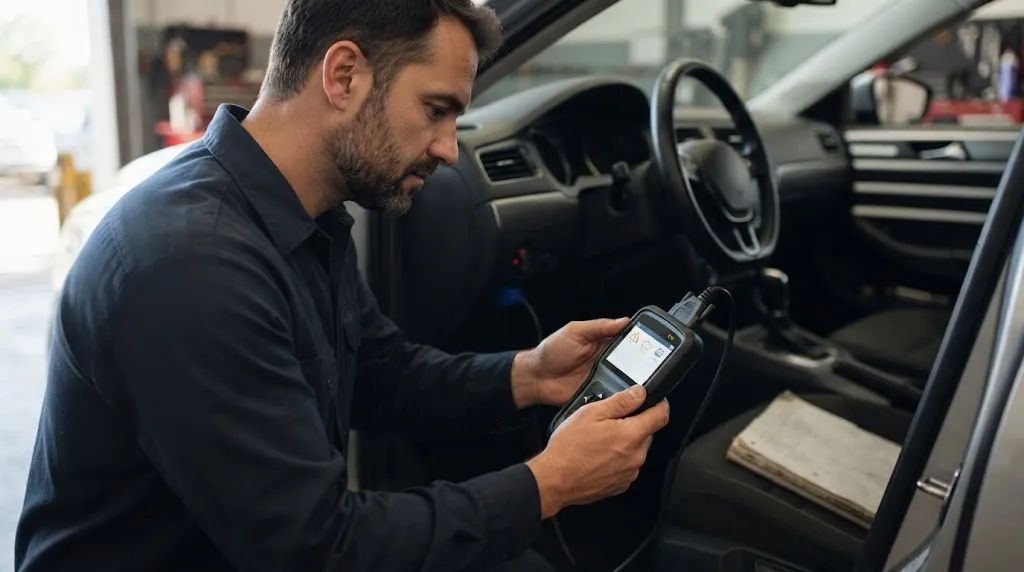
P0700 means the transmission control system has requested illumination of the malfunction indicator lamp. It commonly indicates that the transmission controller has detected a fault requiring additional diagnosis.
P0700 is particularly important because it may appear on a basic code reader without revealing the more specific transmission code responsible for the warning.
Consider this hypothetical situation:
- A transmission controller detects an electrical problem involving a shift solenoid.
- The transmission controller stores a more specific diagnostic fault.
- The engine or powertrain controller records P0700 following the transmission system’s warning request.
- A basic OBD2 reader displays P0700 but cannot access the more detailed transmission fault.
In that situation, P0700 identifies the need to investigate the transmission control system. It does not establish that the transmission controller itself is defective.
The next step is retrieving the relevant transmission-module trouble codes using a compatible diagnostic scanner.
For additional technical context, the P0700 diagnostic explanation from OBD-Codes describes why transmission-module communication is necessary to investigate this warning.
What Type of OBD2 Scanner Reads Transmission Codes?
A scanner with enhanced powertrain or transmission-module diagnostic capability provides broader access than a basic generic code reader.
The important feature is not simply whether a product advertises OBD2 compatibility. It is whether the diagnostic tool explicitly supports the transmission system on your particular vehicle.
| Scanner type | Transmission diagnostic capability | Main limitation |
|---|---|---|
| Basic OBD2 code reader | Generic transmission-related powertrain codes when exposed through OBD2 | May not access TCM-specific faults |
| Bluetooth OBD2 adapter and app | Generic codes; sometimes enhanced codes with compatible software | Depends on adapter, app, and vehicle |
| Enhanced multi-system scanner | Supported TCM codes and possibly transmission live data | Vehicle-specific coverage varies |
| Manufacturer-level diagnostic equipment | Broad supported transmission diagnostics, testing, and service functions | Often requires specialized software or access |
For a concrete example, the Autel MaxiLink ML629 manufacturer documentation distinguishes transmission-system code reading from ordinary OBD2 functions.
Even with an enhanced scanner, compatibility should be checked by vehicle make, model, year, engine, and applicable transmission system.
Does a scanner need bidirectional controls?
No. Bidirectional controls are not required merely to read transmission trouble codes. A scanner can support TCM code retrieval without having the ability to command solenoids or perform transmission actuator tests.
Bidirectional functions become useful when a diagnostic procedure requires commanding a supported component to help identify a malfunction.
For basic fault retrieval, direct transmission-module access and correct vehicle coverage matter more.
How to Read Transmission Codes With an OBD2 Scanner
The scanning process is straightforward once you know which diagnostic functions your tool supports.
- Park safely. Stop on level ground, engage the parking brake, and follow the vehicle’s instructions for ignition position.
- Find the diagnostic connector. On many passenger vehicles, the 16-pin OBD2 port is located beneath the dashboard near the driver’s position.
- Connect the scanner. Insert the diagnostic connector securely and switch on the scanner if required.
- Identify the vehicle. Select the correct make, model, year, and other requested details, or use automatic vehicle identification when supported.
- Run an OBD2 scan. Retrieve stored and pending powertrain codes. Note any transmission-related DTCs.
- Access the transmission module. If available, navigate to Diagnostics, Control Units, Transmission, or TCM. Menu labels vary by scanner.
- Record the results. Save the code numbers, descriptions, status, and available freeze-frame or live-data information before changing anything.
If your tool has no transmission-module menu, consult its supported-function list. A successful generic OBD2 connection alone does not establish TCM access.
Tip
Save all stored, pending, and available permanent codes before clearing anything. Also record freeze-frame information when available. This evidence may help identify intermittent faults that disappear temporarily.
Why Does My Scanner Show No Transmission Codes?
A report showing no codes does not necessarily mean the transmission has no problem.
Several explanations are possible:
- Limited scanner coverage: The tool may read standardized powertrain faults but not enhanced transmission diagnostics.
- Intermittent symptoms: The operating conditions necessary to trigger a fault may not have occurred during the monitored period.
- No detected electronic fault: Some mechanical, hydraulic, or fluid-related problems may not immediately set a diagnostic code.
- Previously cleared codes: Diagnostic information may have been erased before the scan.
- Communication restrictions: Vehicle software, security access, or unsupported diagnostic protocols may prevent module access.
For example, a vehicle may hesitate during a shift without setting a generic powertrain code. A transmission-capable tool might reveal useful temperature, gear-command, or speed-sensor data even when no relevant DTC is stored.
If symptoms continue, a complete vehicle-specific diagnostic assessment is more useful than repeatedly performing the same generic scan.
What Should You Check Before Trusting a Scanner’s Transmission Coverage?
Check the manufacturer’s vehicle coverage information for the exact tool and software version.
Useful questions include:
- Can the scanner communicate directly with the transmission control system?
- Does it retrieve manufacturer-specific transmission DTCs?
- Does it support your exact vehicle and model year?
- Can it display transmission-specific live data?
- Does the feature require a subscription, software package, or additional authorization?
A broad claim such as “works on OBD2 vehicles” is insufficient for confirming enhanced transmission compatibility.
Also distinguish code reading from advanced functions such as adaptation resets, clutch relearns, programming, and calibration. Those functions require separate support and should only be used according to the vehicle’s service procedure.
Can Transmission Codes Tell You Exactly What Needs Repair?
Not necessarily. A transmission code provides a diagnostic starting point, not a guaranteed component diagnosis.
A shift solenoid circuit fault, for instance, may result from a defective solenoid, damaged wiring, poor electrical contact, or an issue with the controller’s output circuit.
Likewise, an incorrect gear ratio code can identify abnormal transmission behavior without establishing which mechanical or hydraulic condition caused it.
Reliable diagnosis combines the code with symptoms, operating conditions, manufacturer service information, and appropriate electrical or mechanical tests.
Warning
If the transmission slips severely, loses drive, makes abnormal mechanical noises, or produces a burning smell, stop driving when safe and arrange professional assessment or towing. Continuing to operate a malfunctioning transmission can create additional damage or unsafe driving conditions.
Should You Clear Transmission Codes After Reading Them?
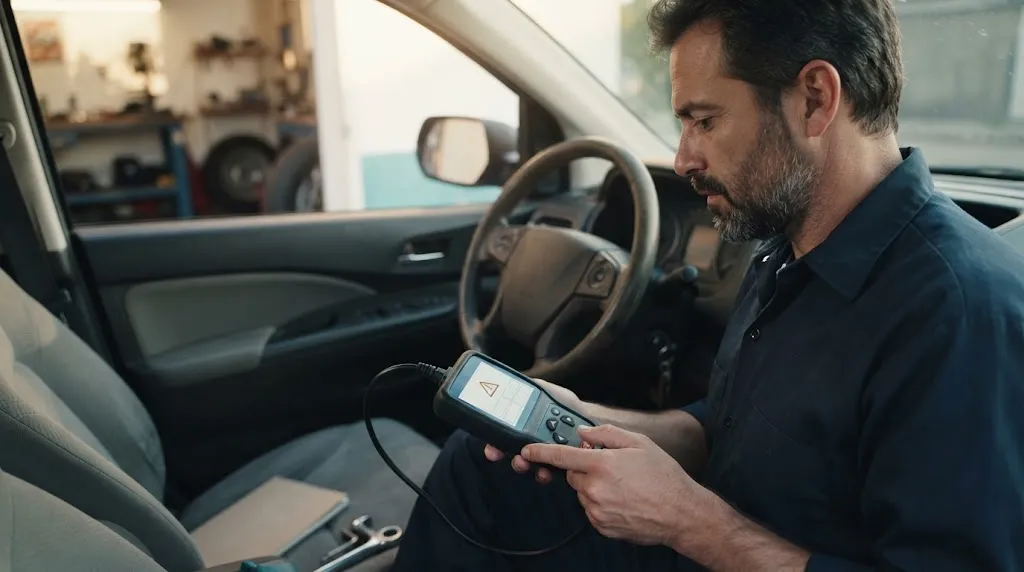
Generally, preserve the diagnostic information until the underlying issue has been identified and addressed.
Clearing codes does not repair a failed sensor, damaged electrical circuit, or mechanical transmission problem. The fault may return once the relevant operating conditions occur.
Erasing codes can also remove useful stored diagnostic information and reset emissions readiness monitors, depending on the vehicle and clearing operation.
After a verified repair, codes can be cleared according to the proper service procedure, followed by an appropriate confirmation test.
Relevant Product
Transmission-Capable OBD2 Diagnostic Scanner
If your current reader cannot access the transmission module, a scanner with confirmed TCM diagnostic coverage may provide the missing fault information. Verify compatibility with your vehicle before choosing a tool.
As an Amazon Associate, we earn from qualifying purchases.
Frequently Asked Questions
Can an OBD2 scanner read CVT transmission codes?
Yes, a compatible scanner can read diagnostic codes from a continuously variable transmission (CVT). Generic faults may appear through OBD2, while detailed CVT controller codes often require manufacturer-enhanced diagnostic access.
Will a Bluetooth OBD2 scanner detect gearbox problems?
It can detect supported electronic faults, but coverage depends on the adapter, mobile app, and vehicle. Bluetooth connectivity itself does not guarantee access to transmission-specific diagnostic information.
Can a transmission have problems without triggering the check engine light?
Yes. Certain transmission problems may cause noticeable driving symptoms without triggering the check engine light. Some vehicles also have separate transmission warnings, and not every mechanical problem immediately creates a stored OBD2 fault.
Can an OBD2 scanner detect low transmission fluid?
Not reliably as a direct fluid-level measurement. Some vehicles may report related pressure, temperature, or performance faults, but these do not confirm low fluid. Fluid level must be checked using the vehicle manufacturer’s specified procedure.
Do manual transmissions generate OBD2 trouble codes?
They can. Vehicles with manual transmissions may store codes involving clutch switches, transmission speed sensors, or related monitored systems. However, ordinary mechanical gear or clutch wear may not generate an electronic diagnostic code.
Can a parts store’s free OBD2 scan read transmission codes?
Sometimes. A free generic code scan may retrieve transmission-related powertrain codes, but detailed TCM diagnostics depend on the equipment and services available at that location. Ask specifically whether the scan includes enhanced transmission-module codes.
Conclusion
OBD2 scanners can read transmission codes, but their diagnostic coverage varies. A basic reader may reveal generic powertrain faults, while detailed transmission-controller codes often require enhanced TCM access.
If your scanner shows P0700 without further detail, or reports no faults despite persistent shifting problems, confirm whether it supports your vehicle’s transmission module. Retrieve the complete diagnostic information before replacing parts or clearing codes.

I’m Alex Rahman, a car enthusiast and automotive writer focused on practical solutions, car tools, and real-world driving advice. I share simple and honest content to help everyday drivers make better decisions.
