ELM327 Not Connecting to ECU? Here’s What to Check
Quick Answer
An ELM327 that pairs with your phone but never reaches the ECU is almost always failing at one of three layers: the vehicle is not fully powering the diagnostic bus (ignition in ACC instead of ON, or a blown OBD port fuse), the app is forcing the wrong protocol, or the adapter itself is a low-quality clone that cannot handle your vehicle’s network. Work from the simplest physical check upward before assuming the adapter is dead.
The frustrating part of this problem is that the adapter often looks like it is working. The LED lights up, Bluetooth pairs, the app says “Connected” — and then the ECU handshake times out with “UNABLE TO CONNECT,” “NO DATA,” or a protocol error. That split between “connected to the dongle” and “connected to the car” is the key to diagnosing it correctly.
The ELM327 is a bridge, not a scanner. It translates AT commands from your app into the electrical pulses your vehicle’s network uses, then translates the ECU’s reply back into text. When that bridge fails, the break can sit at the phone-to-adapter link, the adapter-to-vehicle link, or the vehicle’s own readiness to talk. Most successful fixes come from checking those links in order, cheapest and simplest first.
Start With the Condition Everyone Skips: Ignition State and Port Power

Many vehicles do not energize the diagnostic data bus in the accessory (ACC) position. The radio and cigarette lighter may work, the adapter may light up, but the engine control module is still asleep and will not answer requests.
Turn the key to ON — the position where every dashboard warning light illuminates, just before the starter cranks — or start the engine. If your car has a push-button start, press the button without pressing the brake or clutch to enter ignition ON without cranking. Then reseat the adapter firmly and retry.
If the adapter still shows no sign of life, the problem may be upstream of the ECU entirely. On many vehicles the OBD2 port’s pin 16 power circuit shares a fuse with the cigarette lighter or accessory socket. A blown fuse there cuts power to the adapter even though the port looks normal. Check the owner’s manual for the fuse chart and inspect the circuit before condemning the dongle. A useful background check here is our guide to why an ELM327 says “NO DATA” even when it lights up, which separates power problems from protocol problems.
Warning
Do not pull or replace fuses while the ignition is on or while a diagnostic adapter is connected. Voltage spikes on the data bus can damage control modules. Key off, adapter unplugged, then check the fuse.
Also inspect the OBD2 socket itself. Bent, pushed-back, or corroded pins can pass enough current to light an LED but fail to carry the differential data signal. A short OBD2 extension cable sometimes solves a mechanical seating problem when the port is recessed behind a tight lower dash panel.
The Protocol Mismatch: Why the App and the Car Are Speaking Different Languages
If the adapter is powered and the ignition is genuinely ON, the next most common cause is a protocol mismatch between the software setting and the vehicle’s actual network.
OBD2 is not one protocol. The standards include SAE J1850 PWM and VPW, ISO 9141-2, ISO 14230-4 (KWP2000), and ISO 15765-4 CAN. Vehicles built roughly from 2008 onward in the US market use CAN, but older and region-specific vehicles may sit on a K-line or J1850 network. The ELM327 chip family was designed to support all of them, but the automatic protocol search can fail — especially on older vehicles, niche imports, or when a low-cost adapter’s firmware mishandles the initialization sequence. The ELM327 datasheet explicitly notes that a failed keyword check during ISO 9141-2 or KWP2000 initiation produces “UNABLE TO CONNECT” or “BUS INIT: …ERROR,” and that the adapter can be told to relax that check with AT KW0 in experimental situations[reference:0].
Before reaching for AT commands, check the app first. In Torque, Car Scanner, FORScan, or whichever tool you are using, open the adapter or connection settings and look at the protocol field. If it is set to “Automatic,” try manually selecting the protocol your vehicle uses. For most post-2008 vehicles that is ISO 15765-4 CAN, often listed as 11-bit/500 kbps or 29-bit/500 kbps. For older Asian and European vehicles, ISO 9141-2 or ISO 14230-4 is the likely candidate. A user with a 2012 Opel Astra found that the app connected to the adapter over Bluetooth but returned “cannot connect to ECU”; switching from automatic to manual CAN produced a different error, “protocol not supported,” which correctly identified the adapter rather than the car as the limiting factor[reference:1].
If manual protocol selection produces a connection on one setting but not another, you have learned something useful: the vehicle’s bus is alive, and the problem is either the wrong setting or an adapter that does not implement that protocol correctly. Our explainer on how the ELM327 communicates with a car over OBD2 protocols covers the command-and-response cycle in more detail if you want to understand what the app is actually sending.
Key Insight
“Connected” in your phone’s Bluetooth settings only means the phone reached the adapter’s wireless chip. It says nothing about whether the adapter can reach the ECU. Treat those as two separate handshakes and diagnose them separately.
When the Adapter Itself Is the Bottleneck: Clone Hardware, Firmware, and Connection-Layer Failures
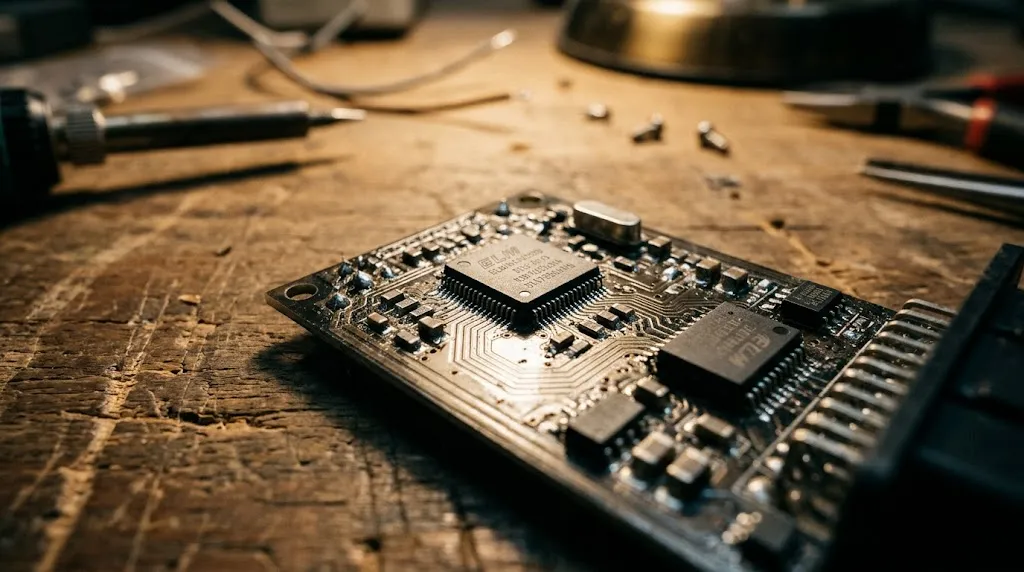
If ignition is correct, the port has power, and manual protocol selection still fails, the adapter’s hardware or firmware becomes the prime suspect. This is where the ELM327 market becomes genuinely difficult, because many inexpensive adapters labeled “ELM327” are not built around an original Elm Electronics chip and do not behave like one.
A genuine ELM327 design centers on a Microchip PIC18F25K80 in the common implementations, but the market contains at least three problematic variations: boards using entirely different microcontrollers with hacked firmware that returns “ELM327” identification strings, PIC18F25K80 chips with altered supporting circuitry or crystal timing, and Bluetooth modules that fail specifically on longer CAN responses[reference:3]. The FORScan project has documented a particularly useful failure pattern: some clone Bluetooth adapters work on short ECU responses but “freeze” on requests that return 25–30 bytes or more, never returning to command mode. The adapter appears connected, then simply stops answering the software.
That freeze pattern explains a lot of “works on one car, not another” behavior. Older pre-CAN vehicles rarely produce long responses, so a marginal clone can look fine on them and fail on a modern CAN vehicle where multi-frame responses are routine. If your adapter reads a 2004 vehicle but dies on a 2019 model, the adapter’s response handling is the likely weak point, not the newer car.
Connection type adds another layer. USB adapters depend on the correct driver and COM port; Bluetooth adapters depend on the Bluetooth stack and, on some Windows systems, on the right COM emulation. A CH340-based USB adapter that times out on ATSPC after acknowledging ATZ, ATI, and ATE0 is a classic sign of a marginal serial bridge rather than a vehicle-side fault[reference:5]. If you are using FORScan, set the connection type and COM port explicitly rather than relying on auto-detection, and try 38400 baud before assuming the adapter is dead. Our walkthrough on connecting an ELM327 to OBD2 step by step covers pairing, port selection, and ignition sequence in order.
Vehicle-Side Limits That Look Like Adapter Failures
Not every “no ECU connection” is the adapter’s fault. A few vehicle conditions can produce the same symptom while leaving the dongle perfectly functional.
A severely low battery can put control modules into a low-power or non-booting state, so the ECU never joins the bus even though the adapter lights up. Aftermarket accessories are another overlooked cause: an improperly wired head unit, remote starter, or tracker can pull CAN High or CAN Low toward a rail and corrupt the differential signal across the whole network. If the problem began immediately after an electrical installation, disconnect the accessory’s harness and retry before buying a new adapter.
There is also a scope boundary worth respecting. A generic ELM327 reads standard powertrain and emissions-related OBD2 data. It does not automatically access ABS, airbag, body, or manufacturer-specific modules. If the app reports “no connection” when you select an ABS or airbag module but reads engine data normally, the adapter is not failing globally — the software is asking for a system the adapter and app combination was never designed to reach. That is a capability limit, not a connection fault.
A Practical Order for Testing
Rather than changing five things at once, work through this sequence and stop when the behavior changes.
- Ignition to ON, engine off. Confirm dashboard lights are on and the adapter is powered.
- Reseat the adapter and inspect the pins. A firm, fully seated connection matters more than it looks.
- Check the OBD port fuse. If the port shares a circuit with the cigarette lighter, a blown fuse cuts adapter power.
- Set the protocol manually. Match the app setting to the vehicle’s likely network instead of leaving it on automatic.
- Test the adapter on a different vehicle. If it fails across multiple makes, the adapter is the common variable.
- Change the connection layer. Try USB instead of Bluetooth, or a different known-good adapter, to separate wireless problems from vehicle problems.
If steps 1–4 produce no change and step 5 shows the adapter failing everywhere, replacement is usually more rational than further troubleshooting. A basic ELM327 is inexpensive, but the time cost of chasing a marginal clone across multiple vehicles adds up quickly. If the adapter works on another car but not yours, the next stop is the vehicle’s port wiring, fuses, or a module holding the bus down — not another dongle.
Frequently Asked Questions
Why does my ELM327 light up and pair with my phone but still show “no ECU connection”?
The light and the Bluetooth pairing only confirm that the adapter is receiving power and that its wireless chip is talking to your phone. The ECU handshake is a separate step. The most common causes are ignition in ACC instead of ON, a blown OBD port fuse, a protocol mismatch in the app, or a clone adapter that cannot handle the vehicle’s response format.
My adapter works on one car but not another. Is the adapter broken?
Not necessarily broken, but possibly limited. Many clone adapters handle short pre-CAN responses better than long multi-frame CAN responses. An adapter that reads an older vehicle but fails on a newer one may be freezing on long replies or missing the protocol implementation entirely. Test the adapter on a third vehicle of a different make to see whether the pattern follows the adapter or the car.
Should I set the protocol manually or leave it on automatic?
Start with automatic. If it fails, switch to the specific protocol your vehicle uses. For most post-2008 vehicles that is ISO 15765-4 CAN; older Asian and European vehicles often use ISO 9141-2 or ISO 14230-4. A manual setting that produces a different error message is useful diagnostic information even if it does not connect.
FORScan says “Unable to connect to vehicle” even though the adapter is detected. What should I check first?
Confirm the ignition is in the ON position, delete any saved vehicle profile that FORScan may be trying to reuse, and set the connection settings to the correct COM port and baud rate rather than relying on auto-detection. If the adapter is a Bluetooth clone, test it with a simpler OBD2 app first to see whether the ECU communication works outside FORScan’s more demanding module scan.
Could a blown fuse really stop an ELM327 from connecting even if the adapter still lights up?
Yes. Some adapters can illuminate from a small backfeed or from the phone-side connection while still lacking enough current on pin 16 to operate the transmitter properly. If the OBD port shares a fuse with the cigarette lighter or accessory socket, check that circuit before assuming the adapter is defective.
Is it worth buying a more expensive adapter to fix this?
If you have confirmed ignition ON, port power, a correct manual protocol setting, and the adapter fails across multiple vehicles, a better adapter is a reasonable next step. Adapters built around genuine STN1110/STN1170 chips or verified original ELM327 implementations handle protocol switching and long CAN responses more reliably than the cheapest clones. But do the free checks first — many “adapter failures” are actually ignition-state or protocol-setting problems.
Conclusion
An ELM327 that refuses to reach the ECU is rarely a mystery once you separate the two handshakes. Phone-to-adapter is one link; adapter-to-vehicle is another. Confirm ignition ON and port power, match the protocol manually, and then judge the adapter’s hardware against a second vehicle. Most failures resolve in the first three checks; the ones that survive usually point to a clone that cannot do what its label claims. A deliberate, ordered test saves both the cost of a needless replacement and the time lost to changing settings at random.

I’m Alex Rahman, a car enthusiast and automotive writer focused on practical solutions, car tools, and real-world driving advice. I share simple and honest content to help everyday drivers make better decisions.
