How Does ELM327 Communicate With a Car? OBD2 Protocols
Quick Answer
The ELM327 communicates with a car by acting as a bridge between the vehicle’s onboard computer network (the OBD-II port) and a diagnostic device like a smartphone or laptop. It translates low-level vehicle network protocols—such as CAN, ISO 9141, or J1850—into readable ASCII text commands that common software applications can easily process via USB, Bluetooth, or Wi-Fi.
What Is an ELM327 Interface?
When you plug a diagnostic tool into a modern vehicle’s under-dash port, you are usually connecting to an OBD-II compliant system. At the heart of many affordable diagnostic adapters is the ELM327 microchip, originally developed by ELM Electronics.
The chip itself is a programmed microcontroller that handles the complex, low-level timing and protocol requirements of automotive networks. Instead of requiring a mechanic or hobbyist to write specialized assembly code for every distinct car manufacturer standard, the ELM327 accepts simple text-based AT commands. It listens to the vehicle’s data bus, packages the raw electronic signals, and converts them into serial communication data that a phone or computer can understand.
The Physical Connection: The OBD-II Port
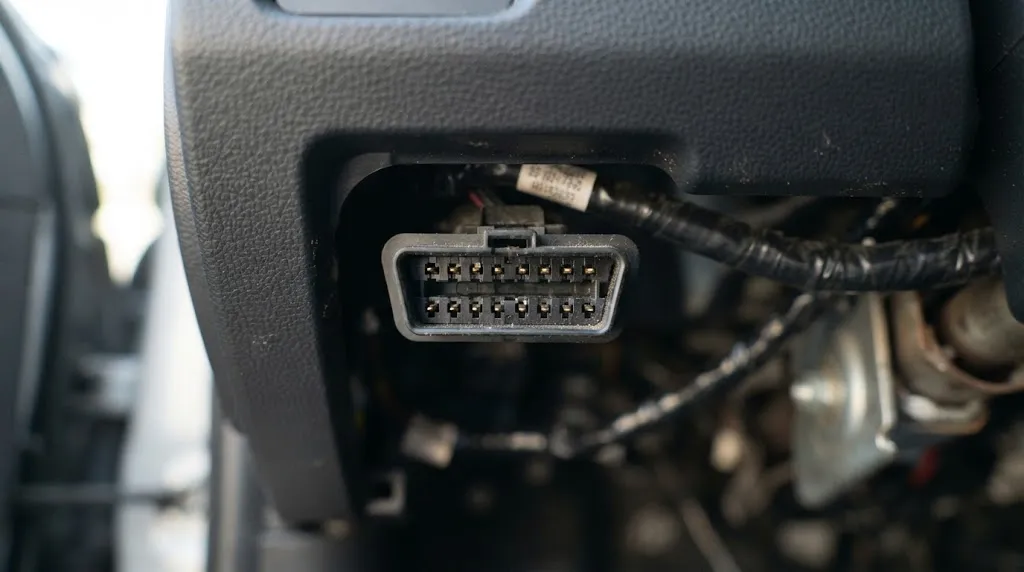
Communication begins at the physical hardware level. Every passenger vehicle sold in the United States since 1996 (and most global vehicles manufactured after the mid-2000s) features a standardized 16-pin Diagnostic Link Connector (DLC), commonly located beneath the driver-side dashboard.
When an ELM327 adapter is plugged into this port, it draws operational power directly from pin 16 of the vehicle’s battery supply and establishes ground connections through pins 4 and 5. The remaining pins carry the differential data signals used by the car’s internal electronic control units (ECUs) to talk to one another.
Key Insight
The ELM327 does not interpret diagnostic trouble codes on its own. It is merely a hardware and firmware translator. It packages the raw bits traveling across the car wires into text strings and sends them outward, while also taking text commands from your app and converting them back into vehicle network pulses.
How the ELM327 Handles Multiple Vehicle Protocols
One of the primary engineering challenges in automotive diagnostics is that different manufacturers rely on completely different communication protocols. Before the industry consolidated around standardized networks, various global regions and brands used entirely separate wiring configurations and signaling speeds.
The ELM327 firmware contains automated routines that can detect and switch between multiple legacy and modern standards:
- SAE J1850 PWM: Commonly used by Ford vehicles, operating at 41.6 kBaud.
- SAE J1850 VPW: Commonly used by General Motors vehicles, operating at 10.4 kBaud.
- ISO 9141-2 and ISO 14230-4 (KWP2000): Frequently found in older Chrysler, European, and Asian imports, utilizing slow- or fast-init K-line communications.
- ISO 15765-4 (CAN): The modern Controller Area Network standard used by virtually all vehicles manufactured after 2008, operating at high speeds (typically 250 or 500 kbps).
When you open a diagnostic app and tap “connect,” the ELM327 runs through an auto-search protocol sequence (using AT commands like AT SP 0) until it receives a valid response from the vehicle’s primary powertrain control module.
The Command and Response Loop
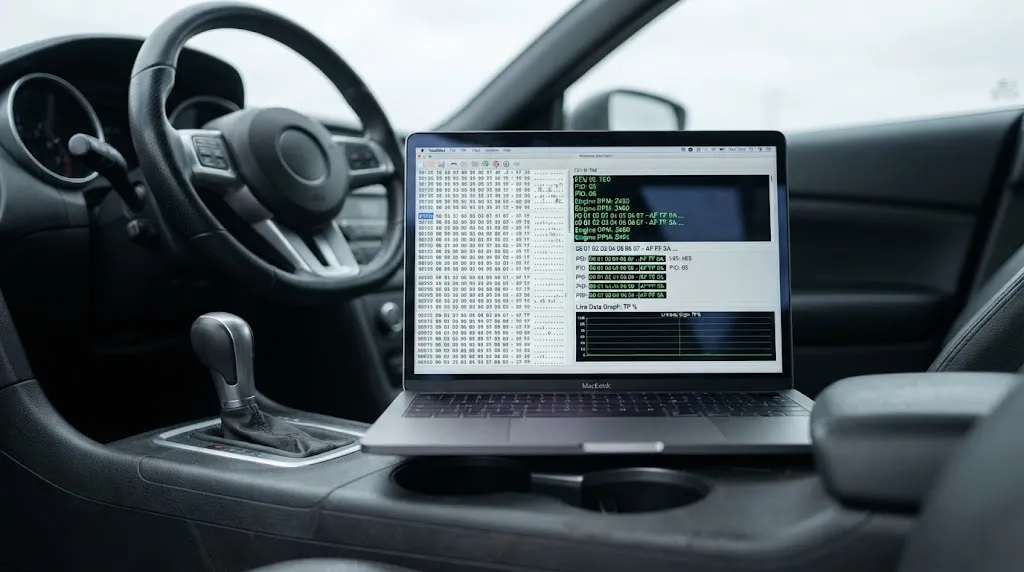
Communication between your diagnostic software and the car is an ongoing request-and-response loop. The ELM327 manages this translation through specific syntax structures:
- User Request: You select a function in a mobile app, such as requesting the current coolant temperature.
- AT Command Translation: The app sends a hexadecimal request string (like
01 05, where01requests current data and05specifies engine coolant temperature) via Bluetooth, Wi-Fi, or USB to the ELM327. - Bus Transmission: The ELM327 takes that request, formats it into the precise electrical voltage pulses required by your car’s specific network protocol, and transmits it onto the data bus.
- ECU Reply: The car’s Engine Control Unit listens to the bus, recognizes the request addressed to it, calculates the current sensor value, and broadcasts the reply.
- Translation to App: The ELM327 picks up the raw ECU response, strips away the header bytes, formats the payload into readable ASCII characters, and transmits it back to your phone or laptop.
Warning
Cheap, unbranded clone adapters often use outdated or incomplete firmware versions that may struggle with automatic protocol detection on newer CAN-bus networks, leading to dropped connections or failed diagnostic scans.
Wireless and Wired Output Interfaces
While the internal chip handles the vehicle bus protocol translation, the adapter must still transmit that translated data outward to your external device. Depending on the specific adapter design, this happens via one of three methods:
- Bluetooth (Classic or BLE): Pairs directly with Android, Windows, or iOS devices, sending serial data streams over short-range radio frequencies.
- Wi-Fi: Creates a local access point that your phone or tablet connects to, which is often required for iOS devices due to legacy Bluetooth pairing restrictions.
- USB / Serial: Plugs directly into a laptop port, providing a stable, latency-free wired connection favored by professional tuning and advanced diagnostic suites.
Regardless of whether the outer shell uses Bluetooth or a USB cable, the underlying communication workflow with the vehicle’s computer network remains fundamentally identical.
Limitations in ELM327 Communication
Although the ELM327 is versatile, it is important to understand its communication boundaries. Standard ELM327 adapters primarily target standard OBD-II generic powertrain parameters (Mode 1 through Mode 10).
They do not automatically have unrestricted access to manufacturer-specific networks unless the diagnostic software specifically sends extended proprietary header commands. For deep body control modules, ABS modules, or supplemental restraint systems (airbags), specialized software or advanced multi-protocol scan tools are typically required.
Related Product
OBD2 Bluetooth Diagnostic Scanner Tool
A reliable wireless adapter helps you easily read live sensor data, check engine codes, and monitor vehicle performance straight from your smartphone.
As an Amazon Associate, we earn from qualifying purchases.
Frequently Asked Questions
Does an ELM327 adapter work on all cars?
It works on all cars compliant with OBD-II standards, which includes essentially all gasoline vehicles sold in the US since 1996, European petrol cars from 2001 onward, and diesel vehicles from 2004 onward.
Can an ELM327 damage my car’s computer?
No. The ELM327 is a listening and translating device that operates within standard automotive voltage and current tolerances designed specifically for the diagnostic port.
Why does my ELM327 scanner fail to connect?
Connection failures are usually caused by incorrect protocol settings in the diagnostic app, a loose physical connection in the OBD port, or ignition power being turned off.
What is the difference between Bluetooth and Wi-Fi ELM327 adapters?
Bluetooth models pair seamlessly with Android and Windows devices, while Wi-Fi models are frequently used for iOS devices because of Apple’s strict Bluetooth accessory pairing protocols.
Can I program car keys with an ELM327?
Generally no. Standard ELM327 interfaces are designed for reading and clearing diagnostic codes and streaming live sensor data, not for advanced dealer-level immobilizer programming.
Does the ELM327 support CAN FD or newer vehicle networks?
Original or cheap clone ELM327 chips do not support newer high-speed CAN FD protocols found in modern late-model vehicles, though updated multi-protocol adapters often feature extended firmware capabilities.
Conclusion
Understanding how the ELM327 communicates with a vehicle helps demystify what happens behind the scenes when you plug in a diagnostic tool. By converting complex vehicle network protocols into simple AT commands, the ELM327 bridges the gap between raw automotive computer signals and accessible consumer apps. Whether you are troubleshooting an engine light or tracking live sensor data, knowing how this translation works allows you to use diagnostic tools more effectively.

I’m Alex Rahman, a car enthusiast and automotive writer focused on practical solutions, car tools, and real-world driving advice. I share simple and honest content to help everyday drivers make better decisions.
