What OBD2 Scanner Is Good for Transmission Diagnostics?
Quick Answer
A good scanner for transmission diagnostics is a full-system tool that can read codes from the transmission control module, not just the engine. For most owners, that means a 4-system handheld or a full-system Bluetooth adapter with live transmission data. If you need to command a solenoid, run a relearn, or test a shift after a repair, you need a bidirectional tool instead.
Transmission trouble is easy to misread. The check-engine light comes on, a cheap reader says “no codes,” and the car still slips, shifts hard, or drops into limp mode. That gap is usually not a mystery fault. It is a scanner that cannot see the module where the fault lives.
Why Most Basic Scanners Miss Transmission Faults
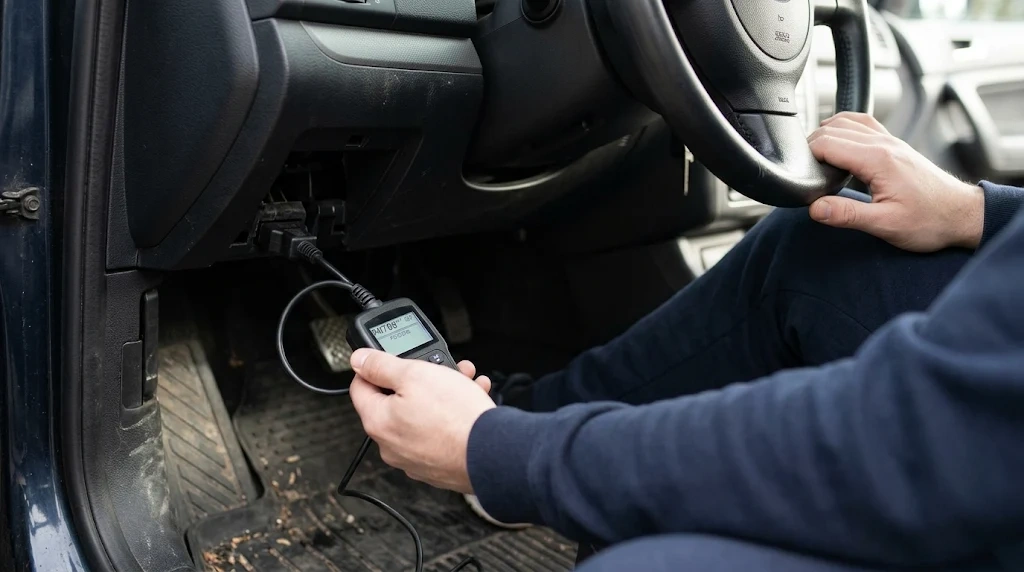
A basic code reader talks mainly to the engine module. Transmission faults often live in a separate module, the transmission control module, or TCM. Both share the same OBD2 port, but a reader that only asks the engine side will not hear the transmission side.
That is why P0700 is so confusing. P0700 is a pointer code: the engine module is reporting that the transmission module has stored a code of its own. P0700 alone does not say which solenoid, sensor, or gear ratio is at fault. You need the companion code from the TCM, usually in the P07xx range, to know what to check next.
Generic codes are the shared codes every compliant scanner should read. Enhanced codes go deeper, and can describe a particular solenoid circuit that a generic read will not show. EngineerFix explains the difference between generic and manufacturer-enhanced transmission codes. Before you buy, look for “transmission,” “TCM,” or “all-system” in the specification, not just “OBD2.” See also whether a scanner can read transmission codes.
Key Insight
“No codes found” from a basic reader does not mean the transmission is healthy. It often means the reader never asked the transmission module.
What a Good Transmission Scanner Must Do
- Read TCM codes. It must list stored, pending, and permanent transmission codes, including manufacturer-specific codes where your vehicle supports them.
- Show live transmission data. At minimum, fluid temperature, commanded gear, input and output speed, and torque-converter lockup status.
- Record freeze-frame data. The snapshot taken when a code set shows fluid temperature, load, speed, and gear at that moment.
- Graph live data. A slipping shift is easier to spot when speed, gear, and temperature move together on a graph.
- Clear codes only after recording them. Clearing is not a repair. Write down every code first.
Two features separate a reader from a repair tool. Bidirectional control lets the scanner command a component, for example energising a solenoid, so you can test whether it responds. A relearn or adaptation reset lets the vehicle relearn shift behaviour after a repair. A warning light with no drivability change is usually a read-and-record job. A harsh shift, or a relearn after work, is usually a test-and-command job.
Which Type of Scanner Fits Which Job?
| Tool type | Good for | Limit |
|---|---|---|
| Basic engine reader | Reading a generic P0700 code | Usually no TCM codes or live data |
| 4-system handheld | Transmission, engine, ABS, and airbag codes | Usually no bidirectional control |
| Full-system Bluetooth adapter | TCM codes and live data on a phone | Depth depends on the app |
| Bidirectional tablet | Solenoid tests, relearns, resets | A wrong command can change shifting |
| Professional tool | Manufacturer-specific tests | High cost for occasional use |
For most owners, the sensible middle ground is a 4-system handheld or a full-system Bluetooth adapter that clearly lists TCM access for their vehicle. That covers the first step: find the real transmission code and check fluid temperature. If you already know you need a relearn or a solenoid test, skip the reader tier. A guide to what bidirectional control means explains what that extra capability lets you command.
The Live Data That Actually Matters
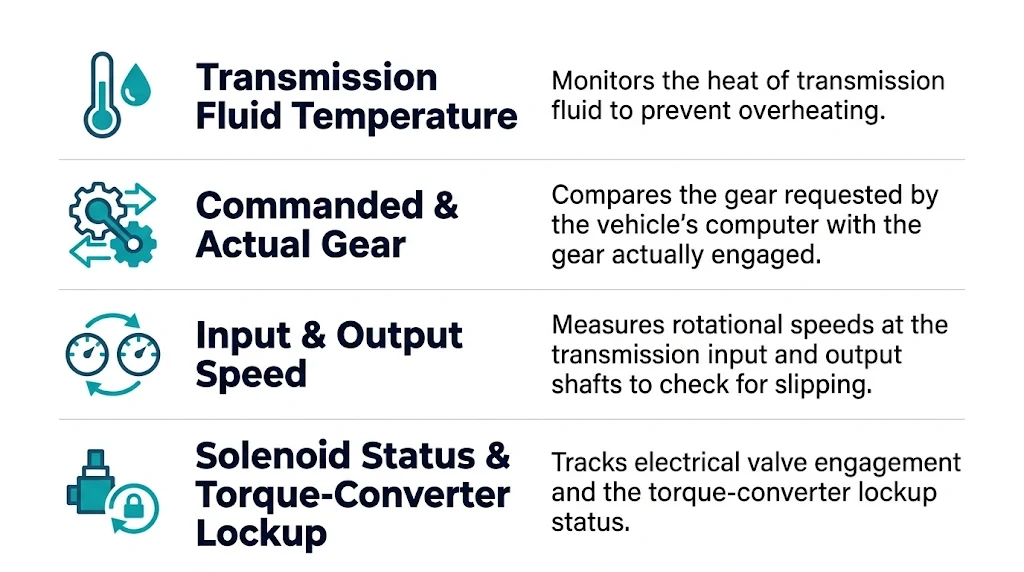
Transmission fluid temperature is the first value to check. It affects shift quality, and on many sealed transmissions with no dipstick it is the only reliable way to judge fluid level against the maker’s temperature-based procedure. A guide to how to check transmission fluid temperature explains why that reading matters.
Commanded gear and actual gear show whether the transmission is doing what the TCM asked. A mismatch points toward a control or hydraulic issue. Input and output speed let you compare turbine speed with road speed: a large difference under load can suggest slip.
Solenoid status and torque-converter lockup show whether commands are being sent and whether lockup engages as expected. Record these values under the same conditions each time, with the engine warm and the car at a steady speed. For a fuller view, see what live data can show about a transmission problem.
Tip
Graph fluid temperature, gear, and input speed together during a short drive. A slip that is hard to feel in numbers alone often shows clearly when the three lines move together.
How to Check Compatibility Before You Buy
Transmission coverage is not universal. A scanner can be excellent on one brand and shallow on another. Check before you pay, using the maker’s coverage checker where one exists.
- Enter your exact vehicle. Year, make, model, engine, and transmission type. A CVT, a dual-clutch, and a conventional automatic need different support.
- Confirm TCM access in writing. Look for “transmission control module” or “TCM” in the supported-systems list for your vehicle.
- Check the protocol. Newer vehicles may use CAN FD, and some FCA vehicles use a Secure Gateway Module that limits write access. A scanner that reads codes may still be blocked from active tests there.
- Check relearn support separately. “Reads transmission codes” does not mean “performs a transmission relearn.”
- Check updates. Find out whether updates are included, how long they last, and whether the tool stops working fully when they expire.
If the maker has no coverage checker, treat broad claims with care. “Works with all cars” usually means “reads generic engine codes on all cars.” A guide to how to scan the transmission control module walks through the scan step.
How to Use a Transmission Scanner Once You Have It
- Note the symptom first: when it happens, hot or cold, which gear, and whether the light is on.
- Plug in, select the transmission module, and read all codes. Record stored, pending, and permanent codes exactly as shown.
- Read freeze-frame data for the main code. Note fluid temperature, speed, load, and gear at the time it set.
- Check live data at idle, then on a short drive that reproduces the symptom. Save the graph if the tool allows it.
- Compare the code with the live data. A solenoid code with normal command and no gear change points one way; a speed-sensor code with a dropping signal points another.
- Only then decide whether to clear codes, run an active test, or seek a repair. Clearing first erases the freeze-frame evidence.
If the scanner cannot reach the transmission module at all, do not assume the module has failed. Check a secure connection, ignition on, the correct vehicle selected, and whether another module can be read.
Mistakes That Waste Money or Mislead the Diagnosis

Buying on “OBD2” alone. Almost every scanner is OBD2. That label does not guarantee transmission access. Check the supported-systems list, not the headline.
Treating P0700 as the fault. P0700 is the flag, not the diagnosis. The companion TCM code is the fault to investigate. Replacing parts for P0700 alone is guessing.
Clearing codes before recording them. A cleared code may not return until the fault happens again, and the freeze-frame data goes with it. Record first, clear second.
Assuming live data proves a mechanical fault, or running a relearn to “fix” a slip. A scanner shows electrical signals, not clutch wear, fluid condition, or internal pressure. A relearn after a repair is a service step, not a fix for slipping.
Warning
Do not command a solenoid, force a gear change, or run a relearn while driving unless the tool and the vehicle maker’s procedure specifically call for it.
When a Scanner Is Not Enough
A scanner is a starting point, not a complete transmission diagnosis. Fluid level and condition are the clearest example: a scanner can show temperature, but it cannot tell you the fluid is low, burnt, or contaminated. That needs a physical check, using the maker’s procedure.
Internal pressure, clutch wear, and valve-body faults also need more than codes. Intermittent faults are another limit: a code that sets once a week may not be present during a short scan. Use the scanner to narrow the problem and avoid replacing parts on a guess. If live data shows slip under load, do not keep driving hard to reproduce it, and if the fault involves limp mode, a flashing warning, overheating, or a strong burnt smell, stop and get a professional assessment.
Related Product
OBD2 Scanner With Transmission Diagnostics
A full-system scanner that lists TCM access and live transmission fluid temperature is the practical next step after reading this guide.
As an Amazon Associate, we earn from qualifying purchases.
Frequently Asked Questions
Can a basic OBD2 scanner read transmission codes?
Usually only at generic level. A basic reader may show P0700, which says the transmission module has stored a code, but it often cannot read the companion TCM code that explains the fault. For transmission work, you need a tool that lists TCM or all-system access for your vehicle.
What is the difference between a 4-system scanner and a bidirectional scanner?
A 4-system scanner reads codes and live data from the engine, transmission, ABS, and airbag systems. A bidirectional scanner can also command components and run service functions, such as a solenoid test or a transmission relearn. Reading tells you what happened; bidirectional control lets you test whether a component responds.
Do I need transmission fluid temperature from a scanner?
Often, yes. Fluid temperature affects shift behaviour and is needed for the maker’s fluid-level procedure on many sealed transmissions with no dipstick. A scanner that shows live transmission fluid temperature is useful for both diagnosis and a fluid check, but follow your vehicle’s procedure rather than guessing a temperature.
Will any full-system scanner work on my car?
Not necessarily. Coverage varies by year, make, model, engine, and transmission type, and some vehicles use CAN FD or a secure gateway that limits write access. Check the maker’s coverage checker for your exact vehicle and confirm TCM access, relearn support, and update terms before you buy.
Can a scanner tell me if my transmission is slipping?
It can give useful evidence, but it cannot prove slip on its own. Compare commanded gear with actual gear, and input speed with output speed, during a short drive. A large difference under load suggests slip, while a physical fluid check and a professional assessment are still needed to confirm the cause.
Should I clear a transmission code and see if it comes back?
Record the code and freeze-frame data first, then clear it only if you have a reason to test whether it returns. Clearing erases the snapshot taken when the code set. If the code returns quickly, or the symptom remains, the fault is still present and needs diagnosis rather than repeated clearing.
Conclusion
A good transmission scanner is defined by access, not by price or screen size. It must reach the transmission control module, read the companion code behind P0700, and show the live data that explains the symptom. For most owners, a 4-system handheld or a full-system Bluetooth adapter covers that first step. If the job needs a solenoid test or a relearn, choose a bidirectional tool instead. Check coverage for your exact vehicle, record codes before clearing anything, and treat the scanner as the start of the diagnosis, not the repair itself.

I’m Alex Rahman, a car enthusiast and automotive writer focused on practical solutions, car tools, and real-world driving advice. I share simple and honest content to help everyday drivers make better decisions.
