Can OBD2 Show Transmission Temperature?
Quick Answer
Yes, an OBD2 scanner can show transmission temperature on many vehicles, but not every scanner or vehicle supports it. Transmission fluid temperature is generally a manufacturer-specific parameter, so you may need a compatible scanner, an app with enhanced diagnostics, and the correct vehicle-specific data support.
Whether an OBD2 scanner can display transmission temperature depends on three things: the vehicle’s available data, the scanner’s capabilities, and the software used to interpret that data. A basic code reader may show engine information and diagnostic trouble codes without displaying the transmission fluid temperature.
If you want to monitor an automatic transmission while driving, towing, or investigating a shifting problem, check for a live-data parameter called Transmission Fluid Temperature (TFT), Transmission Temperature, or a similar manufacturer-defined label.
Why Doesn’t Every OBD2 Scanner Show Transmission Temperature?
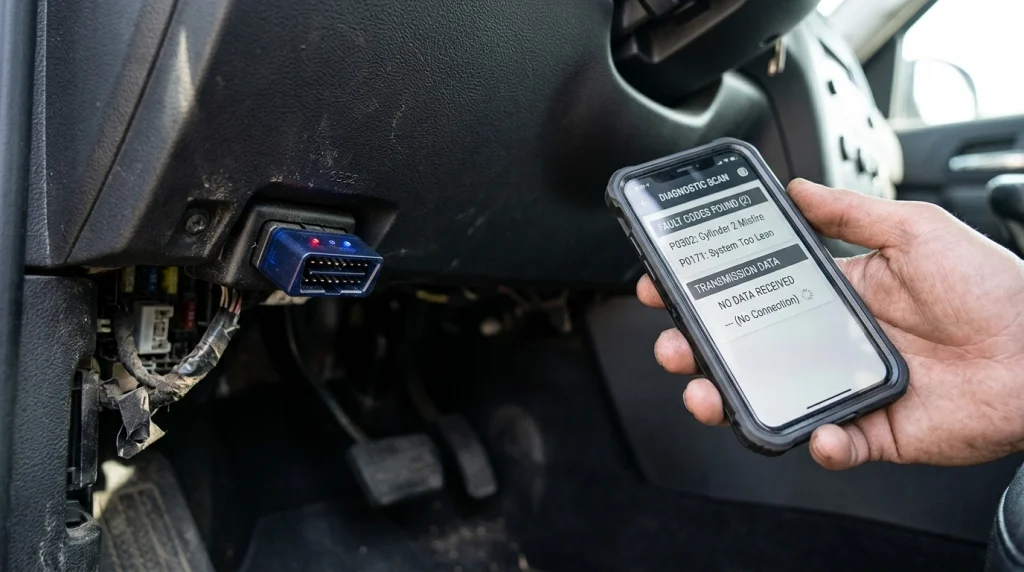
Transmission temperature is not one of the universally supported standard OBD2 live-data parameters. Standard OBD2 focuses primarily on emissions-related diagnostics, while transmission-specific information may require manufacturer-enhanced access.
Your vehicle’s control module may know the transmission fluid temperature, but a generic scanner does not necessarily have permission, software support, or the correct parameter definition to retrieve it. The temperature sensor and control module must also provide usable data for the vehicle in question.
The distinction is between having an OBD2 connection and being able to read a particular data parameter. A device can connect successfully, read engine codes, and display coolant temperature while still being unable to access transmission temperature.
- Basic code reader: Primarily retrieves supported generic trouble codes and standard data.
- Bluetooth adapter and compatible app: May display additional data when the app supports the vehicle’s enhanced parameters.
- Enhanced or professional scan tool: May access the transmission control module and manufacturer-specific live data, depending on vehicle coverage.
The OBDLink explanation of standard versus enhanced diagnostics confirms that transmission temperature is an example of manufacturer-specific information rather than a standard OBD2 parameter.
How Can You Check Whether Your Vehicle Supports Transmission Temperature?
Before purchasing another scanner or trying random custom parameters, confirm that your particular vehicle can provide this information through the diagnostic tool you plan to use.
- Identify the exact vehicle. Record the make, model, model year, engine, and transmission type when known. Different models or powertrains from the same manufacturer may support different diagnostic parameters.
- Check the scanner’s coverage. Look for explicit support for transmission fluid temperature or enhanced transmission live data for your vehicle, rather than relying on a general OBD2 compatibility claim.
- Check the app’s supported sensors. Some applications provide manufacturer-specific parameters or vehicle profiles that expose additional automatic transmission or CVT data.
- Connect to the vehicle. With the vehicle parked safely, connect the scanner and establish communication using the app or tool’s instructions.
- Open live data or the transmission module. Search for TFT, Transmission Fluid Temperature, ATF Temperature, Transmission Temperature, or similar labels.
- Confirm that a real reading appears. Check whether the parameter returns a plausible value and updates as expected. A listed parameter that returns an error or unsupported status is not a usable temperature reading.
For a more capable app or adapter, consult the manufacturer’s supported-vehicle documentation. The OBDLink transmission-temperature guide describes how supported Ford and GM parameters can be selected and displayed as a live gauge.
Tip
Search the scanner or app documentation using your exact model year and transmission type. This is more reliable than assuming that a parameter supported on one vehicle will work on another from the same brand.
What Does the Transmission Temperature Reading Tell You?
The reading indicates the temperature reported by the vehicle’s supported transmission-temperature parameter. Depending on the design, the measurement may come from a sensor monitored by the transmission control module.
Transmission fluid temperature matters because automatic transmission operation, fluid characteristics, and temperature-related control strategies vary with operating conditions. Monitoring the reading can help you understand how the transmission responds to ordinary driving, heavy loads, or prolonged demanding use.
For example, a driver towing a trailer might monitor the temperature during a trip to see whether it rises during sustained climbing and falls after the load decreases. That trend can be useful, but the number alone does not prove that the transmission is healthy or overheating.
There is no single temperature threshold that applies to every vehicle. Normal operating ranges, warning thresholds, measurement locations, and recommended responses depend on the manufacturer’s specifications. Use the correct service information for your exact transmission rather than treating a generic online number as a universal limit.
Also distinguish transmission fluid temperature from engine coolant temperature. They describe different fluids and systems. A scanner displaying engine coolant temperature does not establish the temperature of the transmission fluid.
What If Your OBD2 Scanner Cannot Find the Temperature?
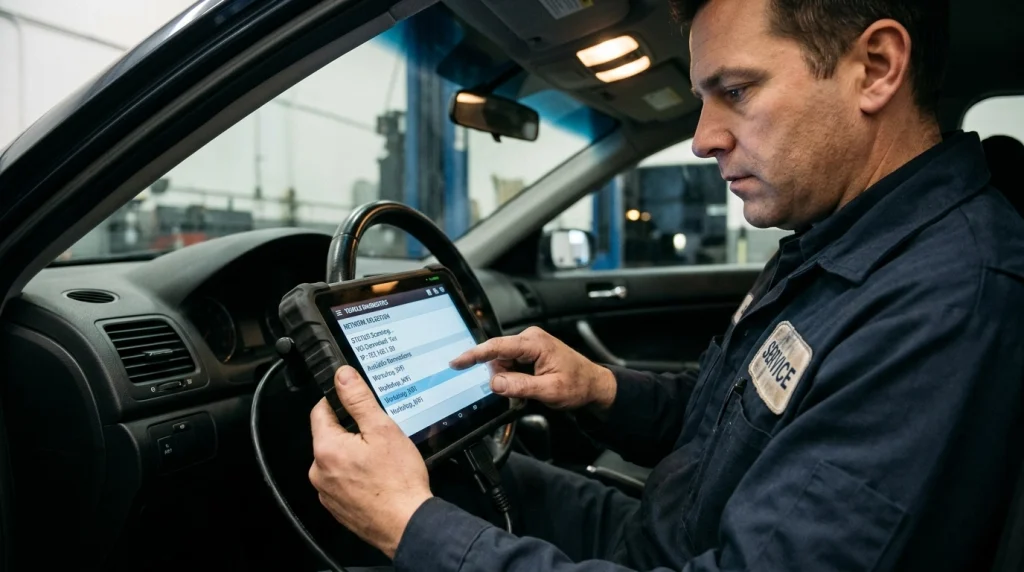
If you cannot find transmission temperature, the missing display does not automatically mean the vehicle lacks a temperature sensor or that the transmission has a fault. Check the diagnostic support before assuming there is a mechanical problem.
- The scanner only supports generic OBD2: It may not request manufacturer-specific transmission data.
- The app lacks the correct vehicle profile: A compatible adapter can still be paired with software that does not support the parameter.
- The wrong diagnostic network is selected: Some enhanced parameters are available only through a particular vehicle network or module.
- The parameter is unsupported: Your specific transmission or model year may not expose that reading through the tool.
- The reading is unavailable or invalid: A sensor, wiring, communication, or control-module problem may be relevant if the vehicle should support the parameter and other evidence indicates a fault.
Start with the simplest explanation: verify the tool’s supported functions, app version, vehicle profile, and connection settings. If the parameter is confirmed to be supported but produces an implausible value or an error, further diagnosis may be necessary.
Do not enter a random custom PID or calculation formula simply because it works on a similar vehicle. Manufacturer-specific parameters can differ in request format, scaling, units, and module access. An incorrect definition can produce an invalid value or no reading at all.
Can You Monitor Transmission Temperature While Driving?
Yes, if the vehicle exposes the parameter and your scanner-app combination supports live monitoring. A compatible adapter can send readings to a phone or tablet, while supported scan tools may display the temperature directly on their screens.
To monitor it usefully, observe the temperature under comparable conditions. Note whether the transmission is cold or warmed up, whether the vehicle is towing, and whether you are climbing hills or moving through heavy traffic. Those factors help explain why readings change.
Set up the display before moving and mount any phone or tablet securely. Do not operate the app or adjust diagnostic settings while driving. If the vehicle shows a transmission-temperature warning, follow the owner’s manual instructions rather than relying on the scanner alone.
A live temperature display is a monitoring aid, not a replacement for warning lights, the manufacturer’s service guidance, or a complete diagnosis. If the reading rises abnormally for your vehicle or the transmission begins slipping, shifting harshly, or losing drive, stop safely and investigate the cause.
Does a Transmission Temperature Reading Prove the Transmission Is Healthy?
No. Temperature is one operating parameter, not a complete assessment of transmission condition. A normal reading cannot rule out worn clutches, hydraulic problems, fluid contamination, electrical faults, or other issues that may not immediately change the displayed temperature.
Likewise, an elevated reading does not identify the cause by itself. Heavy loading, operating conditions, cooling-system issues, fluid problems, or a faulty sensor may need to be considered in context.
If the temperature seems inconsistent with the vehicle’s behavior, compare it with the manufacturer’s diagnostic procedure and other available data. A qualified technician may need to check fluid level and condition, retrieve transmission-specific trouble codes, inspect the cooling system, or test the relevant sensor circuit.
For related diagnostics, see our guide on whether OBD2 scanners can read transmission codes. If you are choosing diagnostic equipment, our guide to what to look for in an OBD2 scanner explains why supported modules and enhanced functions matter.
Related Product
OBD2 Scanner or Bluetooth Adapter With Enhanced Live Data
Choose a diagnostic tool that explicitly supports transmission fluid temperature for your vehicle’s make, model year, and transmission. A generic OBD2 connection alone is not enough.
As an Amazon Associate, we earn from qualifying purchases.
Frequently Asked Questions
Can a cheap OBD2 scanner show transmission temperature?
Sometimes, but many basic code readers do not support manufacturer-specific transmission temperature data. Check the scanner’s supported live parameters for your exact vehicle before buying it for this purpose.
Is transmission fluid temperature the same as engine temperature?
No. Transmission fluid temperature describes the transmission’s fluid temperature, while engine coolant temperature describes the engine cooling system. One reading cannot be used as a substitute for the other.
Can an OBD2 app display transmission temperature on my phone?
Yes, if the adapter, app, and vehicle support the required parameter. You may need a compatible enhanced-diagnostics feature, vehicle profile, or manufacturer-specific PID definition.
Can I read transmission temperature with the engine off?
It depends on the vehicle and diagnostic setup. Some temperature data may be available with the ignition on, while other readings require the control modules to be awake. Follow the scanner’s instructions and check whether the displayed value is current.
Why does my scanner show a transmission temperature of zero or an implausible value?
The parameter may be unsupported, incorrectly configured, unavailable under the current connection settings, or affected by a sensor or communication fault. Verify the vehicle-specific PID definition and diagnostic support before treating the displayed number as accurate.
What should I do if transmission temperature keeps rising?
Compare the reading with the manufacturer’s guidance for your vehicle and consider the driving conditions. If a transmission warning appears or the vehicle slips, shifts abnormally, or loses drive, stop safely and follow the owner’s manual instructions. Continued abnormal temperature readings warrant diagnosis.
Conclusion
An OBD2 scanner can show transmission temperature when the vehicle, diagnostic tool, and software support the required manufacturer-specific data. A basic code reader may not offer this function, even if it connects successfully and displays other live readings.
Before buying a scanner, verify transmission-temperature support for your exact vehicle and transmission. If a reading is available, use the manufacturer’s temperature guidance and interpret changes alongside driving conditions, warning messages, and other diagnostic information. A temperature gauge is useful for monitoring, but it cannot independently confirm that a transmission is healthy or diagnose every cause of overheating.

I’m Alex Rahman, a car enthusiast and automotive writer focused on practical solutions, car tools, and real-world driving advice. I share simple and honest content to help everyday drivers make better decisions.
