What Is OBD2 Mode 01? Live Diagnostic Data Explained
Quick Answer
OBD2 Mode 01 is a standardized diagnostic request mode defined by the SAE J1979 / ISO 15031-5 protocols that allows an external scan tool to access live, real-time powertrain parameter IDs (PIDs) and current emission-related operational data from a vehicle’s On-Board Diagnostics system.
What Is OBD2 Mode 01 and How Does It Work?
Modern vehicles rely heavily on electronic control units (ECUs) to monitor engine performance, emissions, and fuel economy. To maintain universal compatibility between different car manufacturers and diagnostic scan tools, regulatory bodies established standard diagnostic modes.
OBD2 Mode 01, formally known as “Request Current Powertrain Diagnostic Data,” is the foundational command mode used to stream live sensor readings and operational status while the engine is running or while the ignition is turned on. When a compatible OBD2 scanner requests data using Mode 01 followed by a specific Parameter ID (PID), the vehicle’s powertrain control module (PCM) responds with real-time numeric or status values.
This diagnostic capability ensures that any generic or professional scan tool can communicate with any compliant vehicle manufactured from 1996 onward in the United States, and similar standards globally, without requiring proprietary software for basic monitoring.
Understanding Parameter IDs (PIDs) in Mode 01
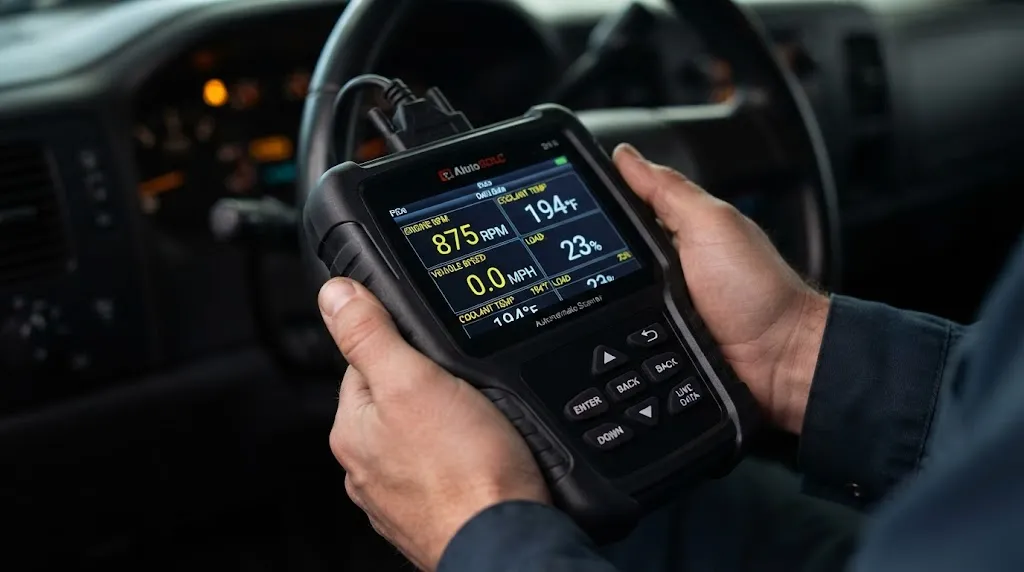
Mode 01 does not pull a single monolithic data block. Instead, it operates using specific sub-identifiers called Parameter IDs (PIDs). Each PID corresponds to a specific engine sensor or calculated value.
For example, requesting PID 0x0D instructs the vehicle computer to return the current vehicle speed, while PID 0x0C requests engine RPM. Standardized PIDs range from basic operational metrics to complex emission readiness indicators.
| PID (Hex) | Parameter Name | Typical Unit / Format | Diagnostic Purpose |
|---|---|---|---|
| 0x04 | Calculated Engine Load | Percentage (%) | Evaluates engine work demand relative to maximum capability. |
| 0x05 | Engine Coolant Temperature | Celsius (°C) / Fahrenheit (°F) | Confirms proper thermostat operation and warm-up cycles. |
| 0x0C | Engine RPM | Revolutions Per Minute | Monitors idle speed and engine rotational velocity. |
| 0x0D | Vehicle Speed | km/h or mph | Compares wheel speed sensor data against transmission output. |
| 0x0F | Intake Air Temperature | Celsius (°C) / Fahrenheit (°F) | Assesses air density entering the intake manifold. |
The table above illustrates only a fraction of the available PIDs supported under the Mode 01 umbrella. Standardized ranges allow tools to query supported PID bitfields (such as PID 0x00, 0x20, and 0x40) to dynamically discover which specific data points an individual vehicle computer supports.
How Diagnostic Scanners Request Mode 01 Data
Communication via the OBD2 port follows a strict request-and-response framework governed by network protocols like ISO 15765-4 (CAN), SAE J1850, or ISO 9141-2. When a diagnostic tool queries Mode 01, it transmits a specific hexadecimal frame.
For instance, requesting engine coolant temperature involves sending a Mode 01 request with PID 05 (often formatted as request ID 7DF with payload 02 01 05 on CAN networks). The vehicle’s ECU processes this request and responds with a data frame indicating the mode, PID, and calculated hexadecimal value, which the scan tool converts into a human-readable number.
Difference Between Mode 01 and Mode 03
A common point of confusion among DIY mechanics is the distinction between Mode 01 and Mode 03. While Mode 01 streams live operational sensors, Mode 03 is dedicated exclusively to retrieving stored Diagnostic Trouble Codes (DTCs) that trigger the check engine light. Mode 01 provides the real-time context—such as fuel trim percentages and sensor voltages—that helps technicians interpret why a particular trouble code was stored.
Practical Applications of Mode 01 in Automotive Diagnostics
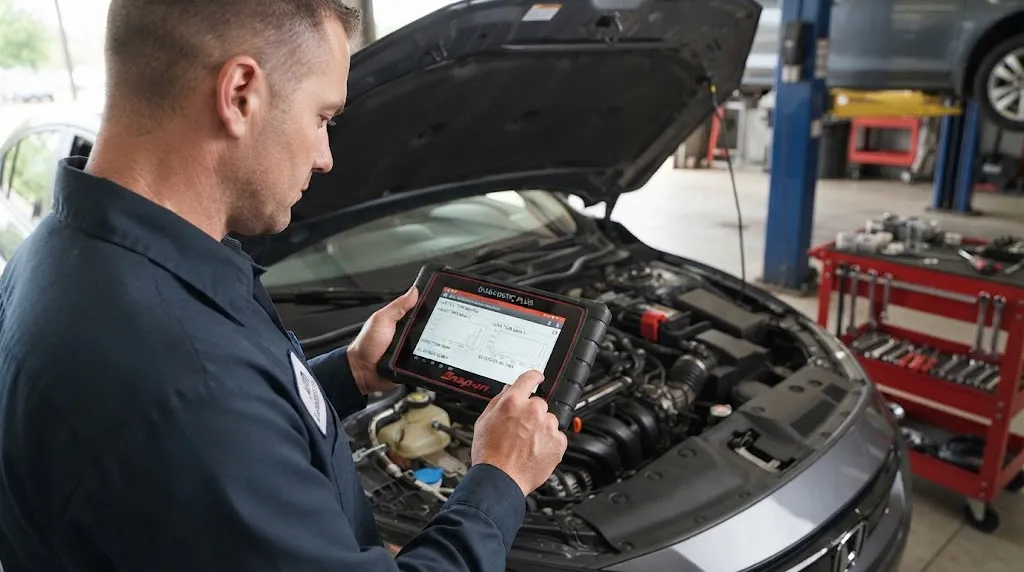
Understanding live data retrieved through Mode 01 is essential for effective automotive troubleshooting. Rather than replacing parts based solely on a trouble code, technicians use Mode 01 data streams to observe component behavior under real-world operating conditions.
Key diagnostic scenarios utilizing Mode 01 include:
- Fuel Trim Analysis: Monitoring Short Term Fuel Trim (STFT) and Long Term Fuel Trim (LTFT) to diagnose vacuum leaks, faulty fuel injectors, or oxygen sensor degradation.
- Oxygen Sensor Responsiveness: Observing upstream sensor voltage oscillations to verify closed-loop fuel control efficiency.
- Temperature Verification: Confirming whether an engine is reaching proper operating temperature before performing emissions testing or diagnosing heater core efficiency.
- Load Calculation Checks: Verifying Mass Air Flow (MAF) sensor accuracy by comparing calculated engine load against expected baseline parameters.
Tip
When diagnosing intermittent drivability issues, use a data-logging OBD2 scanner or smartphone app to record Mode 01 PIDs during the exact moment the symptom occurs, rather than staring at live numbers while driving.
Limitations and Manufacturer-Specific PIDs
While Mode 01 provides standardized parameters required by law for emissions compliance, it has inherent boundaries. Manufacturers are not required to expose every proprietary sensor through standard Mode 01 PIDs.
Advanced parameters—such as individual transmission fluid temperatures, specific ABS wheel speeds, or body control modules—often require manufacturer-specific diagnostic commands (often accessed via enhanced OBD2 modes or OEM software tools). Mode 01 remains strictly focused on standardized powertrain and emissions metrics.
Warning
Avoid monitoring live data parameters on a handheld scanner while driving your vehicle alone. Always secure a passenger to operate the diagnostic tool or utilize automated data-logging features to maintain road safety.
Related Product
OBD2 Bluetooth Diagnostic Scanners
Stream live Mode 01 powertrain data directly to your smartphone or tablet with a wireless OBD2 adapter.
As an Amazon Associate, we earn from qualifying purchases.
Frequently Asked Questions
What does OBD2 Mode 01 stand for?
Mode 01 stands for “Request Current Powertrain Diagnostic Data.” It is an international standard diagnostic command used by scan tools to read live operational sensors from a vehicle computer.
Is Mode 01 available on all cars?
Mode 01 is universally supported on all light-duty gasoline vehicles manufactured from 1996 onward in the United States (OBD-II compliant) and 2001/2004 onward in Europe (EOBD), as well as most modern diesel vehicles.
Can Mode 01 clear check engine lights?
No. Mode 01 is strictly a read-only data streaming mode for live sensors. Clearing diagnostic trouble codes and resetting the check engine light requires Mode 04.
Why do some PIDs show unsupported or blank data?
Not all vehicle manufacturers implement every optional PID defined in the SAE standard. If a vehicle does not utilize a specific sensor or calculation, the ECU will return an unsupported response for that specific PID.
How fast does Mode 01 update live data?
Refresh rates depend heavily on the vehicle communication protocol (such as high-speed CAN bus versus older legacy protocols) and the processing speed of both the vehicle ECU and the diagnostic scan tool.
Do I need an expensive scanner to view Mode 01 data?
No. Even inexpensive ELM327-based Bluetooth dongles paired with smartphone diagnostic applications can successfully query, graph, and log standard Mode 01 PIDs.
Conclusion
OBD2 Mode 01 serves as the backbone for real-time automotive diagnostics, giving vehicle owners and technicians direct insight into engine performance and sensor behavior. By understanding how Parameter IDs function within this standardized mode, you can quickly move past guesswork, accurately interpret live sensor streams, and diagnose complex automotive issues with confidence.

I’m Alex Rahman, a car enthusiast and automotive writer focused on practical solutions, car tools, and real-world driving advice. I share simple and honest content to help everyday drivers make better decisions.
