What Drains a Car Battery When the Car Is Off? And How to Fix It
A car battery drains when the car is off because something keeps drawing electrical current from it. The most common causes are interior lights left on, faulty relays, aftermarket accessories, aging batteries, and active modules that never fully power down. Normal key-off draw should stay under 50 milliamps.
You walked out to your car this morning. Turned the key. Nothing. Just a click, or worse — total silence.
Sound familiar? A dead battery after sitting overnight is one of the most frustrating car problems you can face. And the worst part? It often happens again and again with no obvious explanation.
I’m Alex Rahman, and I’ve spent years helping car owners diagnose electrical gremlins just like this one. What most people don’t realize is that a car battery doesn’t just “go dead.” Something is actively pulling power from it — even with the engine off and the keys out of the ignition.
In this guide, I’ll walk you through every cause of battery drain, ranked by how often they actually happen. I’ll also show you exactly how to track down the problem yourself. Let’s fix this once and for all.
- Parasitic drain above 50 milliamps will kill a battery within days.
- Interior lights, faulty relays, and aftermarket accessories are the top three causes.
- A battery over 4 years old may die from normal drain it once handled easily.
- OBD-II dongles and telematics devices silently drain batteries — most owners never suspect them.
- A multimeter and 30 minutes is all you need to find most parasitic drains at home.
What Does a Car Battery Actually Do When the Engine Is Off?
Your car battery stores electrical energy as chemical potential and releases it on demand. When the engine runs, the alternator generates power and recharges the battery continuously. The moment you shut the engine off, that charging stops — completely.
From that point on, the battery is on its own. It has a fixed amount of stored charge, and anything that draws from it reduces that reserve. A fully charged 12-volt battery sits around 12.6 volts. Drop below 12.0 volts and you’re in trouble. Drop below 11.8 volts and your car likely won’t start.
The battery also keeps critical memories alive — your radio presets, the clock, your ECU’s learned fuel trim data. These draws are tiny by design. But when something goes wrong, the draw grows — and the battery pays the price.
Why Your Battery Stops Charging the Moment You Park
The alternator is a generator driven by your engine’s serpentine belt. No engine spin means no alternator output. This is why a car left parked for even three to five days can come back dead — there is no trickle of charge happening in a standard parked vehicle.
Some modern cars with stop-start technology use enhanced flooded batteries (EFB) or absorbent glass mat (AGM) batteries — both from brands like Optima Batteries and Bosch — specifically because they handle repeated partial discharges better. But even these have limits when a fault creates an abnormal drain.
If your car sits for more than two weeks regularly, a CTEK battery maintainer plugged into a garage outlet keeps the battery topped up without overcharging it. It’s a $50 solution that saves a $200 battery.
What Is Parasitic Battery Drain and Why Does It Matter?
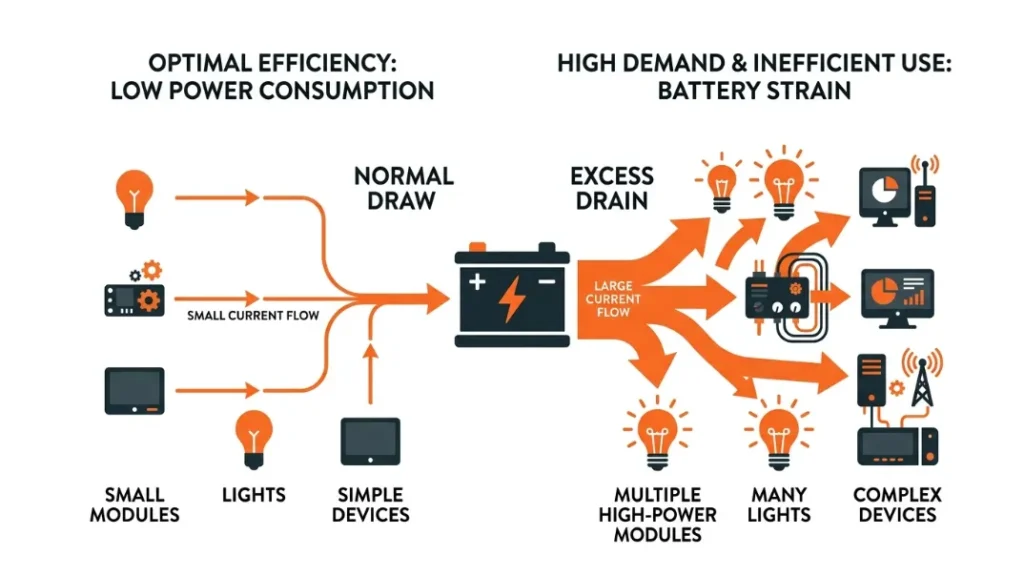
Parasitic battery drain is any electrical current your car pulls from the battery after the ignition is off and all systems have entered sleep mode. Every car has some level of this — it’s completely normal. The problem starts when that draw exceeds what your battery can sustain overnight.
Think of your battery like a phone with a cracked screen running apps in the background. Even with the screen off, something is eating the charge. In a car, that “something” could be a dome light, a faulty relay, or a module that never went to sleep.
What Is the Normal Milliamp Draw for a Parked Car?
Normal parasitic draw is between 25 and 50 milliamps (mA). Most modern cars land around 20–30mA once all modules sleep — typically 10 to 30 minutes after shutdown. Anything consistently above 50mA is considered a fault worth investigating.
| Draw Level | What It Means | Time to Dead Battery |
|---|---|---|
| Under 50mA | Normal — factory design | Weeks to months |
| 50–100mA | Borderline — investigate | 7–14 days |
| 100–300mA | Fault present — fix needed | 2–5 days |
| Over 300mA | Serious fault or active load | Hours to overnight |
The 10 Most Common Things That Drain a Car Battery When Off
These are the real culprits behind dead batteries — ranked from most commonly found to least. Start at the top when you’re diagnosing your own car.
1. Interior Lights Left On — the Most Overlooked Culprit
A single dome light left on overnight draws roughly 10 watts continuously. That’s enough to kill a standard 50Ah battery in under 24 hours. Trunk lights, glove box lights, and footwell LEDs are just as guilty — and far easier to miss.
The door latch switch that triggers your dome light can also fail in the “on” position. Your door appears fully closed, but the switch signals the car that it’s still open. The light stays on. You don’t see it from outside. Battery dies by morning.
Always check the trunk and glove box light when diagnosing a drain. Close the door and look for any light glow through window gaps before assuming the issue is electrical.
2. Faulty Relays That Stay On When They Should Switch Off
Relays are electromagnetic switches that control high-current circuits. When a relay sticks in the closed position, it keeps power flowing to a component — the fuel pump, cooling fan, or ABS module — even with the key out. This is one of the most common causes of overnight drain that leaves no visible symptom.
A stuck fuel pump relay, for example, can draw 4–8 amps continuously. That’s 4,000–8,000 milliamps — more than 80 times the normal drain limit. Your battery won’t last a single night.
3. Aftermarket Accessories Wired Directly to the Battery
Aftermarket stereos, amplifiers, LED light bars, dashcams, and USB charging hubs are often wired directly to the battery’s positive terminal — bypassing the ignition-switched circuit entirely. This means they draw power 24 hours a day, 7 days a week, whether the car is running or not.
A dashcam in parking mode is designed to draw power when parked — but an improperly installed one with no low-voltage cutoff will drain the battery flat within 12–24 hours. Always verify that aftermarket wiring uses a fused, ignition-switched feed unless the device is specifically designed for always-on operation.
4. A Weak or Aging Battery That Can’t Hold a Charge
A car battery has a typical service life of 3 to 5 years. After that point, the internal lead plates sulfate — a process called battery sulfation — and the battery loses its ability to hold a full charge. A battery at 60% capacity will die from the same normal 30mA draw that a healthy battery handles for weeks.
Here’s the tricky part: an old battery often tests fine with a basic voltage check. It reads 12.6 volts fully charged. But under load — the moment you try to start the car — it collapses. A proper load test from a shop like AutoZone (which offers free battery testing) will reveal this instantly.
5. Car Alarm and Security Systems Drawing Constant Power
Your factory alarm system is designed for minimal draw — usually under 5mA. But aftermarket alarm systems, especially older or poorly installed ones, can draw 50–200mA continuously as they keep sensors, sirens, and LED indicators active around the clock.
If your car has a visible LED that flashes rapidly (more than once per second) when parked, that’s a sign the alarm module is working harder than it should. Normal security LEDs pulse slowly — about once every 3–4 seconds.
6. Infotainment and Telematics Modules That Never Fully Sleep
Modern cars run complex infotainment systems, connected services, and telematics modules (like GM’s OnStar or Toyota’s connected services). These modules are designed to enter a deep sleep mode 10–30 minutes after shutdown. When they malfunction, they stay awake — polling GPS satellites, maintaining Bluetooth connections, and checking for software updates.
This is increasingly common in vehicles from 2015 onward. Autel and Foxwell scan tools can identify which module is staying awake by reading live CAN bus data — a technique professional technicians use when chasing ghost drain on modern platforms.
Important: Always wait at least 30 minutes after shutdown before performing a parasitic draw test. Modules need time to enter sleep mode. Testing too early gives a falsely high reading and sends you chasing the wrong problem.
7. OBD-II Dongles and Plug-In Devices Left in the Port
This is one of the most underreported causes of battery drain — and one I see constantly. OBD-II ports sit on an always-on circuit in most vehicles. That means any device plugged into them draws power 24/7. Insurance telematics dongles, Bluetooth OBD scanners, and GPS trackers all pull current even when the car is off.
Most dongles draw between 5mA and 30mA. That’s within safe limits for daily drivers. But on a car that sits for a week, even a 15mA drain adds up. On a weak battery, it’s game over by day three. Unplug your OBD device if the car will sit for more than 48 hours.
8. A Faulty Alternator That Drains Instead of Charges
A failed alternator diode can actually reverse the flow of current — pulling power from the battery instead of pushing it in. This is rare but real. A healthy alternator should show 13.8–14.7 volts at the battery terminals with the engine running. If you’re seeing under 13 volts, your alternator isn’t keeping up, and your battery is slowly dying every time you drive.
A bad diode in the alternator can also create a parasitic draw of 200–300mA with the engine off. A simple AC ripple test with a multimeter reveals this in under five minutes.
9. Extreme Cold Reducing Battery Capacity Dramatically
Cold weather doesn’t drain your battery directly — but it reduces the battery’s available capacity significantly. At 32°F (0°C), a lead-acid battery loses roughly 20% of its rated capacity. At 0°F (-18°C), that loss jumps to 40–50%. A battery that barely handles a normal 30mA overnight draw at room temperature will fail completely in a Minnesota winter.
Cold also thickens engine oil, requiring more cranking amps to start. So at the exact moment your battery has the least power, your engine demands the most. This is why cold mornings expose battery problems that stay hidden all summer.
10. Keyless Entry and Smart Key Systems Pinging Continuously
Keyless entry systems — especially passive entry systems where the car detects the key fob’s proximity — broadcast a low-frequency radio signal continuously. Some smart key systems pulse every few seconds, checking whether the key fob is nearby. This is a known issue on several Honda, Toyota, and Ford models from 2016–2022, where software calibration affects how aggressively the system polls for the key.
Keeping the key fob close to the car (like hanging it on a hook next to the garage door) can trigger constant communication between the fob and the car, accelerating drain. Store your key fob away from the vehicle when parked overnight.
How Long Can a Car Sit Before the Battery Dies?
A healthy car battery with normal parasitic draw (under 50mA) typically lasts 2 to 8 weeks when parked. The exact time depends on battery age, capacity, temperature, and what’s drawing power.
| Battery Condition | Expected Sit Time | Notes |
|---|---|---|
| New, healthy (AGM) | 6–8 weeks | Ideal conditions, no fault |
| New, healthy (lead-acid) | 4–6 weeks | Warm climate |
| 3–4 years old | 1–3 weeks | Depends on condition |
| 5+ years old or weak | 2–7 days | Replace recommended |
How to Test for Parasitic Battery Drain at Home
Finding a parasitic drain is a systematic process. You don’t need a shop — just a multimeter, about 30 minutes, and patience. I’ve done this dozens of times, and the process almost always points you straight to the problem.
What Tools Do You Need for a Parasitic Draw Test?
You need a digital multimeter capable of reading DC milliamps — any unit from brands like Fluke or Klein Tools in the $25–$80 range handles this perfectly. You also need the vehicle’s fuse box diagram, which lives in the owner’s manual or on a sticker inside the fuse box cover.
Step-by-Step Guide to Finding the Drain With a Multimeter
- Turn the car off and remove the key. Close all doors and wait 30 minutes.
- Set your multimeter to DC Amperage — start on the 10A setting for safety.
- Disconnect the negative battery terminal carefully.
- Connect the multimeter in series: red probe to the negative cable, black probe to the battery negative post.
- Read the current draw. If it’s under 50mA after 30 minutes, you’re normal.
- If it’s above 50mA, open the fuse box and pull fuses one at a time while watching the reading.
- When the reading drops significantly, you’ve found the circuit with the fault.
- Use the fuse box diagram to identify which component that fuse controls.
- Inspect, repair, or replace the component or wiring on that circuit.
Never open a car door or turn on any accessory during the test. Any input reactivates sleeping modules and sends your reading through the roof. If you accidentally trigger a wake event, wait another 10–15 minutes before retesting.
Is It the Battery Itself or Something Else Draining It?
This is the most common diagnostic confusion — and it trips up even experienced mechanics. Here’s the clean way to separate the two problems.
If the battery dies after sitting but charges fully and starts well right after a jump, the problem is almost always parasitic drain. The battery holds charge fine — something is just pulling it down while parked.
If the battery dies even after a full overnight charge, or collapses the moment you try to start the car, the battery itself is failing. It can’t hold the charge it accepts. Battery sulfation, internal shorts, or a dead cell are the likely causes. A professional load test confirms this in under two minutes.
Battery drains after sitting = likely parasitic drain. Battery dies immediately despite a full charge = the battery itself is bad. You can have both problems at once — a weak battery made worse by a fault drain. Address the drain first, then test the battery’s true health under load.
How to Stop Your Car Battery From Draining When Parked
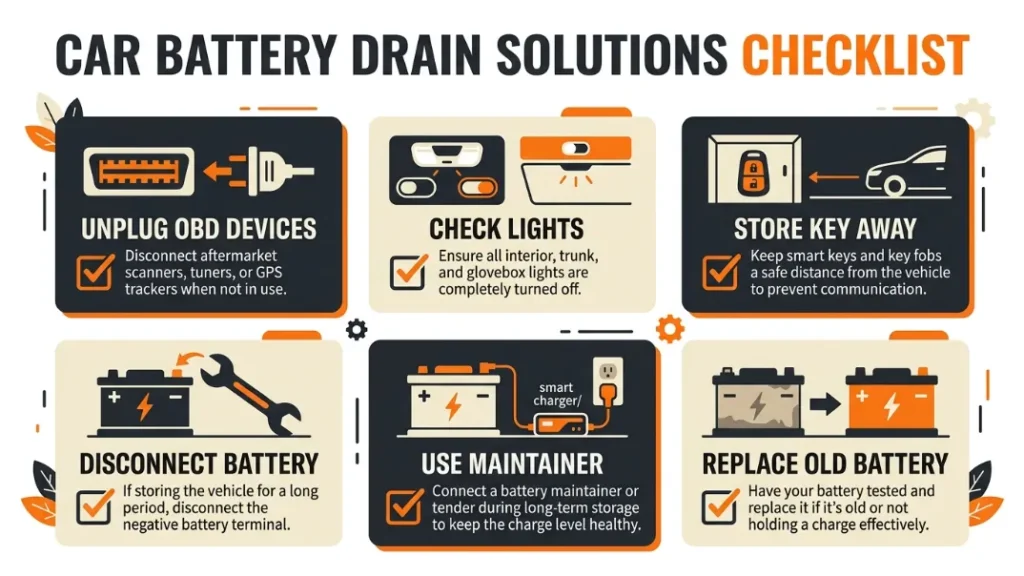
Once you know the cause, fixing battery drain is usually straightforward. Here are the most effective solutions — starting with what you can do today.
Quick Fixes You Can Do Today
- Unplug all OBD-II devices if the car will sit for more than two days.
- Store your key fob away from the car — at least 30 feet away to stop proximity polling.
- Check every interior light — trunk, glove box, and footwell — before locking up.
- Disconnect the negative battery terminal for long-term storage (two weeks or more).
- Connect a CTEK or Battery Tender maintainer if the car sits in a garage regularly.
- Replace any battery over 4 years old that fails a load test — a weak battery amplifies every drain problem.
A $15 battery disconnect switch installed on the negative terminal lets you cut all power instantly when storing the car. No tools needed every time — just a quarter-turn knob. This is the simplest long-term solution for any car that sits more than a week.
When Should You Call a Mechanic Instead of DIYing It?
DIY diagnosis works well for most causes — lights, OBD devices, and obvious accessory wiring. But call a professional when the draw is above 200mA and pulling fuses doesn’t isolate it, when the problem involves modern CAN bus modules or telematics, or when the alternator diode test points to internal alternator failure.
A qualified auto electrician with a Foxwell NT510 or Autel MaxiSys scanner can read live module activity and pinpoint exactly which control unit is staying awake — a task that would take hours with a fuse-pull method alone. For complicated modern vehicles, spending $80–$120 on a professional diagnosis saves you days of frustration. For more guidance on automotive electrical systems, the ASE (Automotive Service Excellence) website is a trusted resource for finding certified technicians near you.
For additional reading on battery health and maintenance best practices, Car and Driver’s battery guide covers real-world testing data across popular battery brands.
I always tell readers this: if your battery has died more than twice in 12 months, don’t just jump it again — find the root cause. Repeated deep discharge permanently damages battery plates. Each time it dies, its capacity shrinks a little more. Solve the drain, and your battery will last its full service life.
Frequently Asked Questions

I’m Alex Rahman, a car enthusiast and automotive writer focused on practical solutions, car tools, and real-world driving advice. I share simple and honest content to help everyday drivers make better decisions.
