REDTIGER F17 4K 3CH Dash Cam 2026: Honest Real Verdict
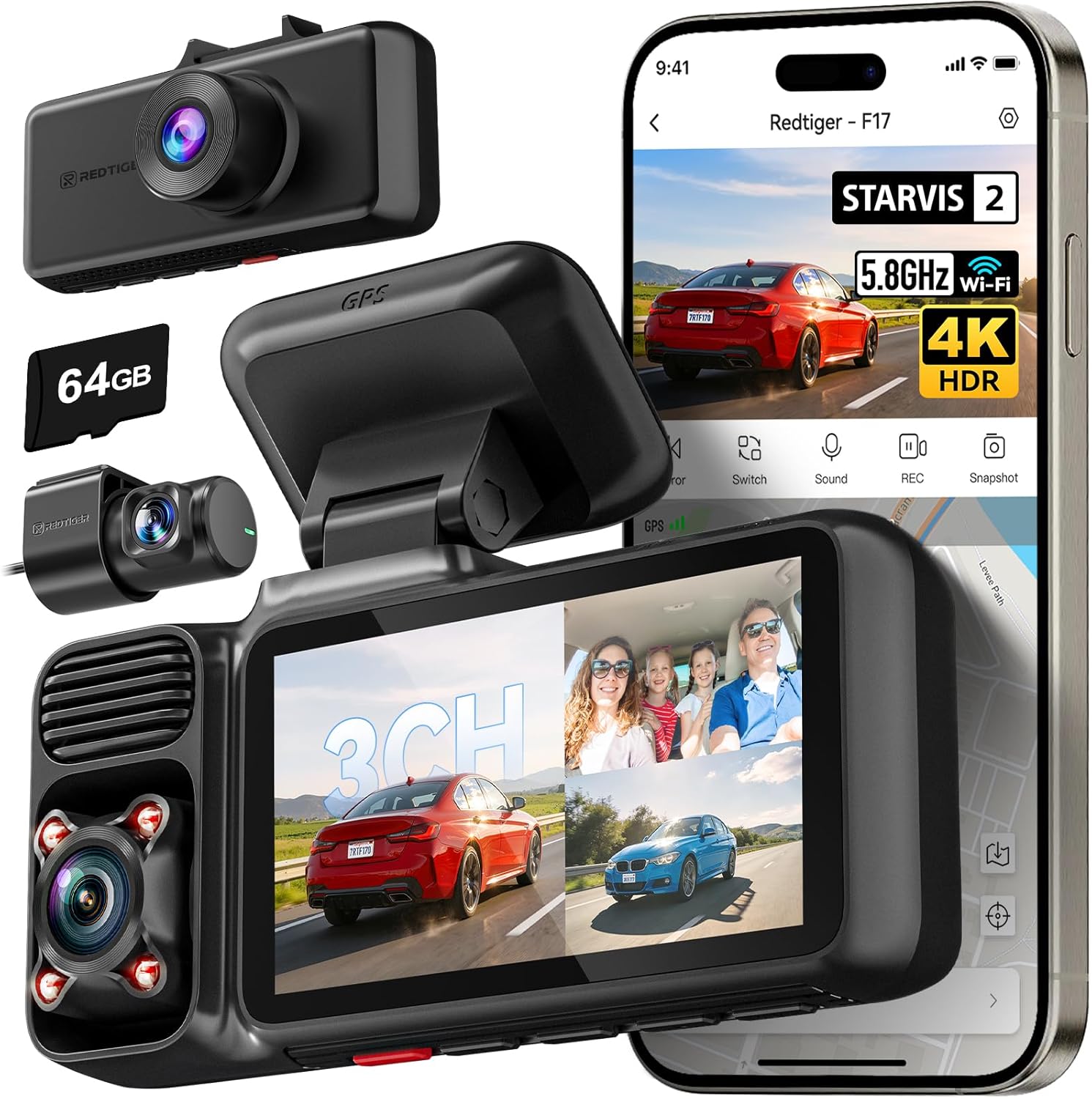
The REDTIGER F17 4K 3CH Dash Cam is aimed at drivers who want more than a front-only record of the road. It combines 4K front video with 1080p cabin and rear recording, plus GPS, app access, IR cabin night vision, and parking support.
I am not going to invent weeks of hands-on testing. This review combines the current product listing, verified specifications, recent pricing, and owner feedback to explain what daily ownership is likely to feel like. For commuters, rideshare drivers, and family cars, the big appeal is simple: three angles in one system without moving into the highest-priced tier.
Quick Verdict
| Overall: 4.4/5 | Performance: 4.5/5 |
| Value: 4.4/5 | Design: 4.2/5 |
| ✅ Best For: commuters, rideshare drivers, families | |
| ❌ Not Ideal For: buyers wanting a tiny one-camera setup | |
| Price: about $150–$170 on Amazon | |
| Check Price on Amazon | |
What Arrives in the Box?
The F17 package is better equipped than many basic dash cams because a 64GB microSD card is included. The main unit uses a 3-inch display, and the system adds separate cabin and rear coverage. The default mount is a 3M adhesive style rather than a suction cup.
The trade-off is cable work. A three-camera layout means more routing around the headliner and rear trim than a front-only camera. The front unit is compact enough to sit near the mirror, but careful placement matters. If this is your first install, this guide to installing a dash cam properly is useful before you stick the mount down.
How the F17 Records
The F17 records the road ahead in 4K 2160p while the cabin and rear cameras record at 1080p. Its front camera uses Sony STARVIS 2 technology, while HDR/WDR processing and four IR lights help with difficult lighting and cabin footage.
Daytime Highway Driving
On a bright highway, the front camera is the strongest part of the system. The 4K feed has much more room for road signs, vehicle shapes, and plate detail than the two 1080p secondary cameras. The front field of view is listed at 150°, which gives broad coverage without making the scene feel excessively stretched.
Night City Driving
At night, the STARVIS 2 sensor, HDR, and WDR matter more than raw resolution. Streetlights, signs, and headlights create sharp exposure changes, so the front camera has to protect highlights without losing the darker road. The cabin camera uses four IR lights, which is especially useful for rideshare or taxi use.
Rear Traffic Coverage
The rear camera records at 1080p with a listed 155° view. That is enough to show lane position, following vehicles, and the basic sequence of a rear-end incident. It is not the same level of detail as the 4K front feed, so distant plate capture behind the car is the main compromise.
Stops, Impacts, and Loop Recording
The F17 supports a G-sensor and loop recording. In normal use, that means the camera can keep writing new files as the card fills rather than simply stopping. Locked event files are intended to protect important clips after an impact. For a deeper explanation, see how continuous dash cam recording works.
Parking-Lot Use
Parking mode is supported, but the camera needs a suitable constant-power setup. REDTIGER lists parking monitoring and a compatible hardwire solution. This is useful for impact events while the car is unattended, but it also adds installation work and makes battery-protection settings more important.
Living With It Every Day
Once installed, the F17 should be fairly hands-off. The camera supports automatic loop recording, GPS logging, and wireless phone access. The app can be used to view clips and route data, and the listed 5.8GHz Wi-Fi is designed to speed up transfers compared with slower 2.4GHz-only links.
The less convenient part is that Wi-Fi is still a direct camera-to-phone connection, not a cloud connection. Some owner feedback also mentions the annoyance of manually connecting for downloads. The good news is that recording itself does not depend on Wi-Fi; this guide explains what dash cam Wi-Fi actually does.
Build and Mounting Quality
The F17 uses a compact plastic camera body, an F1.8 lens, and a 3-inch screen. The 3M mount should feel more permanent than a suction cup and is less likely to become a daily adjustment point.
| Part | What to Expect |
| Main camera | Compact 3-inch display |
| Mount | 3M adhesive |
| Power system | Supercapacitor |
| Storage | Up to 256GB |
The main nuisance is permanence. Repositioning adhesive mounts takes more care than moving a suction cup, and the cable run can look messy if it is not tucked into trim. The supercapacitor is a sensible choice for a device that spends long hours in a hot windshield.
Video in Mixed Lighting
Daylight is where the F17 has the easiest job. The front 4K feed should give the most usable evidence, while the wider secondary cameras add context. Around sunset, rain, or dark streets, HDR/WDR processing becomes more important because glare and deep shadow can exist in the same frame.
Cabin footage has a different goal. The four IR lights are there to make faces and movement visible when the interior is dark. Rear footage remains useful at night, but its 1080p resolution means you should expect less fine detail than from the front camera.
Cleaning and Card Care
Dash cams do not need much maintenance, but small habits matter. I would wipe all three lenses with a clean microfiber cloth when dust or fingerprints show up, and I would check the rear lens after carrying passengers or cargo.
| Task | Simple Routine |
| Lens cleaning | Microfiber as needed |
| Card check | Review saved clips |
| Cables | Inspect loose trim |
| Mount | Check adhesive hold |
The included 64GB card is enough to get started, but heavy three-channel recording fills storage faster than a single-camera setup. If footage matters after an incident, save it quickly. This guide on retrieving dash cam recordings covers app, card, and computer methods.
F17 Pros and Cons
The F17 is strongest on coverage and value. Its compromises come from the same thing that makes it useful: three cameras create more wiring, more files, and uneven resolution between front and rear.
Pros
| Cons
|
How It Compares
Two natural step-up alternatives are the Vantrue N4 Pro and VIOFO A229 Pro 3CH. Both target drivers who want front, cabin, and rear evidence, but they cost more and emphasize stronger imaging or extra control features.
F17 vs N4 Pro and A229 Pro
The F17 wins on price and included storage. The Vantrue N4 Pro also records 4K front plus 1080p cabin and rear, while adding voice control. The VIOFO A229 Pro 3CH moves further upmarket with 4K front, 2K rear, 1080p cabin, dual STARVIS 2 sensors, triple HDR, voice control, and buffered parking modes.
| Model | Video | Best Fit |
| REDTIGER F17 | 4K+1080p+1080p | Value coverage |
| Vantrue N4 Pro | 4K+1080p+1080p | Voice features |
| VIOFO A229 Pro 3CH | 4K+2K+1080p | Higher-end imaging |
If the priority is maximum rear detail and advanced parking features, VIOFO is stronger. If you want three-camera evidence without spending roughly twice the F17’s common sale price, REDTIGER makes the easier value case.
Who Should Buy the F17?
Buy this if:
- You want front, cabin, and rear footage.
- You drive rideshare or carry passengers.
- You want GPS and app playback.
- You prefer a card included in the box.
Avoid this if:
- You only need a tiny front camera.
- You want 2K or 4K rear video.
- You dislike routing long camera cables.
What About Long-Term Durability?
The F17’s supercapacitor is a positive sign for long-term heat tolerance because it avoids relying on a small lithium battery inside a hot windshield-mounted device. REDTIGER also lists an 18-month guarantee for the F17.
The parts most likely to need attention over time are practical ones: adhesive strength, cable wear at tight bends, lens cleanliness, and microSD health. No dash cam is maintenance-free. Periodic playback checks are more valuable than assuming a recording light means every file is healthy.
Power and Installation Reality
For ordinary driving, the simplest setup is vehicle power with the included cable. Parking recording needs a constant-power arrangement, normally a hardwire kit, so installation becomes more involved. Exact recording wattage is not stated in the verified F17 specification page, so I would not invent a number.
Plan extra time for the rear camera cable and hide it away from airbags and moving trim. Parking mode can be useful, but battery protection matters whenever a camera stays powered with the engine off. This guide to dash cams in parking mode explains the power trade-offs.
Common F17 Questions
These are the questions that matter most before buying a three-channel dash cam like this one.
Does the REDTIGER F17 record all three cameras at once?
Yes. The F17 is listed as a three-channel system with 4K front recording plus 1080p cabin and rear recording. That gives one forward view and two extra angles for context.
Does the REDTIGER F17 need Wi-Fi to record?
No. Wi-Fi is mainly for connecting the phone app, viewing files, and accessing GPS-related playback. The camera records to the microSD card without an internet connection.
How much storage does the F17 support?
REDTIGER currently lists support for up to a 256GB microSD card. A 64GB card is included with the package described here.
Does parking mode work when the car is off?
It can, but the camera needs suitable constant power. A hardwire setup is the normal solution, and battery-protection settings should be configured correctly.
Is the REDTIGER F17 good for rideshare drivers?
Yes, that is one of its strongest use cases. The cabin camera, four IR lights, front/rear coverage, GPS, and app access give rideshare drivers more context than a two-channel road-only setup.
| Verdict: strong three-camera value for everyday evidence. |
| Price: about $150–$170 on Amazon |
| Amazon rating: about 4.4/5 from roughly 2.9K ratings |
| Check Current Price & Availability |
Final Verdict on the F17
The REDTIGER F17 4K 3CH Dash Cam makes the most sense for drivers who care about complete incident context more than having the smallest possible camera. Its 4K front feed, 1080p cabin and rear views, IR lights, GPS, 5.8GHz Wi-Fi, included 64GB card, and supercapacitor create a useful package for daily driving.
The main weaknesses are easy to understand. Rear and cabin video are lower resolution than the front, the three-camera install takes more effort, and app connections can add friction when you want a clip quickly. At around the mid-$100 range, though, the F17 offers a strong balance of coverage and features without moving into premium three-channel pricing.

I’m Alex Rahman, a car enthusiast and automotive writer focused on practical solutions, car tools, and real-world driving advice. I share simple and honest content to help everyday drivers make better decisions.
