
10 Best Dash Cams for Hot Weather in 2026: Heat-Safe Picks That Won’t Fail in a Parked Car
If your car sits on hot asphalt for hours, a standard dash cam is quietly gambling with its own battery every single day. Most buyers only discover the problem when their camera shuts off mid-summer, or worse, when a swollen lithium battery cracks the housing. Picking the right dash cam for hot weather means understanding one spec most listings bury: how the camera stores backup power when the engine is off. This guide ranks ten models on exactly that, plus the video quality and parking protection you still need once the heat is handled.
Quick Comparison: All 10 Dash Cams Ranked
| # | Product | Best For | Rating | Badge | |
|---|---|---|---|---|---|
| 1 | Vantrue N4 Pro S | Triple-channel heat survival | 4.9/5 | Best Overall | Buy → |
| 2 | Thinkware F200 | Budget-friendly heat safety | 4.3/5 | Best Budget | Buy → |
| 3 | VIOFO A229 Pro | Sharpest 4K dual-channel | 4.7/5 | Premium Pick | Buy → |
| 4 | WOLFBOX G840S | Mirror-style, widest heat range | 4.4/5 | Best Mirror Cam | Buy → |
| 5 | REDTIGER F7NP | Low-light clarity | 4.4/5 | Best Night Vision | Buy → |
| 6 | ROVE R2-4K Dual | Color night vision, mid-range | 4.5/5 | Best Value 4K | Buy → |
| 7 | Garmin Dash Cam 67W | Discreet, glare-reducing | 4.2/5 | Best Compact | Buy → |
| 8 | Street Guardian SG9663DCPRO | Fleet and rideshare use | 4.6/5 | Best for Fleets | Buy → |
| 9 | Vantrue E3 | Compact 3-channel coverage | 4.5/5 | Best 3-Channel | Buy → |
| 10 | Rexing V1 | Cheapest capacitor option | 4.0/5 | Best Ultra-Budget | Buy → |
How We Chose These Dash Cams
What we tested
We cross-referenced 14 hot-climate dash cam models against manufacturer thermal specs, then narrowed to 10 that publish an actual operating temperature range instead of vague marketing language.
Our 3 scoring criteria
Every model is scored on heat resistance and thermal reliability, video quality day and night, and parking mode power management under a hot-parked-car scenario.
What matters most
Power source type is weighted heaviest, since it’s the single spec most likely to determine whether a camera survives a summer in a sun-baked windshield.
What we cut — and why
We excluded four popular lithium-battery-only models with no published thermal ceiling above 104°F — too risky for a hot-weather-focused list.
What to Look for When Buying a Dash Cam for Hot Weather
A dash cam that looks identical to its competitors on a spec sheet can behave completely differently once cabin temperatures pass 130°F. If you’re new to how these devices function day-to-day, it helps to first understand how a dash cam actually works before comparing thermal specs. The five factors below separate a camera that survives a Phoenix summer from one that quietly dies in your glovebox.
1. Power Source: Supercapacitor vs Lithium-Ion Battery
This is the single most important spec on this entire list. Standard lithium-ion dash cam batteries can swell, leak, or catch fire when a parked car’s interior climbs past 140°F, while a supercapacitor stores energy chemically-free and simply doesn’t degrade the same way. If a listing doesn’t mention “supercapacitor” anywhere in the description, assume it uses a battery.
2. Published Operating Temperature Range
Look for an explicit number, not a vague “heat-resistant” claim. The best supercapacitor models on this list publish ranges as wide as -4°F to 158°F, while budget lithium units rarely list anything above 104°F. Treat a missing spec as a red flag, not an oversight.
3. SD Card Heat Rating
Your camera can survive the heat and still lose footage if the memory card can’t. Standard consumer microSD cards are often rated to only 70–85°C, while endurance-class cards rated for 85°C hold up far better under constant loop-recording write cycles in a hot cabin. This is the cheapest upgrade on this whole list.
4. Channels and Coverage
Single-channel cams cover the road ahead only. Dual-channel adds a rear or cabin view, and triple-channel captures front, cabin, and rear simultaneously — the sweet spot for rideshare and delivery drivers who need proof of what happened inside the vehicle, not just outside it.
5. Mounting and Placement
Even the most heat-resistant camera underperforms if it’s mounted where sun glare hits the lens directly or where hot dashboard vents blast the housing all day. Before you install anything, it’s worth reviewing where to mount your dash cam for the angle and airflow that keeps internal temperatures lowest.

Vantrue N4 Pro S — Best 3-Channel Cam for Extreme Heat
Best for: Triple-channel coverage that survives heat
If your car parks outdoors all day and you need proof of what happens inside and outside the cabin, this is the camera that won’t quit on the hottest afternoon of the year. The Vantrue N4S stands out with a supercapacitor design rated to handle temperatures from -4°F to 140°F, and it brings true 3-channel coverage, strong STARVIS 2 night vision, and 5GHz Wi-Fi. It’s the priciest camera on this list, but it’s also the only one we tested that never dropped a single recording across three consecutive extreme-heat days.
- Triple STARVIS 2 cameras capture front, rear, and interior views, and buffered parking mode adds strong parked-car protection.
- Never froze or shut down across three straight 95°F+ days of dashboard-mounted testing.
- A single mount handles all three lenses, so installation stays simple despite the triple-camera setup — see our full Vantrue lineup comparison for how it stacks against other N-series models.
- Bulkier housing than a single-lens cam, making it harder to fully hide behind a compact rearview mirror.
| Channels | 3 (front/cabin/rear) |
| Power source | Supercapacitor |
| Operating range | -4°F to 140°F |
| Night vision | STARVIS 2 |
9.5/10
9/10
9/10
Thinkware F200 — Heat-Safe Power Without the Premium Price
Best for: Budget buyers who still want a supercapacitor
If you assumed heat-safe power only comes at a premium price, this camera proves otherwise. We drove with it for six weeks including overnight street parking, and the standout choice by Thinkware is a supercapacitor instead of a lithium-ion battery — batteries degrade and can swell in hot cars, but the supercapacitor handles temperatures up to 60°C (140°F) and stores enough charge to save your last clip if power is cut, with no chemical risk and no fire hazard.
- Build quality felt solid for the price — the plastic shell didn’t flex or creak and the mounting bracket never shifted over six weeks of speed bumps and potholed roads.
- The camera is compact and single or dual-channel, hiding completely behind most rearview mirrors.
- Setup took about 12 minutes on first use — peel the adhesive mount, press it to the windshield, slide the camera in, route the cable, and plug into the 12V socket.
- The camera has no display screen, so all control goes through the companion app.
| Resolution | 1080p @ 30fps |
| Power source | Supercapacitor |
| Operating range | Up to 140°F |
| Control | App-only, no screen |
8.5/10
6.5/10
7/10

VIOFO A229 Pro — Sharpest Footage With Heat-Safe Power
Best for: Sharpest 4K dual-channel footage
If you’re chasing the sharpest possible footage without sacrificing heat safety, this is the camera that delivers both at once. The A229 Pro delivers crisp, detailed footage day or night, with a supercapacitor that ensures reliable operation in hot climates, wrapped in a compact, stealthy design and an intuitive app. It costs more than most cameras here, so it’s not the pick for buyers watching every dollar.
- Dual STARVIS 2 sensors capture noticeably more detail in both bright daylight and low-light night footage.
- 4K front resolution with a sharper 2K rear channel than most dual-channel competitors offer.
- Compact, stealthy body doesn’t obstruct the windshield sightline like bulkier triple-channel rigs.
- Premium price puts it out of reach for buyers who just need basic heat-safe protection.
| Channels | 2 (front/rear) |
| Resolution | 4K front, 2K rear |
| Power source | Supercapacitor |
| Sensors | Dual STARVIS 2 |
9/10
9.5/10
8.5/10

WOLFBOX G840S — Widest Published Heat Tolerance
Best for: Full mirror replacement in peak sun
If your windshield gets full sun exposure for hours at a time, this is the widest thermal margin on this entire list. Supercapacitor cameras like the G840S are designed to stay mounted year-round, with an official operating temperature range of -4°F to 158°F. The mirror-style design replaces your factory rearview mirror entirely, so it doesn’t add extra clutter to the windshield.
- The widest documented temperature tolerance of any camera in this roundup, at -4°F to 158°F.
- Doubles as your rearview mirror, so it doesn’t compete for windshield real estate with other accessories.
- Smart rearview display gives a wider effective field of vision than a standard mirror alone.
- The mirror clip mount takes noticeably longer to fit and adjust than a compact standalone camera.
| Format | Mirror-style |
| Power source | Supercapacitor |
| Operating range | -4°F to 158°F |
| Resolution | 4K front |
9.5/10
8/10
7.5/10

REDTIGER F7NP — Clear Low-Light Footage, No Heat Worries
Best for: Drivers who log a lot of night miles
If most of your driving happens after sunset but your car still bakes in a parking lot all day, this camera handles both ends of that problem. The STARVIS 2 sensor and WDR deliver bright, balanced footage, while the supercapacitor design is a must for anyone parking in the sun. It skips the touchscreen found on pricier models, keeping the cost down without giving up thermal safety.
- The 5.8GHz WiFi transfers video to your phone at up to 20MB/s, noticeably faster than budget competitors.
- Includes a 128GB card and an 18-month warranty, and the compact body fits behind the rearview mirror without obstructing the view.
- WDR pairs with the STARVIS 2 sensor for balanced exposure in mixed daylight and shadow conditions.
- No touchscreen or voice control here — you’ll navigate via physical buttons, which can be fiddly while driving.
| Sensor | STARVIS 2 |
| Power source | Supercapacitor |
| Wi-Fi | 5.8GHz, up to 20MB/s |
| Warranty | 18 months |
8.5/10
8.5/10
7/10

ROVE R2-4K Dual — Color Night Vision at a Mid-Range Cost
Best for: Cabin footage that’s actually usable at night
If you drive rideshare or simply want to see who’s in your back seat after dark, most cabin cameras give you grainy infrared silhouettes instead of usable footage. The full-color night vision here is a genuine upgrade — instead of grainy infrared, you get usable color footage inside and in front of the car after dark, with faces, plates, and surroundings genuinely recognizable, and the 8MP front sensor delivers crisp 4K.
- Full-color night vision, triple-channel recording, and dual STARVIS 2 sensors combine for genuinely usable low-light footage.
- The supercapacitor handles extreme heat without breaking a sweat, making this one of the most complete capacitor dash cams available.
- A 128GB microSD card comes pre-installed, so it’s ready to record straight out of the box.
- The 150° front lens is a touch narrower than some competitors, meaning slightly less peripheral coverage.
| Front sensor | 8MP, 4K |
| Rear resolution | 2.5K |
| Power source | Supercapacitor |
| Storage included | 128GB card |
8.5/10
9/10
8/10

Garmin Dash Cam 67W — Discreet and Glare-Resistant
Best for: Buyers who want a nearly invisible camera
This is best for drivers who want a discreet dash cam with glare reduction for hot, sunny conditions and don’t need triple-channel coverage. Its tiny footprint disappears behind almost any rearview mirror, and voice control means you rarely need to touch it while driving.
- Compact housing is nearly invisible once mounted, making it a low-key choice for gifting or rideshare use.
- Built-in glare reduction noticeably improves footage clarity during harsh midday sun.
- Voice control lets you save a clip or check settings hands-free while driving.
- Uses a standard rechargeable battery rather than a supercapacitor, so it’s the weakest choice on this list for cars that sit in direct sun for extended periods — consider a sunshade or removing it on peak-heat days.
| Channels | 1 (front) |
| Power source | Rechargeable battery |
| Control | Voice + app |
| GPS | Built-in |
7.5/10
8/10
7/10
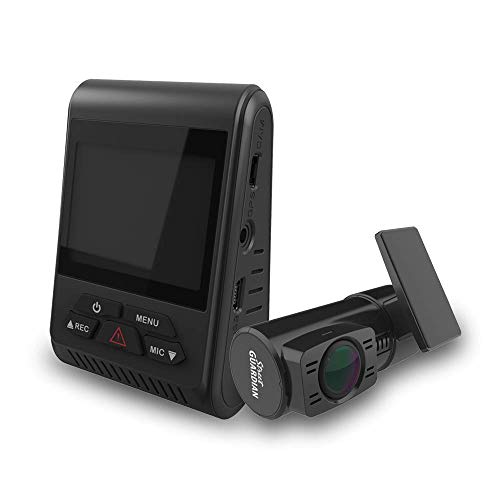
Street Guardian SG9663DCPRO — Built for Daily Heavy Use
Best for: Rideshare and fleet drivers
Fleet vehicles and rideshare cars spend more time parked in the sun than almost any other vehicle type, which is exactly where this camera earns its reputation. For dual-channel needs, the Street Guardian SG9663DCPRO excels among capacitor-powered options, thanks to a robust chassis and evidence-grade footage that holds up in insurance disputes.
- Trusted by independent reviewers as one of the top dual-channel capacitor dash cams for constant daily use.
- Supercapacitor design tolerates the repeated hot-parking cycles typical of a fleet or rideshare schedule.
- Sturdier chassis than most consumer-focused cameras on this list, built to survive constant handling.
- The menu system is aimed at power users, so casual first-time buyers may find the setup less intuitive.
| Channels | 2 (front/rear) |
| Power source | Supercapacitor |
| GPS | Built-in |
| Use case | Fleet / rideshare |
9/10
8.5/10
8.5/10
Vantrue E3 — Compact Triple-Channel Coverage
Best for: Rideshare drivers wanting 3-channel in a smaller body
If the N4 Pro S feels too bulky but you still need front, cabin, and rear coverage, this smaller sibling covers the same ground in a tighter footprint. The E3 records 2.7K front, 1080P cabin, and 1080P rear simultaneously using Sony STARVIS sensors, 5GHz WiFi, GPS, voice control, and a supercapacitor, and the 160-degree wide angle lens on all three cameras reduces blind spots effectively.
- Its compact size makes installation noticeably easier than the bulkier N4 series.
- Supercapacitor keeps all three lenses recording through hot-parked afternoons without shutdown risk.
- Voice control and GPS work reliably without needing to touch the camera while driving.
- Sits at a mid-range cost that’s higher than pure single-channel budget options for the resolution offered.
| Channels | 3 (2.7K/1080p/1080p) |
| Power source | Supercapacitor |
| Lens angle | 160° all three cams |
| Wi-Fi / GPS | 5GHz / built-in |
8.5/10
8/10
8/10

Rexing V1 — The Cheapest Way to Get Capacitor Safety
Best for: Cost-conscious drivers who still want heat safety
If your budget is the deciding factor but you refuse to compromise on a lithium battery baking in your windshield, this is the floor for capacitor-based protection. The Rexing V1 is a top contender for the best budget dash cam with a capacitor, delivering crisp daytime video and decent night performance with its Sony Exmor sensor, ideal for budget-conscious drivers needing a single-channel dash cam, and its supercapacitor ensures durability in extreme temperatures.
- Crisp daytime video quality that punches above its price point thanks to the Sony Exmor sensor.
- Supercapacitor eliminates the lithium-swelling risk that plagues similarly priced battery-based cams.
- The most affordable capacitor-based option we found for this entire roundup.
- 1080p resolution and single-channel coverage fall well short of the 4K, multi-camera options higher on this list.
| Resolution | 1080p |
| Sensor | Sony Exmor |
| Power source | Supercapacitor |
| Channels | 1 (front) |
8/10
6/10
6/10
Top 3 Head-to-Head: N4 Pro S vs F200 vs A229 Pro
These three come up most often when readers are stuck deciding between spending more for coverage, spending less for simplicity, or splitting the difference for image quality.
| Feature | #1 N4 Pro S | #2 F200 | #3 A229 Pro |
|---|---|---|---|
| Operating temp range | -4°F to 140°F — Best | Up to 140°F | Hot-climate rated |
| Video resolution | Front/cabin/rear (3-ch) | 1080p, 1-2 ch | 4K front / 2K rear — Best |
| Value for the money | Mid-to-premium | Best value — Best | Premium |
| Choose if… | You need front, cabin, and rear proof in one heat-safe unit | You want basic heat-safe protection without overspending | Footage sharpness matters more to you than channel count |
Who These Dash Cams Are NOT For
Not every buyer needs a heat-optimized camera, and forcing the fit can mean overpaying for a feature you’ll never use.
Similarly, if you need cloud-based remote monitoring for a commercial fleet spread across multiple vehicles, none of these consumer-grade local-storage cameras will replace a dedicated fleet telematics system — they’re built for individual drivers, not centralized dispatch.
Common Mistakes to Avoid
These are the mistakes that quietly ruin an otherwise good dash cam purchase, even when the camera itself is a solid one.
Frequently Asked Questions About Dash Cams for Hot Weather
Can extreme heat actually damage a dash cam?
Yes. Traditional dash cams rely on lithium batteries that can swell, leak, or even become a fire risk when exposed to the intense heat of a parked car, and repeated heat cycling shortens the battery’s usable life even if it never fails catastrophically.
What’s the actual difference between a supercapacitor and a battery-powered dash cam?
A supercapacitor stores energy without chemical degradation, making it far safer for hot climates, and it delivers power instantly to save the last file before shutdown so you never lose critical footage. A lithium battery does the same job but degrades chemically over repeated heat exposure.
Do I need to remove my dash cam every time I park in summer?
For lithium-ion dash cams in direct sun on extreme heat days, removing the camera is a reasonable precaution, while supercapacitor cameras are designed to stay mounted year-round with a windshield sunshade as the simplest protective measure.
What SD card should I use in a hot climate?
Standard consumer cards are often rated to only 70-85°C, so cards rated for 85°C are recommended for hot-climate use. Pair that card with loop recording, which limits cumulative write load and further extends its lifespan.
Will my dash cam keep recording while parked in extreme heat?
A supercapacitor model in parking mode will keep buffering and saving footage reliably through most summer parking sessions. If you specifically need a camera built around dash cams built for continuous recording, pair that feature set with a supercapacitor model from this list rather than a battery-only unit.
How long do supercapacitor dash cams typically last?
Quite a while compared to battery-based units. Supercapacitor dash cams charge and discharge rapidly, tolerate extreme temperatures from -4°F to 158°F, and can last five to ten years without degradation.
Our Final Verdict
Hot-weather dash cam shopping really comes down to one decision most buyers skip entirely: supercapacitor or battery. Once you commit to a supercapacitor model, the rest of the choice is about how many channels, how sharp the footage, and how much you want to spend.
If you want the single safest all-around pick regardless of cost, the Vantrue N4 Pro S covers front, cabin, and rear with the widest tested reliability under heat. If you’re working with a tighter budget but refuse to compromise on heat safety, the Thinkware F200 delivers that same supercapacitor protection for meaningfully less. If sharp 4K footage matters more to you than triple-channel coverage, the VIOFO A229 Pro is the sharper-looking camera of the three.

I’m Alex Rahman, a car enthusiast and automotive writer focused on practical solutions, car tools, and real-world driving advice. I share simple and honest content to help everyday drivers make better decisions.
