Jump Starter vs Battery Charger: What’s the Real Difference and Which One Do You Actually Need?
A jump starter delivers a short, powerful burst of current to start a dead engine instantly — no waiting required. A battery charger slowly restores a depleted battery over several hours using a wall outlet. The short answer: use a jump starter in a roadside emergency, and a battery charger for long-term battery health at home.
I’m Alex Rahman, and I’ve been stranded with a dead battery more times than I care to admit. The last time it happened was on a cold January morning in a parking garage — no other cars around, no jumper cables, and a meeting I couldn’t miss. That experience taught me something important: grabbing the right tool before you need it is everything.
The confusion between a jump starter and a battery charger is incredibly common. Both devices deal with dead or weak car batteries. Both look like they could solve the same problem. But they work in completely different ways, and reaching for the wrong one in an emergency can leave you stranded for hours. I’ll walk you through exactly what each device does, how they differ, and which one belongs in your trunk or garage — so you never get caught off guard again.
- A jump starter starts your car immediately with a burst of power — no wall outlet needed.
- A battery charger slowly replenishes your battery over hours using a household outlet.
- Jump starters are portable and ideal for roadside emergencies.
- Battery chargers are better for long-term battery maintenance and conditioning.
- For most drivers, a portable jump starter is the more practical everyday tool to keep on hand.
What Is a Jump Starter and How Does It Work?
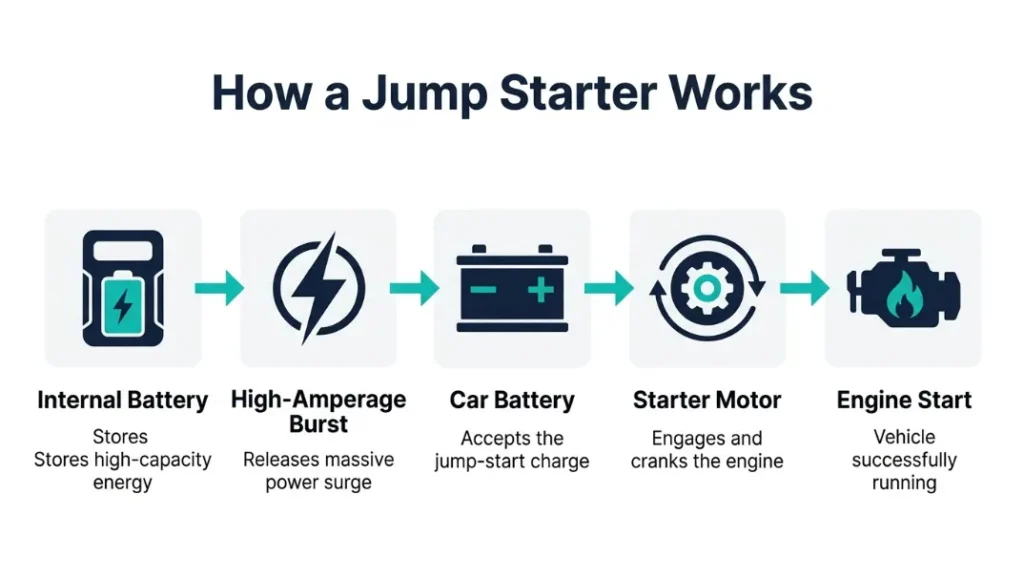
A jump starter is a self-contained battery pack that delivers a high-amperage surge of power directly to your car’s dead battery. That surge is enough to crank the engine and get it running — usually in under 30 seconds.
Modern jump starters use lithium-ion battery technology, which allows them to be compact, lightweight, and powerful enough to fit in a glove compartment. Older models used sealed lead-acid batteries and were much heavier, closer in size to a small toolbox. Today, most portable jump starters weigh between 1 and 3 pounds.
Here is what happens when you use one: you clamp the positive and negative leads to your car’s battery terminals, power on the device, and start the engine. The jump starter doesn’t charge your battery — it simply provides enough power to start the car. Once the engine is running, your alternator takes over and handles the rest.
NOCO (an American automotive electronics company founded in 1914) is one of the most trusted names in this category, and their UltraSafe technology includes spark-proof connections and reverse polarity protection, making their devices very beginner-friendly.
Lithium-ion jump starters can hold a charge for 6 to 12 months when stored properly. Charge yours fully before winter season and re-check it every few months to ensure it’s ready when you need it.
What Is a Battery Charger and How Does It Work?
A battery charger is designed to do the opposite of a jump starter — it slowly restores energy to a depleted battery over a period of time. You plug it into a household outlet, connect it to the battery terminals, and let it work for anywhere from 2 to 24 hours depending on the charger’s amperage and the battery’s condition.
Battery chargers come in two main types: standard chargers and smart (or automatic) chargers. Standard chargers deliver a constant current and need to be monitored so the battery doesn’t overcharge. Smart chargers, sometimes called trickle chargers or float chargers, automatically adjust their output and shut off once the battery is fully charged. They can also be left connected indefinitely for battery maintenance — a feature that’s especially useful for seasonal vehicles like motorcycles or classic cars stored over winter.
CTEK (a Swedish battery management company) and Battery Tender (an American brand under Deltran) are two well-regarded manufacturers in this space, known for producing intelligent multi-stage chargers that not only charge batteries but also condition and desulfate them, which can extend battery lifespan significantly.
The main limitation? You need access to a wall outlet. This makes a battery charger a garage tool, not a roadside tool.
A battery charger is the right tool when your battery is weak, old, or has been sitting unused. It restores charge slowly and safely, and smart models can maintain battery health over time. It requires a power outlet and is not useful in a roadside emergency.
Jump Starter vs Battery Charger: The Core Differences Explained
People often assume these two devices are interchangeable. They are not. The difference between jump starting a car and charging a car battery comes down to speed, portability, and purpose.
| Feature | Jump Starter | Battery Charger |
|---|---|---|
| Primary Purpose | Start a dead engine instantly | Restore and maintain battery charge |
| Power Source | Internal battery (self-contained) | Wall outlet (AC power required) |
| Time Required | Seconds to minutes | 2 to 24 hours |
| Portability | Fully portable, fits in a bag | Requires outlet; mostly stationary |
| Charges the Battery? | No — only starts the engine | Yes — fully restores battery |
| Battery Maintenance | No | Yes (smart chargers) |
| Typical Price Range | $50 – $200+ | $20 – $100+ |
| Best Use Case | Roadside emergency | Garage maintenance |
The most important distinction: a jump starter does not charge your battery. It provides enough power to start the engine, and then your alternator takes over. If your battery is weak or nearing the end of its life, you’ll need a charger — or a new battery — to solve the underlying problem.
Does a Jump Starter Charge a Car Battery?
No. This is one of the most common misconceptions about jump starters, and it’s worth being direct about it.
A jump starter bypasses your weak battery long enough to fire the engine. The moment the engine starts, your vehicle’s alternator begins generating electricity and takes over powering the car’s systems. It also sends current back to the battery to charge it — but only while the engine is running.
So if your battery is dead and you jump start your car, driving it for 20 to 30 minutes will partially recharge it through the alternator. But if the battery is old, damaged, or has an internal fault, no amount of driving will fix it. In that case, a battery charger with a conditioning or desulfation mode — like those from Optima Batteries (an American high-performance battery brand) or CTEK — can sometimes revive a deeply discharged battery that a simple jump start cannot.
If your battery dies repeatedly and requires frequent jump starts, that is a sign of a failing battery or a faulty alternator — not a problem a jump starter can fix. Continuing to jump start without diagnosing the root cause can damage your vehicle’s electrical system over time.
Can You Use a Battery Charger as a Jump Starter?
Standard battery chargers cannot jump start a car. They do not deliver the high-amperage burst of power required to crank an engine — that process demands a surge of current that a normal charger simply is not designed to produce.
However, there are combination units on the market that function as both a battery charger and a jump starter. These hybrid devices typically have a “boost” or “engine start” mode that can supply the cranking current needed to start a car, plus a standard charging mode for slower, steady replenishment.
That said, dedicated jump starters outperform combination units when it comes to portability and emergency starting power, and dedicated smart chargers do a better job of conditioning and maintaining battery health. If you want the best of both functions, keeping one of each is the most reliable approach.
If you own a seasonal vehicle — a motorcycle, boat, RV, or classic car — a smart trickle charger like the Battery Tender Plus is one of the best investments you can make. Left connected over winter, it keeps the battery at peak health so the vehicle starts reliably in spring.
When Should You Use a Jump Starter?
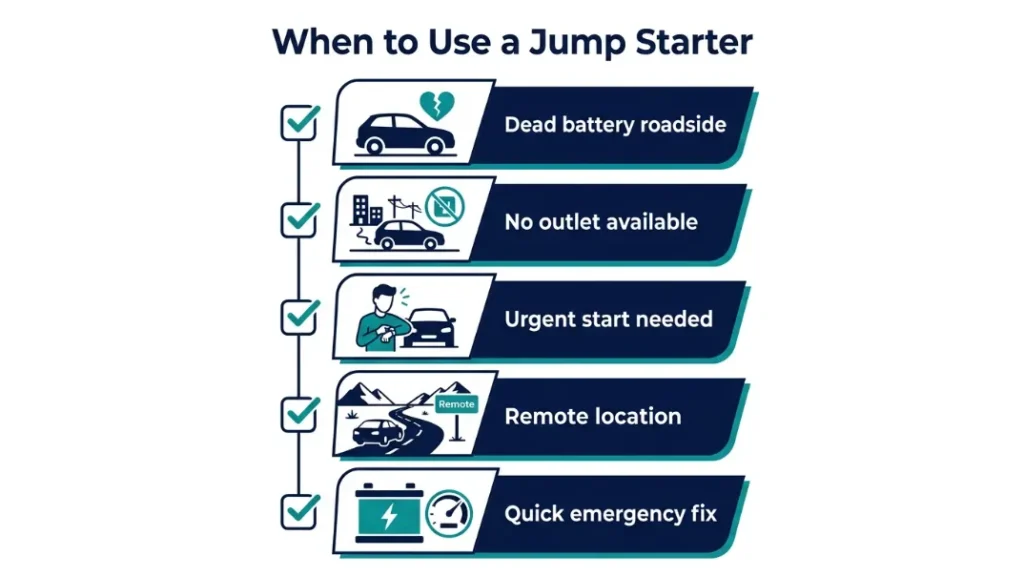
Use a jump starter when you need to start a vehicle immediately and a wall outlet is not available. The most common situations include:
- You left your lights on and came back to a dead battery
- Your car sat unused for several weeks and the battery drained
- You are stranded on the road, in a parking lot, or in a remote area
- You need a quick solution and cannot wait hours for a charge
- You want a reliable backup tool to keep in your trunk at all times
Jump starters are also useful beyond cars. They work with motorcycles, boats, ATVs, lawn tractors, and any 12V vehicle that uses a standard lead-acid or AGM battery. Some higher-end models also support 24V diesel engines found in trucks and commercial vehicles.
When Should You Use a Battery Charger?
Use a battery charger when time is not a critical factor and your goal is to fully restore or maintain the battery. Ideal situations include:
- Your battery is weak and struggles to start the car in cold weather
- You are storing a vehicle for the off-season
- You want to recondition an old battery before replacing it
- You want to maintain a fleet of vehicles in a garage setting
- You have a deeply discharged battery that a jump starter cannot start
For overnight charging, smart multi-stage chargers are the safest option. They start with a bulk charge phase, transition to an absorption phase, and end with a float maintenance phase — never overcharging the battery.
NOCO Boost Plus GB40 1000 Amp 12-Volt UltraSafe Portable Lithium Car Battery Jump Starter Pack For Up To 6-Liter Gasoline And 3-Liter Diesel Engines
The GB40 is the most popular portable jump starter on Amazon — it’s compact enough to live in your glove box, delivers 1,000 amps of starting power, and includes spark-proof, reverse-polarity protection so it’s safe even for first-time users.
How to Use a Jump Starter Safely: Step-by-Step
Using a jump starter is straightforward, but connecting the cables in the correct order matters. Here is the right way to do it every time.
- Make sure the jump starter is fully charged before you need it.
- Turn off the jump starter before connecting any cables.
- Connect the red (positive) clamp to the positive terminal on your car battery.
- Connect the black (negative) clamp to a bare metal ground on your vehicle — not directly to the negative battery terminal. This reduces sparking risk.
- Power on the jump starter and wait 30 to 60 seconds.
- Start your vehicle. If it doesn’t start in 5 seconds, wait 2 minutes and try again.
- Once the engine starts, disconnect the black clamp first, then the red clamp.
- Drive for at least 20 to 30 minutes to let the alternator partially recharge the battery.
Never connect the negative clamp directly to the dead battery’s negative terminal if you can avoid it. Grounding to a metal surface away from the battery reduces the chance of igniting hydrogen gas that batteries can emit when discharged. Always read the manual for your specific vehicle.
How to Use a Battery Charger: Step-by-Step
Charging a car battery at home is simple with a smart charger. The process is safe as long as you follow the connection order correctly.
- Park the vehicle in a well-ventilated area, ideally a garage with the door open.
- Turn off the ignition and all electrical accessories.
- Locate the battery — it is usually under the hood, but in some vehicles it may be in the trunk or under the rear seat.
- Connect the red (positive) clamp to the positive terminal.
- Connect the black (negative) clamp to the negative terminal.
- Plug the charger into a wall outlet and power it on.
- Select the correct battery type (standard, AGM, or gel) if your charger offers this setting.
- Let the charger complete its cycle — a smart charger will beep or display a full indicator when done.
- Unplug the charger from the wall before disconnecting the clamps.
- Disconnect black clamp first, then red clamp.
What Type of Battery Do These Devices Work With?
Most jump starters and battery chargers are designed to work with 12V lead-acid batteries, which is the standard type found in the majority of passenger vehicles. Within that category, there are a few subtypes:
- Flooded lead-acid (FLA): The most common and least expensive type. Found in most standard cars.
- AGM (Absorbent Glass Mat): A sealed, maintenance-free battery found in newer vehicles and stop-start systems. AGM batteries require a charger that specifically supports AGM mode.
- Gel batteries: Less common in vehicles but found in some motorcycles and specialty applications.
- Lithium iron phosphate (LiFePO4): Found in some electric and hybrid vehicles. These require a dedicated lithium-compatible charger — do not use a standard lead-acid charger on a lithium pack.
Always check the battery type in your vehicle’s manual before selecting a charger. Using the wrong charging profile on an AGM battery, for example, can damage it or reduce its lifespan. For authoritative guidance on battery types and specifications, SAE International and the Motorera Battery Reference are reliable technical sources.
If your vehicle uses an AGM battery (common in BMW, Mercedes-Benz, and most vehicles made after 2015 with stop-start technology), you must use a charger with an AGM-specific mode. Standard chargers can overcharge AGM batteries, causing premature failure. Check your owner’s manual to confirm your battery type.
Cold Cranking Amps vs Peak Amps: What the Numbers Mean
When comparing jump starters, two numbers get thrown around constantly: peak amps and cold cranking amps (CCA). Understanding the difference helps you choose the right device.
Peak amps is the maximum current a jump starter can briefly deliver. Manufacturers often advertise this number prominently because it sounds impressive. But peak amps occur only for a fraction of a second.
Cold cranking amps (CCA) is the more meaningful number. It measures how much current a battery can deliver at 0°F (-18°C) for 30 seconds while maintaining a minimum voltage. This is the standard used by engineers to specify starting power for engines in cold conditions.
As a general guideline, most compact cars need around 300 to 400 CCA to start reliably. A 4.0-liter gasoline engine needs approximately 150 to 250 cranking amps at room temperature. A diesel engine — especially a large truck diesel — may need 700 to 1,000 CCA or more. When buying a jump starter, match the device’s CCA rating to your engine size, not just the peak amp number.
In cold climates, a battery’s effective CCA drops significantly. A battery rated at 600 CCA at room temperature may only deliver 400 CCA at freezing temperatures. Always buy a jump starter with some overhead above your vehicle’s minimum requirement — especially if you live in a cold region.
Jump Starter vs Battery Charger: Which One Should You Buy?
The right answer depends on how you plan to use it. Here is a simple framework.
Buy a jump starter if:
- You drive regularly and want roadside emergency protection
- You want a device you can keep in your car at all times
- You live alone and cannot rely on another vehicle to jump start yours
- You need something that works without any external power source
Buy a battery charger if:
- You have a seasonal or stored vehicle that sits unused for months
- Your battery is aging and needs regular maintenance
- You have a garage with easy access to a wall outlet
- You want to condition and extend the life of your battery
Buy both if:
- You have multiple vehicles or a fleet to maintain
- You want complete coverage for both emergencies and long-term maintenance
- You live in an extreme climate where battery failures are more frequent
In my experience, most everyday drivers benefit most from a quality portable jump starter kept in the trunk. It handles the most common real-world scenario — a dead battery with no warning, no nearby outlet, and nowhere to be late. Once you have that covered, a smart charger for your garage is a worthwhile second investment.
Jump starters are for emergencies — portable, fast, and independent of any power source. Battery chargers are for maintenance — slower, thorough, and dependent on a wall outlet. They solve different problems, and the best-equipped driver has both.
Are There Jump Starters That Also Charge Batteries?
Yes. A growing number of combination devices can function as both a jump starter and a trickle charger. These hybrid units are convenient but come with trade-offs.
The charging output on combination units is typically lower than a dedicated smart charger — they may take longer to fully restore a battery, and their maintenance modes are not always as sophisticated. However, for a driver who wants a single device that covers both scenarios, a quality combination unit is a practical choice.
Some modern portable power stations — marketed by brands like Jackery and EcoFlow — also include 12V car jump start ports alongside their AC outlets and USB ports. These multi-function devices are increasingly popular with campers and off-road enthusiasts who need a single versatile power source for extended trips.
How Long Does It Take to Charge a Dead Car Battery?
Charging time depends on the charger’s amperage output and how deeply discharged the battery is. Here is a rough guide:
| Charger Amperage | Estimated Charge Time (50Ah Battery) | Best For |
|---|---|---|
| 1 – 2A (trickle) | 24 – 48 hours | Long-term maintenance |
| 4 – 6A (standard) | 8 – 16 hours | Overnight charging |
| 10 – 15A (fast) | 3 – 6 hours | Faster turnaround |
| 40A+ (rapid boost) | 1 – 2 hours | Workshop / garage use |
For everyday home use, a 4 to 10 amp smart charger is the most practical choice — fast enough to restore a battery overnight, but gentle enough not to damage it.
Battery Safety: What Not to Do With Either Device
Both jump starters and battery chargers involve working with lead-acid batteries, which can emit hydrogen gas and contain sulfuric acid. Here are the safety rules that matter most.
- Never charge a frozen battery. A frozen battery can crack or explode when charged. Let it thaw completely before attempting to charge it.
- Never use a jump starter on a cracked or leaking battery. Replace the battery first.
- Work in a ventilated area. Hydrogen gas is flammable. Avoid sparks and open flames near any battery.
- Disconnect in reverse order. When removing clamps, always remove negative first, then positive, to avoid short circuits.
- Do not overcharge. Continuous high-current charging can overheat, warp, and permanently damage battery cells. Use a smart charger that stops automatically.
Conclusion
The difference between a jump starter and a battery charger is fundamentally about speed versus thoroughness. A jump starter gives you instant power to get back on the road. A battery charger gives your battery a proper, complete restoration over time.
For most drivers, a compact lithium jump starter kept in the vehicle is the single most useful automotive tool you can own. It requires no external power, takes up almost no space, and can save you a tow truck call in seconds. A quality smart charger in the garage is a smart complement — especially if you have an older vehicle, a seasonal car, or a battery that needs regular attention.
I hope this breakdown by Alex Rahman helps you choose the right tool with confidence. Know what you have, know when to use it, and you will never be stuck wondering which device to reach for.
Frequently Asked Questions
Can a jump starter replace a battery charger?
No. A jump starter starts the engine but does not fully charge the battery. If your battery is depleted, you still need a charger or a running alternator to fully restore it. They serve different purposes and are not interchangeable.
How long does a portable jump starter hold its charge?
Most modern lithium-ion jump starters hold a charge for 6 to 12 months when stored in moderate temperatures. It is a good habit to recharge yours every 3 to 6 months, and always before winter.
Is it safe to leave a battery charger connected overnight?
Yes, if you are using a smart charger with an automatic shutoff or float maintenance mode. Standard chargers without automatic shutoff should not be left unattended as they can overcharge and damage the battery.
What size jump starter do I need for my car?
For most passenger cars and small SUVs, a 1,000-amp jump starter is sufficient. Larger trucks, diesel engines, or vehicles with high-capacity batteries may require 1,500 to 2,000 amps or more. Always match the device to your engine size.
Can I use a jump starter on an AGM battery?
Yes. Jump starters work with AGM batteries just like standard lead-acid batteries for starting purposes. However, if you plan to charge an AGM battery, use a charger with a dedicated AGM charging mode to avoid overcharging it.
What happens if you connect a jump starter the wrong way?
Modern jump starters from brands like NOCO include reverse polarity protection, which means nothing will happen — the device simply will not activate until the clamps are connected correctly. Older or budget devices may not have this feature, so always connect positive to positive and negative to a ground point.
Does jump starting a car damage the battery?
Jump starting itself does not damage a healthy battery. However, if your battery requires frequent jump starts, that is a warning sign of a failing battery or charging system issue that needs professional diagnosis.

I’m Alex Rahman, a car enthusiast and automotive writer focused on practical solutions, car tools, and real-world driving advice. I share simple and honest content to help everyday drivers make better decisions.
