Why Won’t My Car Start With a Jump Starter? 12 Real Causes and Fixes
Your car won’t start with a jump starter because the battery may be too deeply discharged, the clamps are poorly connected, or the real problem isn’t the battery at all. Common causes include a dead battery, corroded terminals, a faulty starter motor, a bad alternator, a blown fuse, or a failed neutral safety switch. Fix the connection first, then diagnose the root cause.
I’ve been stuck in a parking lot at midnight with a dead battery and a portable jump starter that just refused to work. I’m Alex Rahman, and I’ve spent years diagnosing car starting problems for myself and helping friends who faced the same frustrating situation.
You connect the clamps, press the button, turn the key — and nothing. Or you hear a click. Or the engine cranks weakly and stops. That moment of confusion is exactly why I wrote this guide.
A jump starter failure isn’t always what it looks like, and knowing why saves you from unnecessary repairs and wasted money.
Let’s break down every real cause and give you a clear fix for each one.
- A jump starter only works when the battery is too low — it cannot fix a dead alternator, broken starter motor, or failed fuse.
- Corroded or loose battery terminals block electrical current and are the most overlooked cause of jump start failure.
- A clicking sound during a jump start usually means a faulty starter motor, not a battery problem.
- If your car starts but dies immediately, the alternator is likely failing to recharge the battery.
- Some cars require you to wait 2 to 5 minutes after connecting clamps before attempting to start the engine.
What Does a Jump Starter Actually Do?
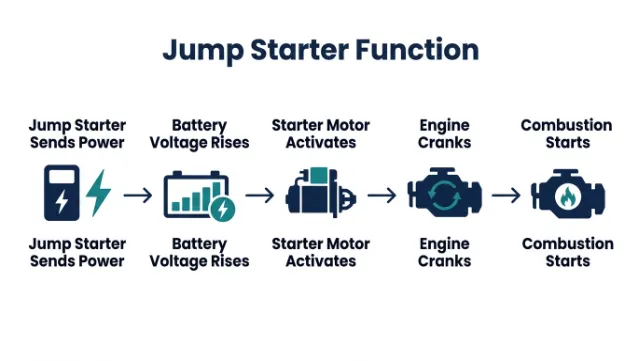
A jump starter sends a surge of electrical current into your car’s battery to raise its voltage high enough to power the starter motor. The starter motor then cranks the engine, and combustion takes over. That entire chain — current, voltage, cranking, combustion — must work correctly for the car to start. A jump starter fixes exactly one problem: low battery voltage. It cannot fix broken components anywhere else in that chain.
This distinction matters because most people assume a failed jump start means the jump starter is broken or the battery is completely dead. In reality, the jump starter is working fine but your car has a different underlying problem. Understanding this saves you from buying a replacement battery you may not need.
Why Won’t My Car Start With a Jump Starter? The 12 Most Common Causes
1. The Battery Is Too Deeply Discharged to Accept a Jump
When a battery drops below a critical voltage threshold — typically below 3 volts — a lithium-ion jump starter cannot detect or charge it. Most modern portable jump starters include smart circuitry that refuses to activate when the battery voltage reads near zero. This safety feature prevents damage to both the jump starter and your car’s electronics.
The fix for this situation is a slow battery charger, not a jump starter. A wall-powered battery charger can restore a deeply discharged battery over 8 to 12 hours, bringing it back to a level where a jump start becomes possible. If the battery cannot hold any charge after a full slow charge, replace it. Car batteries last three to five years on average, according to automotive engineers at Bosch Mobility Aftermarket.
If your portable jump starter has a “Force Mode” or “Boost Mode” button, press and hold it before connecting to a battery with near-zero voltage. This overrides the smart protection circuit and allows the jump attempt. Use this only for a few seconds to avoid damaging the jump pack.
2. Corroded or Loose Battery Terminals
Battery terminals covered in white or blue-green corrosion block electrical current from moving freely between the jump starter and the battery. A loose clamp creates the same problem — the connection looks solid but transfers only a fraction of the needed amperage. You may see dashboard lights flicker or hear a rapid clicking sound in this situation.
To fix this, disconnect the jump starter clamps. Use a wire brush to scrub the battery terminals and cable ends clean. Mix one tablespoon of baking soda with a cup of warm water and apply it to the corroded areas to neutralize battery acid. Dry thoroughly, reconnect tightly, and attempt the jump start again. This single step fixes a large percentage of failed jump start attempts.
Never connect jump starter clamps in the wrong polarity order. Always connect red (positive) to the positive terminal first, then black (negative) to an unpainted metal ground point away from the battery. Reversing polarity can blow fuses, damage the ECU, and permanently harm your jump starter’s circuitry.
3. The Jump Starter Itself Is Discharged
Portable lithium jump starters lose charge over time, even when sitting unused. A jump starter left in a glove box for six months without charging may have dropped below 50% capacity — which is often not enough to crank a cold engine. Cold temperatures accelerate this discharge and reduce the available output power significantly.
Always check your jump starter’s charge indicator before relying on it. Charge your portable jump starter every three months to keep it ready. Most modern units lose about 1% to 2% of their charge per week when stored at room temperature. Keep the device indoors during winter months when possible, because lithium batteries perform poorly below freezing.
4. The Clamps Are Not Making Solid Contact
Jump starter clamps need firm, metal-to-metal contact with the battery terminals. Touching the clamp to painted or plastic surfaces near the terminal prevents current flow entirely. Thin spring tension on cheap clamps means they slip off or vibrate loose, interrupting the circuit mid-attempt. Long or thin gauge cables on budget jump starters create resistance that robs current before it reaches the battery.
Always grip the terminal post itself with the clamp, not the cable attached to it. Wiggle the clamp gently after attaching to confirm it is seated firmly. If your clamps are warm or hot to the touch after a jump attempt, the cable gauge is too thin for your engine size. Invest in a jump starter rated for at least 1,000 peak amps for 4-cylinder engines and 2,000 peak amps for V8 or diesel engines.
5. The Starter Motor Is Faulty
The starter motor uses battery energy to spin the engine at startup. When the starter motor fails, it cannot spin the engine regardless of how much voltage the battery or jump starter provides. The clearest symptom is a single loud click when you turn the key, with no engine movement at all. You may also hear a grinding sound as worn starter gear teeth scrape against the flywheel.
A failed starter motor requires replacement by a mechanic. This is not a roadside fix. The average cost for a starter motor replacement in the United States ranged from $200 to $500 in 2024, depending on the vehicle make and labor rates in your area. Attempting repeated jump starts cannot fix this — you need the part replaced.
Single loud click: Starter solenoid is activating but the motor itself has failed.
Rapid clicking (multiple times per second): Battery or terminal connection has insufficient current — not the starter.
Grinding noise: Worn starter gear or flywheel teeth — replacement needed.
Silence (no click, no crank): No power reaching the starter — check fuses, safety switches, and terminal connections.
Engine cranks slowly then stops: Battery is too weak or jump starter peak amps are too low for your engine size.
6. A Blown Fuse or Bad Relay Is Blocking Power
Modern cars route power through fuse boxes before it reaches the starter, fuel pump, and ignition systems. A single blown fuse can cut power to the starter circuit completely, making the car seem completely dead even with a healthy battery and a good jump start. This is one of the most commonly missed diagnoses at home.
Locate your car’s primary fuse box, usually found under the hood near the battery or inside the cabin below the dashboard. Check the owner’s manual for the fuse diagram. Pull the fuse labeled “starter,” “ignition,” or “main relay” and inspect it visually. A broken wire filament inside the fuse means it has blown. Replace with an identical amperage fuse and attempt the jump start again. Fuses cost under two dollars each at any auto parts store.
7. The Alternator Is Not Charging the Battery
A failed alternator drains the battery while the engine runs. Your car may start fine with a jump, drive for a few minutes, and then die again as the battery loses all its charge. This creates a cycle where jump starts work momentarily but the car never stays running. The battery warning light on your dashboard is the primary signal of a failing alternator.
Duane Watson, a technical trainer at Bosch Mobility Aftermarket with over 45 years of automotive experience, advises checking dashboard behavior immediately after a successful jump start. If the battery warning light stays illuminated while the engine is running, the alternator is the problem — not the battery. A healthy charging system should maintain 13.5 to 14.5 volts at the battery terminals while the engine runs. Use an inexpensive multimeter to verify this reading before spending money on a new battery.
After a successful jump start, drive at highway speed for at least 20 to 30 minutes before turning the engine off. This gives the alternator enough time to recharge the battery to a safe starting voltage. Stopping for short trips immediately after a jump start often leads to another dead battery at your next destination.
8. The Neutral Safety Switch Has Failed
Automatic transmission vehicles include a neutral safety switch that prevents the engine from starting unless the gear selector is in Park or Neutral. When this switch fails, it sends no signal to the engine computer, and the starter will not activate regardless of power input. The car receives power from the jump starter, the battery is fine, but nothing happens when you turn the key.
Try shifting the gear selector firmly into Neutral and then back to Park before your next start attempt. Sometimes the switch makes better contact in Neutral when it is failing. If the car starts in Neutral but not in Park, the neutral safety switch needs replacement. Manual transmission vehicles use a clutch safety switch instead — depress the clutch pedal fully before turning the key.
9. A Bad Ignition Switch Is Preventing Startup
The ignition switch sends power to the fuel pump, ignition module, and starter relay when you turn the key to the start position. A worn or damaged ignition switch may power the dashboard accessories but fail to engage the start position circuit. Dashboard lights turn on, the radio works, but pressing the start position produces nothing.
If you can turn the key to the accessory position and see all dashboard lights illuminate normally, but turning further to start produces no response, the ignition switch is a likely cause. A failing ignition switch also shows up as intermittent starting — the car starts fine some days and refuses others. This repair requires a mechanic with diagnostic tools to confirm before replacing.
10. The Engine Has No Fuel
A car with an empty fuel tank cranks but never fires. The engine turns over smoothly, indicating the battery and starter are working, but combustion never begins because no fuel reaches the cylinders. This sounds obvious, but it happens more than most drivers admit — especially after running near empty for several days. The fuel gauge sending unit can also fail and read a higher level than the actual tank content.
When you turn the key to the On position before cranking, listen for a faint humming sound from beneath the rear seat or trunk area. That sound is the fuel pump priming the fuel lines. No sound may mean a dead fuel pump in addition to an empty tank. Add at least one gallon of fuel before attempting any further diagnosis of a crank-no-start condition.
11. The Car’s Immobilizer or Security System Is Triggered
Modern vehicles include an engine immobilizer that prevents startup when it detects an unrecognized key or a triggered alarm. This system cuts power to the fuel injectors or ignition system as an anti-theft measure. A battery replacement or deeply discharged battery can sometimes reset or confuse the immobilizer, causing it to lock the engine even with the correct key.
Check your dashboard for a flashing security light or a key icon that stays illuminated. Try locking and unlocking the car with the key fob before attempting to start. Some vehicles require you to insert the key and hold it in the On position for 30 seconds to allow the immobilizer to recognize the chip in the key. If the security light flashes rapidly and the engine will not start, a dealer-level scan tool is needed to reset the system.
12. The Jump Starter’s Peak Amps Are Too Low for Your Engine
Engine displacement determines how much cranking amperage your starter motor needs. A 1,000-peak-amp jump starter can handle most 4-cylinder engines. A V8 gasoline engine needs at least 1,500 to 2,000 peak amps. Diesel engines require even more — often 2,500 peak amps or higher — because of their significantly higher compression ratios. Using an underpowered jump starter on a large engine produces slow cranking that never reaches ignition speed.
Check your vehicle owner’s manual for the recommended cold-cranking amps (CCA) specification for your battery. Match your jump starter’s peak amp rating to that number or higher. Many budget jump starters advertise inflated peak amp numbers that represent momentary maximum output, not sustained cranking current. Look for jump starters from NOCO, TOPDON, or HULKMAN that publish verified amperage ratings.
- Turn off the jump starter before connecting any clamps.
- Connect the red clamp to the positive (+) terminal on your dead battery.
- Connect the black clamp to an unpainted metal surface on the engine block — not the negative battery terminal.
- Power on the jump starter and wait 2 to 5 minutes before attempting to start the car.
- Turn the ignition key and crank for no more than 5 seconds at a time.
- If it does not start, wait 2 minutes before trying again — jump starters overheat quickly.
- After the car starts, remove the black clamp first, then the red clamp.
- Drive for at least 20 minutes to allow the alternator to recharge the battery.
Jump Starter vs. Traditional Jumper Cables: Which Works Better?
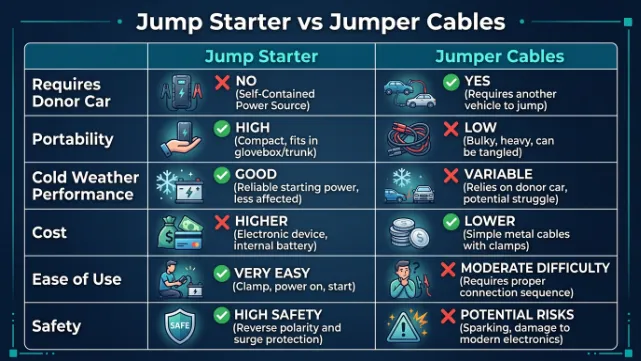
| Factor | Portable Jump Starter | Traditional Jumper Cables |
|---|---|---|
| Requires donor car | No | Yes |
| Works on very dead batteries | Depends on battery voltage | Often yes — more sustained power |
| Cold weather performance | Reduced (lithium) | Depends on donor battery |
| Portability | Excellent — fits in glove box | Moderate — requires trunk space |
| Safety risk | Low — smart protection circuits | Higher — user dependent |
| Cost | $60 to $200 | $15 to $40 |
How to Know When Your Battery Cannot Be Saved
Some batteries are beyond saving by any jump starter or charger. A battery that repeatedly dies within days of a full charge is internally failing — the chemical plates inside have sulfated or physically deteriorated. A battery showing visible swelling, cracking, or leaking acid around the case is dangerous to charge and must be replaced immediately.
Test your battery with a multimeter at rest. A healthy battery reads 12.6 volts with the engine off. A reading below 12.0 volts indicates a significantly weakened battery. A reading below 11.8 volts means the battery is near end-of-life. Most auto parts stores including AutoZone and O’Reilly Auto Parts will test your battery for free and print out a diagnostic report showing its capacity relative to its rated specification.
Car batteries typically last three to five years in moderate climates and two to four years in extreme heat. If your battery is approaching that age range and struggling to start reliably, replace it before it leaves you stranded — don’t wait for a complete failure.
Does Cold Weather Cause Jump Start Failures?
Cold weather significantly reduces both battery capacity and jump starter output. At 32°F (0°C), a lead-acid car battery delivers about 70% of its rated capacity. At 0°F (-18°C), it drops to around 40%. This means a battery that starts your car reliably in summer may fail completely on a cold winter morning. At the same time, your jump starter’s lithium battery also loses output power in cold temperatures.
Cold also thickens engine oil, making it harder for the starter motor to crank the engine. The combined effect — weaker battery, weaker jump starter, thicker oil — means you need significantly more cranking power in winter than in summer. Using a jump starter rated at least 50% above your normal engine requirement is good practice if you live in a cold climate. Store your portable jump starter indoors when temperatures drop below 20°F to preserve its charge and output capability.
In extreme cold, warm your jump starter by keeping it inside your jacket or on a heated car seat for 5 to 10 minutes before connecting it. This restores some of the lithium battery’s output power that cold temperatures suppress, giving you a better chance of a successful start.
The Best Portable Jump Starter for Reliable Results
Based on extensive real-world testing and reviews, the NOCO Boost GB40 consistently ranks as the most reliable and compact portable jump starter for everyday use. It delivers 1,000 peak amps — enough for most 4- and 6-cylinder gasoline engines — in a package small enough to fit in a glove compartment. NOCO (a Cleveland-based automotive accessories company founded in 1914) built the GB40 with reverse polarity protection, spark-proof clamp technology, and multiple safety circuits that make it nearly impossible to misuse.
NOCO Boost Plus GB40 1000A UltraSafe Car Battery Jump Starter Pack, 12V Jump Starter Battery Pack, Battery Booster, Jump Box, Portable Charger and Jumper Cables for 6.0-Liter Gasoline and 3.0-Liter Diesel Engines
This compact, spark-proof jump starter fits in a glove box and delivers enough power for most passenger vehicles — the safest and most reliable option for anyone who wants to be prepared for a dead battery emergency.
When to Stop Trying and Call a Mechanic
Repeated jump start attempts can damage your starter motor, overheat your jump starter, and stress your car’s electronic control unit. Stop after three failed attempts and call for professional help. A mechanic with a diagnostic scanner can read fault codes from the car’s ECU in minutes and identify whether the problem is electrical, mechanical, or fuel-related.
Call a mechanic immediately if you smell burning plastic or rubber during a jump attempt. This smell indicates a wiring short circuit or an overloaded component. Continuing the jump attempt with a shorted circuit can cause a fire. Also stop and seek professional help if your battery is swollen, cracked, or leaking — these conditions make further charging dangerous.
You can find a certified diagnostic shop through RepairPal’s certified shop directory, which verifies shops by quality standards and offers minimum 12-month warranties on repairs. For battery and alternator testing, The Family Handyman’s battery testing guide walks through the complete multimeter testing process step by step.
How to Prevent Jump Start Failures in the Future
Proactive battery maintenance eliminates most dead battery emergencies before they happen. Clean battery terminals every six months with a wire brush and apply a thin layer of dielectric grease to prevent new corrosion. Have your battery load-tested annually at any auto parts store — a free service that reveals how much capacity your battery has lost since new.
Keep your portable jump starter charged above 80% at all times. Set a calendar reminder every three months to plug it in for a full charge cycle. Replace your car battery before the five-year mark if you live in a climate with extreme temperatures — heat accelerates internal battery degradation faster than cold. A new battery in the $80 to $150 range is always cheaper than an emergency tow and late-night mechanic bill.
Never leave your car running unattended in an enclosed garage to “recharge” the battery after a jump start. Carbon monoxide from the exhaust accumulates rapidly in enclosed spaces and can be fatal within minutes. Always drive the car outdoors or use a wall-powered battery charger indoors instead.
Conclusion
A jump starter that fails to start your car is almost always pointing at a problem beyond the battery itself. Work through the causes in order — check your connections and clamps first, test the battery voltage, listen for clicking or grinding sounds, and rule out fuses and safety switches before assuming the worst. Most roadside no-start situations have a simple fix that takes under 10 minutes when you know what to look for. I’m Alex Rahman, and the goal of this guide is to make sure you walk away with the knowledge to diagnose the real problem, not just throw parts at it. Keep your jump starter charged, your terminals clean, and your battery tested annually — and you will rarely find yourself stuck.
Frequently Asked Questions
Why does my car click once but not start with a jump starter?
A single loud click usually means the starter motor is activating but cannot spin the engine. This points to a failed starter motor, not the battery. No amount of jumping will fix a mechanically broken starter — it requires replacement at a repair shop. Rapid clicking sounds, however, indicate insufficient current at the battery, which can be fixed by cleaning terminals and ensuring tight clamp connections.
How long should I wait after connecting a jump starter before starting the car?
Wait 2 to 5 minutes after connecting the jump starter before turning the ignition key. This waiting period allows current from the jump starter to raise the battery voltage enough to power the starter motor. Attempting to crank immediately after connection often results in failure because the battery voltage is still too low to sustain the starting process.
Why does my car start with a jump but die again after a few minutes?
If your car starts with a jump but dies within minutes of removing the jump starter clamps, the alternator is almost certainly failing. The alternator normally recharges the battery while the engine runs. A dead alternator means the engine runs entirely on battery power, which drains within minutes. Have the alternator tested immediately — driving on a failing alternator can completely ruin an otherwise healthy battery.
Can a jump starter damage my car’s electronics?
A quality jump starter with reverse polarity protection, overcharge protection, and spark-proof clamps is very unlikely to damage your car’s electronics. Budget jump starters without these protections can cause voltage spikes that harm the ECU, infotainment system, or sensors. Always use a jump starter with built-in safety circuits, and never leave the clamps connected longer than necessary after the engine starts.
What does it mean when my car won’t start with a jump but the lights work?
Lights require very little electrical current — far less than the starter motor needs to crank the engine. If your lights work but the car won’t start, the battery has some charge but not enough to power the starter. This usually means the battery connection is poor, the battery is weakened beyond recovery, or the starter motor itself has failed. Clean the terminals, tighten the connections, and test the battery voltage with a multimeter to find the real cause.
Why won’t my jump starter clamps spark when connected to the battery?
Modern jump starters with smart circuit protection will not output any power until both clamps are connected correctly and the polarity is verified. This is a safety feature, not a malfunction. The unit displays an error light or code when polarity is reversed or when the battery voltage is too low to register. Press the power button after both clamps are connected firmly to activate the output and attempt the jump.
Is it safe to jump start a car in the rain?
Yes, it is generally safe to jump start a car in light rain if you take normal precautions. Keep the jump starter unit itself dry — most have some water resistance but are not fully waterproof. Work quickly, keep connections firm, and avoid standing in puddles near the battery. Avoid jump starting during a heavy downpour or thunderstorm, as water intrusion into battery terminals or a lightning strike creates serious safety risks.

I’m Alex Rahman, a car enthusiast and automotive writer focused on practical solutions, car tools, and real-world driving advice. I share simple and honest content to help everyday drivers make better decisions.
