Can a Jump Starter Start a Car Multiple Times? (The Complete Answer)
Yes, a jump starter can start a car multiple times on a single charge. Most quality lithium jump starters deliver 4 to 20 jumps per charge, depending on battery capacity, engine size, and temperature. Lead-acid jump packs can do even more. Recharge your jump starter after every use to keep it ready for the next emergency.
You’re stranded. Your battery is dead. You grab your jump starter — but then the worry kicks in. Will it work twice if the first start doesn’t hold? I’m Alex Rahman, and I’ve tested more jump starters than I can count. This is the question I hear most from car owners, and the answer might surprise you.
The short answer: yes, most jump starters handle multiple starts per charge. But the real number depends on a few key factors. Let’s break this down so you know exactly what to expect from your device.
- Most lithium jump starters handle 4 to 20 starts per charge under ideal conditions.
- Engine size, battery health, and cold weather all reduce how many jumps you get.
- Lead-acid jump packs can deliver more attempts but are heavier and bulkier.
- Always recharge your jump starter after use — don’t assume it’s still full.
- A jump starter is not a battery charger — it starts the car but won’t fix a dead battery long-term.
How Many Times Can a Jump Starter Start a Car on One Charge?
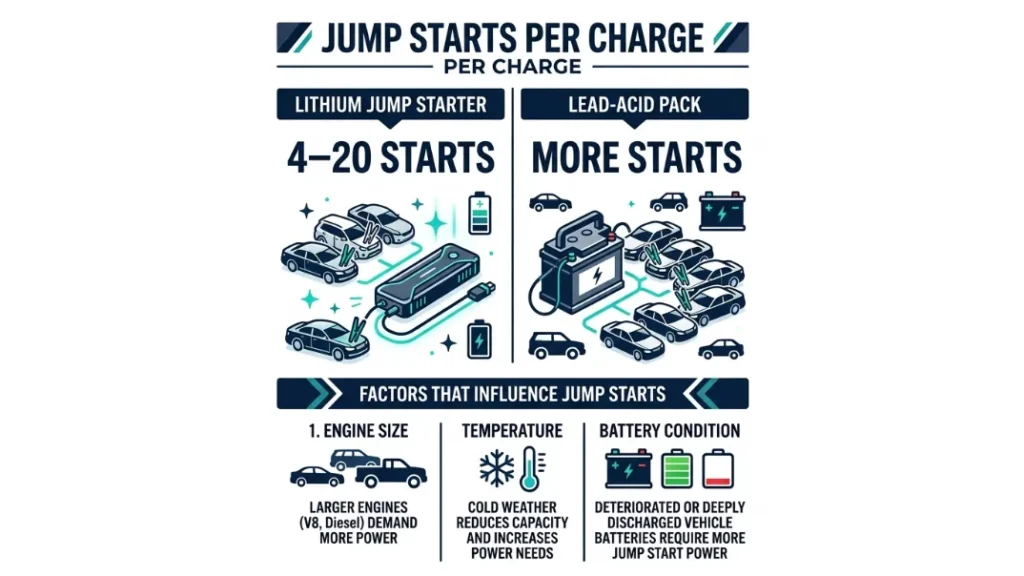
The honest answer is: it depends. But here’s a useful baseline. Most lithium-ion jump starters deliver between 4 and 20 jump starts per full charge under typical conditions. Real-world testing by Weego confirmed at least four maximum-current starts per charge. NOCO rates their 1,000-amp GB40 model at up to 20 attempts under ideal settings.
Lead-acid booster packs — the older, heavier kind — often exceed that count. One real-world report had a mid-range lithium unit starting a V8 truck five times with the charge indicator still reading full. Those results depend heavily on the variables below.
What Factors Affect How Many Times a Jump Starter Works?
Several variables decide how many starts you get. Some are in your control. Some aren’t. Knowing all of them helps you plan better.
Battery Capacity of the Jump Starter
Bigger internal battery equals more jumps. A typical lithium jump starter carries 15,000 to 20,000 mAh of stored energy. A compact 1,000-amp unit might give you 4 to 6 good starts. A 2,000-amp unit can push 10 to 20 starts before needing a recharge. Check the capacity in mAh or Wh on the product spec sheet.
Engine Size and Type
A 1.5L four-cylinder drinks far less power than a 5.7L V8. Larger engines need more cranking current — often 400 to 600 amps — and that burns through your jump pack’s reserve faster. Diesel engines need even more. If you drive a big truck or diesel SUV, always choose a higher-capacity jump starter.
How Dead Is the Car Battery?
A mildly discharged battery takes much less effort to jump than a completely flat one. When a battery is near-dead, the jump starter carries more of the load during cranking. That eats more capacity per attempt. A battery that’s just slightly low might start on the first try and barely dent your jump pack’s charge.
Outside Temperature
Cold weather is brutal on jump starters. At low temperatures, your car needs more current to start, and the jump pack’s lithium cells lose output efficiency too. Most lithium units struggle below 15°F (-9°C). Lead-acid packs handle cold better but are larger and heavier.
How Long You Leave It Connected Before Cranking
A jump starter feeds power to the car battery the whole time it’s connected. The longer it sits before you attempt the start, the more capacity drains away. Connect it, wait 30 seconds, then attempt the start. Don’t leave it hooked up for 10 minutes.
If your car doesn’t start after 3 to 5 attempts, stop. Repeated cranking overheats both the starter motor and your jump pack. Wait 3 to 5 minutes between attempts. Most modern jump starters enter a recovery mode automatically to protect their circuits from heat damage.
Lithium vs. Lead-Acid Jump Starters: Which Handles More Starts?
Both types work, but they behave very differently when it comes to repeated use.
| Feature | Lithium-Ion | Lead-Acid |
|---|---|---|
| Size and Weight | Compact, palm-sized | Heavy, tote-bag sized |
| Starts Per Charge | 4 to 20 (ideal conditions) | More starts, longer cranking power |
| Cold Weather Use | Struggles below 15°F | Better in freezing temps |
| Shelf Life | Up to 12 months (quality models) | 3 to 6 months before self-discharge |
| Completely Dead Battery | Sometimes struggles | Handles it better |
| Price Range | $50 to $200+ | $80 to $300+ |
For most everyday drivers, a lithium jump starter is the better choice. It’s smaller, lighter, and holds a charge far longer in storage. For fleet vehicles, diesel trucks, or extreme cold climates, a lead-acid pack earns its bulk.
How to Get the Most Jump Starts Out of One Charge
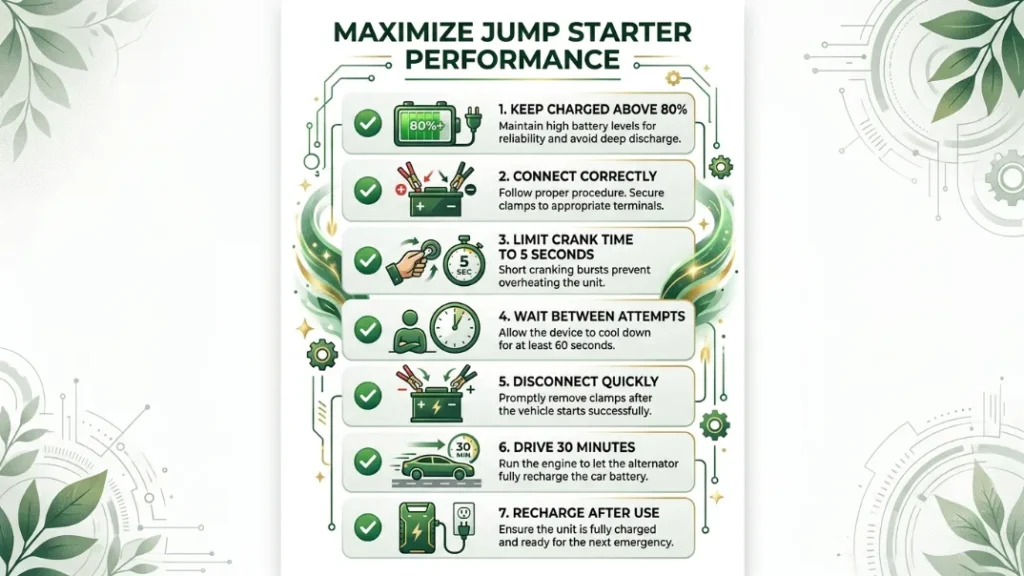
You can stretch your jump starter’s capacity with a few smart habits. None of these are complicated. They’re just things most people skip.
- Keep your jump starter charged above 80% at all times. Check it monthly.
- Connect clamps correctly — red to positive, black to negative — then wait 30 seconds.
- Attempt to start for no more than 5 seconds. If it doesn’t catch, stop.
- Wait 3 minutes between attempts to let the jump starter recover heat.
- Disconnect immediately once the engine starts. Don’t leave it connected.
- Drive for at least 30 minutes so the alternator recharges the car battery.
- Recharge your jump starter fully when you get home.
Can a Jump Starter Work on a Completely Dead Battery?
Here’s where it gets interesting. A fully dead car battery — one that won’t hold any charge — can actually block a lithium jump starter’s connection to the starter motor. That dead battery acts like a wall between your pack and the engine.
Many modern lithium jump starters include a “boost mode” that pushes a small charge into the dead battery first, warming it up before the main start attempt. NOCO’s UltraSafe series and HULKMAN’s Alpha line both include this feature. If your unit has a boost or pre-charge button, use it and wait 5 full minutes before cranking. It dramatically improves success rates on fully depleted batteries.
Press the boost or pre-charge button first and wait 5 minutes before attempting to start. This pre-charges the dead battery enough for the starter motor to fully engage. This one step can be the difference between success and a second roadside call.
Does a Jump Starter Recharge the Car Battery?
No — and this trips up a lot of people. A jump starter is not a battery charger. It delivers a massive short burst of current to crank the engine. Once the engine starts, the alternator takes over.
Your alternator begins recharging the battery as soon as the engine runs. Drive for at least 30 minutes after a jump start to give the alternator time to restore meaningful charge. Turning the car off right after jumping it will drain the battery again fast.
A typical jump starter carries 15,000 to 20,000 mAh. A standard car battery holds 50,000 to 100,000 mAh. The math alone tells you a jump starter can’t refill a car battery. What it does have is burst power strong enough to crank the starter motor into action.
If you need multiple jump starts in a short period, that’s a symptom — not bad luck. Your car battery likely needs testing or replacement. A battery older than 4 to 6 years and requiring repeated jumps is past its useful life. Most auto parts stores test batteries free of charge.
How Long Does a Jump Starter Hold Its Charge in Storage?
This is one of the most overlooked questions. You buy a jump starter, toss it in your trunk, and forget about it for a year. Will it work when you need it?
Quality lithium jump starters hold their charge for up to 12 months in storage. Budget models lose charge faster. Lead-acid booster packs self-discharge significantly in 3 to 6 months. Check your jump starter’s charge level every 3 months and top it off if needed.
Store it in a cool, dry location — not a hot trunk in summer. Heat kills lithium batteries faster than nearly anything else. Freezing temperatures also reduce capacity over time.
Set a calendar reminder every 3 months to check and top off your jump starter. A 2-minute charge check every quarter means it’ll always be ready when you actually need it.
What Size Jump Starter Do You Actually Need?
Matching jump starter power to your vehicle is critical. Here’s a quick reference.
| Vehicle Type | Recommended Peak Amps | Example Models |
|---|---|---|
| Small car, 4-cylinder gas | 400 to 800 amps | NOCO GB20, GB40 |
| Midsize car or V6 | 1,000 to 1,500 amps | NOCO GB40, HULKMAN Alpha65 |
| V8 truck or large SUV | 1,500 to 2,000 amps | NOCO GB70, HULKMAN Alpha85 |
| Diesel engine | 2,000+ amps | NOCO GB150, GOOLOO GP4000 |
Undersizing is the most common mistake people make. If you’re on the edge between two sizes, always go bigger. You’ll get more starts per charge, better cold-weather performance, and the unit won’t strain as hard each time.
A quality jump starter delivers 4 to 20 starts per charge depending on capacity and engine size. Always recharge after use. Use boost mode for fully dead batteries. Drive 30 minutes after jumping so the alternator recovers the battery. Repeated jump starts on the same car mean the battery needs replacing, not more jumps.
NOCO Boost Plus GB40 1000A UltraSafe Car Battery Jump Starter, 12V Jump Starter Battery Pack, Battery Booster, Jump Box, Portable Charger and Jumper Cables for 6.0-Liter Gasoline and 3.0-Liter Diesel Engines
The NOCO GB40 is one of the most trusted lithium jump starters available — compact enough for a glove box, powerful enough for most gas engines up to 6.0L, and rated for up to 20 jump attempts per charge.
Common Jump Starter Mistakes That Waste Charges
Getting fewer starts than expected? One of these is likely why.
- Leaving it connected too long before cranking. Every minute it’s hooked up before you turn the key drains stored energy. Connect, wait 30 seconds, then start.
- Storing it in a hot car trunk. Summer heat above 100°F degrades lithium cells fast. Keep it indoors or in a cool shaded spot.
- Not recharging after use. One start can drop a jump starter 20 to 30%. Don’t assume it’s still full next time.
- Ignoring the charge indicator. Most quality units have LED charge indicators. Check monthly — not just when you need it.
- Cranking too long per attempt. Five seconds max per try. Long cranks drain your pack and overheat the starter motor.
Is It Safe to Jump Start the Same Car Multiple Times?
Yes — but only up to a point. Using a jump starter on the same vehicle two or three times in a day is fine. Doing it daily for a week signals a deeper problem. Frequent jump starts mean the battery can’t hold a charge. That points to a dying battery, a faulty alternator, or a parasitic drain.
Get the battery tested if you’ve needed more than three jumps in a month. AutoZone, O’Reilly Auto Parts, and most battery shops test for free. A replacement 12V battery typically costs $80 to $200 — far cheaper than repeated roadside calls.
For more on battery health and charging systems, Car and Driver’s battery guide and the SAE J537 battery standard are well-respected references used by automotive engineers.
If you smell rotten eggs near the battery, see the case bulging, or notice acid leaks — do not attempt to jump start the vehicle. These are signs of a dangerous battery failure. Call a professional immediately.
Frequently Asked Questions
Can a jump starter start a car multiple times without recharging?
Yes. Most quality lithium jump starters provide 4 to 20 starts per charge under normal conditions. The actual number depends on engine size, battery condition, and temperature. Larger capacity units deliver more starts before needing a recharge.
How long does a jump starter stay charged when not in use?
Quality lithium jump starters hold their charge for up to 12 months in storage. Lead-acid booster packs self-discharge faster, typically within 3 to 6 months. Check and top off your unit every 3 months to keep it reliable.
Why won’t my jump starter start my car even though it’s charged?
The most common reason is a completely dead battery blocking the connection. Use the boost or pre-charge mode if your unit has one, and wait 5 minutes before cranking. If the car still won’t start, the battery may need replacement or the starter motor could be faulty.
Does a jump starter charge the car battery?
No. A jump starter delivers a quick burst of power to start the engine — it doesn’t recharge the battery. After jumping, drive for at least 30 minutes so the alternator can restore the battery’s charge.
How many amps do I need to jump start my car?
Most small to midsize gas engines need 400 to 800 peak amps. V8 and large engines require 1,500 to 2,000 amps. Diesel engines often need 2,000 amps or more. Always match your jump starter’s peak amp rating to your engine size.
Can cold weather prevent a jump starter from working?
Yes. Most lithium jump starters lose efficiency below 15°F (-9°C) and may fail in extreme cold. Lead-acid packs perform better in freezing temps. Warming your lithium jump starter indoors for 10 to 15 minutes before use helps in very cold conditions.
How do I know when to replace my jump starter?
Replace your jump starter if it can’t hold a charge for more than a few weeks, consistently fails to start your car, or shows physical damage like swelling or a cracked case. Most lithium jump starters last 3 to 5 years with proper care and storage.
A good jump starter handles multiple starts per charge with no problem. Keep it charged, match it to your engine, and treat it right. Hope this clears everything up — and if you want more guides on battery maintenance and roadside preparedness, check out Leadfoot Automotive. — Alex Rahman

I’m Alex Rahman, a car enthusiast and automotive writer focused on practical solutions, car tools, and real-world driving advice. I share simple and honest content to help everyday drivers make better decisions.
