Why Does My Jump Starter Keep Beeping? Every Cause Explained and Fixed
Quick Answer: A jump starter beeps to alert you to a problem — most commonly low charge, reverse polarity (wrong clamp connection), a bad connection, overheating, or a completely dead vehicle battery it cannot detect. The fix depends on which cause triggered the alarm. In most cases, charging the unit fully or reconnecting the clamps correctly stops the beeping within seconds.
I know the feeling. You’re standing in a parking lot, clamps attached, and instead of a successful jump start — your jump starter just beeps at you. It feels like the one tool you need is now broken too. I’m Alex Rahman, and after testing and troubleshooting portable power devices for years, I can tell you this: that beeping is not random. Your jump starter is trying to tell you something specific, and once you understand what, the fix is almost always simple.
Modern jump starters from brands like NOCO, Everstart, Duralast, and Schumacher Electric all have internal protection circuits — known as a Battery Management System (BMS) — that actively monitors what is happening. When something is off, the BMS triggers an alarm. The beep is the alarm. Let’s decode every possible reason and get you back on the road.
- The most common cause of beeping is a low or depleted internal battery — charge the unit fully before using it.
- Reverse polarity (wrong clamp connection) triggers an immediate safety alarm on virtually every modern jump starter.
- A completely dead vehicle battery below 2 volts may cause continuous beeping because the jump starter cannot detect it.
- Overheating, overload, and poor clamp connections are three other frequent triggers — each has a fast fix.
- Never force a jump start while the unit is beeping — it signals an active protection mode that is keeping both you and your vehicle safe.
What Does It Mean When a Jump Starter Beeps?
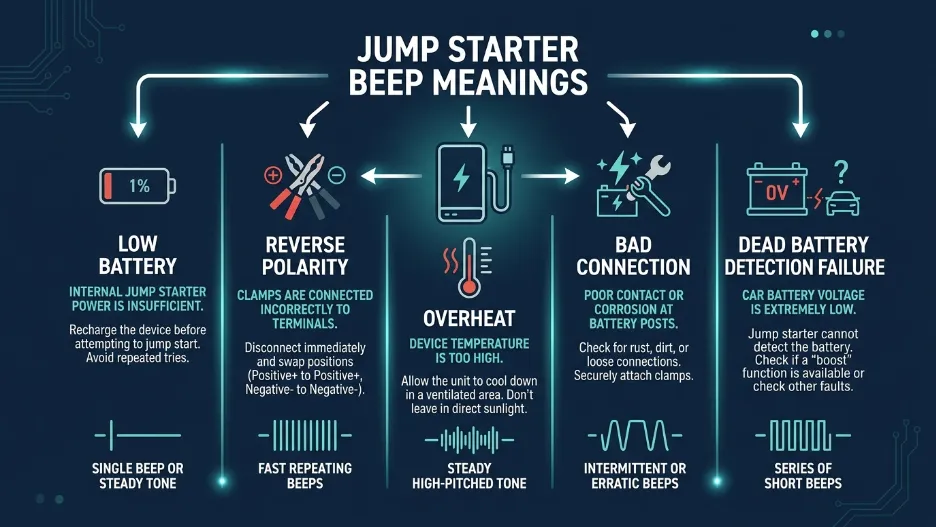
The short answer is this: every beep is a diagnostic signal, not a random malfunction. Jump starters contain a Battery Management System — a small internal circuit board that monitors voltage, temperature, current flow, and connection polarity in real time. When any of those readings fall outside safe limits, the BMS activates an audible alarm.
Think of the beep the same way you would a warning light on your car dashboard. It does not mean the device is broken. It means the device has detected a condition it cannot safely ignore. The specific beep pattern — continuous, intermittent, or a set number of pulses — often tells you which condition triggered it. Your user manual will show the exact pattern for your model, but the underlying causes are consistent across almost every brand.
Before doing anything else, check your jump starter’s charge level indicator. If only one LED bar is showing, a low internal battery is almost certainly the cause of the beeping — plug it in for a full charge before troubleshooting further.
The 6 Most Common Reasons Your Jump Starter Keeps Beeping
Each cause below comes with a direct fix. Work through them in order — the first two resolve the issue about 80% of the time.
1. The Jump Starter’s Own Battery Is Too Low
This is the number-one cause. A jump starter is itself powered by an internal lithium-ion battery. If that battery has been sitting discharged for weeks or months, its voltage drops below the threshold needed for safe operation. The unit detects this and beeps to warn you before it can do any damage.
Most units need to be at three or four LED bars — ideally 100% charged — before they can deliver enough current to start a car engine. Attempting a jump with less than two bars of charge strains the internal battery and can permanently reduce its capacity.
- Disconnect the clamps from the vehicle battery immediately.
- Turn the jump starter OFF completely.
- Plug the unit into a wall outlet using the supplied AC adapter — not a car USB port.
- Charge uninterrupted until all LED charge indicators are solid (typically 3–8 hours depending on the model).
- Once fully charged, reattempt the jump start.
One thing that surprises people: brand-new units or units that have been in storage often need a full initial charge before they will perform reliably. If your Everstart or Duralast jump starter started beeping the first time you ever used it, this is almost certainly why.
2. Reverse Polarity — The Clamps Are Connected Backward
This is the second most common trigger, and it happens more often than people admit. Reverse polarity occurs when you connect the red (positive) clamp to the negative battery terminal, or the black (negative) clamp to the positive terminal. Every reputable jump starter on the market — including NOCO Boost models, Schumacher Electric units, and Duralast packs — will immediately trigger a loud beeping alarm and refuse to deliver power when it detects this.
This is a safety feature, not a flaw. Forcing current in the wrong direction would instantly damage your vehicle’s electronics, and potentially cause a battery explosion. The jump starter is protecting you.
- Power OFF the jump starter immediately — do not attempt to start the car.
- Remove the black clamp first, then the red clamp.
- Locate the positive (+) and negative (−) terminals on the vehicle battery — look for the stamped symbols or colored covers.
- Reconnect red clamp to positive (+), black clamp to a chassis ground point (not directly to the negative terminal if possible).
- Power ON the jump starter — the red error light should clear and the boost light should come on.
Never try to override or force the unit to deliver power when the reverse polarity alarm is active. On NOCO Boost units, manual override mode disables both spark-proof and reverse polarity protection simultaneously — using it with backward connections can cause immediate, non-warranty damage to your vehicle’s electronics.
3. The Vehicle Battery Is Completely Dead (Below 2 Volts)
Modern jump starters with built-in safety circuits need to detect a minimum voltage at the battery terminals before they will activate. On most lithium-ion jump starters, that threshold is around 2 volts. If your vehicle battery is completely discharged — often the case after the car has sat unused for months — the jump starter cannot detect it, and it beeps to indicate the fault.
This is not the same as the jump starter being broken. The protection circuit is working as designed. NOCO Boost models, for example, will show a red error LED and refuse to boost until you either partially charge the dead battery first or use the Manual Override mode (which disables safety protections — use with extreme caution).
A good diagnostic step here: connect a voltmeter to your vehicle battery terminals. If you read less than 2 volts, the battery may be too far gone to jump start at all and may need replacement. For batteries between 2–6 volts, connecting the jump starter for 2–5 minutes before pressing boost can allow enough charge to transfer for the circuit to recognize the battery and stop beeping.
4. Poor Clamp Connection or Corroded Battery Terminals
A loose or corroded connection can mimic a dead battery to the jump starter’s detection circuit. When the clamps are not making solid metal-to-metal contact, the voltage reading at the terminals fluctuates. The BMS interprets this as a fault and beeps continuously.
Corrosion on battery terminals — the white, greenish, or bluish crust you sometimes see — acts as a resistor. It blocks current flow and creates a poor connection even when the clamp looks secure. This is especially common on Everstart heavy-duty models that have been stored for extended periods.
- Disconnect the jump starter and power it off.
- Mix one tablespoon of baking soda in a cup of warm water.
- Apply the solution to corroded terminals using an old toothbrush and scrub until the crust lifts.
- Wipe dry with a clean cloth and let the terminals air dry for one minute.
- Reconnect clamps firmly — press them down until you feel the spring close fully on the terminal post.
- Power on the jump starter and check if the beeping has stopped.
After cleaning, apply a thin layer of dielectric grease to each battery terminal post before reconnecting the clamps. This prevents future corrosion and keeps connections solid — a 5-minute step that saves a lot of frustration.
5. Overheating — The Thermal Protection Circuit Is Active
Lithium-ion cells — the same chemistry used in all modern portable jump starters — are sensitive to temperature extremes. When the internal temperature of the unit rises above its safe operating limit (typically around 60°C / 140°F), the BMS activates thermal protection mode and stops power delivery. The unit beeps to signal this condition.
Overheating usually happens after multiple jump start attempts in quick succession, after storing the unit in a hot car trunk on a summer day, or after leaving it in direct sunlight. It is not a permanent failure — it is a temporary protection mode.
The fix is simple: disconnect the unit, move it to a shaded or air-conditioned area, and wait 20–30 minutes before trying again. Do not attempt to force a jump start while the thermal protection alarm is active. Some units — including certain Duralast models — will not respond to the boost button at all until the internal temperature drops to a safe level.
6. Overload — Too Much Current Being Drawn
If the vehicle’s electrical load is too high for what the jump starter can safely deliver — for example, if you have the headlights, AC, and radio all drawing power while you attempt a jump — the overcurrent protection circuit triggers. This causes beeping and an automatic shutoff to protect both the jump starter’s internal battery and the vehicle’s electronics.
The fix is straightforward: turn off all vehicle accessories before attempting the jump start. Make sure the ignition is in the off position. Connect the clamps, wait 30 seconds for the jump starter’s BMS to analyze the battery, then try starting the engine. Never attempt to jump a vehicle with all its power loads running simultaneously.
Low internal battery → Charge unit fully before use.
Reverse polarity → Disconnect and reconnect clamps correctly (red to +, black to ground).
Vehicle battery below 2V → Attempt a trickle charge first, or test battery health.
Corroded / loose clamps → Clean terminals, reseat clamps firmly.
Overheating → Cool the unit in shade for 20–30 minutes.
Overload → Turn off all vehicle accessories before jumping.
Jump Starter Beep Pattern Decoder: What Each Pattern Means
Most people hear beeping and assume it all means the same thing. It does not. Manufacturers encode different fault types into distinct audio patterns. Here is a general reference — always check your specific model’s manual for exact codes.
| Beep Pattern | Most Likely Cause | Immediate Action |
|---|---|---|
| Continuous rapid beeping on connection | Reverse polarity | Power off, swap clamps |
| Single beep every few seconds | Low internal battery | Charge unit fully |
| Beeping while connected but not boosting | Vehicle battery too dead to detect (<2V) | Pre-charge battery or use manual override |
| Intermittent chirping during boost | Poor clamp connection or corrosion | Clean terminals, reseat clamps |
| Beeping after several start attempts | Overheating / thermal protection | Disconnect and cool for 20–30 min |
| Multiple beeps then shutdown | Overload / too high current draw | Turn off all vehicle accessories |
Brand-Specific Beeping: NOCO, Everstart, Duralast, and Schumacher
Different brands implement their BMS alarm systems differently. Here is what you need to know for the most common models.
NOCO Boost (GB40, GB70, GBX45, GB251)
NOCO’s UltraSafe series uses a combination of LED indicators and audio tones. A solid red Error LED paired with beeping almost always means reverse polarity or an overtemperature condition. A blinking red LED with clamps connected correctly typically indicates the internal battery is too hot — bring the unit indoors and allow it to cool. On the GB251 (Boost Max), the error LED blinks in sequences of 1–6 to indicate specific fault codes, from short circuit detection to charge timeout errors.
NOCO’s Manual Override mode — available on all Genius Boost models — lets you force the boost function on batteries below 2 volts. To activate it, hold the Manual Override button for 3 seconds until the white Boost LED flashes. Be aware: this disables both spark-proof and reverse polarity protection simultaneously. Use it only when you are certain the clamps are correctly connected.
Everstart (Walmart)
Everstart jump starters frequently report persistent beeping during charging when the internal battery is heavily sulfated or the clamp connection to the unit’s internal battery has corroded. If an Everstart model beeps while plugged in and refuses to charge, inspect the negative battery lead inside the unit for corrosion — this is a known issue on older Everstart Maxx models. If the case is swollen, smells of rotten eggs, or shows any leaking, treat it as a failed unit and do not continue using it.
Duralast (AutoZone)
Duralast’s SmartSense system on their DL-2000 and Elite models uses a 10-second analysis period when first connected — during this window, single beeps are normal and indicate the system is reading the vehicle battery’s health. If beeping continues beyond 10 seconds, it has confirmed an unsafe condition. Duralast also supports a hard reset: power off completely, hold the power button for 10 seconds until all LEDs flash once, then release. This clears the Nuvoton microcontroller’s fault latches and resolves roughly 40% of persistent beeping cases without any hardware changes.
Schumacher Electric
Schumacher jump starters are designed to beep immediately if the clamps are connected backward before the power switch is turned on. This is a pre-connection polarity check — unique to the brand. The unit also beeps under overload conditions when you are drawing more current than it can safely supply. If you hear beeping from a Schumacher unit during connection before you have even powered it on, reverse the clamp connections.
The single most important rule with any beeping jump starter: power it off before you do anything else. Every troubleshooting step starts from a powered-off state. Attempting to investigate connections while the unit is active and beeping risks a short circuit or sparking event.
NOCO Boost Plus GB40 1000A UltraSafe Lithium Jump Starter – 12V Lithium Battery Booster Pack, Portable Jump Box, Power Bank & Jumper Cables – for 6.0L Gas and 3.0L Diesel Engines
If your current jump starter keeps beeping, upgrading to the GB40 gives you a unit with clear LED diagnostics, built-in reverse polarity protection, spark-proof technology, and a reliable charge-level display — so you always know the unit is ready before you need it.
Why Is My Jump Starter Beeping While Charging?
Beeping during charging is different from beeping during a jump start attempt, and it has its own set of causes.
The most common reason a jump starter beeps while plugged in is that the internal battery has dropped so low that the BMS cannot safely accept a charge at the normal rate. This triggers a fault alarm to warn you that the battery needs attention. On most units, leaving it plugged in for 30 minutes will allow enough recovery charge for the alarm to clear and normal charging to resume.
A second cause is a faulty AC adapter or damaged charging cable. If the adapter is delivering inconsistent voltage, the BMS interprets it as an anomaly and alarms. Try a different wall outlet or the original adapter that came with the unit.
A third and more serious cause is internal battery degradation. If the jump starter beeps every time it is plugged in and never successfully charges past one LED bar despite multiple attempts, the internal lithium-ion cells have likely failed. At this point, either a professional battery replacement (typically under $50 for compatible cells) or a full unit replacement is the right path forward.
If your jump starter smells of burning plastic, has a swollen or bulging case, or leaks any fluid, stop using it immediately. Place it on a non-flammable surface away from enclosed spaces. These are signs of a failing lithium-ion cell — a fire risk. Contact the manufacturer for warranty or disposal guidance.
How to Prevent Your Jump Starter From Beeping in the Future
Most beeping incidents are preventable with a simple monthly maintenance routine. Here is what I follow personally to keep my jump starter ready at all times.
Charge It Every 30 Days
Lithium-ion batteries self-discharge over time. Leaving a jump starter uncharged for more than 4–6 weeks can drop the internal voltage below safe thresholds. Top the unit up to 60–80% every month — even if you have not used it. This prevents deep discharge events that cause beeping and permanently reduce capacity.
Store It in a Temperature-Controlled Environment
Storing a jump starter in a hot car trunk — where summer temperatures can exceed 140°F / 60°C — will reduce lithium-ion cell capacity by up to 35% in as little as 30 days. Store the unit indoors in a cool, dry location. Extreme cold (below -4°F / -20°C) also damages cells and will trigger the thermal protection beep the next time you try to use the device.
Inspect Clamps and Cables Before Each Use
Take 30 seconds to visually check the clamp teeth for wear and the cables for cracks or fraying before connecting. Damaged cables create resistance and poor connections — both of which can trigger beeping alarms during use. Replace worn clamps and cables before they cause a problem roadside.
Apply Dielectric Grease to Terminals Periodically
A small amount of dielectric grease on the clamp contact points and on the vehicle battery terminals prevents corrosion from building up. This is especially useful in humid climates and for older vehicles with a history of terminal corrosion.
After every successful jump start, recharge your jump starter as soon as you get home. A single jump start can consume 30–50% of the unit’s capacity. Leaving it partially discharged accelerates battery degradation and increases the chance of a fault alarm next time you need it.
When Is Beeping a Sign That the Jump Starter Needs Replacing?
Not all beeping is fixable. Here are the clear signals that the unit has reached the end of its usable life.
It beeps after three or more full charge cycles and still will not boost. If charging does not fix the issue, the internal cells have likely failed permanently and cannot hold a working voltage.
It overheats during normal charging. A jump starter should charge warm but never hot. If it becomes uncomfortable to touch during a standard charge, a cell is failing and creating excess heat.
The charge level indicator never advances past one bar. This indicates the cells can no longer hold charge — a dead internal battery that cannot be recovered through normal charging.
The unit shuts off randomly or delivers inconsistent power. Erratic behavior suggests a BMS hardware failure or severely degraded cells. At this point, the unit is unreliable and should not be trusted in an emergency.
Most lithium-ion jump starters have a serviceable lifespan of 3–5 years with proper maintenance. Check your purchase date and warranty before buying a replacement — brands like NOCO offer a limited warranty that covers manufacturing defects and may apply to your situation.
For a deeper look at battery maintenance best practices, Battery University’s guide on storing lithium batteries is an excellent resource. And for vehicle battery health diagnostics, AutoBest’s jump starter safety guide covers proper use protocols in detail.
Conclusion
A beeping jump starter is not a broken jump starter — at least not usually. It is a device doing its job, protecting you and your vehicle from a potentially damaging situation. The six causes covered here — low internal battery, reverse polarity, completely dead vehicle battery, poor connections, overheating, and overload — account for the overwhelming majority of beeping incidents. All six have straightforward fixes you can complete in under 10 minutes.
Start with the simplest checks first: verify the charge level, confirm polarity, and reseat the clamps firmly. Nine times out of ten, one of those steps will stop the beeping and get you moving. I’m Alex Rahman, and I hope this guide saves you from a stressful roadside experience. Keep your jump starter charged, stored properly, and maintained — and it will be ready every time you need it.
Frequently Asked Questions
Why does my jump starter keep beeping when I connect it to the car battery?
The most likely causes are reverse polarity (wrong clamp connection), a vehicle battery below 2 volts that the unit cannot detect, or corroded terminals preventing a solid connection. Power the unit off, check that red goes to positive and black to a chassis ground, and ensure the clamps are making solid metal-to-metal contact.
How do I stop my jump starter from beeping?
First, power the unit off. Then identify the cause: check the charge level indicator, verify clamp polarity, inspect for corrosion, and check if the unit feels hot. Address whichever issue applies — charge the unit, swap the clamps, clean the terminals, or let the unit cool — then retry.
What does it mean when a jump starter beeps continuously without stopping?
Continuous beeping on connection almost always indicates reverse polarity — the clamps are connected backward. Disconnect the unit immediately, switch the clamp connections so red is on the positive terminal and black on a ground point, then power back on.
Why is my NOCO Boost beeping and showing a red light?
A red error LED on any NOCO Boost model indicates either reverse polarity or an overtemperature condition. If the clamps are correctly connected, the unit needs to cool down — move it to a shaded area and wait 20 minutes. If the red light persists with correct connections, perform a power off/on reset.
Can I use a jump starter that is beeping?
No. When a jump starter is actively beeping, it is in a protection mode and will not deliver power safely. Attempting to force a jump start while the alarm is active risks damaging your vehicle’s electrical system or the jump starter itself. Always resolve the cause of the beeping before attempting a jump start.
Why does my jump starter beep while charging?
Beeping during charging usually means the internal battery has dropped so low that the BMS cannot accept a charge normally, or the charging adapter is delivering inconsistent power. Let the unit rest on the charger for 30 minutes — the alarm often clears as partial charge accumulates. If beeping persists across multiple charge cycles, the internal cells may need replacement.

I’m Alex Rahman, a car enthusiast and automotive writer focused on practical solutions, car tools, and real-world driving advice. I share simple and honest content to help everyday drivers make better decisions.
