
What Happens when Your Car Battery Dies
When your car battery dies, the starter motor receives no power, so the engine cannot crank or start. All electrical systems — lights, radio, power windows, and the ECU — shut down instantly. You can fix this by jump-starting the car, using a portable jump starter, or recharging the battery with a dedicated charger.
I was 20 minutes late to an important meeting when I turned my key and heard — nothing. Not even a click. My 4-year-old car battery had finally given up on a freezing January morning. I’m Alex Rahman, and after that experience I spent weeks learning exactly what happens inside a vehicle when battery power drops to zero — and how to handle it fast. Whether your car sits silent in the driveway or you’re stranded in a parking lot, understanding what a dead car battery triggers across your entire vehicle helps you respond correctly, safely, and without expensive mistakes.
Key Takeaways
- A dead battery instantly cuts power to the starter motor, engine, and all electronics including the ECU.
- Your car’s computer may lose saved settings — radio presets, seat positions, and adaptive drive data — when the battery dies completely.
- Jump-starting works in minutes, but a battery that dies repeatedly needs testing and likely replacement.
- Most lead-acid car batteries last 3 to 5 years; extreme temperatures and parasitic drain shorten that lifespan significantly.
- A portable jump starter like the NOCO GB40 lets you restart your car alone, without needing another vehicle.
What Does a Car Battery Actually Do?
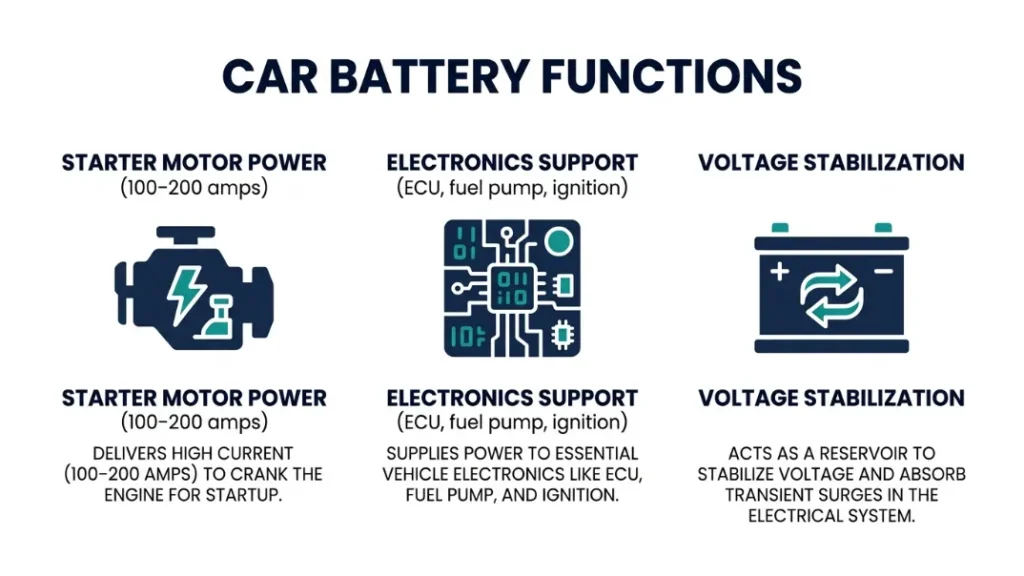
Your car battery is a 12-volt lead-acid power source that stores and delivers electrical energy on demand. It performs three critical jobs every time you use your vehicle. First, it powers the starter motor to crank the engine. Second, it runs all electronics before the engine starts — the fuel pump, ignition system, and ECU. Third, it stabilizes voltage across the electrical system while the engine runs.
How the Battery Powers Your Starter Motor
The starter motor draws between 100 and 200 amps of current to spin the engine’s flywheel. This massive draw happens in the first two seconds of every start attempt. Without a healthy battery delivering full voltage — at least 9.6 volts under load — the starter motor either turns too slowly or refuses to engage at all. A battery that cannot deliver enough cold cranking amps (CCA) fails this task even if it reads 12 volts at rest.
Cold cranking amps measure how many amps a battery delivers at 0°F (-18°C) for 30 seconds while staying above 7.2 volts. Most standard passenger cars need 400 to 600 CCA. Trucks and SUVs often require 700 to 900 CCA. When a battery ages, its CCA rating drops below specification even before visible symptoms appear.
Why the Alternator Is Not a Backup Battery
Many drivers assume the alternator keeps the car running if the battery fails. This is a dangerous myth. The alternator generates electricity to recharge the battery and power accessories while the engine runs — but it cannot start the engine by itself. If your battery dies while driving, the alternator will sustain the electrical systems for a short time, but voltage will drop, warning lights will appear, and the engine will eventually stall.
Tip:
A fully charged car battery reads 12.6 volts with the engine off. Anything below 12.0 volts means the battery is 50% discharged. Below 11.8 volts, the battery is functionally dead for starting purposes.
Now that you understand what the battery does, let’s look at the warning signs that appear before it fails completely.
What Are the Warning Signs Before a Battery Dies?
A car battery rarely fails without warning. It typically shows several distress signals over days or weeks before it leaves you stranded. Recognizing these signs early saves you from a breakdown and gives you time to test or replace the battery on your own schedule.
Slow Engine Crank — The First Red Flag
A healthy engine cranks fast and starts within one to two seconds. When the battery begins to fail, the cranking sound slows down — it sounds labored, sluggish, or like the engine is “struggling to wake up.” This slow crank happens because the battery cannot deliver full amperage to the starter motor. If you hear this sound even once on a warm morning, get the battery tested immediately.
Dashboard Warning Lights You Should Never Ignore
The battery warning light — shaped like a rectangle with a plus and minus symbol — illuminates when the charging system drops below 13.5 volts while the engine runs. This light often signals an alternator problem, but it can also mean a failing battery is causing voltage instability. The check engine light can also appear when the ECU detects erratic voltage readings from a weak battery. Never ignore either light for more than 24 hours.
Electrical Glitches That Point to Battery Trouble
Flickering interior lights, dim headlights at idle, unresponsive power windows, and a radio that resets itself all point to low battery voltage. Modern vehicles rely on stable 12.6-volt power to keep dozens of control modules running correctly. When battery voltage dips below 12.0 volts, these modules behave erratically. You may also notice that your key fob range shortens, your backup camera image degrades, or your infotainment system reboots without reason.
Warning:
Never ignore a battery that dies and then “recovers” after sitting overnight. This surface charge recovery tricks many drivers into thinking the problem is solved. The underlying capacity loss remains, and the battery will fail again — often at the worst possible moment.
Quick Summary: Battery Warning Signs
Watch for: slow cranking on startup, battery or check engine warning lights, flickering headlights or interior lights, electrical accessories behaving randomly, and a battery that tests below 12.4 volts at rest. Any one of these is reason enough to test the battery this week.
Understanding the warning signs prepares you — now let’s look at exactly what happens the moment battery voltage reaches zero.
What Happens the Moment Your Car Battery Dies?
The instant your car battery loses the ability to deliver usable voltage, a cascade of electrical failures happens across your entire vehicle simultaneously. This is not a gradual process — it is immediate and total.
The Engine Goes Silent — Here Is Why
The starter motor requires a burst of 100 to 200 amps to turn the engine. A dead battery delivers near-zero amperage, so the starter motor either refuses to engage or produces only a single weak click — the sound of the solenoid trying and failing. The engine never cranks, never fires, and never starts. If the battery dies while the engine is already running, the alternator temporarily sustains power, but voltage drops below the minimum threshold needed for fuel injectors and ignition coils, causing the engine to stall within minutes.
Why Your Car’s Computer Loses Its Memory
Your vehicle’s Engine Control Unit (ECU) stores critical data in its memory: adaptive fuel trim values, transmission shift points, idle speed calibrations, and in many vehicles, anti-theft codes and radio presets. This memory requires a constant low-level trickle of voltage — typically 0.05 amps or less — to remain active. When the battery dies completely, that trickle disappears and volatile memory is erased instantly.
After jump-starting or replacing the battery, your ECU must relearn its adaptive settings. The engine may idle rough, shift awkwardly, or use slightly more fuel for the first 50 to 100 miles while the computer recalibrates. Your radio may ask for a security code. Your power windows may need to be reset to their automatic function. These are normal consequences of a complete battery loss — not new mechanical problems.
How Security Systems and Alarms React
Many factory and aftermarket alarm systems trigger when battery power is suddenly restored after a complete loss. This happens because the alarm module interprets the voltage spike as a tampering event. If your car alarm goes off after a jump-start, use your key fob or insert the physical key into the driver’s door to disarm it. If you do not have the security code for a radio or navigation system that locks after power loss, contact your dealer with your Vehicle Identification Number (VIN) to retrieve it.
On vehicles built after 2010, a battery death can also trigger Tire Pressure Monitoring System (TPMS) errors, transmission mode resets, and lane-keeping assist recalibration needs — because these systems store learned baseline data that vanishes with power loss.
Knowing what fails gives you the full picture — next, let’s examine the specific causes behind battery failure so you can prevent it from happening again.
What Causes a Car Battery to Die?
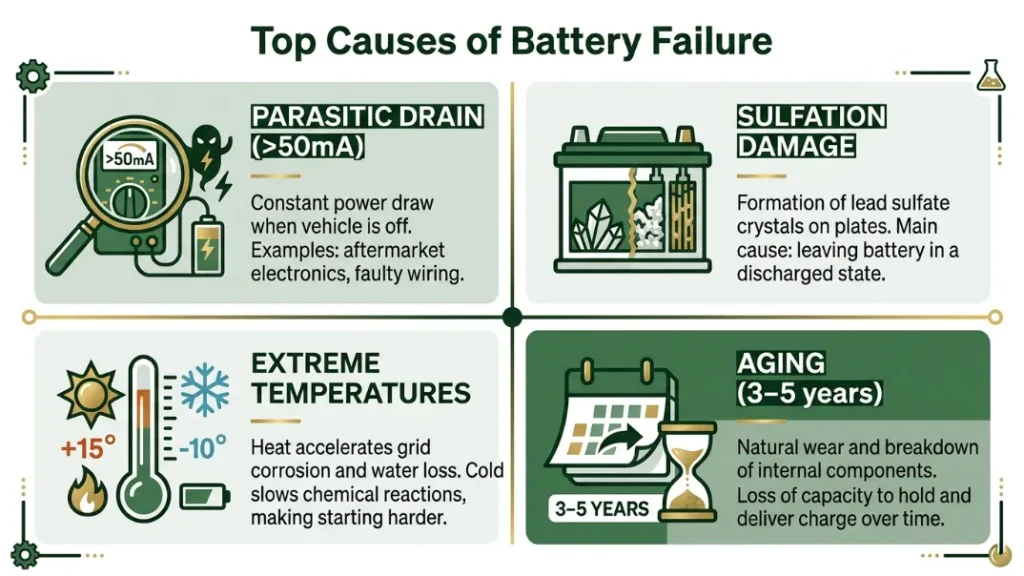
A car battery dies for one of four reasons: it is drained by a parasitic electrical load, it has degraded internally through sulfation, it has been damaged by extreme temperatures, or it has simply reached the end of its 3-to-5-year natural lifespan. Identifying the actual cause determines whether recharging fixes the problem or replacement is unavoidable.
Parasitic Drain — The Silent Killer
Parasitic drain is electrical current that flows out of the battery when the vehicle is off and all accessories appear to be shut down. Every vehicle has a small acceptable parasitic draw — typically 25 to 50 milliamps — to keep the clock, ECU memory, and security module active. A parasitic drain problem occurs when that draw exceeds 50 milliamps, often caused by a stuck relay, a faulty aftermarket accessory, a malfunctioning infotainment system, or an interior light that refuses to turn off.
A 75-milliamp parasitic draw will fully deplete a typical 60 Amp-hour battery in about 33 days. A 200-milliamp draw — common with a stuck power seat module — kills the same battery in roughly 12 days. This explains why cars that sit unused for two to three weeks frequently develop a dead battery even though “nothing was left on.”
How Sulfation Destroys a Battery from the Inside
Lead-acid batteries contain lead plates submerged in sulfuric acid electrolyte. Every discharge cycle produces lead sulfate crystals on those plates. Normally, these crystals dissolve back into the electrolyte during recharging. When a battery sits in a discharged state for days or weeks, the crystals harden into permanent deposits — a process called sulfation. Sulfation reduces the battery’s capacity, raises its internal resistance, and eventually makes it impossible to fully recharge. A sulfated battery may read 12.0 volts at rest but deliver less than 200 CCA — far below what most cars need to start.
Tip:
Never leave a discharged battery sitting for more than 48 hours. Recharge it immediately after any deep discharge to prevent permanent sulfation damage. A battery maintainer or trickle charger prevents this entirely for vehicles in seasonal storage.
Extreme Cold and Heat: The Temperature Factor
Battery chemistry slows dramatically in cold temperatures. At 32°F (0°C), a lead-acid battery loses roughly 20% of its capacity. At 0°F (-18°C), capacity drops by up to 60%. This is why cold January mornings cause more battery failures than any other time of year — the battery delivers less power precisely when the cold engine demands more to start. Heat is equally destructive over time. Prolonged exposure to engine bay temperatures above 100°F (38°C) accelerates water evaporation from the electrolyte and speeds up internal corrosion, shortening lifespan by up to two years in hot climates.
Quick Summary: Common Battery Death Causes
The four leading causes of car battery failure are: (1) parasitic electrical drain above 50mA, (2) sulfation from repeated deep discharge, (3) temperature extremes reducing capacity or causing water loss, and (4) natural aging past the 3-to-5-year lifespan. Test your battery annually after year three.
Once you understand why the battery died, the next priority is getting the car started — here is exactly how to do it safely.
How to Start a Car with a Dead Battery (Step-by-Step)
You have two safe options for starting a car with a dead battery: traditional jumper cables connected to a second vehicle, or a portable lithium jump starter that works without another car present. Both methods work — but they carry different risks when used on modern vehicles with sensitive electronics.
Using Jumper Cables Safely
Step-by-Step: Jump-Starting with Jumper Cables
- Park the working vehicle so both batteries are within cable reach — engines should face each other or sit side by side.
- Turn off both vehicles completely before connecting any cables.
- Connect the RED (positive) clamp to the POSITIVE terminal of the dead battery.
- Connect the other RED clamp to the POSITIVE terminal of the good battery.
- Connect the BLACK (negative) clamp to the NEGATIVE terminal of the good battery.
- Connect the final BLACK clamp to an unpainted metal surface on the dead car’s engine block — NOT to the dead battery’s negative terminal. This prevents sparks near the battery.
- Start the working car and let it run for 3 to 5 minutes to charge the dead battery slightly.
- Attempt to start the dead car. If it starts, let both cars run for 10 more minutes.
- Remove cables in the exact reverse order: black from engine block → black from good battery → red from good battery → red from previously dead battery.
Warning:
Never connect the negative clamp directly to the dead battery’s negative terminal. Batteries emit hydrogen gas during charging. A spark at the battery terminal can ignite this gas and cause the battery to explode. Always ground to unpainted metal on the engine block instead.
Using a Portable Jump Starter
Step-by-Step: Jump-Starting with a Portable Jump Starter
- Ensure the jump starter unit is charged to at least 50% — check its indicator lights before you need it.
- Turn off the vehicle and all accessories.
- Connect the RED clamp to the POSITIVE battery terminal.
- Connect the BLACK clamp to an unpainted metal surface on the engine block.
- Power on the jump starter unit.
- Wait 60 seconds, then attempt to start the vehicle.
- If the engine starts, disconnect the black clamp first, then the red clamp.
- Drive for at least 20 to 30 minutes to allow the alternator to recharge the battery.
Jumper Cables vs. Portable Jump Starter — Which Is Better?
| Factor | Jumper Cables | Portable Jump Starter |
|---|---|---|
| Requires second vehicle | Yes | No |
| Electronics risk | Higher voltage spikes possible | Regulated, lower risk |
| Ease of use | Moderate — needs exact sequence | Easy — spark-proof clamps |
| Cost | $15 – $40 | $60 – $150 |
| Best for | Budget option, older vehicles | Modern cars, solo drivers |
NOCO Boost GB40: 1000A UltraSafe Jump Starter – 12V Lithium Battery Booster Pack, Portable Jump Box, Power Bank & Jumper Cables
The NOCO GB40 is the portable jump starter I now keep in every vehicle I own — it delivers 1,000 amps of starting power, includes spark-proof clamps with reverse polarity protection, and handles gas engines up to 6.0L without needing another car present. 👉 Check Price on Amazon
Getting the car started is step one — now comes the critical decision of whether to recharge the battery or replace it entirely.
Should You Recharge or Replace Your Dead Battery?
Not every dead battery needs replacement. A battery that died because of a one-time drain event — like a door left ajar overnight — may still have years of useful life. A battery that fails repeatedly or tests below minimum capacity needs replacement regardless of its age. The answer depends entirely on what a voltage and load test reveals.
How to Test Your Battery Voltage at Home
A basic digital multimeter costs $15 to $25 and gives you everything you need to assess battery health. Set the multimeter to DC voltage, touch the red probe to the positive terminal and the black probe to the negative terminal, and read the result with the engine off for at least two hours after the last charge.
| Voltage Reading | Battery State | Action |
|---|---|---|
| 12.6V – 12.8V | Fully charged | No action needed |
| 12.4V – 12.6V | 75% charged | Drive or charge |
| 12.0V – 12.4V | 50% or less | Recharge and load test |
| 11.8V – 12.0V | Critically low | Recharge then test CCA |
| Below 11.8V | Dead / sulfated | Replace the battery |
When Recharging Is Enough
Recharging works when the battery is less than three years old, has no history of repeated failures, and tests above 12.2 volts after a full charge cycle. A slow recharge at 2 to 4 amps over 8 to 12 hours is safer than a fast charge at 10 to 15 amps — slow charging reduces heat and stress on the plates. After recharging, have a load test performed at any auto parts store. Most AutoZone, O’Reilly Auto Parts, and Advance Auto Parts locations offer free battery testing in under five minutes.
When Replacement Is the Only Option
Replace the battery immediately if it is four or more years old and tests below minimum CCA, if it has failed to hold a charge after two full recharge cycles, if the case is cracked or swollen, or if the terminals show severe corrosion that cannot be cleaned. A replacement lead-acid battery costs $80 to $200 depending on the vehicle and brand. AGM (Absorbent Glass Mat) batteries — used in vehicles with start-stop systems — cost $150 to $300 but last 4 to 8 years and handle deep discharge better than standard flooded batteries.
Tip:
When replacing the battery in a modern vehicle with a CAN bus system, use a battery memory saver — a small device that plugs into the OBD-II port or cigarette lighter — to maintain power to the ECU during the swap. This prevents adaptive memory loss and security system lockouts during replacement.
Whether you recharge or replace, the real victory is making sure the battery never reaches zero again — here is how to do that.
How to Prevent Your Car Battery from Dying Again
Battery failure is highly preventable with a few consistent habits and one inexpensive piece of equipment. Most people experience a dead battery two or three times before they adopt these practices — you do not have to be one of them.
Simple Habits That Extend Battery Life
Turn off all interior lights, phone chargers, and accessories before leaving the vehicle. Check that doors close fully so dome lights do not stay on overnight. Drive the vehicle for at least 20 minutes at highway speeds at least twice per week — short trips do not give the alternator enough time to fully recharge the battery. Keep the battery terminals clean: a paste of baking soda and water applied with an old toothbrush removes sulfate corrosion from terminals every six months. Have the battery professionally tested every year after it reaches three years of age, and every six months after year four.
For authority reference on battery maintenance standards, the MotorTrend battery care guide and the Consumer Reports battery buying guide both provide independently verified maintenance benchmarks.
The Role of a Battery Tender or Trickle Charger
A battery tender — also called a float charger or maintainer — connects to your battery and delivers a small, regulated current that keeps it at 100% charge without overcharging. The NOCO Genius series and Battery Tender Plus are two of the most trusted options available, with smart circuitry that monitors battery voltage and adjusts output automatically. If you store a vehicle seasonally, park it for more than two weeks at a time, or live in a climate below 20°F (-7°C) in winter, a battery maintainer pays for itself the first time it prevents a dead battery.
AGM batteries — found in BMW, Mercedes-Benz, Audi, and most vehicles with start-stop technology — require an AGM-compatible charger. Using a standard charger on an AGM battery can damage it permanently. Always check your battery label before connecting any charger.
With prevention in place, let’s wrap up with the most important points to carry forward.
Final Thoughts
When your car battery dies, it does not just shut down the engine — it cuts power to the starter motor, erases ECU memory, disables every electrical system, and may trigger the alarm. Understanding this cascade of failures removes the panic from the moment and gives you a clear action plan. Jump-start safely using the correct clamp sequence, diagnose the root cause (parasitic drain, sulfation, age, or temperature), and decide whether recharging or replacing is the right call based on a voltage test.
The most important insight from everything above is this: a battery that dies once deserves a load test the same day. A battery that dies twice in one year needs immediate replacement, not another jump-start.
I’m Alex Rahman, and if this guide saved you from a breakdown or helped you avoid an expensive mistake at the shop, I’d encourage you to bookmark it and share it with anyone who drives. A portable jump starter in the trunk and a battery tester in the glovebox costs less than a single tow truck call — and gives you complete independence the next time a battery gives out.
Frequently Asked Questions
Can a completely dead car battery be recharged?
Yes — in many cases. If the battery has been deeply discharged but has not suffered permanent sulfation damage, a slow charge at 2 to 4 amps over 8 to 12 hours can restore it to usable capacity. However, a battery that reads below 10.5 volts or fails a load test after a full recharge has sustained internal damage and should be replaced. Age matters too — batteries older than four years rarely recover fully from a complete discharge.
Why does my car battery die overnight?
A battery that dies overnight almost always has a parasitic drain problem — something is drawing current from the battery while the car is off. Common culprits include a stuck interior light, a faulty trunk release module, a malfunctioning aftermarket alarm, or a failing relay that does not fully disengage. A mechanic can measure parasitic draw with a clamp-style ammeter. Any reading above 50 milliamps warrants investigation.
How long does it take to jump-start a car?
With jumper cables connected to a running donor vehicle, allow 3 to 5 minutes of charging time before attempting to start the dead car. Most vehicles start within the first attempt after this wait. With a portable jump starter, the process takes 60 to 90 seconds — connect, wait one minute, then start. After a successful jump-start, drive for at least 20 to 30 minutes at varying speeds to let the alternator recharge the battery.
Does a dead battery damage the alternator?
A single dead battery event typically does not damage a healthy alternator. However, repeatedly jump-starting a severely depleted battery causes the alternator to work at maximum output for extended periods to recharge it. Sustained high output accelerates alternator diode wear over time. If your battery dies frequently, address the root cause promptly — both to protect the alternator and to avoid stranded breakdowns.
How often should you replace your car battery?
Most automotive manufacturers and battery brands recommend replacing lead-acid batteries every 3 to 5 years as preventative maintenance. AGM batteries in premium vehicles typically last 4 to 8 years. In hot climates like the American Southwest or Southeast Asia, replace standard batteries every 3 years due to accelerated heat damage. In cold climates, replace them at the first sign of slow cranking — cold amplifies every existing weakness in an aging battery.
What happens to a car’s electronics when the battery dies?
When the battery dies, the ECU loses its adaptive memory — including fuel trim settings, transmission shift maps, and idle calibrations. Radio security codes, power window auto-close settings, and sunroof memory may also reset. After reconnecting a new battery, the engine may run roughly for the first 50 to 100 miles while the ECU relearns. This is normal and requires no repairs — just normal driving.
Is it safe to jump-start a modern car with another car?
Yes, but with important precautions. Modern vehicles with CAN bus electronics are sensitive to voltage spikes. Always turn off both vehicles before connecting cables, never connect the negative clamp to the dead battery terminal, and avoid revving the donor vehicle’s engine aggressively during charging. A regulated portable jump starter like the NOCO GB40 poses even less risk than a donor car because it delivers a controlled, surge-protected output that does not spike.

I’m Alex Rahman, a car enthusiast and automotive writer focused on practical solutions, car tools, and real-world driving advice. I share simple and honest content to help everyday drivers make better decisions.
