Why Won’t My Scanner Communicate With the ECU?
Quick Answer
A scanner usually fails to communicate with the ECU because the ECU is asleep, has lost power or ground, or cannot complete a protocol handshake. Start with the ignition ON, engine off, a firmly seated plug, and a charged battery. If it powers on but still shows a link error, check the port fuse, the ECU fuse, and the protocol setting before assuming the ECU has failed.
A scanner that lights up and then reports no communication with the ECU is a specific failure. The tool has power, so the port is not completely dead. The missing piece is the reply from the engine computer.
What “No Communication With the ECU” Actually Means
When a scanner tries to talk to the ECU, it sends a request and waits for a reply. The ECU is the engine control unit, also called the powertrain control module, or PCM, on many vehicles. It manages fuel, ignition, and emissions, and holds the diagnostic information a scanner reads.
A communication failure means that loop never completes. The scanner may show “link error,” “no communication,” or “no response from ECU.” That does not prove the ECU is broken. It may be asleep, unpowered, disconnected from the data bus, speaking a different protocol, or blocked by another fault.
The U.S. EPA OBD regulations Q&A explains that OBD II standardized the connector, codes, and communications format, with full implementation for light-duty gasoline vehicles in model year 1996. That is why a generic scanner can talk to many cars, and why a protocol mismatch can still stop it.
Is the Scanner Talking to the Port, or Not to the ECU?
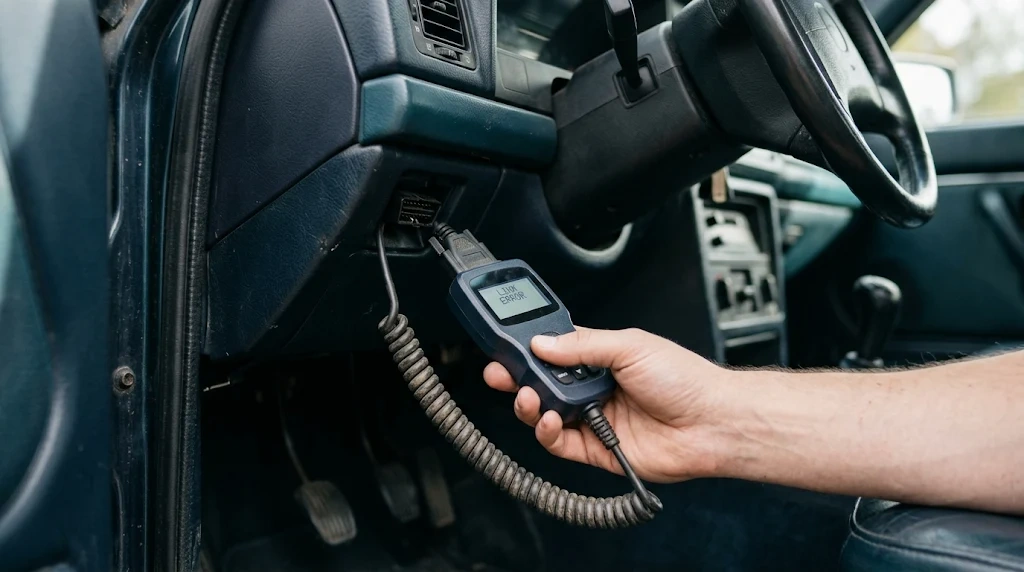
Read the scanner screen first. The symptom tells you where to look next.
| What you see | What it usually means | Check next |
|---|---|---|
| Scanner stays dark | No power at the port | Port fuse, pin 16 power, battery |
| Scanner powers on, then link error | Power is present, data reply is missing | Ignition, protocol, CAN bus, ECU power |
| Scanner works on another car | The tool is probably fine | This car’s ECU, wiring, or network |
A dark scanner is mainly a power fault; a powered scanner with a link error is mainly a communication fault, with the ECU at the centre of it. A scanner that has power but no communication still needs the data path checked, including the signal pins, the protocol, and the ECU’s own power and ground.
The ECU Has to Wake Up First
Most ECUs do not answer all the time. They wake with the ignition in ON or RUN, then return to a low-power state when the car is off. A scanner connected with the key in ACC may power on from the port and still get no reply, because the ECU is asleep.
On a push-button car, press start once without the brake. That usually brings the ignition to ON without starting the engine, and the dashboard warning lights should be on.
A weak battery can create the same effect less obviously. The engine may still crank and the scanner may still light up, yet the ECU may drop in and out of its awake state when voltage falls. As a rough guide, a rested battery near 12.6 volts is healthy, while a reading near 12.2 volts means it is significantly discharged. Charge the battery before blaming the ECU, and wait a few seconds after turning the ignition on for the ECU to boot.
ECU Power, Ground, and Relay Checks
The ECU needs its own power and ground, separate from the power that lights up the scanner. If that supply is missing, the ECU cannot reply even when the port looks fine. The usual suspects are a blown ECU fuse, a failed main relay, or a damaged ground.
Check the fuses for the diagnostic port and the ECU or PCM, using the owner’s manual or fuse-box diagram. On many cars the port shares a circuit with the cigarette lighter, so a blown accessory fuse can remove port power while the rest of the car seems normal. A fuse that looks fine can still be open, so test it when you can.
Grounds matter as much as power. The port uses pins 4 and 5 for ground, and the ECU has its own ground points. Corrosion or a loose bolt can raise resistance enough to break communication while a voltage reading still looks normal. A guide to what the OBD2 ground pins do explains why a weak ground can cause a link failure even when the scanner powers on.
Warning
Never replace a blown ECU or diagnostic-port fuse with a higher-rated one. A larger fuse can let a short circuit damage the ECU or the harness.
Protocol: The Scanner and ECU Must Speak the Same Language
OBD2 allows several protocols, including CAN (ISO 15765-4), used by most vehicles from 2008 onward in the United States, ISO 9141-2, KWP2000 (ISO 14230-4), and the older SAE J1850 systems. If the scanner tries the wrong protocol, the ECU will not answer, even though both sides are powered.
Most scanners try protocols automatically. That step can fail on older cars, on cars with a slow wake-up, or when firmware is out of date. When it fails, try manual selection. A guide on how to identify an OBD2 protocol can help you work out which one your car should use, from the model year, the port pins, and the emissions label.
Vehicle selection matters too. A scanner set to the wrong year, make, model, or engine may send requests the ECU does not recognise. Cars built before 1996 in the United States usually do not use OBD2 at all.
CAN Bus Problems Between the Port and the ECU
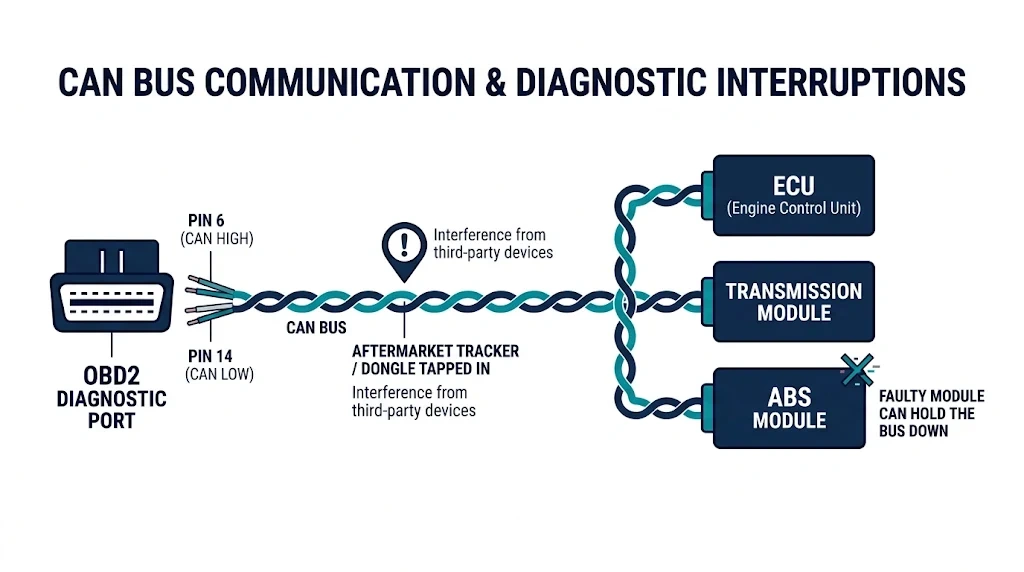
On most modern cars the scanner talks to the ECU over the CAN bus, the vehicle’s shared network. If the bus is damaged, the ECU’s reply may never reach the scanner.
On CAN cars, pins 6 and 14 carry CAN High and CAN Low. Damage to those circuits, a short between them, corrosion, or a faulty module elsewhere on the bus can break the link and make the ECU look silent.
Aftermarket devices are a common cause. A tracker, insurance dongle, remote starter, or alarm tapped into the diagnostic wiring can interfere with the signal, so remove any splitter, extension cable, or added device and try a direct connection. If the scanner can reach other modules but not the ECU, the fault is more likely at the ECU. If no module answers, it is more likely in the shared bus or port wiring.
Scanner-Side Reasons the ECU Will Not Answer
Not every no-communication fault is in the car. Outdated firmware is a common scanner-side cause: makers release updates when car makers change ECU software or add new model years, so a scanner that worked last year may fail on a newer car until it is updated.
Bluetooth and Wi-Fi adapters add another layer. The adapter may pair with the phone while never linking to the car. Forget the pairing, restart the phone and the adapter, and pair again. With a wired scanner, try a different cable.
Cheap or counterfeit ELM327 adapters are a known weak point. Some clones report a newer version than they support, or drop the connection on a protocol the clone handles badly. If an ELM327 adapter fails where a wired scanner works, the adapter is the likelier fault. The case of an ELM327 adapter not connecting to the ECU covers the clone, pairing, and protocol checks for those adapters. Some cars also use a gateway module that controls access to the ECU; a generic scanner may reach the gateway and stop there. That is a coverage limit, not proof that the ECU is dead.
What to Try, in Order
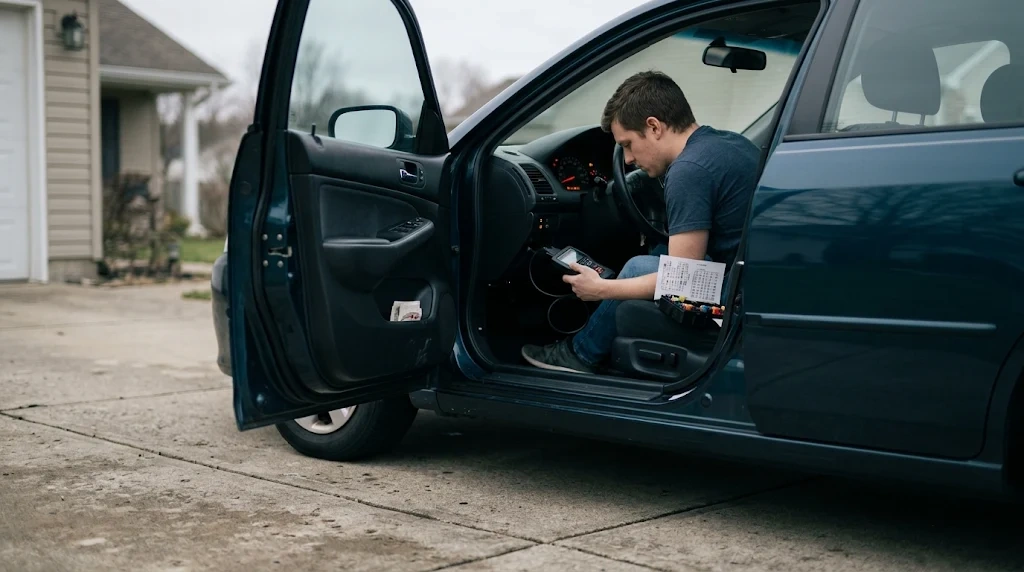
Work from the simplest checks toward the harder ones, changing only one thing at a time.
- Ignition: key to ON, engine off, dashboard lights on. On a push-button car, press start once without the brake.
- Plug: push the scanner plug fully in, then hold it still while it tries to link.
- Battery: check that the battery is charged and the terminals are clean and tight.
- Fuses: check the diagnostic-port fuse and the ECU or PCM fuse. Replace a blown fuse only with the same rating.
- Second car: try the scanner on another compatible car. If it works there, the fault is in the first car.
- Protocol: let auto-detect run, then try manual selection. Check the vehicle selection too.
- Clean connection: remove splitters, extension cables, and dongles, then try a direct connection.
- Update: update the scanner firmware and the app, then retry with a different cable or adapter if one is available.
If the scanner still cannot reach the ECU, the next checks need a multimeter and the wiring diagram: pin 16 power, grounds, and the CAN circuits. A guide to whether an OBD2 port can have no power explains the port-power checks that come before those deeper network tests.
Mistakes That Waste Time
The most common mistake is replacing the ECU first. A new or used ECU is expensive, needs correct programming and matching to the car, and will not fix a blown fuse, a bad ground, a protocol mismatch, or a faulty scanner.
Disconnecting the battery to “reset” the ECU is another poor shortcut. It can erase useful diagnostic information and reset readiness monitors without fixing the fault. Stop and get professional help when the car will not start and no module answers, when a fuse blows again immediately, or when wiring is burnt, wet, or chewed. A technician can check ECU power, ground, and bus signals directly.
Related Product
Multi-Protocol OBD2 Scanner
A multi-protocol scanner with automatic protocol detection can try the protocol your ECU uses, instead of stopping at the first mismatch.
As an Amazon Associate, we earn from qualifying purchases.
Frequently Asked Questions
Can a bad battery stop a scanner from communicating with the ECU?
Yes. A weak battery can leave the ECU in a low-power state, even when the scanner still lights up. Charge the battery and check the terminals before blaming the ECU or the scanner.
Does a scanner need the engine running to talk to the ECU?
No. Most cars need the ignition ON, engine off, for a normal scan. The engine running is needed for some live-data checks, but not for the initial link.
Why does my scanner work on one car but not another?
The cars may use different protocols, model years, or gateway layouts. The scanner may also lack coverage for the second car’s ECU. Check the protocol, vehicle selection, and stated coverage for that make and year.
Can a blown fuse cause an ECU communication failure?
Yes. A blown fuse for the diagnostic port can remove scanner power, and a blown ECU or PCM fuse can leave the ECU unpowered. Replace a blown fuse only with the same rating.
Is a link error always a failed ECU?
No. A link error is far more often caused by the ignition position, a weak battery, a fuse, a ground, a protocol mismatch, or a CAN bus fault. A failed ECU is possible, but only after those checks pass.
Can an ELM327 adapter fail to connect to the ECU while a wired scanner works?
Yes. A clone adapter, outdated firmware, a pairing problem, or poor protocol support can stop an ELM327 adapter from reaching the ECU. Try it on another car, update its app and firmware, and test with a wired scanner.
Conclusion
A scanner that will not communicate with the ECU is usually telling you about a wake-up, power, ground, protocol, or network fault, not a dead engine computer. Start with the ignition, battery, and fuses, then check the protocol and the connection. Test the scanner on another car when you can. If those checks pass and the ECU still does not answer, get its power, ground, and CAN bus signals tested before replacing any module.

I’m Alex Rahman, a car enthusiast and automotive writer focused on practical solutions, car tools, and real-world driving advice. I share simple and honest content to help everyday drivers make better decisions.
