Why Freeze Frame Data Is Useful for OBD2 Diagnosis
Quick Answer
Freeze frame data is useful because it adds the conditions behind a fault code: what the engine was doing, how hard it was working, and whether it was cold or warm when the fault was set. A code alone says what was detected. The freeze frame helps explain when and under what conditions it happened, so you can narrow the cause, reproduce the fault, and avoid replacing parts on a guess.
A fault code is a useful starting point, but it is often a short label for a condition, not a complete explanation. Two cars can show the same code for different reasons, and the same car can set a code only in one kind of driving. Freeze frame data is the snapshot that helps you tell those cases apart.
This article focuses on value, not on definitions or button-by-button reading. For the basic definition, see what OBD2 freeze frame data is, and for the detailed reading steps, see how to read OBD2 freeze frame data.
What a Code Alone Leaves Unanswered

A code tells you that a monitored condition crossed a threshold. It does not, by itself, tell you whether the fault appeared at idle or at motorway speed, under light load or heavy load, or before the engine had warmed up. Those missing details matter because many faults are condition-dependent.
Freeze frame fills that gap with a single, time-stamped set of readings taken when the fault was set. Typical values can include engine speed, vehicle speed, calculated load, coolant temperature, fuel trim, throttle position, and fuel-system status. The exact set varies by vehicle, code, and scan tool, so treat the list as a snapshot of conditions, not as a complete recording of everything the car was doing.
The practical difference is between knowing a fault exists and knowing the situation in which it exists. The first points you toward a system. The second points you toward a test, a driving condition, or a likely cause within that system.
How It Narrows the Cause: Same Code, Different Story
The clearest use of freeze frame data is comparison. Read the code together with load, speed, temperature, and fuel trim, and the same code can suggest very different next checks.
Suppose a lean code appears at idle, with the car stationary, the engine warm, and fuel trim strongly positive. That pattern points first toward an air leak or another problem that shows up most when airflow is low and vacuum is high. Now suppose the same lean code appears at high speed and high load. That pattern points more toward fuel delivery struggling to meet demand, such as a weak pump or a restriction, because the problem appears when demand is greatest.
Neither pattern proves a part has failed. Each one changes the order of your checks and helps you avoid starting with the least likely cause. A misfire example works the same way. A misfire recorded only under heavy load suggests a component that fails under strain, while a misfire recorded at a cold, low-speed start suggests a different set of checks. The code names the fault. The conditions narrow the search.
Key Insight
Do not read freeze frame values one by one. Read them as a scene: speed and load describe the driving, coolant temperature describes warm-up, and fuel trim describes how the engine was compensating. The pattern across those values is usually more useful than any single number.
Why It Helps Most With Intermittent Faults
Intermittent faults are where freeze frame earns its reputation. By the time you scan the car, the engine may run normally and current readings may look reasonable. Without the snapshot, you are left with a code and a car that will not repeat the problem on demand.
Freeze frame preserves the moment the fault was detected, even if the symptom has gone. It can show whether the fault happened at a cold start, at hot idle, during steady cruising, during acceleration, or under high load. That information lets you try to reproduce the same condition rather than testing the car at random and hoping the fault returns.
This is also why timing matters. Clearing codes can erase the stored snapshot, and a later fault can overwrite an earlier generic frame in many vehicles. The value is highest when the frame is saved or noted before anything is cleared. For when that capture happens, see when OBD2 freeze frame is captured.
How It Turns a Code Into a Test You Can Run
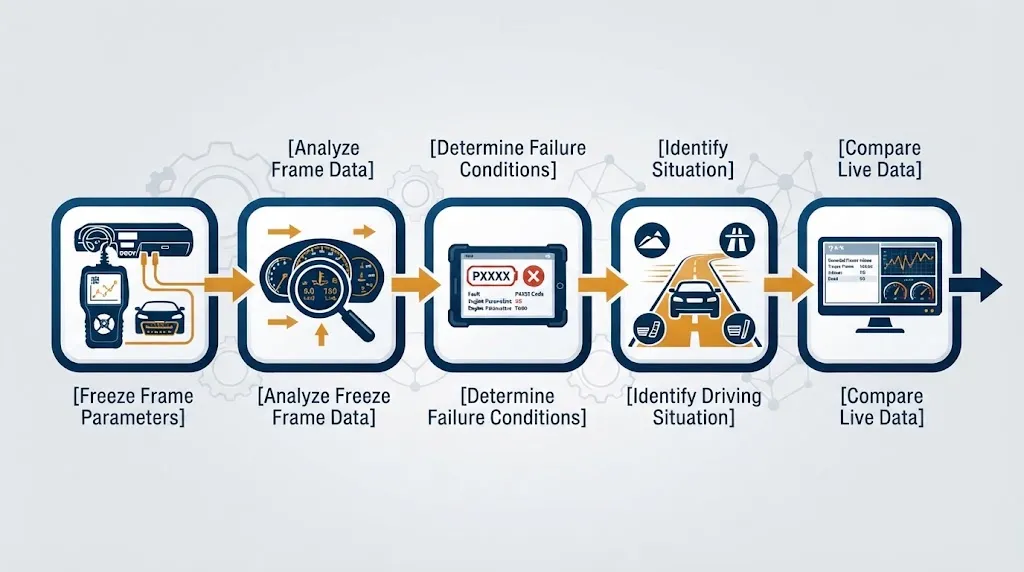
Freeze frame is most useful when it changes what you do next. Start by writing down the driving scene: speed, engine speed, load, coolant temperature, and fuel trim. Then ask what condition would be needed to see the fault again.
If the frame shows a hot idle, the next check should focus on idle behaviour, not on a high-speed road test. If it shows high load, the next check should include the load condition, carefully and safely, rather than only a stationary test. If it shows a cold engine, warm-up behaviour and fuel-system status deserve attention first.
From there, live data becomes a follow-up tool rather than a fishing trip. You already know which conditions to recreate, so you can watch the relevant readings under those conditions and see whether the fault returns or a value moves out of range. For that next step, see how to read OBD2 live data. In short, freeze frame tells you which conditions to reproduce, and live data shows whether the fault can be observed again.
Code Alone vs. Code Plus Freeze Frame
The table below summarises the practical difference. It is not a claim that freeze frame replaces diagnosis. It shows why the snapshot usually leads to a shorter, more focused diagnostic path.
| What you have | What you can reasonably do |
|---|---|
| Code alone | Identify the affected system and look up possible causes. |
| Code plus freeze frame | Narrow the causes by driving condition, then test under that condition. |
| Code plus freeze frame plus live data | Confirm whether the fault repeats and which readings change with it. |
That progression is the core benefit. Each layer reduces guessing, but freeze frame is the layer that connects a stored code to a real driving situation.
How It Saves Time, Money, and Miscommunication
The most direct saving is fewer wrong parts. A code label alone can tempt a quick replacement, especially when the named sensor sounds like the obvious culprit. A freeze frame that shows the fault only under a specific load or temperature is a reason to pause and test the condition first, rather than assuming the sensor itself is defective.
It also makes help easier to get. If you ask a workshop, a forum, or a parts supplier for advice, a code alone invites generic answers. A code plus the recorded speed, load, temperature, and fuel trim gives the other person the context needed to suggest a relevant check. Save the exact values, not just your summary of them, because a small difference in load or temperature can change the advice.
For a used car or a recurring fault, the same discipline matters. A snapshot tied to one driving condition is stronger evidence than a vague report that a light came on once. It does not prove the car is sound or faulty, but it gives the next person a concrete starting point instead of a story to reinterpret.
When Freeze Frame Does Not Help as Much
Freeze frame is evidence, not a verdict. It records selected conditions around a fault, and it does not by itself identify a failed part. A code plus a snapshot still needs the right diagnostic procedure, and in some cases a manufacturer-specific test, before a repair decision is made.
There are also practical limits. Most vehicles store only one generic frame at a time, so a later fault can replace an earlier one. Not every code produces a useful generic frame, and the available parameters vary by vehicle and tool. A missing or thin frame is not proof that a component has failed, and it is not proof that no fault occurred. For the full parameter picture, see what information is stored in freeze frame.
Finally, freeze frame is a single moment, not a history or a video replay. It does not show what happened before the fault or how values changed afterward. That is why it works best alongside the code, any symptoms you noticed, and live data taken under the same conditions. The Innova freeze frame PID definitions show how the standard parameter set is organised, while OBD Europe’s freeze frame guide explains the same limit in practical terms: use the snapshot as evidence, not as a complete diagnosis.
Tip
Before clearing any code, photograph or save the freeze frame screen with the code, speed, load, coolant temperature, and fuel trim visible. That one habit preserves the most useful part of the diagnosis.
Related Product
OBD2 Scanner With Freeze Frame Display
A scanner that can display freeze frame data lets you capture the conditions behind a code before you clear it.
As an Amazon Associate, we earn from qualifying purchases.
Frequently Asked Questions
Does freeze frame data tell you which part to replace?
No. It records the conditions when a fault was set, which narrows the likely causes and the next test. The part decision still needs the code, symptoms, live data where relevant, and the vehicle diagnostic procedure.
Should you save freeze frame data before clearing codes?
Yes. Clearing codes can erase the stored snapshot, and a later fault can overwrite it in many vehicles. Save the code and the key values first, so the diagnostic context is not lost.
Why is there usually only one freeze frame?
Generic OBD2 freeze frame is tied to the fault that set the light, and many vehicles keep one frame at a time. That is why the earliest, highest-priority frame matters, and why timely capture is important.
Is freeze frame data the same as live data?
No. Freeze frame is a fixed snapshot from the moment a fault was set. Live data shows current readings while you test. Freeze frame tells you which conditions to reproduce, and live data shows what happens under those conditions now.
Can freeze frame help if the warning light is off now?
It can, if the code and its frame are still stored. The snapshot preserves the fault conditions even when the symptom has gone, which is especially useful for intermittent faults that do not repeat on demand.
Does every fault code come with useful freeze frame data?
No. Availability depends on the vehicle, the code, and the tool, and some frames contain only a limited parameter set. A thin or missing frame should prompt further checks, not a conclusion on its own.
Conclusion
Freeze frame data is useful because it turns a fault code from a label into a situation. Speed, load, temperature, and fuel trim show when and how the fault appeared, which narrows the cause, helps reproduce intermittent faults, and gives you a focused next test instead of a guess. Save the frame before clearing codes, read its values as a pattern rather than in isolation, and use live data to confirm what the snapshot suggests. That sequence is what makes a simple stored reading genuinely diagnostic.

I’m Alex Rahman, a car enthusiast and automotive writer focused on practical solutions, car tools, and real-world driving advice. I share simple and honest content to help everyday drivers make better decisions.
