When Did OBD2 Become Standard? The 1996 US Answer
Quick Answer
OBD2 became the required standard for passenger cars and light trucks sold in the United States with the 1996 model year. That is the date to use for most US vehicles, but it was not a single worldwide switch: Europe, diesel models, heavier vehicles, and the later CAN protocol each followed on their own timetables.
The short version is easy to remember, and easy to overstate. Saying “1996” answers the US question, but it does not tell you whether a car in another market, a diesel model, or a 1994 or 1995 car uses the same system. Those exceptions still affect which scanner will connect and why an older car may have a familiar-looking port without full OBD2 support.
The 1996 Rule in Plain Terms
For the United States, the rule was tied to model year, not the calendar date on which a car was bought. A car built in late 1995 but sold as a 1996 model was required to comply, while a 1995 model was not, even if it was first registered later. The requirement covered passenger cars and light trucks, generally up to a 14,000-pound gross vehicle weight rating.
The EPA has stated that OBD systems have been required on all new passenger vehicles beginning with model year 1996. That makes 1996 the practical cutoff for US buyers, owners, and emissions testing, rather than the year the technology was first invented or first fitted to a few cars.
Why a Common Standard Was Needed
California took the first major step. The California Air Resources Board (CARB) required basic on-board diagnostic capability on new cars sold in California from the 1988 model year. That early system, later called OBD1, was a real advance, but it was not uniform.
Different manufacturers used different connectors, different communication methods, and different fault-code meanings. A workshop might need several adapters and several code lists, and emissions testing could not rely on one consistent check. The system also monitored only a limited set of components, so a developing emissions fault could go undetected for longer than regulators wanted.
OBD2 was therefore designed as a package, not just a new plug. It required broader monitoring of emissions-related systems, a warning light when a fault could push emissions materially above the certified level, and a common way for an external tool to ask for codes, live data, and readiness information. The federal Clean Air Act Amendments of 1990 carried that California-led direction into national law, with a phase-in that ended with the 1996 model year.
A Timeline That Avoids the Usual Oversimplification
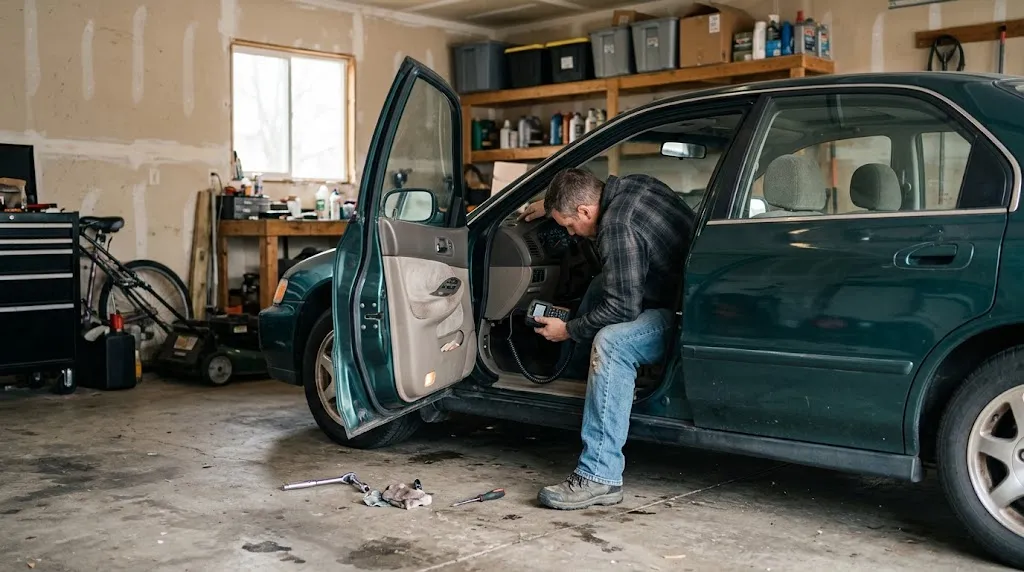
OBD2 did not appear overnight in 1996. It was phased in, and later changes tightened the communication rules without changing the basic 1996 answer for US light vehicles.
| Year | What changed |
|---|---|
| 1988 | California requires basic OBD capability, later called OBD1. |
| 1994–1995 | Some manufacturers phase in OBD2 early; other cars still use OBD1. |
| 1996 | OBD2 required for US passenger cars and light trucks. |
| 2001 / 2004 | EOBD required in the EU for petrol cars, then diesel cars. |
| 2008 | CAN becomes the required OBD2 communication protocol for US cars. |
The phase-in is the detail most short answers skip. Some 1994 and 1995 models already had OBD2, while others did not, and a small number of early 1996 systems were still completing some required features. That does not move the legal cutoff, but it does mean a transition-year car should be checked individually rather than assumed compliant from its year alone.
What “Standard” Actually Standardized
Four parts of OBD2 did most of the work. First, the physical connection became the same: a trapezoidal 16-pin diagnostic link connector, defined by SAE J1962, normally found inside the passenger compartment near the driver’s side. Second, generic fault codes became comparable across brands, with the familiar P0xxx series for generic powertrain faults.
Third, diagnostic services were standardized, so a scan tool could request stored codes, pending codes, freeze-frame data, live data, and monitor status in a consistent way. Fourth, the system had to run readiness monitors that track whether emissions-related tests have completed. That last point is why clearing codes is not the same as passing an emissions check: the monitors may still read “not ready” afterward.
What OBD2 did not do at first was force every car onto one communication protocol. Early US cars could use SAE J1850 PWM, SAE J1850 VPW, ISO 9141-2, or ISO 14230-4 (KWP2000), depending on the manufacturer. The connector and the generic code structure were common, but the “language” underneath could still differ. That distinction explains many connection problems on 1996–2007 cars.
Why 1996 Was Not a Worldwide Date
Europe used a closely related system called EOBD, but on a later timetable. EOBD became mandatory for petrol cars first registered in the EU from 1 January 2001, and for diesel cars from 1 January 2004. For newly introduced models, those dates applied a year earlier. If you are checking a European car, the US 1996 date is therefore the wrong shortcut.
The practical difference is smaller than the name suggests. EOBD and OBD2 share the same 16-pin connector idea and much of the same diagnostic structure, which is why the difference between OBD2 and EOBD is mainly about regulation, scope, and timing rather than a completely different plug. For a fuller picture of the European rules, see whether OBD2 is mandatory in Europe.
Vehicle type also mattered. Heavier vehicles and some diesel applications were brought into OBD requirements later than US petrol passenger cars, and later rules extended diagnostics further rather than replacing the 1996 foundation. So a statement such as “all cars became OBD2 in 1996” is only safe if it is limited to US passenger cars and light trucks of that model year.
How to Check Your Own Car
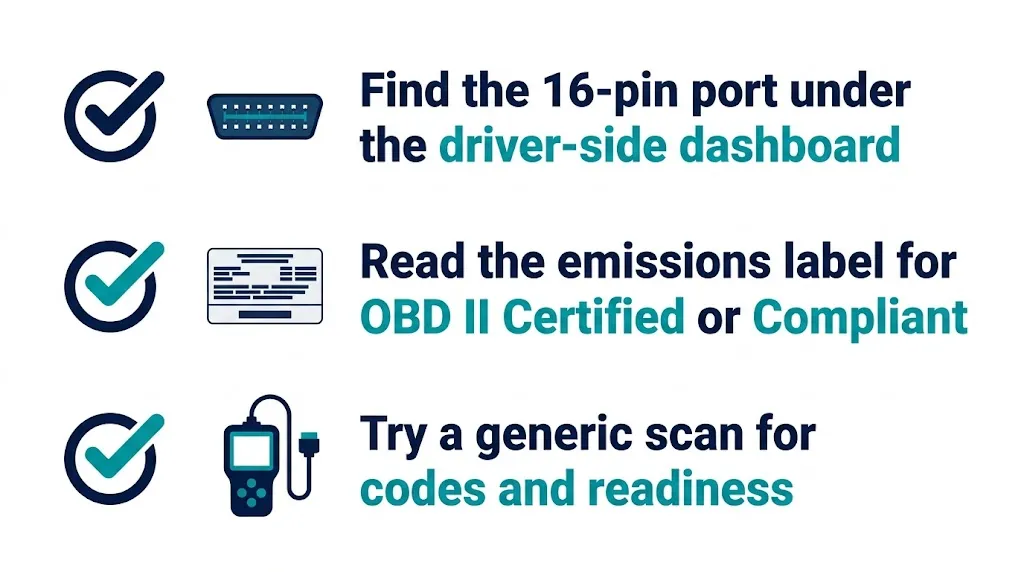
Start with model year and market, not with the shape of the port alone. A US 1996-or-newer passenger car or light truck should be OBD2, while a pre-1996 car usually is not. For transition years, and for cars sold outside the US, use a physical check as well.
- Find the port: look under the dashboard on the driver’s side for a trapezoidal 16-pin connector.
- Read the emissions label: the Vehicle Emission Control Information label under the hood should state “OBD II Certified” or “OBD II Compliant” on a compliant car.
- Try a basic scan: if a generic scanner connects and reports generic codes and readiness monitors, that supports OBD2 compliance.
For older vehicles, the check matters even more. Working out whether an OBD2 scanner works on older cars covers the cases where a port is present but full communication is not guaranteed. If you are unsure after those checks, checking your vehicle’s OBD2 compatibility is the next step before buying an adapter or booking an emissions test.
Key Insight
The 1996 date is a model-year rule for a market, not a manufacturing technology that switched on globally on 1 January 1996. Always pair the year with the market and vehicle type.
What Changed After 1996
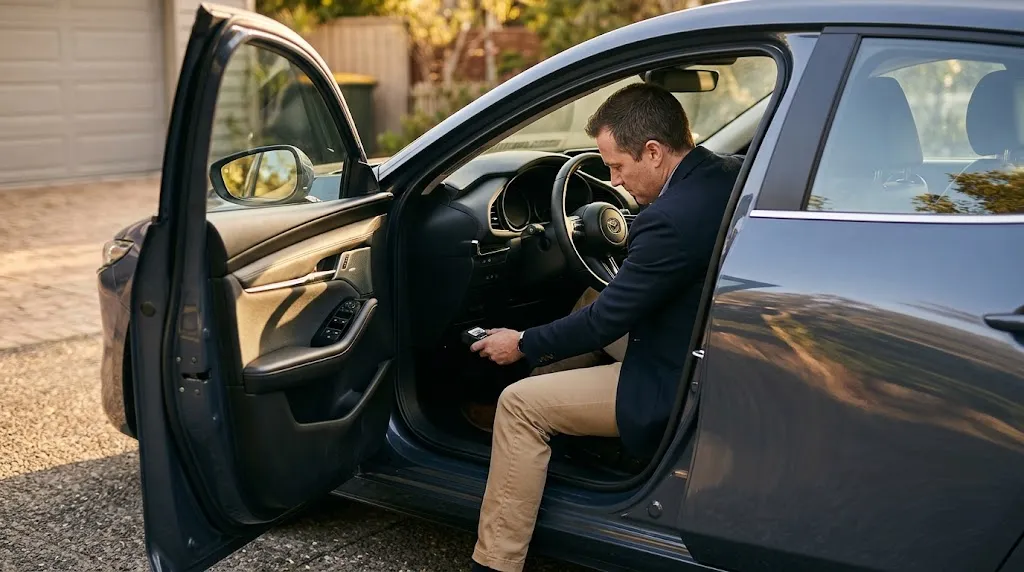
The biggest later tightening was communication, not the connector. From the 2008 model year, cars sold in the US were required to use ISO 15765-4, the CAN-based protocol. That is why a modern generic scanner usually connects quickly to a post-2008 car, while a 1996–2007 car may need a scanner that still supports the older protocols.
The difference between OBD2 and CAN is worth keeping straight: OBD2 is the diagnostic system and its rules, while CAN is the communication method that later became mandatory underneath it. Confusing the two leads to the mistaken idea that CAN “replaced” OBD2 in 2008. It did not; it standardized how OBD2 data travels.
Later emissions rules and vehicle electronics have added more data and more manufacturer-specific functions, but they have not removed the basic OBD2 doorway on compliant light vehicles. That continuity is the reason a code reader bought today can still read a 1996 car, provided it supports that car’s protocol.
Mistakes That Make the Date Confusing
Three misunderstandings recur. The first is treating build date and model year as the same thing; a car built in 1995 can still be a 1996 model. The second is assuming a 16-pin port proves full OBD2 compliance, when some transition cars had a similar port without complete OBD2 support. The third is applying the US date to Europe, where petrol and diesel cars followed in 2001 and 2004.
A related mistake is assuming “standard” meant “identical in every detail.” Generic emissions codes became comparable, but manufacturers still kept proprietary codes and functions beyond the generic set. A generic scanner therefore answers the emissions question well, while deeper body, chassis, or manufacturer-specific diagnosis may still need a more capable tool.
Related Product
OBD2 Scanner
A basic OBD2 scanner is the practical way to confirm the port, generic codes, and readiness monitors discussed above on a 1996-or-newer car.
As an Amazon Associate, we earn from qualifying purchases.
Frequently Asked Questions
Did OBD2 become standard in 1996 or 1994?
1996 is the required standard for US passenger cars and light trucks. 1994 was the start of the phase-in, so some earlier models already had OBD2, but it was not yet required for every car.
Is my 1995 car OBD2?
Possibly, but do not assume it. Check the under-hood emissions label for “OBD II Certified” or “OBD II Compliant,” look for the 16-pin port, and try a generic scan. A 1995 car without that label is likely using an earlier, non-standard system.
Did Europe get OBD2 at the same time as the US?
No. Europe’s EOBD system became mandatory for petrol cars from 2001 and diesel cars from 2004, with newly introduced models covered a year earlier in each case.
Why do some 1996 cars use different communication protocols?
OBD2 standardized the connector, generic codes, and diagnostic services first, but it initially allowed several protocols. CAN became the required US protocol only from the 2008 model year, so earlier cars may use J1850, ISO 9141-2, or KWP2000.
Does a 16-pin port guarantee that a car is OBD2 compliant?
Not on its own, especially for transition-year cars. The port is a strong clue, but the emissions label and a successful generic scan are better confirmation, because a similar port does not always mean complete OBD2 support.
Has OBD2 been replaced by a newer standard?
No, not for the basic emissions-diagnostic doorway on compliant light vehicles. Later rules changed the communication protocol and added more data, but the 1996 OBD2 foundation, including the standard connector and generic codes, remains in use.
Conclusion
OBD2 became standard in the United States with the 1996 model year for passenger cars and light trucks. That date is the right answer for most US owners, provided it is read as a model-year and market rule, not a global switch. Europe followed with EOBD for petrol cars in 2001 and diesel cars in 2004, and CAN later unified US communication from 2008. If your car sits near one of those boundaries, check the model year, the emissions label, and the port before assuming what it supports.

I’m Alex Rahman, a car enthusiast and automotive writer focused on practical solutions, car tools, and real-world driving advice. I share simple and honest content to help everyday drivers make better decisions.
