What Cars Don’t Use OBD2? Vehicles and Exceptions Explained
Quick Answer
Cars that don’t use OBD2 are mainly vehicles built before 1996 for the U.S. market, older imports, certain heavy-duty trucks, and some vehicles sold in countries that adopted standardized diagnostics later. Fully electric vehicles also have different diagnostic needs. Most 1996-and-newer U.S. passenger cars use OBD2, but compatibility depends on the vehicle’s original market, model year, and emissions certification. See how to use an OBD2 scanner once you’ve confirmed compatibility.
Vehicles That May Not Support Standard OBD2
- Pre-1996 U.S. cars: Most use OBD1 or older manufacturer-specific diagnostic systems.
- Older European cars: Many petrol vehicles before 2001 and diesels before 2004 lack standardized EOBD support.
- Older Japanese imports: Some domestic-market vehicles use manufacturer-specific protocols.
- Heavy-duty vehicles: Some trucks use different diagnostic connectors, standards, and communication systems.
- Classic vehicles: Carbureted cars and vehicles without electronic engine controls may have no diagnostic interface.
- Fully electric vehicles: Standard engine-emissions OBD2 functions generally don’t apply, although diagnostic ports may exist.
How to Verify Compatibility
- Check the model year: Start with the vehicle’s original sales market and engine type.
- Inspect the emissions label: Look for an OBD II certification statement when applicable.
- Confirm the protocol: A 16-pin connector alone doesn’t prove compatibility.
Ever plugged an OBD2 scanner into an older car and watched it fail to connect? I’ve found that the most useful starting point is identifying the vehicle’s diagnostic standard before blaming the scanner.
Some vehicles predate OBD2, while others use similar connectors without supporting its communication protocols. I’ll explain which vehicles fall outside the standard, how to check yours, and what tools make sense.
What Is OBD2, and Why Don’t All Cars Have It?
OBD2, or On-Board Diagnostics II, is a standardized system for monitoring vehicle emissions-related components and reporting diagnostic trouble codes. It allows compatible scanners to communicate with a vehicle’s electronic control systems through a standardized interface.
The standard became widely required for U.S. passenger cars starting with the 1996 model year. Vehicles built before that transition often used different diagnostic designs.
How OBD2 Works
An OBD2-compatible vehicle monitors selected engine and emissions systems through electronic sensors and control modules. When the system detects certain faults, it can store a diagnostic trouble code and illuminate the check engine light.
Common OBD2 functions include:
- Reading standardized diagnostic trouble codes (DTCs).
- Checking emissions readiness monitors.
- Viewing supported engine sensor data.
- Retrieving freeze-frame information.
- Clearing certain diagnostic codes after repairs.
For regulatory background, the U.S. Environmental Protection Agency (EPA) maintains information about vehicle emissions systems and diagnostic requirements.
What’s the Difference Between OBD1 and OBD2?
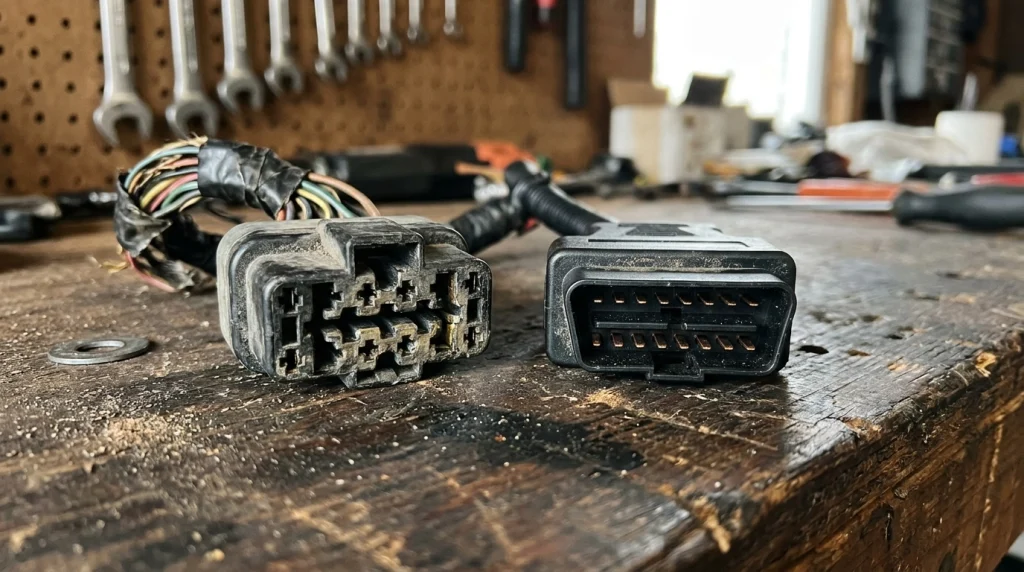
OBD1 refers broadly to earlier onboard diagnostic systems that were less standardized across manufacturers. OBD2 introduced more consistent diagnostic codes, connector specifications, and emissions-related communication requirements.
That difference matters when selecting tools. An OBD1-capable scanner may need a manufacturer-specific cable and software, even when an OBD2 tool works with newer vehicles.
| Feature | OBD1 | OBD2 |
|---|---|---|
| Common U.S. model years | Mostly before 1996 | Mostly 1996 onward |
| Connector | Manufacturer-specific | Standardized 16-pin DLC |
| Communication | Varies by manufacturer | Standardized protocols |
| Diagnostic codes | Often manufacturer-specific | Generic and manufacturer-specific |
| Scanner choice | OBD1-compatible equipment | Compatible OBD2 scanner |
Which Cars Made Before 1996 Don’t Use OBD2?
Most U.S.-market passenger cars built before 1996 weren’t required to have fully standardized OBD2. Many used earlier electronic systems, while some classic vehicles had no comparable onboard diagnostics.
These examples illustrate the different systems you may encounter:
- 1993 Honda Civic: Common U.S. versions use Honda’s earlier diagnostic system rather than standard OBD2.
- 1994 Toyota Camry: Many versions use Toyota-specific diagnostic procedures.
- 1993 Ford Mustang: Common U.S. versions use Ford’s EEC-IV diagnostic system.
- 1994 Chevrolet Camaro: Diagnostic support varies by engine and configuration, with transitional GM systems on some versions.
- Older carbureted vehicles: Many lack the electronic controls needed for scanner-based diagnostics.
However, the 1996 cutoff isn’t absolute for every earlier vehicle. Some 1994 and 1995 models introduced OBD2-compatible equipment before the nationwide requirement.
Do 1995 Cars Have OBD2?
Some 1995 vehicles have OBD2, but many don’t. The answer depends on their original emissions certification and the exact engine and model configuration.
For example, certain transitional vehicles used a 16-pin connector while retaining nonstandard diagnostic communication. I’ve found that checking the emissions label prevents a lot of unnecessary scanner troubleshooting.
The U.S. Government Publishing Office provides access to federal regulatory records covering the development of onboard diagnostic requirements.
What Cars Outside the United States Don’t Use OBD2?
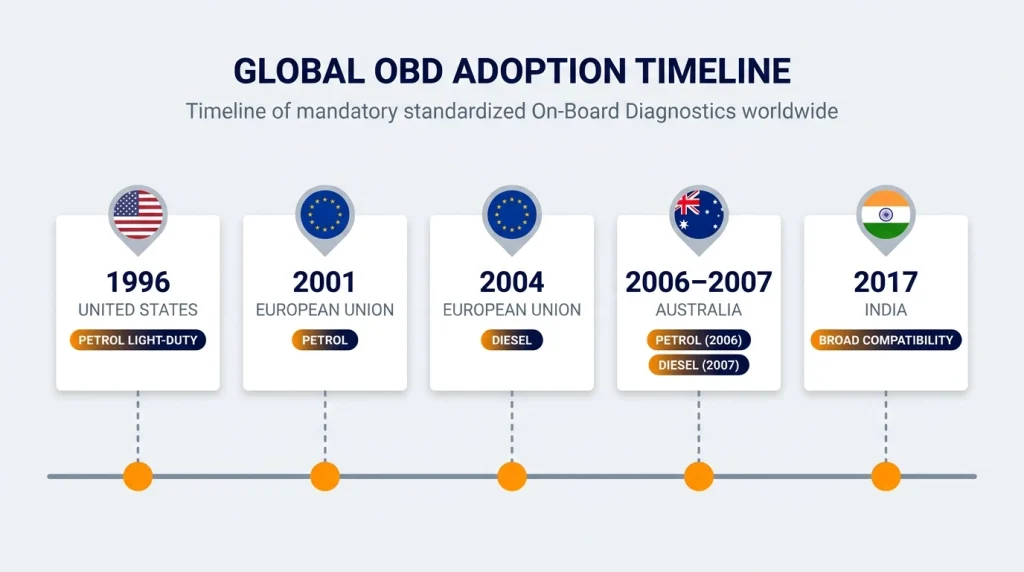
Vehicles sold outside the United States followed different implementation schedules. A car’s manufacturing country doesn’t establish compatibility; its original sales market matters more.
Many regions adopted their own OBD-related emissions regulations years after the U.S. transition. This explains why a newer imported car may not communicate with a generic American OBD2 scanner.
European Cars and EOBD
European On-Board Diagnostics (EOBD) serves a similar emissions-monitoring purpose to U.S. OBD2. Common reference years are 2001 for petrol passenger cars and 2004 for diesel passenger cars, with regulatory exceptions and transitional coverage.
Older European-market vehicles may have proprietary systems even when a familiar diagnostic connector is present.
Japanese Domestic Market Vehicles
Some Japanese Domestic Market (JDM) vehicles use manufacturer-specific diagnostic protocols rather than fully standardized OBD2. Their support can differ from an otherwise similar model originally sold in the United States.
For example, Toyota, Nissan, and Honda models may require brand-specific diagnostic capability depending on their model year and market. Always verify the exact chassis and engine configuration.
Other International Markets
Countries including Australia, India, and Brazil introduced standardized onboard diagnostics on different schedules. As a result, applying the U.S. 1996 rule globally can lead to incorrect compatibility assumptions.
The following table provides practical reference points rather than guarantees for every vehicle class.
| Original Market | Useful Reference Year | Important Note |
|---|---|---|
| United States | 1996 petrol light-duty | Earlier vehicles need individual checking; diesel and heavier classes differ. |
| European Union petrol | 2001 | Transitional and vehicle-class exceptions apply. |
| European Union diesel | 2004 | Some 2004–2006 vehicles have limited generic support. |
| Australia petrol | 2006 | Earlier support varies by vehicle. |
| Australia diesel | 2007 | Confirm equipment and engine coverage. |
| India | 2017 for broad generic compatibility | Some 2013–2016 models have limited support. |
Important: These are compatibility guidelines, not universal legal start dates. The OBDLink vehicle compatibility reference provides further market-specific details.
Do Diesel Cars and Heavy-Duty Trucks Use OBD2?
Many diesel cars use OBD2-compatible diagnostics, but requirements depend on their model year, weight classification, and market. Heavy-duty trucks may use different diagnostic standards and connectors.
For U.S. light-duty diesel vehicles below 8,500 pounds gross vehicle weight rating, federal OBD requirements reached full implementation for the 1997 model year. Heavier vehicle classes followed different phase-in schedules.
Heavy-Duty Diagnostic Standards
Commercial trucks frequently use protocols such as SAE J1939 to communicate between electronic control units. Depending on the truck, diagnostics may use a heavy-duty connector instead of a passenger-car-style 16-pin port.
Examples include older configurations of:
- Freightliner commercial trucks.
- Kenworth heavy-duty trucks.
- Peterbilt commercial vehicles.
- International medium- and heavy-duty trucks.
These brands also manufacture newer vehicles with more advanced diagnostic capabilities. The brand alone doesn’t determine which scanner is appropriate.
Do Electric and Hybrid Cars Have OBD2?
Hybrid vehicles commonly support standardized emissions diagnostics for their gasoline engines. Fully electric vehicles don’t have combustion-engine emissions systems, so conventional OBD2 functions aren’t necessarily useful or available.
Hybrid Vehicle Compatibility
A hybrid Toyota Prius, for example, may support generic engine codes through OBD2. Reading traction-battery health or inverter faults generally requires enhanced vehicle-specific diagnostic coverage.
A basic scanner isn’t automatically a complete hybrid diagnostic tool.
Fully Electric Vehicle Diagnostics
Electric vehicles such as Tesla models may provide diagnostic connections or service interfaces, but those don’t necessarily offer conventional OBD2 engine-emissions data. Manufacturer-specific hardware and software may be required.
Don’t assume every vehicle with an electrical diagnostic port supports standard OBD2 commands.
How Can You Tell If Your Car Is OBD2 Compatible?
The safest method is to verify the vehicle’s model year, original sales market, emissions label, and supported communication protocol. Checking only the connector shape can produce misleading results.
Step-by-Step Compatibility Check
- Identify the model year. Use the vehicle documents or manufacturer identification information, not just its registration date.
- Confirm the original market. Determine where the vehicle was originally sold new.
- Inspect the diagnostic connector. A standard OBD2 connector has 16 positions and commonly sits beneath the dashboard.
- Read the emissions certification label. Check for an OBD II certification statement where applicable.
- Review the vehicle manual. Look for onboard diagnostics, service connector, or scan-tool information.
- Check scanner coverage. Confirm the tool supports the make, model, engine, and year.
- Attempt a supported diagnostic connection. Follow the scanner instructions before deciding the vehicle is incompatible.
One practical tip: take a clear photo of the connector before buying an adapter. That makes it easier to compare connector shape and pin locations against the manufacturer’s documentation.
Does a 16-Pin Connector Always Mean OBD2?
No. Some vehicles have a 16-pin connector without implementing the standardized OBD2 communication functions expected by generic scanners.
Physical compatibility doesn’t guarantee software compatibility. If you’re unsure which protocol your vehicle uses, read this guide to the five main OBD2 protocols.
Why Won’t an OBD2 Scanner Connect to My Car?
A connection failure doesn’t automatically mean the car lacks OBD2. A compatible vehicle can also refuse communication because of electrical faults, incorrect ignition settings, or scanner limitations.
Check these common causes before replacing your diagnostic tool:
- Ignition position: The scanner may require the key in the ON position with the engine off.
- Blown fuse: A damaged diagnostic-port power circuit may prevent the scanner from operating.
- Weak battery: Low voltage can disrupt communication.
- Damaged connector: Bent or corroded pins may interrupt power or data.
- Unsupported protocol: The scanner may not recognize the vehicle’s communication system.
- Faulty wiring or module: A communication network problem may block access to the vehicle computer.
For a more detailed troubleshooting process, see what to do when an OBD2 scanner has power but won’t communicate.
Can an Adapter Make an OBD1 Car Work With OBD2?
A connector adapter alone can’t convert OBD1 communication into standardized OBD2. It only changes the physical connection unless the equipment includes compatible electronic translation and diagnostic software.
For an older Ford, GM, Toyota, or Honda, choose a diagnostic solution designed for that vehicle’s original system. Avoid buying a cable based only on matching connector shapes.
What Diagnostic Tools Work With Cars That Don’t Use OBD2?

Vehicles without OBD2 often need different diagnostic methods. The right choice depends on whether the car has OBD1 electronics, manufacturer-specific systems, or no electronic diagnostics at all.
OBD1 and Manufacturer-Specific Scan Tools
Some older vehicles need dedicated scanners or compatible diagnostic cables. Others allow limited fault retrieval through dashboard warning-light sequences or manufacturer-prescribed procedures.
Always follow the vehicle service manual before attempting electrical diagnostic tests.
Mechanical Diagnostic Tools
Older carbureted vehicles may require traditional testing rather than electronic scanning. Common tools include:
- Digital multimeters for electrical testing.
- Compression testers for engine mechanical condition.
- Fuel-pressure gauges matched to the fuel system.
- Vacuum gauges for suitable gasoline engines.
- Manufacturer service manuals and wiring diagrams.
These tools complement electronic diagnostics rather than replacing every scanner function.
When a Modern OBD2 Scanner Still Makes Sense
If you maintain multiple cars, a modern OBD2 scanner can still be useful for compatible vehicles. I recommend checking compatibility before comparing advanced features or prices.
Our OBD2 scanner buying guide explains which features matter most.
Recommended Diagnostic Tools for Compatible Vehicles
If you’ve confirmed that your vehicle supports OBD2, these are three practical options worth comparing. None should be purchased as a guaranteed solution for an older OBD1 vehicle.
Affiliate disclosure: As an Amazon Associate, we may earn from qualifying purchases at no additional cost to you.
🏆 Best for Basic Diagnostics
ANCEL AD310 OBD2 Scanner
★★★★☆ 4/5 editorial suitability
A handheld code reader designed for basic standardized OBD2 diagnostics, including trouble-code reading and readiness checks. I favor this type of simple tool for owners who want straightforward engine fault information without smartphone pairing.
📱 Best for Phone-Based Diagnostics
BlueDriver Bluetooth Pro OBD2 Scan Tool
★★★★☆ 4.5/5 editorial suitability
A Bluetooth diagnostic adapter designed to work with a companion smartphone application. I’d consider this approach when code explanations and phone-based diagnostic reports are more useful than a separate handheld screen.
🔧 Best for Additional Diagnostic Information
Autel AutoLink AL519
★★★★☆ 4/5 editorial suitability
A handheld OBD2 diagnostic tool offering standardized trouble-code functions, live data, and emissions readiness information. It’s a sensible option for owners who want more diagnostic detail while retaining a standalone scanner.
Buying reminder: These editorial scores describe suitability for the stated use cases, not measured customer-review averages or hands-on test results. Confirm current features, vehicle coverage, and seller information before purchasing.
Frequently Asked Questions
Does every car made after 1996 have OBD2?
No. Most 1996-and-newer U.S.-market gasoline passenger cars and light trucks use standardized OBD2, but the rule doesn’t cover every vehicle worldwide. Some imports, commercial trucks, and vehicles in other regulatory categories follow different standards or implementation dates. Check the original market and emissions certification.
Can I use an OBD2 scanner on a 1994 car?
Possibly, but many 1994 vehicles use OBD1 or proprietary systems. Some transitional models introduced OBD2 equipment earlier than required. Check the underhood emissions label, diagnostic connector, and manufacturer service information. A compatible-looking plug alone doesn’t guarantee communication with a standard OBD2 scanner.
Do all Japanese cars have OBD2?
No. Japanese vehicles built for the U.S. market generally follow applicable U.S. OBD2 requirements, while Japanese domestic-market models may use different systems. Two vehicles with the same manufacturer and similar appearance can have different diagnostic capabilities because of their market, engine, or production year.
Can a car run without an OBD2 system?
Yes. Many classic vehicles operate without OBD2 because they were manufactured before standardized electronic emissions diagnostics became mandatory. Modern vehicles generally must meet the applicable emissions requirements for their class and market. Removing or disabling required emissions equipment is a separate legal and mechanical issue.
What should I do if my vehicle doesn’t support OBD2?
Identify its original diagnostic system before purchasing equipment. You may need an OBD1 scanner, manufacturer-specific cable, service manual, or conventional mechanical testing tools. For a classic or unusual import, a technician familiar with that vehicle may help identify the correct diagnostic procedure and avoid incompatible adapters.
Final Takeaway: Know Your Vehicle Before Buying a Scanner
Most cars that don’t use OBD2 are older vehicles, certain imports, and vehicles belonging to categories with different diagnostic requirements. The U.S. 1996 model-year guideline is useful, but it isn’t a universal rule for every vehicle.
As of 2026, the most reliable approach remains checking your car’s original market, emissions label, and actual protocol support. That small compatibility check can prevent wasted purchases and make your next diagnostic session far more productive.
Next step: Find your vehicle’s model year and original sales market, then verify scanner compatibility before choosing a diagnostic tool.

I’m Alex Rahman, a car enthusiast and automotive writer focused on practical solutions, car tools, and real-world driving advice. I share simple and honest content to help everyday drivers make better decisions.
