How Much Does a Professional OBD2 Diagnostic Test Cost?
Quick Answer
In the United States, a professional OBD2 diagnostic test typically costs about $50–$160 at an independent repair shop, while dealership diagnostics can cost $100–$400 or more for complex problems. A basic code scan may be free, but a complete diagnosis includes interpreting trouble codes and performing additional tests to identify the underlying fault. Before paying, ask what the diagnostic fee covers and whether the shop will apply it toward the repair.
What affects the price?
- Basic code scan: Free at some auto parts stores or around $30–$100 at a paid service provider.
- Independent mechanic: Often $50–$160 for a standard diagnostic appointment.
- Dealership testing: Commonly $100–$400 or more, depending on labor rates and complexity.
- Advanced diagnostics: Intermittent electrical faults, transmission issues, and multi-system problems can require additional paid testing.
- Repair charges: Parts, labor, and replacement components are generally billed separately unless the estimate specifies otherwise.
How can you avoid overpaying?
- Ask whether the fee covers a code scan only or hands-on troubleshooting.
- Request approval before additional diagnostic time or repairs begin.
- Save any existing trouble codes before clearing them or disconnecting the battery.
A check engine light can appear without warning, leaving you wondering whether your car needs a quick scan or a costly repair. The price depends on how deeply a technician must investigate the problem, not simply on plugging in a scanner.
I’m Alex Rahman, and in this guide, I’ll break down typical diagnostic fees, explain what you’re paying for, and show you how to compare professional testing with a do-it-yourself OBD2 scanner. The goal is to help you spend money on useful diagnostic work rather than unnecessary guesswork.
What Is a Professional OBD2 Diagnostic Test?
A professional OBD2 diagnostic test is a vehicle troubleshooting process that uses an electronic scan tool and additional testing, when needed, to identify the cause of a warning light or performance problem. It can include retrieving diagnostic trouble codes, reviewing sensor readings, checking vehicle systems, and testing suspected components.
OBD2 stands for On-Board Diagnostics II. In the United States, standardized OBD2 requirements cover most light-duty gasoline vehicles from the 1996 model year onward, although vehicle-specific capabilities and requirements vary.
The important distinction is that a diagnostic trouble code identifies a detected condition, not necessarily a failed part. For example, an oxygen-sensor-related code might result from a faulty sensor, an exhaust leak, damaged wiring, or another underlying problem.
What does a technician do during the test?
A professional diagnosis commonly involves several stages, depending on the complaint and the vehicle.
- Initial assessment: The technician asks about warning lights, unusual noises, starting trouble, and driving symptoms.
- Code retrieval: A scan tool reads available stored, pending, and other supported diagnostic codes.
- Data analysis: The technician reviews relevant live sensor readings and freeze-frame information, which records selected conditions when a fault occurred.
- Follow-up testing: The technician may inspect connectors, test electrical circuits, check fuel pressure, or perform other procedures.
- Findings and estimate: The shop explains the likely cause, recommends repairs, and provides pricing for the next step.
Not every appointment includes every stage. A simple fault may require little additional work, while an intermittent electrical problem can take hours to reproduce and isolate.
How Much Does a Professional OBD2 Diagnostic Test Cost in 2026?
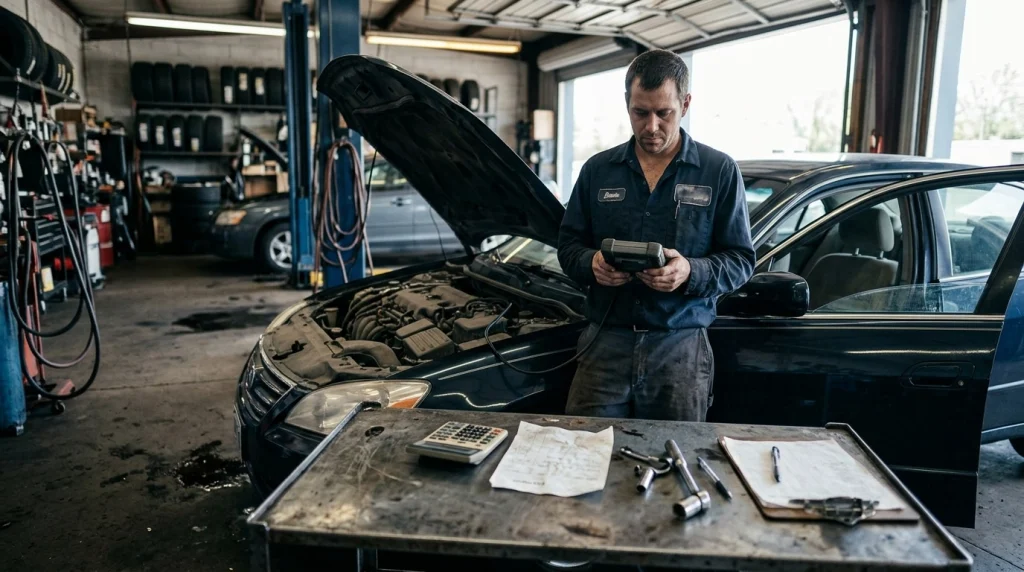
For U.S. drivers in 2026, budgeting roughly $50–$160 for a standard independent-shop diagnostic is a reasonable starting point. Dealership and advanced diagnostic work can cost substantially more, particularly when a technician must investigate several systems or a fault that appears only occasionally.
The following ranges are planning estimates, not a national fixed price list. Actual charges depend on the shop, vehicle, location, and work included.
| Diagnostic service | Estimated U.S. cost | Typical scope |
|---|---|---|
| Basic parts-store scan | $0 | Basic check-engine code retrieval at participating locations |
| Paid basic code scan | $30–$100 | Code retrieval and a limited explanation |
| Independent mechanic | $50–$160 | Standard diagnostic assessment and some follow-up testing |
| Dealership diagnostic | $100–$400+ | Manufacturer-specific diagnostics and more involved troubleshooting |
| Complex electrical diagnosis | $150–$400+ | Intermittent faults, wiring tests, or extended investigation |
These categories can overlap. A dealership might charge less for a straightforward scan, while an independent specialist could charge more for a difficult electrical problem.
For a practical comparison, a $90 diagnostic appointment at an independent shop may be better value than a $40 code-only scan if the mechanic also checks relevant sensor data and explains the findings. Compare the scope of work, not just the advertised fee.
Why Does the Cost of an OBD2 Diagnostic Test Vary?
The final bill reflects the technician’s time, the equipment required, the vehicle’s diagnostic complexity, and the shop’s pricing policy. A scan that identifies a clear fault quickly costs less than an investigation that requires several tests.
1. Shop labor rates
Many repair shops price diagnostics using a minimum labor charge or a set diagnostic package. If a shop charges $120 per hour and bills one hour for diagnosis, the initial fee is $120 even if connecting the scanner takes only a few minutes.
Ask whether the quoted amount covers a fixed assessment or the first block of labor. This distinction helps you understand what happens if the technician needs more time.
2. Fault complexity
Some codes point toward a well-defined system problem, while others require more investigation. A misfire, for example, can involve an ignition coil, spark plug, fuel delivery, compression, or wiring.
Intermittent problems are especially challenging. A vehicle may run normally during the appointment, forcing the technician to examine recorded data, reproduce the symptom, or test the circuit under specific conditions.
3. Vehicle make and diagnostic coverage
Some vehicles require manufacturer-specific software or specialized procedures to access enhanced system information. Luxury vehicles, newer models, hybrids, and vehicles with complex electronic systems may need more specialized equipment or expertise.
A generic OBD2 scanner typically focuses on standardized engine and emissions-related information. Access to ABS, airbag, transmission, body-control, and other modules depends on the scanner and vehicle.
4. Location and service type
Labor rates often vary between regions and even between nearby repair facilities. A mobile mechanic may also include travel time or a call-out fee in the quoted price.
Before booking, compare two or three local providers and ask each one to describe the diagnostic service included in its estimate.
Does a Free OBD2 Scan Tell You What’s Wrong With Your Car?
A free scan can tell you which diagnostic trouble codes the vehicle has stored, but it usually cannot confirm the root cause by itself. It is a useful first step when you want to understand a check engine light before deciding whether to pay for professional testing.
Some U.S. auto parts retailers offer complimentary check-engine code scans, although availability and service details can vary by location.
What a free scan can tell you
- The diagnostic trouble code recorded by the vehicle.
- A general description of the affected system or condition.
- Whether further investigation may be necessary.
What a free scan may not include
- Testing a sensor or electrical circuit to confirm the cause.
- Reviewing advanced live data or manufacturer-specific modules.
- Reproducing intermittent symptoms or checking mechanical condition.
- Providing a detailed written repair diagnosis.
For example, a P0420 code generally relates to catalyst-system efficiency being below the threshold expected by the vehicle’s diagnostic system. That code does not automatically prove the catalytic converter has failed.
A technician may need to assess oxygen-sensor signals, exhaust leaks, engine performance, and other relevant conditions before recommending an expensive replacement.
The U.S. Environmental Protection Agency explains how onboard diagnostics monitor emissions-related faults and record diagnostic information. You can explore its official emissions resources for additional background.
Professional Diagnostic Test vs. DIY OBD2 Scanner: Which Is Better?
A DIY scanner is useful for reading codes and monitoring supported vehicle data, while a professional diagnostic appointment provides access to technical testing and repair expertise. The right choice depends on how often you need diagnostics and whether you can interpret the information correctly.
| Factor | DIY scanner | Professional service |
|---|---|---|
| Initial cost | Often about $20–$150 for basic tools | Often $50–$160 at an independent shop |
| Code retrieval | Yes, if supported | Yes |
| Live data | Depends on the tool | Usually available with appropriate equipment |
| Advanced troubleshooting | Limited by coverage and user skill | Can include electrical and mechanical tests |
| Best use | Routine checks and preliminary troubleshooting | Confirming faults and planning repairs |
Suppose you buy a $60 scanner and use it for three separate code checks over a year. That may cost less than paying $90 for each of three basic diagnostic appointments, provided the scanner supports your needs and you can interpret the results appropriately.
However, a scanner cannot replace every professional test. If the issue involves a safety system, difficult electrical fault, or unclear drivability problem, professional diagnosis may save money by preventing unnecessary parts replacement.
For help comparing features before buying, see this guide to what to look for in an OBD2 scanner.
When Should You Pay for a Professional Diagnostic Test?
Pay for professional diagnosis when a warning light persists, a problem affects how the vehicle runs, or a code does not provide enough information to identify the cause. A professional assessment is particularly valuable when replacing the wrong component could cost hundreds of dollars.
- The check engine light returns: A recurring code suggests that the underlying condition may remain unresolved.
- The car runs poorly: Stalling, misfires, hesitation, or starting trouble may require tests beyond code retrieval.
- Several warning lights appear: Multiple systems may require enhanced scanning and additional checks.
- The fault is intermittent: A technician may need to reproduce the issue or inspect live data.
- You are buying a used vehicle: A diagnostic scan can contribute useful information, but it should not replace a complete pre-purchase inspection.
One warning deserves special attention: if the check engine light flashes while the engine runs, reduce engine load and stop driving when safe. A flashing light can indicate a severe misfire that may damage the catalytic converter, so arrange prompt professional advice.
For braking, steering, airbag, overheating, or other serious safety symptoms, do not rely on a basic code scan to decide whether the vehicle is safe to drive.
How Can You Lower Your Professional Diagnostic Bill?
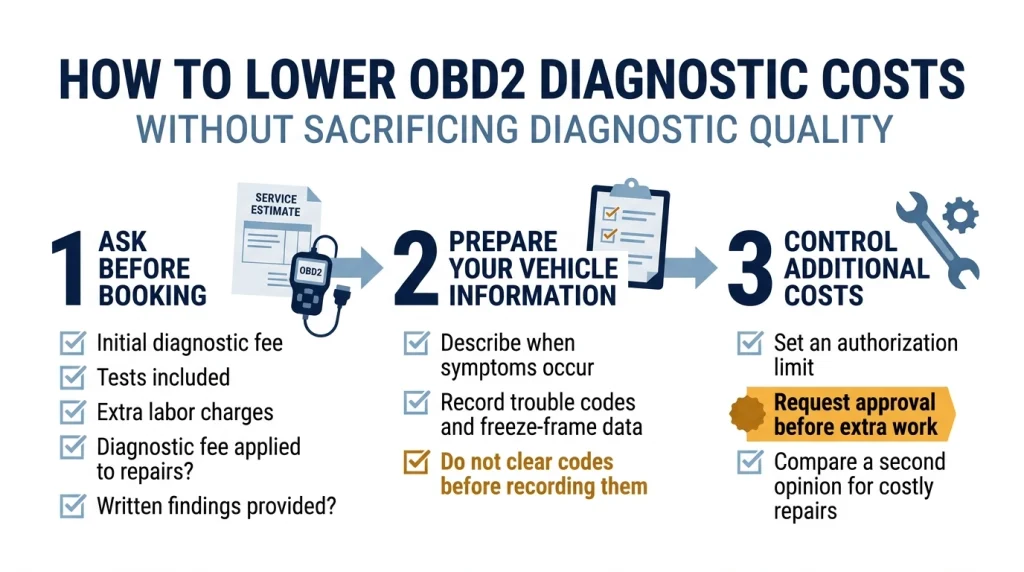
You can often reduce diagnostic costs by preparing useful information, comparing service packages, and agreeing on a spending limit before the mechanic starts testing. The aim is to help the technician find the fault efficiently without sacrificing the quality of the diagnosis.
Ask these questions before booking
- What is the initial fee? Confirm the exact price for the diagnostic appointment.
- What does it include? Ask whether the shop will interpret codes, inspect relevant components, and perform basic follow-up tests.
- Is additional time billed separately? Find out the hourly rate and whether you will receive approval requests.
- Does the fee apply toward repairs? Some shops credit the diagnostic fee toward approved work, while others charge separately.
- Will I receive the findings? Request the codes, test results, suspected cause, and repair estimate.
The Federal Trade Commission’s auto repair consumer guide recommends comparing repair shops, understanding diagnostic charges, and requesting written estimates before authorizing work.
Prepare your car’s symptoms in advance
Describe exactly what happens, when it happens, and whether the warning light stays on or flashes. Details such as a rough idle after a cold start or hesitation during acceleration can help the technician choose relevant tests.
If you already own an OBD2 scanner, record the codes and available freeze-frame data before clearing anything. Share those findings with the mechanic, but avoid presenting a code description as proof that a particular part has failed.
Set a diagnostic spending limit
Ask the shop to contact you before exceeding the initial estimate or performing extra work. A written authorization limit helps prevent an uncomplicated appointment from turning into an unexpectedly expensive investigation.
If a repair recommendation seems unusually costly, consider a second opinion before approving major parts replacement. Make sure the second shop understands which tests have already been performed so you can avoid paying to repeat unnecessary work.
Should You Buy an OBD2 Scanner Instead of Paying for Repeated Tests?
Buying your own scanner can make financial sense if you regularly troubleshoot vehicles, check used cars, or want to monitor common engine faults. However, occasional drivers may spend less by using a free basic scan and paying a professional when deeper testing becomes necessary.
For most DIY owners, start by matching the scanner’s capabilities to the problems you expect to investigate. You do not need a professional diagnostic tablet just to read a standard check engine code.
These are three scanner options worth comparing by function and intended use; confirm current prices, exact model specifications, and vehicle coverage before purchasing.
BUDGET-FRIENDLY DIY
ANCEL AD310 Classic Enhanced Universal OBD II Scanner
★★★★☆
A wired handheld reader designed for basic engine and emissions-related code retrieval. I’d consider this type of tool for occasional checks rather than advanced multi-system diagnosis.
WIRELESS DIY CHECKS
BlueDriver Bluetooth Pro OBDII Scan Tool
★★★★☆
This phone-connected tool provides code reading and supported enhanced diagnostic information. I’d compare its vehicle coverage and app requirements if I wanted more detail than a basic handheld reader provides.
ADVANCED DIY DIAGNOSTICS
Autel MaxiCOM MK808BT Pro
★★★★☆
A more advanced diagnostic tablet aimed at users who need broader system access and selected service functions. I’d verify exact vehicle coverage and software-update costs before choosing a tool in this category.
These are product suggestions based on their intended tool categories, not claims of hands-on testing or independently verified ratings. Product availability and specifications can change, so check the current listing and the manufacturer’s compatibility information before ordering.
If you are still deciding which features matter, use this related guide on essential OBD2 scanner features to narrow your options.
Frequently Asked Questions
How much should I pay for a basic OBD2 scan?
A basic scan may be free at participating auto parts stores, while a paid code-reading service may cost around $30–$100. If a mechanic charges more, ask whether the price includes interpreting the codes and checking the likely cause rather than simply retrieving fault numbers.
Is a $200 diagnostic fee reasonable?
A $200 diagnostic fee can be reasonable for dealership testing or a complicated fault that requires substantial technician time. For a simple code read, it may be expensive. Ask for a breakdown of the work, the labor rate, and the additional tests included before approving the charge.
Does a diagnostic fee include the repair?
Usually, the diagnostic fee covers investigating the fault rather than replacing parts or completing the repair. Some shops apply the fee toward approved repair work, but others charge for diagnosis separately. Confirm the shop’s policy and request a written estimate that separates testing, parts, and labor.
How long does a professional OBD2 diagnostic test take?
A straightforward scan may take 15–30 minutes, while a standard diagnostic appointment may take 30–60 minutes or longer. Intermittent electrical faults and problems requiring road tests or specialized measurements can take several hours. The time needed depends on the vehicle and the symptoms.
Can I diagnose my car without visiting a mechanic?
You can read many standard engine codes with a compatible DIY OBD2 scanner, but interpreting them correctly takes additional knowledge. A scanner cannot confirm every failed component or detect every mechanical problem. Use professional testing when the cause remains unclear or the issue affects safety or drivability.
Final Takeaway: Pay for the Diagnosis, Not Just the Code
A professional OBD2 diagnostic test generally costs about $50–$160 at an independent U.S. repair shop, with dealership and complex diagnostic services potentially reaching $400 or more. A free scan can help you get started, but it does not necessarily establish what repair your vehicle needs.
Before booking, compare the service scope, ask whether extra testing costs more, and confirm how the shop handles diagnostic fees when you choose another repair provider. Keep the initial findings and authorize further work only after reviewing the estimate.
If you routinely check your own vehicle, a suitable OBD2 scanner may help you reduce repeat code-reading costs. For faults that require deeper testing, a qualified technician can turn those initial codes into a more reliable diagnosis.

I’m Alex Rahman, a car enthusiast and automotive writer focused on practical solutions, car tools, and real-world driving advice. I share simple and honest content to help everyday drivers make better decisions.
