How Does OBD2 Work? The Complete Automotive Guide
Quick Answer
OBD2 (On-Board Diagnostics, Second Generation) works by having a vehicle’s network of Electronic Control Units (ECUs) continuously monitor engine, transmission, and emissions sensors, log Diagnostic Trouble Codes (DTCs) when parameters fall out of range, and transmit that data through a standardized 16-pin port whenever an external tool requests it.
What Is the Purpose of the OBD2 System?
Modern vehicles are no longer purely mechanical; they rely on complex electronic networks made up of dozens of computerized modules. Introduced as a mandatory federal standard for passenger vehicles, OBD2 was created to standardize how cars monitor and report emissions and powertrain performance.
Before OBD2, every automotive manufacturer used proprietary diagnostic plugs, communication protocols, and fault codes. This fragmentation meant a mechanic needed a different tool for every brand. OBD2 established a universal hardware port, a standard set of communication protocols, and a uniform code structure, turning vehicle diagnostics into a standardized process.
Core Components of the OBD2 Architecture
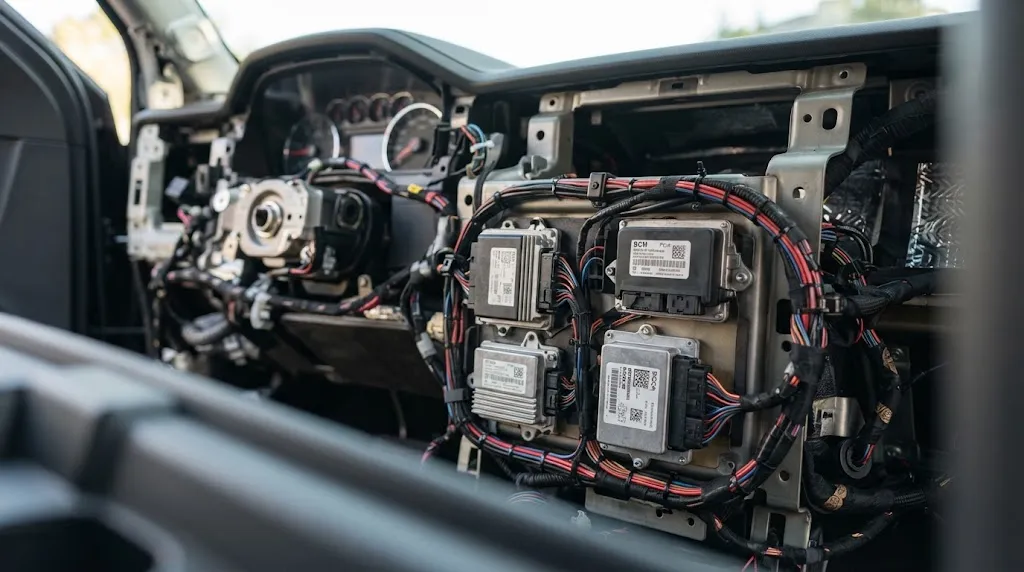
To understand how OBD2 works, it helps to look at its underlying structure. The system relies on three primary hardware and software layers working together behind the dashboard:
- Electronic Control Units (ECUs): The onboard computers—such as the Engine Control Module (ECM) and Transmission Control Module (TCM)—that manage specific vehicle subsystems.
- Sensors and Actuators: Sensors measure physical parameters like oxygen levels, coolant temperature, manifold pressure, and crankshaft speed, while actuators execute commands issued by the ECUs.
- The Data Link Connector (DLC): A standardized 16-pin trapezoidal port located inside the cabin, usually under the driver’s side dashboard near the steering column, providing direct access to the vehicle’s communication network.
How ECUs Monitor Systems and Log Faults
As you drive, the vehicle’s ECUs constantly poll live data streams from various sensors to ensure everything operates within factory parameters. For example, the oxygen sensor monitors unburned oxygen in the exhaust, while the mass air flow (MAF) sensor tracks incoming air volume.
If a sensor reading falls outside expected thresholds or a component fails a self-test, the ECU does two things:
- It illuminates the Malfunction Indicator Light (MIL)—commonly known as the check engine light—on the dashboard to alert the driver.
- It generates and stores a Diagnostic Trouble Code (DTC) in its non-volatile memory alongside freeze-frame data capturing the exact engine conditions at the moment the fault occurred.
Decoding Diagnostic Trouble Codes (DTCs)
Every OBD2 fault code consists of five characters that pinpoint the nature of the issue. Understanding how these codes are structured helps translate raw computer data into a logical diagnostic direction.
- First Character (Letter): Identifies the overarching vehicle system. P stands for Powertrain (engine and transmission), B for Body (airbags, climate control), C for Chassis (ABS, suspension), and U for Network communication.
- Second Character (Digit): Indicates whether the code is generic (0), meaning it applies to all OBD2-compliant vehicles, or manufacturer-specific (1).
- Third Character (Digit): Refers to the specific subsystem, such as fuel metering, ignition systems, or emissions controls.
- Fourth and Fifth Characters: Pinpoint the exact component or circuit fault causing the code to trigger.
Key Insight
A diagnostic trouble code points toward a symptom or a failing circuit, not an automatic part replacement. A code indicating a low oxygen sensor voltage often means an exhaust leak or a fuel delivery problem rather than a dead sensor.
Communication Protocols and Data Extraction
When an external code reader or scan tool is plugged into the 16-pin Data Link Connector, it does not magically fix the car; instead, it opens a communication channel with the vehicle’s internal network.
The tool initiates protocol negotiation to determine which communication standard the vehicle uses. Standardized protocols include SAE J1850 (used historically by Ford and GM), ISO 9141-2, and modern Controller Area Network (CAN Bus) protocols. Modern vehicles rely heavily on the CAN bus because of its high-speed data transfer rates across multiple control modules.
Once connected, the reader sends standardized Parameter Identification (PID) requests to the ECUs. For instance, requesting PID 0C asks for engine RPM, while PID 0D requests vehicle speed. The ECU responds with raw hexadecimal data, which the scanner translates into human-readable metrics, live graphs, and fault codes.
What Data Can an OBD2 System Access?
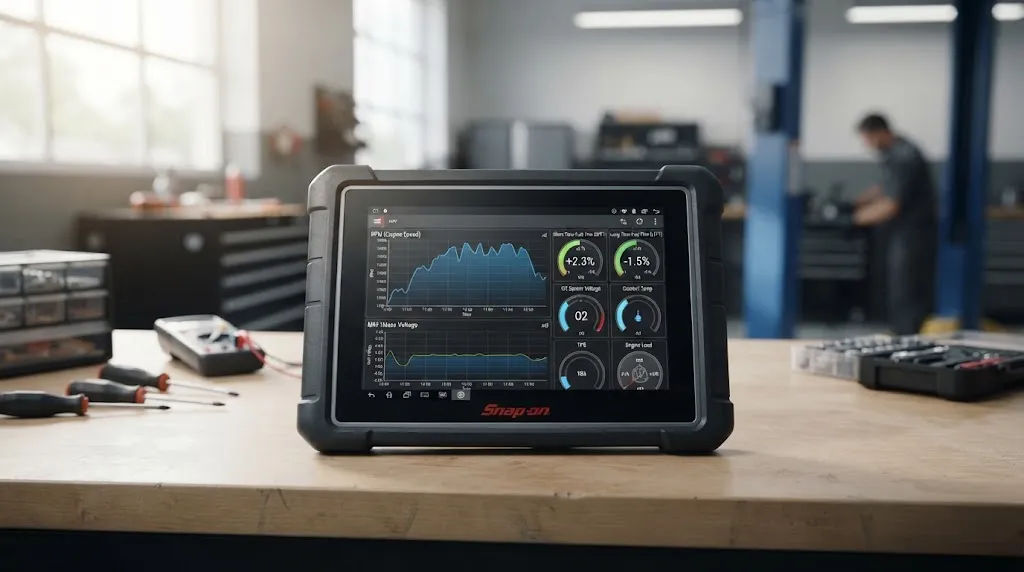
OBD2 systems provide far more than just check engine light codes. Diagnostic tools can pull several distinct categories of vehicle information:
- Live Data Streams: Real-time numerical values from sensors, including fuel trim levels, coolant temperature, manifold absolute pressure (MAP), and oxygen sensor switching rates.
- Freeze Frame Data: A stored snapshot of all vital sensor values captured precisely at the millisecond a fault code was triggered, helping technicians recreate the exact failure conditions.
- Readiness Monitors: Internal self-test flags that indicate whether emission control systems (such as the catalytic converter, EVAP system, and EGR valve) have completed their self-diagnostics, which is vital for passing state smog inspections.
- Pending Codes: Intermittent faults that have occurred once or twice but haven’t happened frequently enough to illuminate the permanent check engine light.
Warning
Do not clear diagnostic trouble codes before diagnosing the root problem. Erasing codes turns off the warning light, but if the underlying mechanical or electrical fault remains, the light will return. Furthermore, clearing codes resets all readiness monitors, which will cause an immediate failure on state emissions inspections.
The Evolution and Future of Vehicle Diagnostics
While standard OBD2 systems were originally built around tailpipe emissions compliance, their underlying architecture has evolved to support modern automotive technology. Today, wireless Bluetooth and Wi-Fi OBD2 dongles allow drivers to stream real-time vehicle analytics directly to smartphones. Furthermore, advanced diagnostic platforms utilize bi-directional controls, allowing technicians to send commands back through the port to actuate components, calibrate steering angles, and perform module software flashes.
Related Product
OBD2 Code Readers and Diagnostic Scanners
A reliable handheld or wireless OBD2 scanner lets you read live sensor data, check emissions readiness, and clear troubleshooting codes at home.
As an Amazon Associate, we earn from qualifying purchases.
Frequently Asked Questions
Where is the OBD2 port located in a vehicle?
On virtually all OBD2-compliant vehicles manufactured after 1996, the 16-pin diagnostic port is located inside the passenger cabin under the driver’s side dashboard, typically within arm’s reach of the steering column or center console.
Do all cars use OBD2 systems?
Yes. OBD2 is a legal mandate in the United States for all light-duty passenger cars and trucks built from 1996 onward. Similar standards were adopted later in Europe (EOBD) and other global regions.
What causes a check engine light if there are no codes?
If the dashboard light is illuminated but a basic scanner reports no codes, the issue may stem from a temporary communication glitch, a network fault that basic generic readers cannot access, or a non-powertrain module indicator that requires an advanced multi-system diagnostic tool.
Can an OBD2 scanner predict when a part will fail?
Basic code readers only report current faults or historical trouble codes. However, advanced diagnostic software and IoT data loggers can monitor long-term trends in live sensor data—such as slow oxygen sensor response times or battery voltage drops—to help predict component wear before a complete breakdown occurs.
What is the difference between generic and manufacturer-specific codes?
Generic codes (starting with a 0 after the system letter) are standardized across all automotive brands, defining common issues like misfires or catalyst efficiency drops. Manufacturer-specific codes (starting with a 1) are tailored by individual automakers to monitor proprietary systems and unique component layouts.
Does unplugging the car battery clear OBD2 codes?
Disconnecting the battery can temporarily clear active dashboard warning lights and volatile memory error codes on older vehicles, but modern vehicles store Diagnostic Trouble Codes in permanent EEPROM memory. Furthermore, cutting power erases powertrain adaptive learning maps and resets emission monitors, requiring a drive cycle to recalibrate.
Conclusion
The OBD2 system serves as the central nervous system for modern vehicle diagnostics. By standardizing how electronic control units monitor sensors, log fault codes, and communicate via a universal 16-pin port, OBD2 turns complex automotive troubleshooting into an accessible, structured process. Whether you are checking live engine data, tracking emission monitor readiness, or interpreting a diagnostic trouble code, understanding how this system operates allows you to approach vehicle maintenance with clarity and precision.

I’m Alex Rahman, a car enthusiast and automotive writer focused on practical solutions, car tools, and real-world driving advice. I share simple and honest content to help everyday drivers make better decisions.
