What Is an Active Test in Vehicle Diagnostics? Complete Guide
Quick Answer
An active test—frequently called bi-directional control—is a diagnostic function that allows a scan tool to send commands directly to a vehicle’s electronic control units (ECUs). Instead of only reading passive sensor data, an active test forces components like fuel pumps, cooling fans, solenoids, and injectors to turn on or off so you can verify their physical response in real time.
Understanding Active Tests and Bi-Directional Control
Traditional OBD2 code readers are passive listeners. They query the vehicle’s computer to retrieve diagnostic trouble codes (DTCs) and view live data streams, but they cannot influence what the car is doing. If a cooling fan fails to turn on, a basic scanner can only show you that the coolant temperature is high.
An active test changes this dynamic by establishing a two-way communication channel. The diagnostic tool acts as a command center, instructing the vehicle’s computer to actuate specific devices independently of normal operating conditions. This capability lets you isolate whether a fault stems from the component itself, its wiring harness, or the computer command signal.
How an Active Test Works in Modern Vehicles
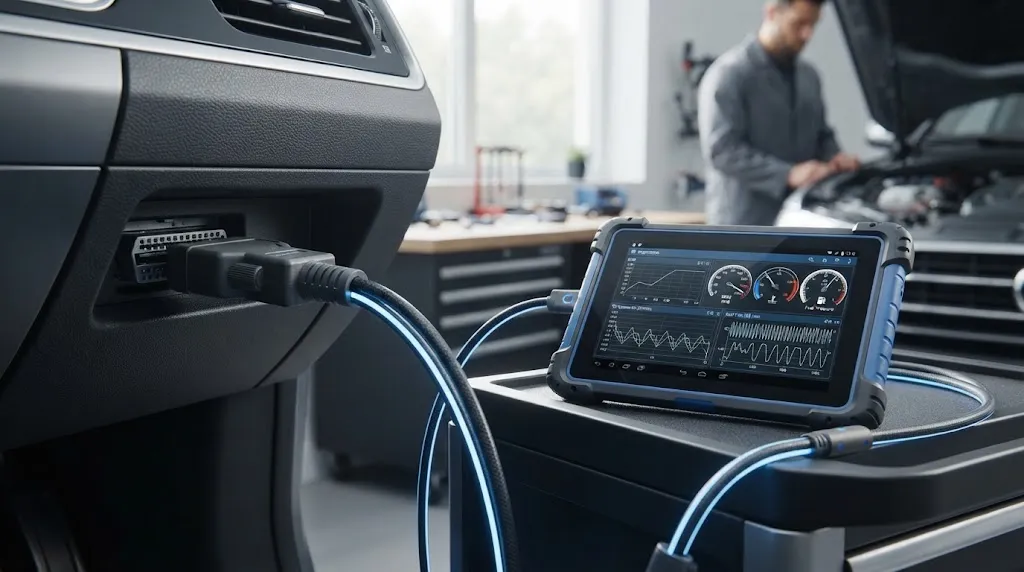
Modern vehicles rely heavily on networks of electronic control units (such as the ECM, BCM, and ABS module) connected via data buses like CAN bus. Sensors continuously feed data back to these computers, while actuators execute physical tasks based on programmed software logic.
When you initiate an active test using a compatible advanced scan tool:
- The scan tool sends a specific command packet over the data link connector (DLC) to the target module.
- The module overrides its standard sensor inputs and momentarily energizes or de-energizes the output circuit controlling the target component.
- The component physically responds—such as a fuel pump priming, an ABS valve clicking, or a radiator fan spinning.
- The technician observes the physical outcome or monitors accompanying live parameter IDs (PIDs) to confirm proper operation.
This process bypasses normal computer preconditions. For instance, testing a radiator fan normally requires the coolant to reach a specific high temperature. An active test lets you command that fan on instantly while the engine is completely cold.
Common Examples of Active Tests in Automotive Repair
Active tests apply across nearly every major automotive system. Technicians and advanced DIYers utilize bi-directional controls to streamline diagnostics for complex mechanical and electrical symptoms.
1. Fuel Pump and Injector Testing
When investigating a fuel pressure drop or rough idle, guesswork can lead to expensive unneeded replacements. An active test lets you command the fuel pump relay on and off while observing fuel rail pressure data. Similarly, a cylinder cut-off test disables individual fuel injectors one by one to check for changes in engine RPM. If disabling a specific cylinder does not change the idle speed, you have isolated a dead cylinder or faulty injector circuit.
2. Cooling Fan Speed and Relay Control
An engine that overheats only when idling in traffic often points to a cooling fan failure, relay issue, or wiring fault. Commanding high and low fan speeds directly through the scan tool verifies whether the motor and its dedicated control circuit respond correctly.
3. ABS Pump and Solenoid Actuation
Brake system diagnostics often require cycling internal hydraulic components. Active tests enable technicians to trigger the ABS pump motor and individual fluid solenoids to bleed stubborn air pockets or verify internal valve movement after a hydraulic repair.
4. EVAP Purge and Vent Solenoid Checks
Evaporative emission system codes (like P0440 or P0446) can be difficult to trigger during routine driving cycles. Using an active test, you can open or close the purge and vent valves instantly to listen for clicks or check for proper vacuum sealing.
Why Active Tests Are Critical for Modern Troubleshooting
As automotive electrical architecture becomes more intricate, component replacement based solely on trouble codes frequently fails to resolve root issues. A trouble code points to a circuit or sensor value that is out of range, but it rarely proves which specific part failed.
Active testing bridges the gap between digital data and physical reality. By forcing an output, you test the entire control loop—including the computer output driver, the wiring harness, relays, fuses, and the actuator itself—in a matter of seconds.
Tip
Always monitor corresponding live data PIDs while running an active test. For instance, commanding an EVAP purge valve open should immediately reflect a change in fuel trim or vacuum sensor data if the line is clear and functioning.
What Equipment Do You Need to Perform Active Tests?
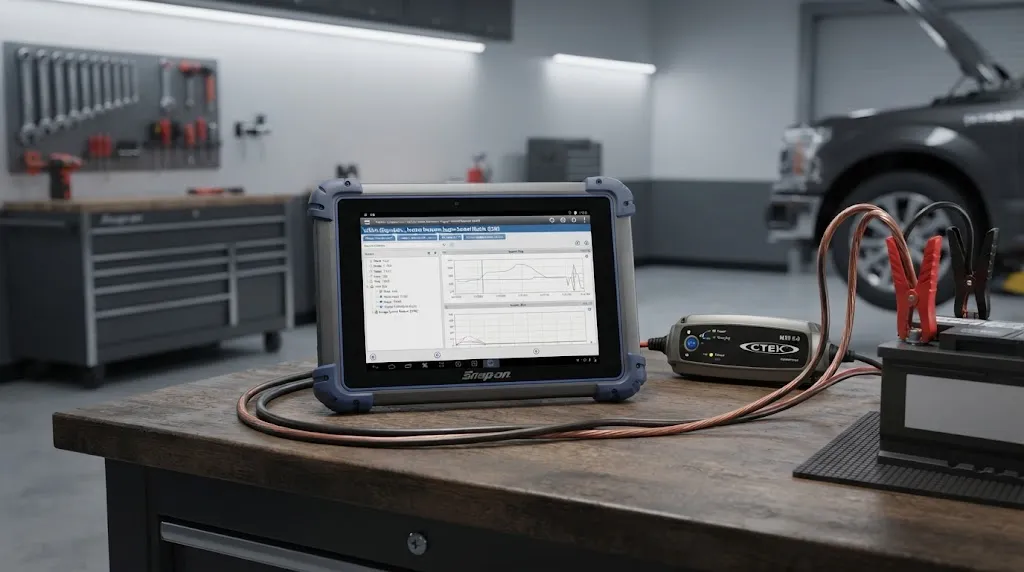
Basic code readers and standard generic OBD-II apps cannot perform active tests because they lack bi-directional communication protocols. To run active tests, you need:
- A Bi-Directional Diagnostic Scan Tool: Handheld diagnostic tablets or software interfaces explicitly advertised with bi-directional control or active test capabilities.
- Vehicle-Specific Software: Software packages matched to your exact vehicle make, model, and year, as proprietary ECU communication protocols vary widely between manufacturers.
- Stable Battery Voltage: Because active tests often require actuating high-draw components while the engine is turned off, connecting a battery maintainer prevents voltage drops that can interrupt communication with the modules.
Related Product
Bi-Directional Automotive Diagnostic Scan Tool
A capable mid-range diagnostic scanner with full bi-directional control features lets you command components, run active tests, and perform system re-calibrations.
As an Amazon Associate, we earn from qualifying purchases.
Frequently Asked Questions
Are all OBD2 scanners capable of running active tests?
No. Standard entry-level code readers only read and clear generic trouble codes and display basic live data streams. Running active tests requires advanced bi-directional software capabilities and proper communication protocols.
Can an active test damage a vehicle’s computer?
When used correctly within the software’s guided parameters, active tests are entirely safe. However, overriding automated controls improperly—such as repeatedly cycling sensitive electronic actuators or ignoring safety warnings—can cause component wear or temporary fault logs.
Do I need the engine running to perform an active test?
It depends entirely on the specific test. Tests involving fuel injectors, ignition coils, or cooling fans can often be performed with the ignition on and engine off (KOEO). Other tests, such as monitoring fuel pressure under load or transmission shifting, require the engine to be running.
What is the difference between active testing and coding?
Active testing temporarily commands existing components to check their physical response. ECU coding, by contrast, involves rewriting or updating software parameters within the vehicle’s computer to configure new modules, enable hidden factory features, or adjust system calibration settings.
Why won’t my scan tool let me run a specific active test?
If an active test option appears greyed out or unavailable, it usually means the vehicle’s current operating conditions do not meet the module’s safety prerequisites (such as vehicle speed needing to be zero, or transmission parking gear engaged), or the specific module variant on your trim level does not support that function.
How do I know if my car supports bi-directional diagnostics?
Most vehicles equipped with an OBD2 port manufactured after the mid-2000s support advanced communication protocols. Compatibility depends primarily on whether your diagnostic tablet includes the software license for your specific vehicle make and model.
Conclusion
Active tests transform a standard diagnostic scan tool from a passive reader into an active troubleshooting powerhouse. By directly commanding actuators, relays, and sub-systems, you bypass guesswork and pinpoint whether a fault lies within the component itself or its control circuit. Understanding how and when to use bi-directional controls allows you to diagnose complex vehicle problems faster and with greater confidence.

I’m Alex Rahman, a car enthusiast and automotive writer focused on practical solutions, car tools, and real-world driving advice. I share simple and honest content to help everyday drivers make better decisions.
