How to Calculate Fuel Flow from OBD2 Data: Formulas & PIDs
Quick Answer
To calculate fuel flow from OBD2 data, you can use the Mass Air Flow (MAF) sensor method by dividing the live MAF gram-per-second reading by the ideal air-fuel ratio (typically 14.7:1) and the density of gasoline (approx. 720–745 g/L). Alternatively, you can query specific engine load and injector pulse-width PIDs depending on vehicle support.
Understanding OBD2 Fuel Flow Data Basics
Modern vehicles continuously track engine parameters through an onboard diagnostics system. Accessing this data via an ELM327 adapter or a dedicated diagnostic scan tool lets enthusiasts and developers monitor real-time operating metrics.
However, the OBD2 standard does not always provide a single, universal “liters per hour” or “gallons per hour” PID for every vehicle make and model. Instead, you must pull underlying sensor data—primarily air mass or volumetric efficiency—and apply specific mathematical formulas to calculate actual fuel flow rates.
The MAF Sensor Method for Fuel Flow Calculation
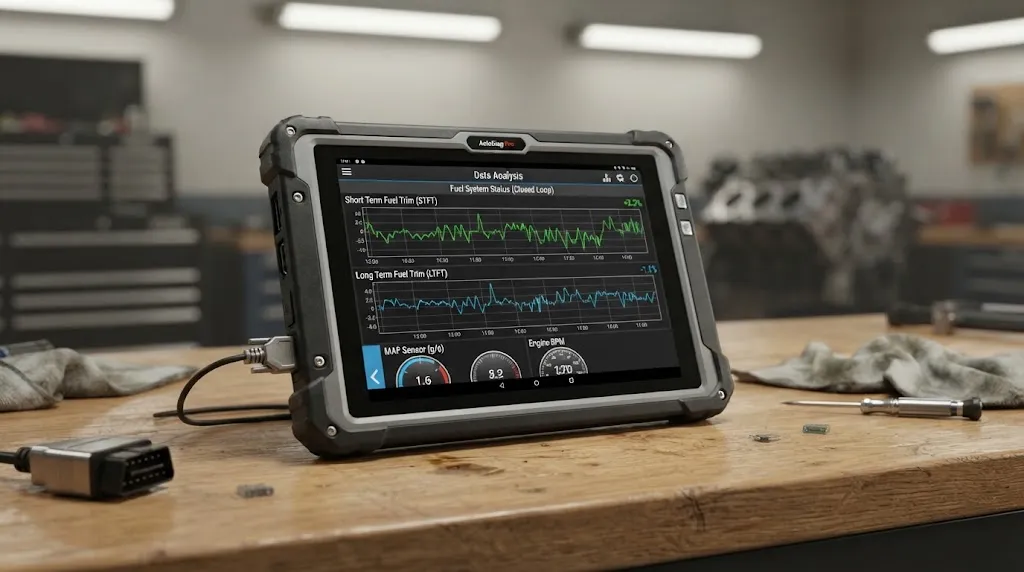
The most common and reliable method for calculating live fuel flow on modern gasoline engines relies on the Mass Air Flow (MAF) sensor data (OBD2 PID 0110).
Because the engine computer maintains a tightly controlled air-fuel ratio to optimize combustion and emissions, knowing the exact weight of incoming air allows you to calculate the weight of the fuel being injected right alongside it.
Step-by-Step MAF Calculation Formula
- Retrieve MAF Grams per Second: Query PID
0110to get the mass of air entering the engine in grams per second ($g/s$). - Factor in the Air-Fuel Ratio (AFR): Divide the MAF value by the stoichiometric air-fuel ratio for gasoline, which is standardly 14.7. This gives you fuel mass flow in grams per second.
- Convert Mass to Volume: Divide the resulting mass flow by the density of gasoline (approximately 720 to 745 grams per liter at typical operating temperatures, or roughly 6.0 pounds per gallon).
- Scale to Hourly Rates: Multiply by 3,600 to convert seconds into hours if you want liters per hour ($L/h$) or gallons per hour ($GPH$).
Tip
Keep in mind that flex-fuel vehicles running high ethanol blends have a different stoichiometric ratio (closer to 9.8:1 for E85), which alters the divisor in your calculation.
The Manifold Absolute Pressure (MAP) Alternative
If your vehicle uses a Speed Density system rather than a MAF sensor—or if you want a secondary cross-check—you can calculate air mass using the Manifold Absolute Pressure (MAP) sensor, Intake Air Temperature (IAT), and Engine RPM.
This approach applies the ideal gas law alongside volumetric efficiency (VE) estimates:
- Engine RPM (PID 010C): Determines how many engine cycles occur per minute.
- MAP Sensor (PID 010B): Measures intake manifold pressure.
- IAT Sensor (PID 010F): Provides air temperature to compute density changes.
- Volumetric Efficiency (VE): An estimated percentage (often between 75% and 90% for normal driving) representing how efficiently the engine fills its cylinders.
Once you estimate total air mass flow using these variables, you apply the same air-fuel ratio division to isolate the fuel mass.
Comparing Calculation Approaches
| Calculation Method | Required OBD2 PIDs | Pros | Cons |
|---|---|---|---|
| MAF-Based | MAF (0110), AFR equivalents | Direct, highly accurate on modern stock vehicles | Prone to error if the MAF sensor is dirty or modified |
| MAP / Speed Density | RPM (010C), MAP (010B), IAT (010F) | Works on vehicles without a physical MAF sensor | Requires estimating volumetric efficiency accurately |
Selecting the right method depends entirely on your vehicle’s factory sensor configuration and which data streams broadcast reliably through your OBD2 port.
Common Mistakes to Avoid When Calculating Fuel Flow
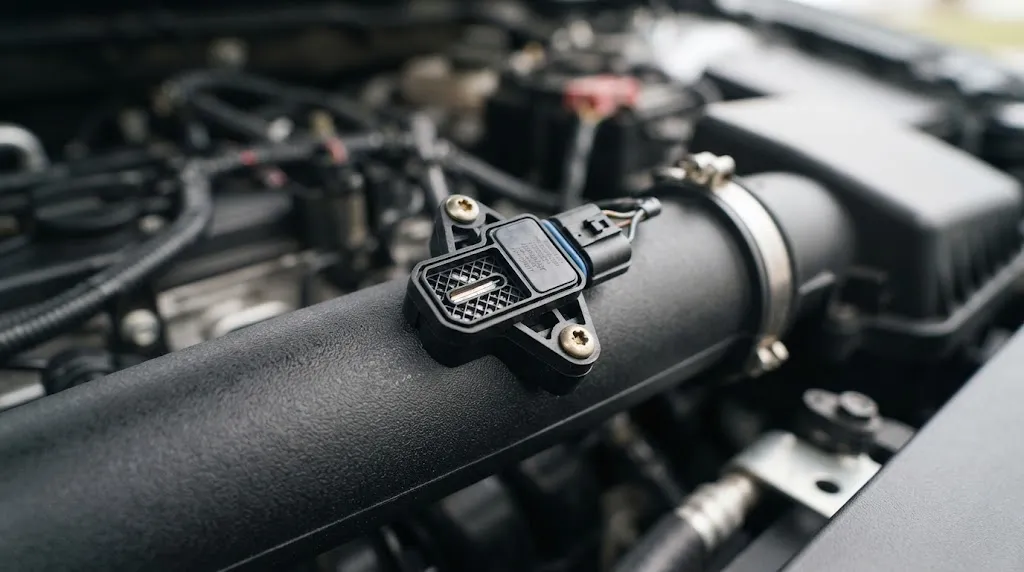
When writing scripts or configuring diagnostic software to calculate fuel flow, several common pitfalls can skew your results:
- Ignoring Closed-Loop Trims: Short-term and long-term fuel trims dynamically adjust the amount of fuel injected. Relying strictly on base stoichiometric calculations during heavy acceleration or enrichment states can introduce minor errors.
- Using Incorrect Fuel Density Constants: Assuming gasoline density remains completely static despite major temperature swings will introduce minor calculation drift.
- Polling Latency Issues: OBD2 bus speeds limit how fast individual PIDs refresh. Trying to poll too many parameters simultaneously slows down your sample rate, resulting in jagged, delayed flow calculations.
Warning
Never attempt to diagnose live fuel system delivery pressures or high-pressure fuel rail leaks using standard OBD2 flow calculations alone. Always reference manufacturer service manuals and physical pressure gauges for safety-critical diagnostics.
Related Product
OBD2 Bluetooth Diagnostic Scanners
A reliable wireless OBD2 adapter helps you stream real-time sensor data directly to your smartphone or laptop for fuel tracking.
As an Amazon Associate, we earn from qualifying purchases.
Frequently Asked Questions
Can all OBD2 scanners calculate live fuel flow?
No. While most basic code readers only pull diagnostic trouble codes, advanced scan tools, custom ELM327 apps, and data loggers can stream live sensor PIDs necessary to compute real-time fuel flow equations.
Why does my calculated fuel flow spike during idle?
Fuel flow measured in liters per hour or gallons per hour drops significantly at idle because the engine demands very little air mass compared to highway cruising or acceleration.
How accurate are OBD2-derived fuel calculations?
When sensors like the MAF and oxygen sensors are functioning correctly, calculated fuel flow is generally within 2% to 5% of actual fuel consumption measured at the fuel rail.
Does ethanol content change the calculation formula?
Yes. Higher ethanol concentrations lower the stoichiometric air-fuel ratio, meaning more total fuel mass is required to burn the same amount of incoming air effectively.
What PID corresponds to Mass Air Flow?
In standard OBD2 protocol, PID 0110 requests the Mass Air Flow sensor reading, returning values scaled in grams per second.
Can I calculate fuel economy (MPG) directly from flow rate?
Yes. By combining instantaneous fuel flow rate with your current vehicle speed pulled from PID 010D, you can easily derive instantaneous miles per gallon or kilometers per liter.
Conclusion
Calculating fuel flow from OBD2 data bridges the gap between raw sensor measurements and actionable performance insights. By leveraging accurate Mass Air Flow readings and factoring in standard stoichiometric ratios, you can build reliable real-time fuel monitoring tools for diagnostics or efficiency tuning.

I’m Alex Rahman, a car enthusiast and automotive writer focused on practical solutions, car tools, and real-world driving advice. I share simple and honest content to help everyday drivers make better decisions.
