Flashing Check Engine Light: OBD2 Meaning & Codes
Quick Answer
A flashing check engine light usually means your vehicle’s OBD2 system has detected a severe engine misfire that could quickly damage the catalytic converter. It is more urgent than a steady light. Reduce power demand, pull over somewhere safe, and shut the engine off; arrange towing if the light continues flashing, the engine shakes, or it runs poorly. An OBD2 scan may reveal P0300-series misfire codes, but those codes identify the affected condition—not necessarily the failed part.
If your dashboard light is blinking while you are driving, the first priority is protecting yourself and the vehicle, not connecting a scanner at the roadside. Once the car is safely parked, diagnostic trouble codes can help establish what happened and what to inspect next.
Why Is a Flashing Check Engine Light More Serious Than a Steady One?
A steady check engine light reports a detected engine or emissions-system fault that needs diagnosis. A flashing light is a more urgent warning, commonly triggered when an engine misfire is severe enough to threaten the catalytic converter.
A misfire means one or more cylinders are not producing their expected combustion power. On a gasoline engine, unburned fuel and oxygen can travel into the exhaust, where excess heat may damage the catalytic converter’s internal material. This risk explains why a flashing warning cannot be treated like a routine emissions code.
The U.S. Environmental Protection Agency’s OBD guidance identifies blinking as a warning of severe misfire and advises drivers to reduce speed and seek service promptly.
| Light behavior | Likely meaning | Practical response |
|---|---|---|
| Steady while driving | Fault detected; urgency varies | Arrange prompt diagnosis; follow vehicle-manual guidance |
| Flashing while engine runs | Potential catalyst-damaging misfire | Safely pull over, stop engine, assess towing |
| Briefly lit during key-on check | Normal lamp self-test on many vehicles | Check whether it extinguishes after starting |
The distinction is the light’s behavior while the engine is running. A lamp illuminated briefly during startup is not the same as a warning that repeatedly blinks on the road.
What Should You Do Immediately When It Starts Flashing?

- Ease off the accelerator. Avoid hard acceleration, high engine speed, steep-load demands, and towing while finding a safe place to stop.
- Move out of traffic safely. Use an appropriate parking area or shoulder only where stopping is safe. Turn on hazard lights when needed.
- Shut off the engine. Persistent flashing, rough running, strong vibration, loss of power, or unusual exhaust behavior are reasons not to continue driving.
- Arrange diagnosis and transportation. A tow is the prudent choice when a severe misfire is suspected. If you cannot stop immediately, drive only as far as required to reach safety, following the vehicle owner’s manual.
- Record the warning and symptoms. Note whether it happened at idle, during acceleration, on a hill, or just after starting. These details may help a technician later.
Warning
Do not keep driving simply to see whether the light goes away. A flashing check engine light can signal conditions capable of causing expensive exhaust-system damage in a short period.
Engine overheating, smoke, an oil-pressure warning, or a severe loss of power may indicate additional dangers. Stop safely and arrange assistance rather than assuming every warning is explained by the misfire alone.
What Will an OBD2 Scanner Show?
An OBD2 scanner reads diagnostic information stored by the vehicle’s electronic control systems. With a flashing warning, the most relevant results are often misfire-related powertrain codes, but the exact codes depend on the vehicle and the detected fault.
Common standardized codes include:
| OBD2 code | Meaning | Diagnostic direction |
|---|---|---|
| P0300 | Random/multiple-cylinder misfire | Look for shared causes as well as individual-cylinder problems |
| P0301 | Cylinder 1 misfire | Check cylinder 1 ignition, fuel delivery, and mechanical condition |
| P0302 | Cylinder 2 misfire | Investigate cylinder 2 and associated systems |
| P0303–P0312 | Specific cylinders 3–12 | Investigate applicable cylinder on engines with that cylinder count |
For example, P0302 does not prove that a spark plug is defective. An ignition coil, injector, air leak, wiring issue, compression loss, or another condition could cause cylinder 2 to misfire. The distinction is explored further in our guide to how OBD2 detects engine misfires.
A scanner may also show other powertrain codes, including fuel-mixture faults. Those clues need to be interpreted together with the symptoms rather than treated as a shopping list of replacement parts.
How to Scan the Vehicle Without Losing Useful Evidence
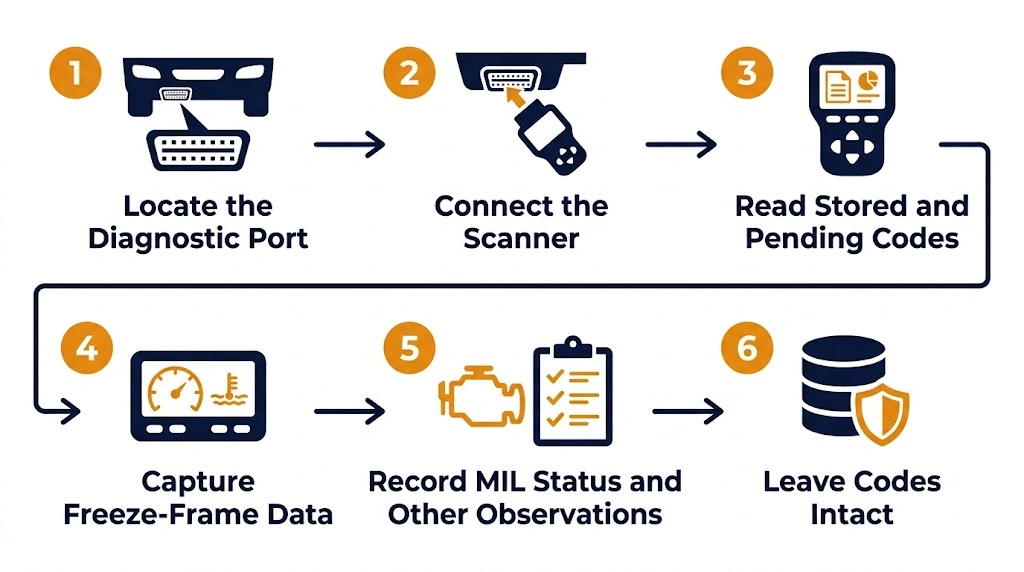
Once the vehicle is safely stopped and the engine is off, a compatible scan tool can help preserve information for diagnosis. Do not restart or leave an obviously misfiring engine running merely to capture live data.
- Locate the diagnostic port. The 16-pin OBD2 connector is usually beneath the dashboard on the driver’s side; consult the manual if needed.
- Connect the scanner. Follow its instructions, often using the ignition-on, engine-off position for initial communication.
- Read stored and pending codes. Save the exact alphanumeric codes rather than relying on a brief generic description.
- Capture freeze-frame data. When supported, record engine speed, load, coolant temperature, and other values saved when a diagnostic event occurred.
- Record MIL status and other observations. Note whether the dashboard flashed, whether the engine shook, and when it happened.
- Leave codes intact. Share the information with the repair technician before any reset or component replacement.
For scanner operation and code categories, see how to use an OBD2 scanner properly. The goal is to document evidence, not to make the warning disappear.
What Commonly Causes a Severe Misfire?
Several mechanical and electrical faults can cause the same misfire warning. A technician narrows them down using trouble codes, operating conditions, targeted tests, and the vehicle’s service information.
Ignition problems
Worn spark plugs, failed ignition coils, damaged coil boots, and wiring faults can prevent reliable ignition in gasoline engines. Misfires under acceleration may be especially noticeable because cylinder pressure and ignition demands increase.
Fuel-delivery problems
A malfunctioning fuel injector, fuel-pressure problem, or incorrect fuel supply can leave combustion unstable. A code pointing to one cylinder may suggest a localized issue; misfires on several cylinders may justify checking shared fuel delivery.
Air leaks and mixture faults
Unmetered intake air or other air-fuel mixture problems may cause lean running and intermittent misfires. Relevant fuel-trim and mixture codes can help distinguish a shared intake problem from an isolated ignition issue.
Mechanical engine faults
Low cylinder compression, valve problems, and some timing faults can also prevent normal combustion. These require mechanical testing rather than replacement of ignition parts based on code descriptions alone.
The scanner identifies what the control system detected. It rarely proves the root cause by itself, and some vehicles require manufacturer-specific data for more precise diagnosis.
What If the Light Stops Flashing or the Scanner Shows No Codes?
A light that stops blinking does not prove the underlying fault has been repaired. Misfires may appear only under certain engine speeds, loads, temperatures, or driving conditions. The warning may become steady or disappear when those conditions change.
Check stored, pending, and—where supported—permanent diagnostic information. Some inexpensive readers display only certain code categories, and intermittent events may be difficult to capture. Our article on why a check engine light may appear without readable OBD2 codes explains common limitations.
If no codes are visible, record exactly what the scanner can access and have the vehicle assessed using suitable equipment. Do not conclude that the warning was harmless.
Should You Clear the Code or Replace a Part?

Neither should be the first response to a flashing warning. Clearing codes may erase valuable freeze-frame information and does not repair a misfire. Changing a spark plug or coil solely because a cylinder code appeared can waste money and leave the dangerous condition unchanged.
Read our explanation of what clearing OBD2 codes actually does before resetting anything.
A sound diagnostic process confirms the affected cylinder or operating condition, checks related components, performs appropriate electrical or mechanical tests, repairs the verified fault, and then confirms the misfire has stopped. The vehicle should not return to normal driving until the safety concern has been resolved.
Key Insight
A flashing light describes the urgency of an operating condition. An OBD2 code describes what the computer detected. A proper diagnosis determines why it happened. These are three different pieces of information.
Related Diagnostic Tool
OBD2 Code Reader
A compatible code reader can save misfire trouble codes and available freeze-frame details once the vehicle is safely parked. It is not a substitute for professional diagnosis of an active severe misfire.
Frequently Asked Questions
Can a loose gas cap cause a flashing check engine light?
A loose gas cap commonly triggers an evaporative-system fault and a steady warning, not a severe-misfire flashing warning. Do not assume tightening the cap resolves a flashing light.
Can a flashing check engine light damage the engine?
The flashing warning primarily highlights the risk of catalyst-damaging misfire, but the cause of the misfire may also harm engine operation. Continued driving can make repairs more complicated or costly.
Why does the light flash only during acceleration?
Some faults become noticeable under higher engine load, including certain ignition and fuel-delivery problems. The pattern is a useful clue, not proof of one failed component.
Can I scan a car with the engine off?
Yes. Many scanners can retrieve stored codes with the ignition on and engine off. Follow the scanner and vehicle instructions; avoid running an actively misfiring engine unnecessarily.
Does P0300 mean every cylinder is misfiring?
No. P0300 means the system detected random or multiple-cylinder misfires. It does not establish that every cylinder misfired or identify the underlying cause.
Can I drive home if the light stopped flashing?
Not automatically. An intermittent severe misfire can return under load. If the engine ran roughly or the light flashed repeatedly, arrange inspection and consider towing rather than relying on the warning’s temporary disappearance.
Conclusion
A flashing check engine light is a warning to act promptly, not simply another code to erase. Stop safely, avoid operating a badly misfiring engine, and use OBD2 results as evidence for diagnosing the cause. Protecting the catalytic converter and confirming a real repair matter more than turning the dashboard light off.

I’m Alex Rahman, a car enthusiast and automotive writer focused on practical solutions, car tools, and real-world driving advice. I share simple and honest content to help everyday drivers make better decisions.
