Can OBD2 Diagnose an Engine Misfire? Explained
Quick Answer
Yes, an OBD2 scanner can detect many engine misfires and often identify the affected cylinder through trouble codes such as P0300 or P0301. However, a misfire code does not reveal the exact cause. You may need live data, ignition checks, fuel-system testing, or a compression test to determine why the cylinder is misfiring.
A shaking engine, rough idle, or hesitation during acceleration can make you wonder whether an OBD2 scanner will find the problem. In many cases, it provides the fastest starting point.
The important distinction is between detecting a misfire and diagnosing its cause. Understanding that difference can prevent unnecessary repairs and help you interpret your scanner’s results correctly.
How Does OBD2 Detect an Engine Misfire?
OBD2 detects misfires through the vehicle’s engine control system. On many gasoline engines, the computer monitors small changes in crankshaft speed to determine whether individual combustion events are producing the expected power.
When a cylinder fails to contribute normally, the crankshaft’s rotation may change enough for the computer to recognize a potential misfire.
The engine control module evaluates those events against programmed diagnostic criteria. If the conditions are met, it may store a diagnostic trouble code and illuminate the check engine light.
A misfire can happen when combustion is incomplete or fails altogether. The underlying problem might involve ignition, fuel delivery, incoming air, engine timing, or mechanical compression.
OBD2 monitors the results of these problems, but it cannot directly examine every component that might have caused them.
Which OBD2 Codes Indicate an Engine Misfire?
The most recognizable misfire codes belong to the P0300 family. These codes help distinguish a random or multiple-cylinder misfire from a problem associated with one cylinder.
| OBD2 Code | Meaning | What to Investigate |
|---|---|---|
| P0300 | Random/multiple-cylinder misfire | Shared ignition, fuel, air, or mechanical issues |
| P0301 | Cylinder 1 misfire | Cylinder 1 ignition, injector, or compression |
| P0302 | Cylinder 2 misfire | Cylinder 2 components and mechanical condition |
| P0303 | Cylinder 3 misfire | Cylinder 3 ignition and fuel delivery |
| P0304 | Cylinder 4 misfire | Cylinder 4 ignition, fuel, and compression |
| P0305–P0312 | Misfires in cylinders 5–12 | Corresponding cylinder, where applicable |
For example, P0302 directs attention toward cylinder 2. It does not prove that cylinder 2 has a defective spark plug. A coil, injector, wiring fault, or compression problem could produce the same misfire code.
Other stored codes can provide valuable context. A lean-mixture code such as P0171, for instance, may justify investigating unwanted intake air or fuel delivery rather than immediately replacing ignition parts.
How to Check an Engine Misfire With an OBD2 Scanner
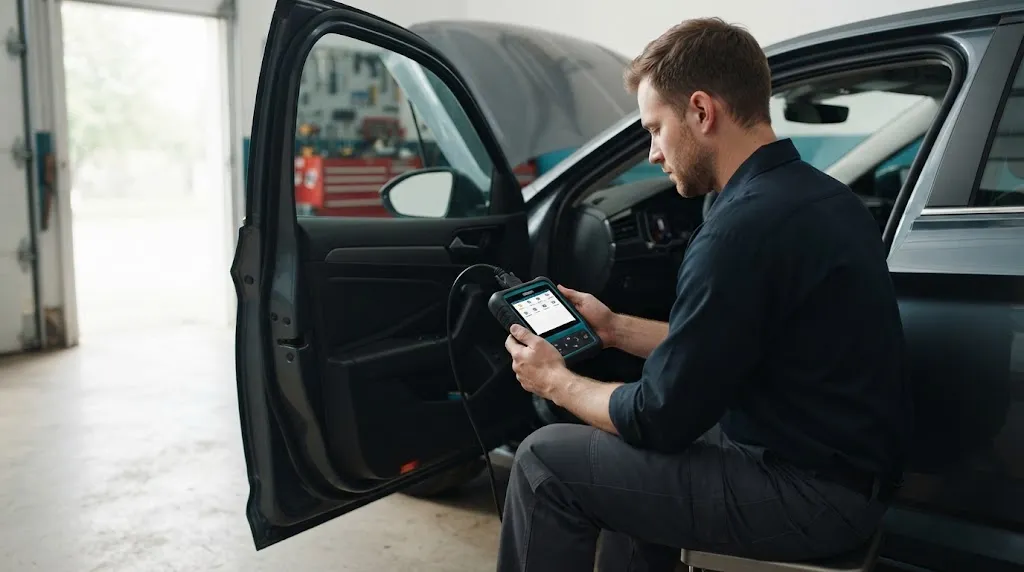
Start with the information already stored by the vehicle. A basic scanner can provide useful clues without disassembling engine components.
- Locate the OBD2 port. It is commonly beneath the dashboard near the driver’s side. Refer to the owner’s manual if necessary.
- Connect the scanner. Plug it into the diagnostic port and switch the ignition on according to the scanner’s instructions.
- Read stored and pending codes. Look for P0300-series faults, but record every relevant powertrain code.
- Save freeze-frame information. When available, record engine speed, load, temperature, and other captured operating conditions.
- Check live data. If supported, inspect fuel trims, engine speed, and cylinder-specific misfire counters.
- Compare the findings with the symptoms. Note whether the problem occurs at idle, during acceleration, under load, or when the engine is cold.
- Investigate the likely cause. Use appropriate component checks before replacing parts.
Do not erase codes immediately after reading them. Clearing diagnostic memory can remove useful fault information and reset emissions readiness monitors.
For intermittent problems, the original freeze-frame conditions may be especially valuable because the engine could appear to run normally during a later inspection.
Can OBD2 Identify Exactly Which Cylinder Is Misfiring?
Often, yes. Codes such as P0301 and P0304 identify a specific cylinder, and some advanced scanners display misfire counts for individual cylinders.
These counters are useful when an engine occasionally hesitates but has not stored a confirmed misfire code.
Using Mode $06 Misfire Data
Mode $06 provides results from onboard diagnostic monitoring tests. Depending on the vehicle and scanner, those results may include cylinder-specific misfire information.
For example, if one cylinder repeatedly registers more misfire events than the others during the same operating conditions, that finding may help narrow the investigation.
However, Mode $06 availability, test identifiers, counter behavior, and scaling vary by manufacturer and model. Not every scanner decodes the data correctly or presents it in a useful format.
General Motors’ published Mode $06 data definitions illustrate why vehicle-specific interpretation matters.
A zero misfire count does not always establish that the engine is healthy. The relevant test may not have operated under the conditions that trigger the complaint.
What Can Live OBD2 Data Reveal About a Misfire?
Live data helps connect a trouble code with the circumstances that produce it. The available parameters depend on the vehicle and scanner software.
- Short-term and long-term fuel trims: Can suggest whether the engine computer is compensating for a lean or rich air-fuel mixture.
- Engine RPM: Helps document unstable running and identify the operating range where symptoms occur.
- Mass airflow or manifold pressure: Can support investigation of intake-air measurement problems.
- Engine coolant temperature: Helps establish whether a fault appears primarily during cold or warm operation.
- Misfire counters: May reveal which cylinder experiences repeated events.
None of these readings should be interpreted in isolation. Fuel trims, for example, must be evaluated alongside engine load, operating mode, vehicle specifications, and other diagnostic findings.
Key Insight
An OBD2 code identifies an observed malfunction, not necessarily the failed part. Combining trouble codes, operating conditions, and component testing is more reliable than replacing whichever part seems most likely.
What Causes an Engine Misfire After OBD2 Detects It?
Once a misfire is confirmed, the next task is determining which system is failing. The main possibilities fall into three groups.
Ignition Problems
Worn spark plugs, defective ignition coils, damaged plug wires, or electrical connection problems can prevent reliable spark delivery.
On an engine with individual ignition coils, a technician may sometimes compare coils between cylinders as a diagnostic test, provided the parts are compatible and the procedure is appropriate for that vehicle.
If the misfire moves with the coil, that is meaningful evidence. It is still important to inspect the plug, connector, and related wiring.
Fuel and Air Problems
Clogged injectors, inadequate fuel pressure, intake vacuum leaks, and incorrect air measurement can disrupt combustion.
A P0300 code affecting multiple cylinders may justify examining shared systems before focusing on one spark plug or coil.
Mechanical Engine Problems
Low compression, leaking valves, head-gasket damage, or valve-timing problems may produce persistent misfires even when ignition components are functioning properly.
These faults often require additional testing, such as compression or cylinder leak-down measurements. An ordinary code reader cannot perform those mechanical checks.
Can an Engine Misfire Occur Without an OBD2 Code?
Yes. A brief, intermittent, or condition-dependent misfire may occur without a confirmed diagnostic trouble code or illuminated check engine light.
Possible explanations include a fault that has not met the computer’s detection criteria, operating conditions outside an effective monitoring range, or a problem that has not recurred sufficiently.
Check pending codes and available enhanced misfire data when symptoms persist. If the scanner reports no faults, record precisely when the shaking or hesitation happens.
Also consider that vibrations caused by engine mounts or other drivetrain components can resemble a misfire. A physical symptom alone does not confirm a combustion problem.
Is It Safe to Drive With an OBD2 Misfire Code?
Driving risk depends on severity. A mild intermittent symptom requires diagnosis, while a severe misfire can threaten the catalytic converter and create an immediate drivability concern.
Warning
A flashing check engine light can indicate a severe misfire capable of damaging the catalytic converter. Reduce speed, avoid heavy engine load, and stop driving as soon as safely practical. Arrange professional assistance rather than continuing to operate a badly shaking or power-limited vehicle.
The U.S. Environmental Protection Agency’s OBD guidance specifically associates a flashing malfunction indicator with potentially serious misfire-related emissions-system damage.
When Do You Need More Than an OBD2 Scanner?
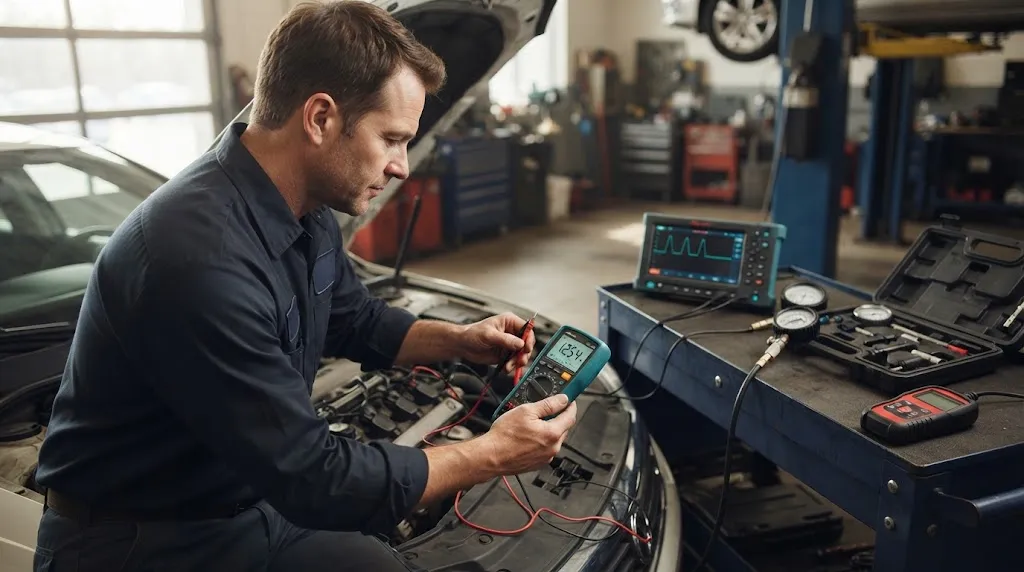
Additional diagnostic equipment becomes necessary when stored data cannot distinguish between competing causes.
For example, a cylinder-specific misfire with normal-looking scan data may still require inspection of ignition output, injector operation, and mechanical compression.
A multimeter, fuel-pressure equipment, compression tester, oscilloscope, or manufacturer-specific diagnostic tool may be appropriate depending on the suspected failure.
If the fault repeatedly returns after basic checks, or if fuel-system and mechanical testing would be required, qualified diagnosis is generally more useful than repeatedly clearing the code or replacing parts by trial and error.
Relevant Product
OBD2 Scanner With Live Data
A scanner that reads pending codes, freeze-frame records, and live engine data can make misfire troubleshooting more informative. Check for vehicle-specific compatibility and misfire-counter support before choosing one.
As an Amazon Associate, we earn from qualifying purchases.
Frequently Asked Questions
Can a cheap OBD2 scanner detect a misfire?
Yes. A basic compatible scanner can generally read standard P0300-series trouble codes. However, it may lack live data, enhanced diagnostics, or cylinder-specific misfire counters.
Will OBD2 tell me if a spark plug is bad?
Not conclusively. A worn spark plug can cause a misfire code, but the same code may result from an ignition coil, injector, or mechanical problem. Additional checks are needed.
Can OBD2 detect an intermittent misfire?
Sometimes. Pending codes, freeze-frame records, and supported misfire-monitor data may reveal intermittent faults. Some brief misfires produce no readable code.
Does P0300 mean all cylinders are misfiring?
No. P0300 indicates random or multiple-cylinder misfire detection. It does not necessarily mean that every cylinder is affected.
Should I clear a misfire code after replacing a part?
Only after recording useful diagnostic information and addressing the suspected fault. Follow the vehicle’s repair verification procedure and confirm that the problem does not return.
Can a Bluetooth OBD2 scanner diagnose misfires?
Yes, when the adapter, app, and vehicle support the necessary functions. Basic Bluetooth setups may read misfire codes, but advanced data access varies considerably.
Final Verdict
OBD2 is an effective first step for identifying engine misfires, especially when a P0300-series code points toward the affected cylinders. More capable scanners can provide additional information through live data and supported misfire-monitor results.
The scanner identifies where to begin investigating; component testing establishes why the problem occurred. Preserve diagnostic information, investigate the evidence systematically, and treat severe misfire symptoms promptly.

I’m Alex Rahman, a car enthusiast and automotive writer focused on practical solutions, car tools, and real-world driving advice. I share simple and honest content to help everyday drivers make better decisions.
