Do Modern Cars Still Use OBD2? What You Need to Know in 2026
Quick Answer
Yes, modern gasoline-powered cars and many hybrids still use OBD2 in 2026. OBD2 remains the standard system for monitoring emissions-related faults, reading diagnostic trouble codes, and accessing vehicle data. Newer cars combine OBD2 with advanced communication networks and sometimes restricted diagnostic access. All-electric vehicles are different, and their scanner compatibility varies. For the basics, see how to use an OBD2 scanner correctly.
What matters in modern vehicles?
- Gasoline vehicles: Modern U.S.-market cars and light trucks continue to support standardized OBD2 diagnostics.
- Hybrid vehicles: Hybrids generally support emissions-related OBD2 functions, but battery diagnostics require compatible tools.
- Electric vehicles: EVs may have familiar diagnostic connectors without supporting standard gasoline-engine diagnostic functions.
- CAN networks: Modern vehicles commonly use CAN communication while retaining OBD2 diagnostic capabilities.
- Advanced systems: ABS, airbags, security modules, and manufacturer-specific functions may require enhanced scanners.
Before buying a scanner
- Check compatibility: Confirm your vehicle’s model year, market, powertrain, and required diagnostic functions before purchasing.
Modern cars have become rolling computers, so it’s reasonable to wonder whether the old OBD2 scanner still works. The answer is more interesting than a simple yes or no.
I’ll explain why OBD2 remains relevant, what newer technology changes, and where inexpensive scan tools fall short.
What Is OBD2, and Why Do Cars Still Need It?
OBD2 stands for On-Board Diagnostics, Second Generation. It’s a standardized diagnostic framework that monitors emissions-related vehicle systems and makes fault information available through compatible scan tools.
The technology became mandatory for U.S.-market passenger cars and light trucks starting with the 1996 model year. Its core purpose remains important today: detecting faults that could increase vehicle emissions.
The California Air Resources Board’s OBD-II explanation describes how onboard monitoring helps identify emission-control problems throughout a vehicle’s useful life.
How does OBD2 work in a modern vehicle?
A modern car contains electronic control units, or ECUs, that manage different vehicle systems. These computers collect sensor information and perform diagnostic checks.
When an emissions-related malfunction meets the required detection conditions, the system may store a diagnostic trouble code and illuminate the check engine light.
- Sensors: Measure operating conditions such as temperature, pressure, airflow, and exhaust composition.
- Control modules: Analyze sensor readings and monitor system performance.
- Diagnostic trouble codes: Identify detected fault conditions using standardized or manufacturer-specific identifiers.
- OBD2 connector: Provides a standardized physical connection for supported diagnostic communication.
- Scan tools: Retrieve codes, operating data, readiness information, and other supported records.
Consider code P0301, which indicates a detected cylinder-one misfire. The code helps narrow the investigation, but it doesn’t prove which component failed.
That’s why I treat fault codes as starting points rather than repair instructions.
Do All New Cars Still Have an OBD2 Port?
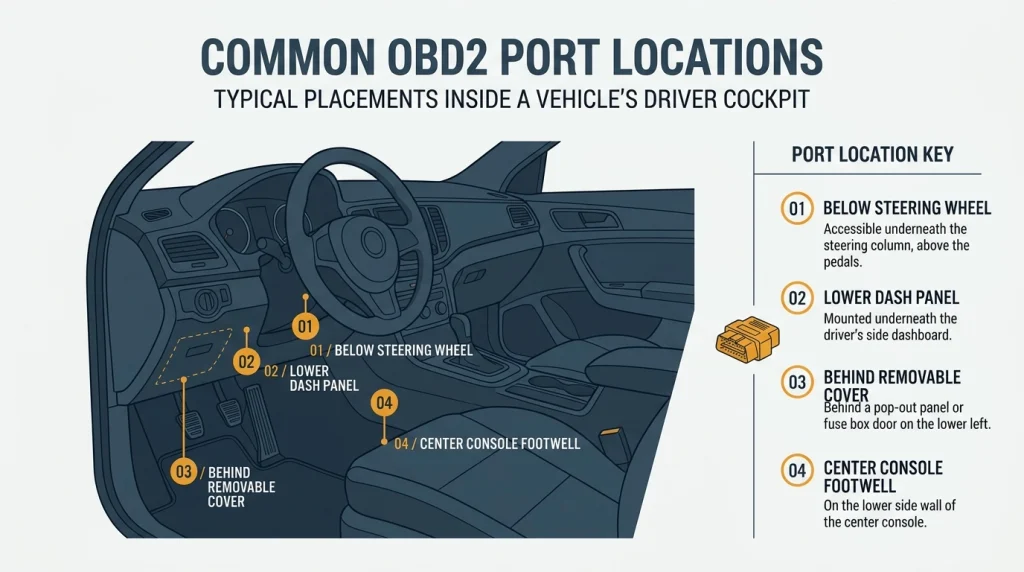
New U.S.-market gasoline passenger cars and light trucks still use standardized onboard diagnostic interfaces in 2026. However, the answer becomes more complicated for electric vehicles, imports, and specialized vehicles.
A traditional OBD2 connector is a 16-pin trapezoidal socket, commonly found beneath the dashboard near the steering column.
Where is the OBD2 port located?
Most drivers can find the connector without removing major interior panels. Its exact location depends on the manufacturer and vehicle design.
- Below the steering wheel or dashboard.
- Near the driver’s lower dashboard panel.
- Behind a removable plastic cover.
- Near the center console or footwell on some models.
The connector may be labeled DLC, meaning Data Link Connector. Consult your owner’s manual if you cannot locate it.
Does having an OBD2-shaped port guarantee compatibility?
No. A familiar 16-pin connector doesn’t guarantee that every generic scanner can communicate with every vehicle module.
This distinction becomes especially important with electric vehicles, secure gateways, and manufacturer-specific systems.
Which Modern Vehicles Support OBD2?
OBD2 support depends on vehicle type, model year, and market. The following comparison focuses primarily on vehicles sold in the United States.
| Vehicle Type | OBD2 Status | Typical Scanner Access |
|---|---|---|
| Gasoline cars, 1996+ | Required for U.S.-market light-duty vehicles | Engine codes, emissions data, readiness monitors |
| Modern gasoline SUVs and light trucks | Standard OBD2 support | Generic emissions diagnostics; enhanced access varies |
| Hybrid vehicles | Generally OBD2 compliant in the U.S. | Engine emissions data; hybrid systems need enhanced support |
| All-electric vehicles | Standard OBD2 support not universally required | Vehicle-specific diagnostics and proprietary data |
| Heavy-duty commercial trucks | Different requirements and interfaces may apply | May require heavy-duty diagnostic equipment |
Market regulations matter too. European vehicles use EOBD requirements, while other regions may follow different implementation schedules.
For imported vehicles, check the original sales market rather than relying solely on the manufacturer’s country of origin.
Is OBD2 Being Replaced by New Technology?

OBD2 isn’t simply disappearing. Instead, modern automotive diagnostics are expanding beyond its original emissions-focused functions.
Today’s vehicles combine standardized diagnostic access with faster networks, advanced software, and manufacturer-controlled security systems.
OBD2 vs CAN bus: What’s the difference?
OBD2 defines standardized diagnostic functions, while CAN is a communication network used by vehicle computers. They serve different purposes and often work together.
CAN stands for Controller Area Network. It allows ECUs to exchange information efficiently over shared communication wiring.
For a deeper explanation, see our guide to OBD2 vs CAN bus and their differences.
| Feature | OBD2 | CAN Bus |
|---|---|---|
| Primary purpose | Standardized diagnostics | Electronic module communication |
| Main function | Access codes and supported vehicle data | Exchange electronic messages |
| Typical use | Emissions-related diagnostics | Internal vehicle networking |
| Can work together? | Yes. OBD2 diagnostic communication commonly operates over CAN. | |
What about automotive Ethernet and DoIP?
Some newer vehicles use automotive Ethernet and Diagnostics over Internet Protocol, called DoIP, for advanced diagnostic communication.
These technologies can support high-speed data transfers, module programming, and complex manufacturer diagnostics. Their presence doesn’t automatically eliminate standardized OBD functions.
Do secure gateways block OBD2 scanners?
Some manufacturers protect vehicle networks using secure gateway modules. These systems can restrict certain diagnostic commands or bidirectional operations.
Basic emissions-code reading may remain available, while service resets, programming, and special tests require authorization.
- Basic code reading: Often remains available through generic OBD2 access.
- Code clearing: Availability depends on the vehicle and module.
- Service functions: May require enhanced software or authorized access.
- Programming: Usually needs specialized tools, software, and sometimes manufacturer credentials.
Do Electric Cars and Hybrids Still Use OBD2?
Hybrids generally retain conventional emissions-related OBD2 capabilities. Fully electric vehicles are different because they don’t have a combustion engine or its associated exhaust systems.
Hybrid vehicles
A hybrid combines an internal combustion engine with electric propulsion. Its engine and emissions systems still need diagnostic monitoring.
However, a basic scanner may not display high-voltage battery condition, individual battery-module information, or hybrid inverter faults.
- Standard engine trouble codes may be available.
- Emissions readiness monitoring generally remains relevant.
- Hybrid battery data may need enhanced diagnostics.
- Manufacturer-specific fault codes may require supported software.
Fully electric vehicles
EV diagnostic access varies widely among manufacturers and models. Some EVs provide a familiar connector, while others require proprietary adapters or service equipment.
An ordinary gasoline-engine code reader cannot automatically interpret EV battery-management data. Confirm specific vehicle support before buying a tool.
The OBDLink vehicle compatibility information also distinguishes conventional OBD2 support from electric-vehicle diagnostic limitations.
Can You Still Use an Old OBD2 Scanner on a New Car?
Sometimes, yes. An older scanner may read standard emissions-related codes on a newer vehicle if it supports the required communication protocol.
Age alone doesn’t determine compatibility. Protocol coverage, firmware, and requested features matter more.
Check these features before connecting
- CAN compatibility: Essential for standard diagnostic communication on modern U.S.-market vehicles.
- Supported model years: Check the manufacturer’s compatibility information.
- Live data: Useful for reading operating conditions beyond trouble codes.
- Enhanced diagnostics: Needed for many ABS, airbag, transmission, and body-module functions.
- Software updates: Can add supported vehicles or correct communication issues.
- Security access: Some service functions require authorized gateway access.
My practical rule is to choose the scanner based on the problem I’m diagnosing. A basic check engine light rarely justifies an expensive professional tool.
For shopping details, review our OBD2 scanner buying guide before choosing a model.
What Can an OBD2 Scanner Diagnose in a 2026 Car?
A compatible scanner can still provide valuable engine and emissions information. More advanced tools expand coverage to additional vehicle modules.
Functions available on many basic scanners
- Read generic diagnostic trouble codes.
- Display check engine light status.
- View supported live engine parameters.
- Read stored freeze-frame information.
- Check emissions readiness monitors.
- Clear supported emissions codes after repairs.
Functions that may require advanced equipment
- Airbag and ABS module diagnostics.
- Manufacturer-specific transmission diagnostics.
- Electronic parking brake service functions.
- Steering-angle sensor calibration.
- Battery registration and supported maintenance resets.
- Advanced hybrid and EV battery diagnostics.
Don’t confuse a scanner’s advertised features with confirmed vehicle compatibility. Even professional equipment may support different functions across model years.
How Do You Check Whether Your Modern Car Supports OBD2?
You can usually confirm OBD2 compatibility in a few minutes. Start with your vehicle documentation and verify the scanner’s supported functions.
- Identify your vehicle: Record the model year, make, model, engine type, and original sales market.
- Find the diagnostic connector: Check beneath the driver’s dashboard or consult the owner’s manual.
- Check documentation: Look for OBD2, OBD-II, or applicable emissions-diagnostic compliance information.
- Review scanner compatibility: Confirm supported protocols and any enhanced vehicle coverage.
- Connect safely: With the vehicle parked, plug in the scanner and follow its ignition instructions.
- Test communication: Try reading supported engine information or emissions readiness status.
If the scanner cannot connect, don’t immediately assume the vehicle lacks OBD2. The cause might be an unsupported protocol, a blown diagnostic-port fuse, or a communication problem.
Is OBD2 Still Required by Law in 2026?
Yes. Standardized onboard emissions diagnostics remain part of U.S. vehicle emissions regulations in 2026.
There is no general federal rule ending OBD2 on new gasoline passenger cars. Regulatory requirements continue to evolve alongside vehicle technology.
The U.S. Environmental Protection Agency oversees federal vehicle emissions requirements, while California maintains its own important onboard diagnostic framework.
Federal regulations also address onboard diagnostics for 2027 and later model years. The 2027-model-year onboard diagnostic regulation demonstrates that emissions diagnostics remain a continuing requirement.
Does every state require an OBD2 emissions inspection?
No. Vehicle inspection programs differ by state, county, vehicle age, and registration type.
Some areas check emissions readiness and stored fault information, while others have different inspection requirements or exemptions.
Clearing codes before an inspection can reset readiness monitors. Learn why that matters in our guide to scanning a car with the check engine light off.
Will OBD2 Eventually Become Obsolete?
OBD2 may continue evolving, but its underlying need is unlikely to disappear soon. Regulators, repair shops, manufacturers, and vehicle owners still depend on standardized diagnostic information.
The bigger change is the growing complexity of automotive electronic systems.
- More vehicle computers: Modern cars contain numerous interconnected modules.
- Advanced network protocols: CAN FD, Ethernet, and DoIP expand communication capabilities.
- Connected services: Some vehicles support remote fault reporting and telematics.
- Security controls: Manufacturers increasingly protect sensitive diagnostic operations.
- Electric powertrains: Battery and charging diagnostics create new requirements.
My recommendation is simple: don’t abandon OBD2 because your car is newer. Instead, make sure your scanner supports the specific diagnostics you need.
Recommended OBD2 Scanners for Modern Cars
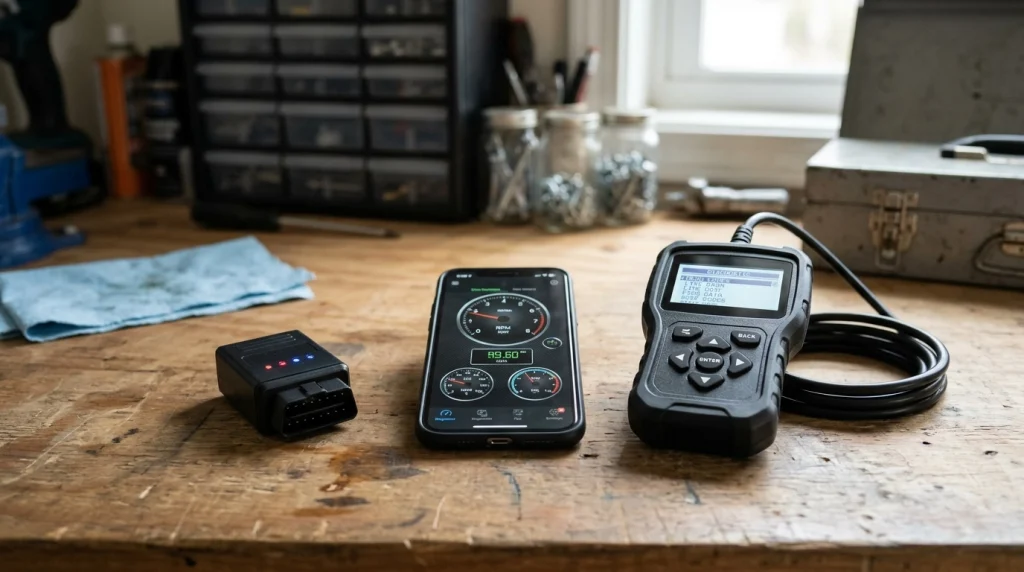
If you’re choosing a diagnostic tool, these three established models cover different priorities. Check your exact vehicle compatibility and current product specifications before purchasing.
Affiliate disclosure: The following Amazon links may earn us a commission from qualifying purchases, at no additional cost to you. The suitability scores below are editorial assessments, not verified customer-review averages.
🏆 Best for App-Based Diagnostics
OBDLink MX+ Bluetooth OBD2 Adapter
★★★★☆ 4.5/5 editorial score
This Bluetooth adapter supports standard OBD2 diagnostics and compatible enhanced vehicle functions through supported apps. I prefer this type of tool when live-data logging and smartphone convenience matter more than a built-in screen.
📱 Best for Guided Diagnostics
BlueDriver Bluetooth Pro OBD2 Scanner
★★★★☆ 4.0/5 editorial score
BlueDriver pairs a wireless adapter with a dedicated diagnostic app, including code explanations and supported enhanced diagnostics. I’d consider it for owners who prefer guided information over interpreting raw data alone.
💰 Best for Basic Code Reading
Autel AutoLink AL319
★★★★☆ 4.0/5 editorial score
The AL319 is a handheld code reader with a built-in display, standard trouble-code functions, and emissions readiness checks. It’s my practical pick for occasional engine-light diagnosis without depending on a smartphone.
Frequently Asked Questions
Do 2026 cars still have OBD2 ports?
Yes. New U.S.-market gasoline passenger cars and light trucks continue to use standardized onboard diagnostic interfaces in 2026. The familiar connector is commonly located beneath the dashboard, although exact placement varies. Electric vehicles and specialized vehicle categories may have different requirements and compatibility limitations.
Can a 1990s OBD2 scanner work on a new car?
It depends on the scanner’s communication protocols and software. An early scanner that lacks CAN support may not communicate with a modern vehicle. A compatible older tool may still retrieve generic emissions codes but cannot necessarily access advanced modules or protected service functions.
Does Tesla use OBD2?
Tesla vehicles use electronic diagnostic systems, but they do not provide the same universal OBD2 functionality found on conventional gasoline cars. Diagnostic connector arrangements vary by model and year. Accessing Tesla-specific battery and vehicle data may require compatible adapters, software, or manufacturer service tools.
Will OBD3 replace OBD2?
There is no universal consumer OBD3 replacement standard that has displaced OBD2 in 2026. Vehicle diagnostics continue evolving through networking, cybersecurity, connected services, and updated regulatory requirements. Marketing references to OBD3 should not be treated as proof of a new universally adopted diagnostic standard.
Is buying an OBD2 scanner still worth it?
Yes, for many gasoline-car and hybrid owners. A compatible scanner helps identify engine fault codes, inspect supported live data, and check emissions readiness before visiting a repair shop. However, advanced electronic-system diagnostics may require a more capable scanner or professional equipment.
Final Takeaway: OBD2 Is Still Relevant in Modern Cars
Modern cars still use OBD2 because standardized emissions diagnostics remain important. The technology hasn’t disappeared; it now works alongside increasingly complex electronic networks.
For most gasoline-car owners, a compatible OBD2 scanner remains one of the most useful diagnostic tools to keep available. It can help you understand a warning light before deciding on repairs.
Before buying, verify your vehicle’s compatibility and identify which functions you need. A well-matched scanner is more valuable than an expensive tool with features your car cannot use.
Ready to diagnose your car? Start with a compatible OBD2 scanner, read any stored codes, and investigate the actual cause before replacing components.

I’m Alex Rahman, a car enthusiast and automotive writer focused on practical solutions, car tools, and real-world driving advice. I share simple and honest content to help everyday drivers make better decisions.
