Can an OBD2 Scanner Detect a Bad Battery? What It Can Tell You
Quick Answer
Yes, an OBD2 scanner can help detect signs of a bad car battery by displaying system voltage, revealing certain electrical fault codes, and monitoring charging-system behavior. However, a standard scanner cannot reliably measure battery health, cold cranking amps, or internal damage. For a confirmed diagnosis, use a dedicated battery tester or a professional load test. Start by learning how to use an OBD2 scanner correctly.
What Your Scanner Can Reveal
- Low system voltage: A reading below the expected range can suggest a discharged battery or electrical problem.
- Charging problems: Running-voltage readings may reveal alternator or charging-system issues.
- Electrical fault codes: Supported codes can identify abnormal voltage conditions.
- Intermittent voltage drops: Some advanced scanners can record changing voltage during operation.
- Battery limitations: Normal voltage does not prove that the battery can start your engine reliably.
Best Confirmation Method
- Check voltage: Compare scanner readings with a multimeter directly across the battery terminals.
- Test battery health: Use a compatible conductance tester or professional load test before replacing the battery.
When your car struggles to start, plugging in an OBD2 scanner seems like an easy way to identify the problem. But a scanner showing normal voltage doesn’t necessarily mean your battery is healthy.
I’ll explain what these tools can detect, which readings matter, and how to avoid replacing the wrong component.
How Does an OBD2 Scanner Detect Battery Problems?
An OBD2 scanner detects potential battery problems indirectly by reading electrical information from your vehicle’s onboard diagnostic system. It doesn’t normally perform a physical test of the battery itself.
OBD2 stands for On-Board Diagnostics, Second Generation. This electronic system monitors supported vehicle systems and stores diagnostic information when certain problems occur.
According to the U.S. Environmental Protection Agency, OBD technology primarily supports monitoring and diagnosing emissions-related vehicle problems.
Reading Battery and System Voltage
Many scanners can display vehicle electrical-system voltage through a dedicated voltage screen or supported diagnostic data. The displayed value reflects the electrical system at the measurement point.
For example, a scanner might show 12.1 volts while the engine is off. That reading suggests the battery may be partially discharged, assuming the measurement represents the resting battery voltage.
However, some tools display voltage measured at the diagnostic connector rather than directly at the battery terminals. Wiring resistance and electrical loads can create differences between those locations.
Checking Electrical Trouble Codes
Some vehicle computers store diagnostic trouble codes when the electrical supply operates outside expected limits. The exact codes available depend on the vehicle and scanner.
Examples include:
- P0560: System voltage malfunction.
- P0562: System voltage low.
- P0563: System voltage high.
These codes identify voltage-related conditions rather than proving that the battery has failed. The alternator, wiring, connections, or voltage regulation may also be responsible.
That’s why I would never recommend replacing a battery solely because a scanner displays P0562.
Monitoring Charging-System Behavior
With the engine running, some scanners can display voltage changes that help evaluate charging-system behavior. The alternator normally supplies electrical power and replenishes the battery while the engine operates.
On many conventional vehicles, running voltage commonly falls around 13.7–14.7 volts. Modern smart-charging systems may operate outside that range by design.
A consistently abnormal reading deserves further investigation. It isn’t enough to identify a faulty alternator without additional checks.
What Battery Voltage Should an OBD2 Scanner Show?
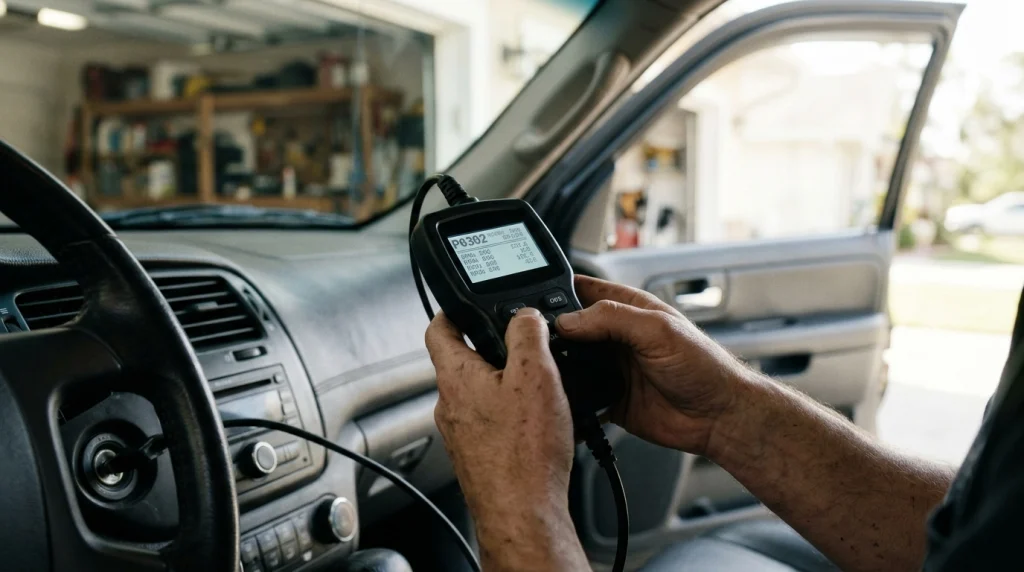
For a conventional 12-volt lead-acid starting battery, resting voltage offers a useful estimate of charge level. A fully charged battery commonly measures around 12.6 volts or slightly higher.
The following reference ranges apply mainly to a rested battery near room temperature, without significant electrical loads.
| Voltage Reading | Possible Meaning | Recommended Action |
|---|---|---|
| 12.6–12.8V | Fully or nearly fully charged | Test starting performance if symptoms remain |
| 12.4–12.5V | Somewhat below full charge | Check recent use and charging |
| 12.2–12.3V | Partially discharged | Recharge and retest |
| 12.0–12.1V | Significantly discharged | Charge fully and investigate why |
| Below 12.0V | Severely discharged | Check battery condition and charging system |
These values are approximate, not universal pass-or-fail limits. Battery chemistry, temperature, recent charging, and connected loads affect the results.
For additional information, Interstate Batteries’ technical FAQs explain typical resting and running voltage readings.
Why Normal Voltage Doesn’t Guarantee a Healthy Battery
A battery can show 12.6 volts and still fail when the starter demands substantial current. That’s because voltage and starting capability measure different characteristics.
State of charge describes how much electrical energy remains available. State of health describes the battery’s ability to perform relative to its original condition.
A worn battery may accept a charge but lose useful starting capacity. A simple voltage reading often misses that problem.
How Do You Test a Car Battery With an OBD2 Scanner?
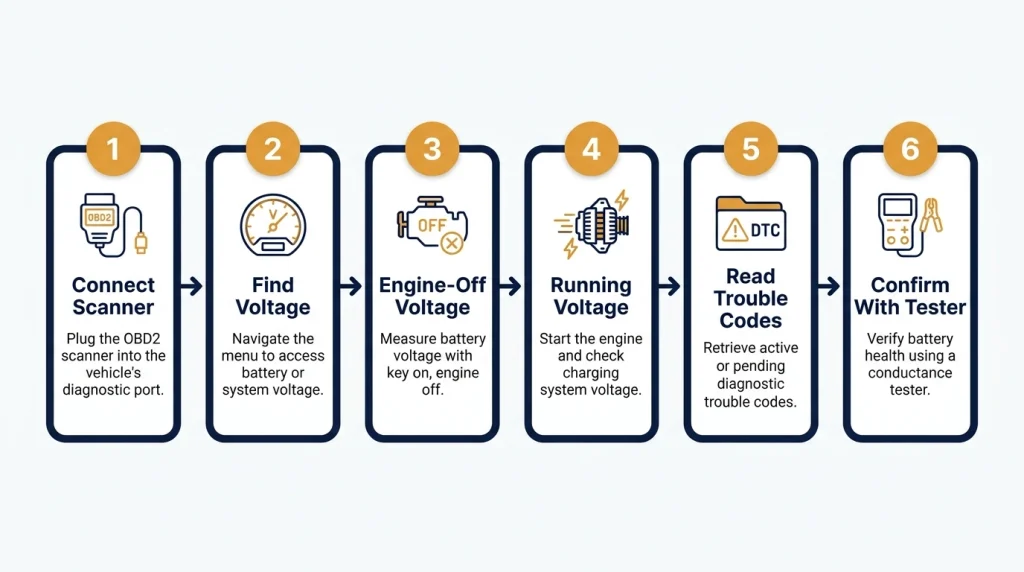
You can use a compatible OBD2 scanner to screen for voltage problems in a few minutes. The process works best when you compare multiple readings instead of relying on one number.
Step 1: Connect Your Scanner
- Park on a level surface and engage the parking brake.
- Switch off the engine and unnecessary electrical accessories.
- Locate the 16-pin OBD2 diagnostic port, usually underneath the dashboard.
- Plug your scanner into the connector without forcing it.
- Follow the scanner’s instructions for ignition position and vehicle connection.
If your scanner fails to connect, don’t immediately blame the battery. Review common causes of an OBD2 scanner having power but no communication.
Step 2: Find the Voltage Reading
Look for a menu labeled Battery Voltage, System Voltage, Vehicle Voltage, or a similar function. Some scanners display their own supply-voltage reading separately from ECU live data.
If your tool offers neither function, it may not support useful battery-voltage monitoring. Generic OBD2 compatibility doesn’t guarantee access to every electrical parameter.
Step 3: Check the Engine-Off Voltage
Ideally, let the vehicle rest with the ignition and accessories switched off before measuring battery voltage. This helps reduce the influence of recent charging and electrical loads.
Some scanners require ignition-on communication, which means their readings aren’t true resting-voltage measurements. Use a multimeter at the battery terminals for a better resting-voltage check.
As a practical example, suppose a battery reads 12.1 volts after sitting overnight. I’d investigate its charge level before considering replacement.
Step 4: Check Voltage While the Engine Runs
Start the vehicle only when it’s safe, and never run an engine in an enclosed garage. Observe the supported voltage reading after the engine settles into idle.
On a conventional charging system, a reading near 14 volts often indicates that charging is occurring. On smart-charging vehicles, consult the manufacturer’s expected operating behavior.
If voltage stays unusually low or rises excessively, investigate the charging system and battery connections.
Step 5: Read Stored Trouble Codes
Open the diagnostic trouble code menu and save any stored or pending codes. Check whether the vehicle has reported low system voltage or another electrical concern.
Do not clear codes before recording them. Erasing diagnostic information can make an intermittent fault harder to investigate.
Step 6: Confirm With a Battery Tester
If starting remains difficult, use a battery conductance tester or arrange professional battery testing. Select the correct battery chemistry and rating when using a dedicated tester.
This final step matters because an OBD2 scanner alone cannot prove that the battery meets its required starting performance.
Can an OBD2 Scanner Detect a Bad Battery Without a Check Engine Light?
Yes, an OBD2 scanner may reveal low voltage even when the check engine light is off. However, many weak batteries produce no relevant OBD2 trouble code.
Battery condition is not the primary purpose of standardized emissions diagnostics. Therefore, the absence of codes should never be treated as proof of battery health.
Watch for these common warning signs:
- Slow engine cranking: The starter turns the engine more slowly than usual.
- Repeated jump-starts: The vehicle struggles to restart after parking.
- Dim lights: Electrical accessories appear weak, particularly before starting.
- Clicking during starting: The starter solenoid clicks without normal cranking.
- Unexpected electronic resets: Displays or modules restart during low-voltage events.
These symptoms can also indicate corroded terminals, poor grounds, starter faults, or charging problems. Confirm the cause before purchasing a replacement battery.
What Can an OBD2 Scanner Not Detect About Battery Health?
A standard OBD2 scanner cannot reliably measure several important physical characteristics of a starting battery. Understanding those limits prevents misleading conclusions.
Cold Cranking Amps
Cold cranking amps, or CCA, describe a battery’s ability to supply starting current under specified cold-temperature conditions. An ordinary code reader doesn’t measure available CCA.
Dedicated conductance testers can estimate starting performance using electrical measurements and the battery’s specified rating.
Internal Battery Damage
An aging lead-acid battery may suffer from sulfation, plate deterioration, or internal cell problems. Such damage might not produce a recognizable diagnostic code.
A specialized battery test offers more useful evidence of reduced starting capability than simply reading system voltage.
True Reserve Capacity
Reserve capacity describes how long a battery can deliver a specified electrical load under defined testing conditions. A basic OBD2 scanner cannot directly measure it.
Even some fast battery-health testers estimate performance rather than directly measuring reserve capacity.
Parasitic Battery Drain
Parasitic drain occurs when electrical components draw current after the vehicle has been parked and should be asleep. Excessive drain can discharge an otherwise healthy battery.
A scanner may provide supporting clues, but diagnosing unwanted current draw usually requires appropriate electrical measurement and circuit investigation.
Also consider whether your diagnostic adapter remains connected for long periods. Our guide explains how an OBD2 device can drain a car battery.
OBD2 Scanner vs. Multimeter vs. Battery Tester: Which Is Better?
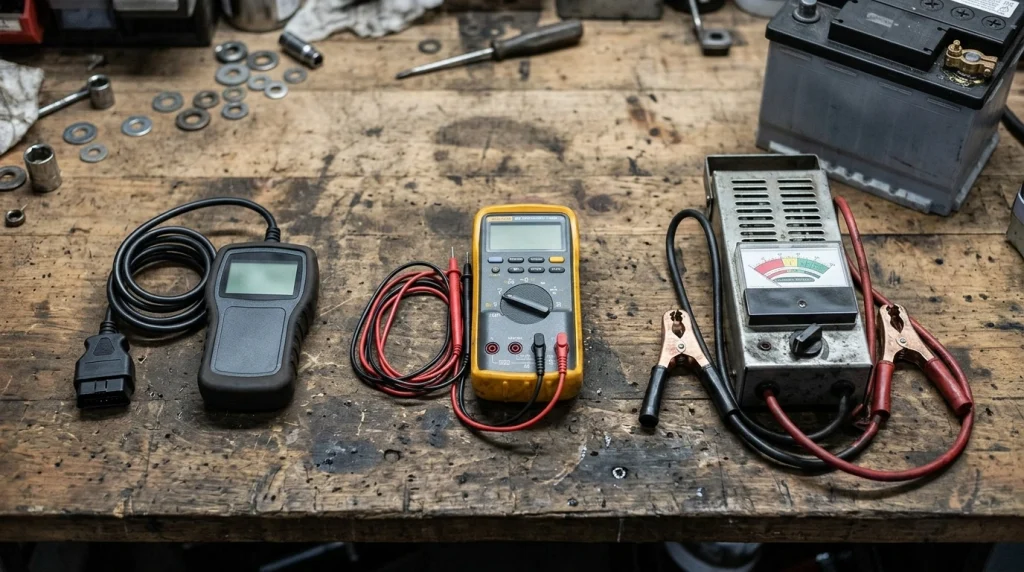
Each tool answers a different diagnostic question. Choosing the correct tool matters more than buying the most expensive scanner.
| Capability | OBD2 Scanner | Multimeter | Battery Tester |
|---|---|---|---|
| Measure voltage | If supported | Yes | Yes |
| Read vehicle fault codes | Yes | No | Generally no |
| Assess starting performance | Indirect clues | Voltage drop only | Yes, model-dependent |
| Estimate available CCA | No, standard tools | No | Conductance models |
| Check charging voltage | If supported | Yes | Some models |
| Best purpose | Vehicle diagnostics | Electrical measurements | Battery condition assessment |
For direct battery diagnosis, I’d choose a dedicated battery tester. For broader engine and electronic troubleshooting, an OBD2 scanner remains more useful.
Professional testing methods also differ. Interstate Batteries provides information about battery condition, while NAPA’s conductance-testing guidance discusses measurement limitations.
Can an OBD2 Scanner Tell Whether the Battery or Alternator Is Bad?
An OBD2 scanner may help distinguish battery discharge from charging-system problems, but its readings are not conclusive. A direct electrical test is usually necessary.
Consider these common diagnostic situations:
- Low resting voltage, normal running voltage: The battery may be discharged, aging, or affected by unwanted electrical drain.
- Normal resting voltage, poor cranking: The battery may lack starting capability, or the starter circuit may have excessive resistance.
- Low running voltage: The alternator, charging controls, drive belt, wiring, or connections may need inspection.
- Unusually high running voltage: Investigate voltage regulation using vehicle-specific service information.
For example, suppose a car measures 12.0 volts before starting and 14.2 volts while running. That suggests the charging system is supplying voltage, but the battery’s actual health remains uncertain.
If the battery loses charge again after sitting overnight, a battery performance test and parasitic-drain investigation become more important.
Why Might an OBD2 Scanner Give Misleading Battery Readings?
Scanner voltage readings can be accurate yet lead to incorrect conclusions. Interpretation depends on the vehicle’s operating conditions and measurement location.
Ignition-On Electrical Loads
When you switch the ignition on, computers, displays, pumps, and other equipment may consume power. The voltage reading may drop compared with the battery’s rested condition.
A lower ignition-on reading doesn’t automatically identify a defective battery.
Smart Charging Systems
Many modern vehicles adjust alternator output according to operating conditions and battery-management commands. Their running voltage isn’t always fixed near 14 volts.
Compare readings against the manufacturer’s specifications before diagnosing an alternator failure.
Temperature and Recent Charging
Cold temperatures reduce available starting performance, while recent charging can temporarily elevate measured voltage. Both situations influence diagnosis.
For more technical background, Battery University discusses battery measurement methods and their limitations.
Voltage Loss in Wiring
Loose terminals, corroded grounds, and damaged wiring can cause voltage differences across the electrical system. The scanner may therefore show a lower voltage than a direct battery-terminal measurement.
If readings disagree, compare them with a multimeter and inspect the relevant connections.
What Should You Do When Your Scanner Shows Low Battery Voltage?
Start with simple checks before buying a replacement battery. Low voltage is a symptom that requires an explanation.
- Confirm the reading: Measure directly across the battery terminals with a suitable digital multimeter.
- Inspect the battery: Look for loose connections, corrosion, case damage, or leaking electrolyte.
- Check charging: Compare running voltage with the vehicle manufacturer’s specifications.
- Recharge appropriately: Use a charger compatible with the battery type and follow its instructions.
- Retest battery performance: Use a battery conductance tester or professional testing service.
- Investigate repeated discharge: Check for charging problems or excessive parked-vehicle current draw.
Don’t attempt normal DIY handling or charging if the battery is swollen, leaking, frozen, or physically damaged. Arrange qualified assistance instead.
Battery testing also involves electrical and chemical hazards. Follow the manufacturer’s safety procedures and use proper eye protection when handling batteries.
Does the Same OBD2 Battery Diagnosis Work on Hybrid and Electric Cars?
Not necessarily. Hybrid and electric vehicles can contain a low-voltage auxiliary battery and a separate high-voltage traction battery.
A standard OBD2 scanner may show selected low-voltage information without providing detailed traction-battery health data. Specialized vehicle-compatible diagnostic software may access additional parameters.
For deeper coverage, see what OBD2 data is available on an electric vehicle.
Never open or probe high-voltage battery components without the required training and equipment. High-voltage diagnostics should follow manufacturer-approved procedures.
Best Diagnostic Tools for Checking Car Battery Problems
If you’re deciding what to buy, I’d separate general vehicle diagnostics from direct battery testing. These tools serve different purposes and work well together.
Disclosure: The following product links are affiliate links. Qualifying purchases may generate a commission at no additional cost to you.
🏆 Best for Battery Health
TOPDON BT100 Battery Tester
★★★★☆ 4/5 — Editorial fit
This dedicated 12-volt battery tester evaluates battery condition and estimated cranking performance. I’d prioritize this type of tool when the main question is whether a starting battery needs replacement.
💰 Budget Battery Testing
ANCEL BA101 Battery Tester
★★★★☆ 4/5 — Editorial fit
The BA101 is designed for automotive battery testing, including starting-performance assessment. I’d consider it for DIY users who want more useful battery information than voltage alone.
🔧 Best for Basic OBD2 Diagnostics
ANCEL AD310 OBD2 Scanner
★★★★☆ 4/5 — Editorial fit
The AD310 is a basic wired code reader for supported engine diagnostic functions. I’d choose it for general trouble-code checks, not as a substitute for direct battery-health testing.
The star scores above are editorial suitability assessments, not verified customer-review averages. Always confirm battery compatibility, supported functions, and current product specifications before purchasing.
Frequently Asked Questions
Can an OBD2 scanner tell me if my battery needs replacing?
An OBD2 scanner can identify signs of low voltage and certain charging-system faults, but it cannot reliably determine whether a battery needs replacement. A healthy voltage reading does not guarantee adequate starting performance. Use a dedicated battery tester or professional load test to confirm battery condition.
What OBD2 code indicates a bad car battery?
No universal OBD2 trouble code proves that a car battery is bad. Codes such as P0562 can indicate low system voltage, while P0560 identifies a system-voltage malfunction. These conditions can also result from alternator problems, poor connections, or wiring faults.
Can an OBD2 scanner test battery voltage while driving?
Some OBD2 scanners can monitor supported vehicle-voltage data while the engine operates. This may help identify unusual charging behavior or intermittent voltage changes. Keep your attention on driving and have a passenger monitor readings, or use a safe recording function for later review.
Can a battery be bad even if the OBD2 scanner reads 12.6 volts?
Yes. A battery can display approximately 12.6 volts at rest while having insufficient starting capability. The voltage reading mainly indicates charge condition rather than overall battery health. A conductance or appropriate load test helps evaluate whether the battery can deliver the required starting current.
Can an OBD2 scanner detect an alternator problem?
An OBD2 scanner may reveal abnormal system voltage or charging-related diagnostic codes. However, these findings don’t independently prove that the alternator is defective. Battery connections, voltage regulation, wiring, and smart-charging controls also affect readings. A proper charging-system inspection is needed for confirmation.
Final Verdict: Is an OBD2 Scanner Enough to Diagnose a Bad Battery?
An OBD2 scanner is useful for identifying electrical symptoms, monitoring supported voltage data, and retrieving relevant trouble codes. But it cannot reliably determine a conventional starting battery’s physical condition from voltage alone.
As of 2026, the practical approach remains straightforward: use your scanner for vehicle-level diagnostic clues and a dedicated battery tester for starting-performance assessment.
My recommendation: Before replacing a suspected bad battery, confirm its voltage, test its cranking capability, and check the charging system. Those steps can help avoid replacing a healthy battery when the actual problem lies elsewhere.
Start with the diagnostic tools you already own, record the results, and seek professional testing when the evidence remains unclear.

I’m Alex Rahman, a car enthusiast and automotive writer focused on practical solutions, car tools, and real-world driving advice. I share simple and honest content to help everyday drivers make better decisions.
